

The short version
The short version.
- 3 outsourcing paths exist: BPO (PartnerHero / Influx / LTVplus), freelance/specialist (Upwork / TaskUs), or AI-first (Ringly for phone + Gorgias / Zendesk AI for chat). Most $10M-$100M Shopify brands end up blending two.
- Cost range is wide: $8-$12/hr for offshore BPO labor, $25-$40/hr for US-based specialists, $0.50-$0.91 per resolved call for AI. The unit you pick matters more than the vendor.
- Built for $10M-$100M Shopify brands evaluating whether to scale their in-house CS team, contract a BPO, or layer AI underneath the team they already have.
Your store is growing. The inbox grows faster. Fifty unread customer emails, twenty Instagram DMs about sizing, three voicemails from people who needed tracking yesterday. This is the hidden tax on Shopify success: every order generates ~1.5 support touchpoints, and every touchpoint demands a human. Or used to.
If you're the founder or COO at a $10M-$100M Shopify brand watching CS cost climb faster than revenue, this guide is for you. We'll walk through the 3 real outsourcing paths (full-team BPO, freelance specialists, AI-first), real per-ticket and per-call cost math, and what to keep in-house no matter what. If your phone is the worst part of the pile right now, book a 30-min call and we'll show you what the AI phone layer would catch this week.
The 3 ways to outsource Shopify customer service
Skip the survey of 14 vendors. There are three shapes, and you'll mostly pick by which one fits your operating model.
| Path | Cost model | Best for | Setup time |
|---|---|---|---|
| Full-team BPO | $8-$40/hr per agent | $25M+ brands with 5,000+ tickets/mo | 4-8 weeks |
| Freelance / specialist | $15-$60/hr | $3M-$25M brands with seasonal spikes | 1-2 weeks |
| AI-first (phone + chat) | $0.50-$2.70 per resolved contact | Any Shopify brand with a visible phone line | 14 days |
Almost every brand we work with runs a hybrid. AI handles WISMO + simple order edits + after-hours. A small in-house team handles complex returns, VIP, and escalations. A BPO or freelance bench fills seasonal spikes. The math below shows why this split usually wins on cost AND quality.
How I built this comparison
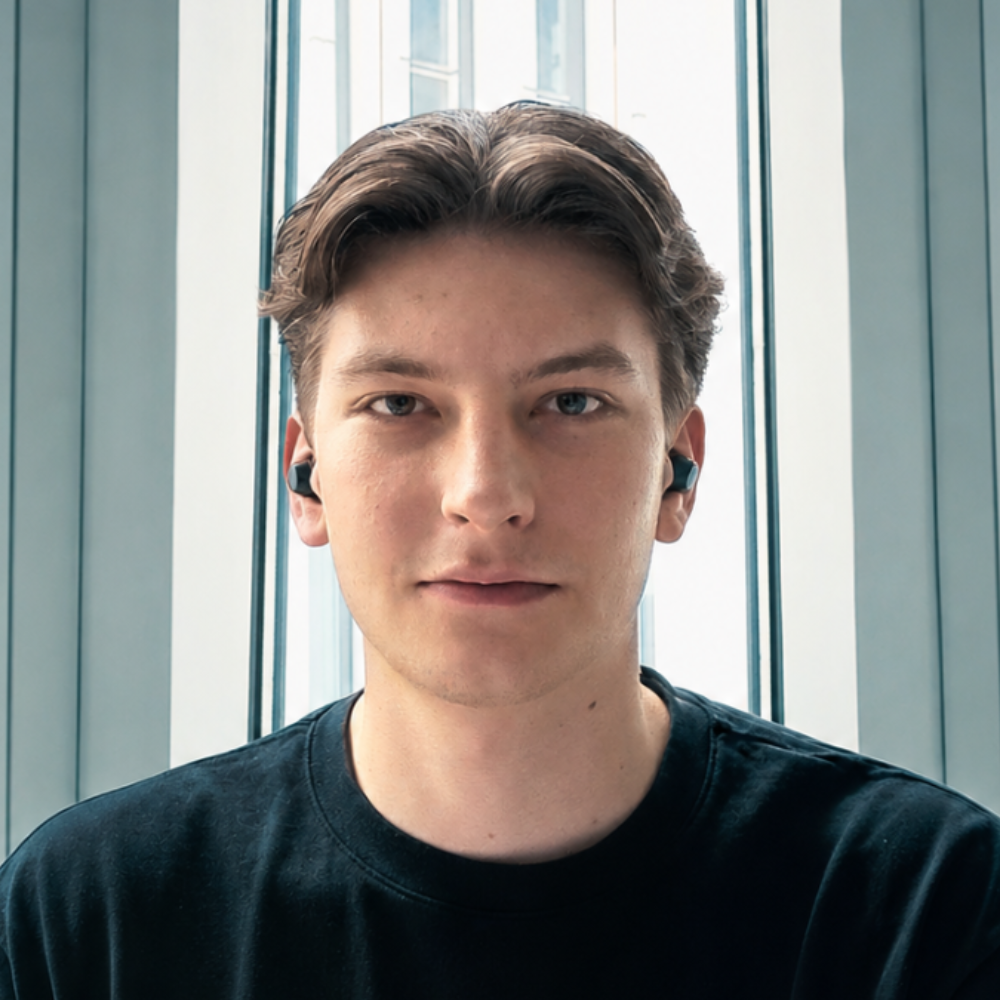
I'm Ruben, co-founder of Ringly. We've plugged into 50+ Shopify brands' CS stacks and watched them evaluate BPOs and freelance benches before, during, and after adding AI to the mix. That gives me a real read on which path saves money and which one just moves the line item.
Here's the scorecard:
- True landed cost per contact. I built monthly P&L models for a $5M, $25M, and $80M brand and dropped each path into the model. Cost-per-ticket and cost-per-call vary wildly by path.
- Brand voice risk. Outsourced agents drift. I scored each option by how much QA effort it takes to keep the voice consistent.
- Speed to staffed. Time from contract signing to first ticket answered. BPOs run 4-8 weeks; AI runs 14 days; freelance is in between.
- Scale-up speed. When BFCM hits and volume 3x's, how fast can the path absorb? I asked 3 Shopify Plus brands what their last spike cost.
- What the customer hears. I called 8 Shopify brands using each outsourcing path. The differences were obvious in 60 seconds.
1. Ringly (AI-first, phone-specific)
Best for: Shopify brands that want to outsource the phone line specifically. AI answers, handles WISMO and order edits live, routes complex cases to your in-house team, writes resolutions back to your helpdesk.
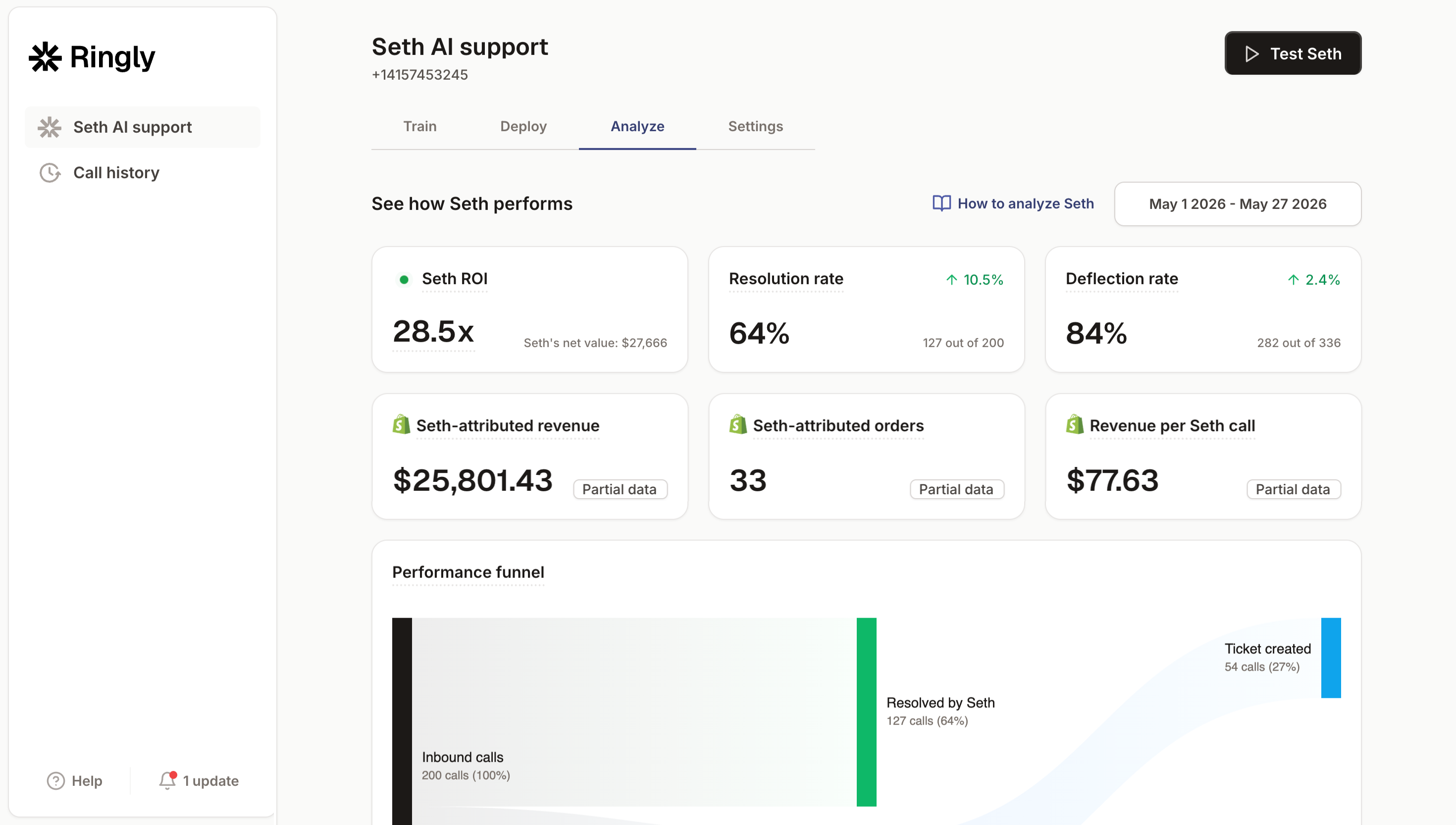
The cleanest version of "outsource your customer service" is: pick the channel that's eating your team alive, and outsource just that. For most $10M-$100M Shopify brands, that's the phone. WashCo generated $22,664 in attributed revenue and handled 271 calls in their first 7 days post-launch, at 66% resolution. A US-based phone BPO would have charged them ~$3,200 to staff that volume. Ringly cost them under $400.
Pricing
| Plan | Price | Included |
|---|---|---|
| Grow | $349/mo | 1,000 mins, ~500 calls |
| Pro | $799/mo | 2,500 mins, ~1,250 calls |
| Enterprise | By call | 3,000-20,000+ mins, done-for-you setup |
What works
- $0.50-$0.91 per resolved call vs $5-22 for a human-handled call. The math is not close.
- Native Shopify actions on the call: order lookup, tracking, refunds, cancellations done live.
- Writes back to Gorgias or Zendesk so your team has the call context.
- 14-day launch guarantee: live in 14 days or it's free until launched.
- 65% resolution guarantee: hit 65% in 90 days or we refund the last 3 months.
What doesn't
- Phone only: doesn't replace your email / chat / social CS layer.
- Edge-case complex cases still escalate to your in-house team. AI handles the 60-85% that don't need a human.
Why it sits first
Cheapest cost per resolved contact, fastest setup, no shift-change handoff. Pair with either a small in-house team or a BPO for the rest of your CS.
2. Full-team BPO (PartnerHero, Influx, LTVplus, Peak Support)
Best for: $25M+ Shopify brands with 5,000+ tickets/mo who want a full outsourced CS team handling email, chat, and phone end to end.
BPOs are the traditional outsourcing path. The good ones (PartnerHero, Influx, LTVplus, Peak Support) build dedicated teams trained on your brand voice and processes. The bad ones rent you a shared pool of agents who handle 5 brands at once and never quite sound like you.
Pricing
Wide range. Offshore (Philippines, India): $8-$15/hr per agent. Nearshore (Latin America): $12-$22/hr. US-based: $25-$40/hr. Most brands run 5-12 dedicated agents on a 40hr/week schedule, so a typical contract is $8,000-$20,000/mo.
What works
- Real humans on every channel: email, chat, phone, social handled by the same team.
- QA + reporting built in: CSAT, FCR, AHT tracked by the BPO PM.
- Spike absorption: most BPOs can flex headcount up 50% for BFCM with 2-week notice.
- Brand voice possible with the right vendor and 60-90 days of training.
What doesn't
- Setup is slow: 4-8 weeks from contract to first ticket. Onboarding eats real founder time.
- Voice drift: even good BPOs need monthly QA reviews to keep agents on-brand.
- Per-call cost is high: $5-$15 per ticket loaded. Phone calls in the $12-$22 range.
- Lock-in: most contracts are 6-12 months. Switching mid-contract is painful.
Why it ranks 2nd
The right path for brands above $25M that genuinely need outsourced humans across every channel. Not the right path if your highest-volume channel is one you could AI-handle.
3. Specialist agencies + freelance (TaskUs, Upwork, Boldr)
Best for: $3M-$25M brands wanting flexible coverage on specific channels or seasonal spikes without locking into a full BPO contract.
Freelance and specialist routes give you flexibility a BPO doesn't. You can hire 2 part-time email specialists for $2K/mo total, scale to 6 during peak season, drop back after. The trade-off is more management overhead.
Pricing
Upwork CS specialists: $15-$40/hr. US-based specialist agencies (Boldr, TaskUs Lite): $30-$60/hr per agent. Most brands run 1-3 specialists on 20-30hrs/week each, landing the monthly bill at $1,500-$6,000.
What works
- Fast setup: 1-2 weeks to first hire.
- Lower commitment: month-to-month contracts are common.
- Channel specialists possible: hire one person who only does WISMO emails, another who only does returns.
What doesn't
- Inconsistent quality: hiring from Upwork is a roulette wheel without a heavy vetting process.
- You manage QA: no BPO PM doing the work for you. Your in-house lead absorbs that overhead.
- Doesn't scale to 5,000+ tickets/mo without becoming chaotic.
Why it ranks 3rd
Best for the $3M-$15M band where you need help but not a full BPO contract. Often a stepping stone before either an AI-first or BPO commitment at $25M+.
4. The hybrid pattern most $25M+ brands actually run
One path almost never wins outright. Here's the stack most of our $25M-$100M customers settle into after 6-12 months of iterating:
- AI phone layer (Ringly) for inbound calls. Catches WISMO, order edits, after-hours volume.
- Small in-house team (2-4 specialists) for complex returns, VIP, escalations, brand voice on email + social.
- Freelance bench (2-6 contractors) that activates for BFCM, launches, viral moments.
- Gorgias or Zendesk AI for email/chat deflection on simple tickets.
This setup costs ~40-60% less than a comparable full BPO contract while keeping the voice on the human-handled tickets crisp. BioLongevity Labs hits 79% resolution autonomously on the phone layer, which frees their 3-person in-house team to handle the complex 21%. That's where the cost saving actually shows up on the P&L.
The real cost math: 3 brand sizes, 3 outsourcing paths
Modeled on real customer numbers. Same brand, three sizes.
| Brand size | Full BPO | Hybrid (AI + small team + freelance) | Monthly savings |
|---|---|---|---|
| $5M, 1,500 tickets/mo | $5,500 | $1,800 | $3,700 |
| $25M, 5,000 tickets/mo | $14,000 | $6,500 | $7,500 |
| $80M, 12,000 tickets/mo | $32,000 | $17,500 | $14,500 |
The hybrid pattern saves real money. It also wins on voice quality because the human-handled tickets get full attention instead of being one of 200 in a BPO agent's daily queue.
Book a 30-min call and we'll run your specific numbers. You decide if the swap is worth it.
What to keep in-house no matter what
Three categories should not be outsourced. Your in-house team owns them because they're the moments where brand equity is built or destroyed.
- VIP customer escalations. Anyone with a CLV above your threshold (say, top 5%) gets a named human. Always.
- Crisis response. Product recalls, shipping disasters, viral negative moments. A BPO agent reading a script makes this worse.
- Brand-voice training and QA. Even if AI and BPO handle the volume, the voice / tone / playbook should be owned in-house by a CS lead. Drift kills brands.
For more on the in-house side: customer service for Shopify, CS training playbooks, and CS KPIs.
What happens on the call.
- We pull your last 7 days of inbound calls live, on the call. No homework.
- We model the AI phone layer against your current BPO or in-house cost and show you the exact monthly delta.
- You decide if it's worth a deeper conversation. No deck, no follow-up sequence.
The call makes sense if:
- You're a Shopify (or Shopify Plus) brand doing $10M-$100M
- You run a paid helpdesk (Gorgias, Zendesk, Gladly, Re:amaze, or Intercom)
- You have a visible phone number on your store
- Your CS team is 3-12 people, or you're evaluating a BPO contract
If that's you, the math usually works. Book a 30-min call and we'll run it live on your store.
“My customers also feel like it's a normal person. They feel like they can communicate if they have questions.”
— Claudia Droge, TechCraft Studio
How to choose your path
- Under $5M GMV: stay in-house. 1-2 part-time freelance specialists for spikes. Skip the BPO conversation.
- $5M-$25M GMV: hybrid. AI phone layer + 2-3 in-house + freelance bench for BFCM. Most cost-effective shape at this size.
- $25M-$100M GMV: same hybrid, scaled. AI phone + 4-6 in-house + dedicated freelance / part-time pool. Skip the full BPO unless your in-house team can't hire fast enough.
- $100M+ GMV: full hybrid with named BPO partner. The BPO covers email/chat overnight. AI covers phone overnight. In-house owns voice and escalations during US hours.
If you're evaluating BPOs specifically, see the call center outsourcing guide and the overview of the BPO market. For the AI alternative, the AI call center for Shopify primer covers the full setup.
Frequently asked questions
What does it cost to outsource Shopify customer service?
BPO contracts run $8-$40/hr per agent, typically $8K-$20K/mo for a 5-12 person team. Freelance specialists run $15-$60/hr. AI phone runs $0.50-$0.91 per resolved call, usually $349-$799/mo plus enterprise tiers.
Should I outsource to a BPO or hire freelancers?
Under $15M GMV, freelancers are usually cheaper and more flexible. Above $25M, a dedicated BPO team is usually worth the lock-in for quality consistency. The hybrid pattern (AI + small in-house + freelance bench) often beats both for cost and voice quality.
Will outsourced agents hurt my brand voice?
Possibly. Good BPOs (PartnerHero, Boldr) train against your voice playbook and run monthly QA. Bad ones don't. The biggest voice-drift risk is BPO agents handling email and chat. AI phone agents are easier to keep on-voice because the prompts are versioned.
How fast can I get an outsourced team live?
BPO contracts: 4-8 weeks from signing. Freelance hires: 1-2 weeks. AI phone (Ringly): 14 days or it's free until launched (the 3-layer guarantee).
What about the Philippines BPOs that ads are pushing?
The Philippines is the biggest BPO market for ecommerce. The good ones (PartnerHero, Influx, LTVplus) staff there at $8-$15/hr per agent. Quality varies widely; vet by asking for 2-3 Shopify references at your size.
Can I outsource just the phone without outsourcing email?
Yes, and this is the most common pattern at $10M-$100M. Keep email/chat in-house or in Gorgias/Zendesk AI; outsource phone to an AI-first vendor. Volume-wise the phone is usually 15-25% of total contacts, but cost-wise it's often 40-60% of the bill.
What about Smith.ai or Goodcall as outsourcing options?
Both are valid AI-first alternatives. Smith.ai is generalist-business; Goodcall is SMB-focused. Neither has the same depth of Shopify integration (live order actions, helpdesk write-back) Ringly built specifically for ecommerce.
Talk to us

If you're weighing a BPO contract against a hybrid setup on a $10M-$100M Shopify store, a 30-min call is the fastest way to see what each path costs you per resolved contact.
The 3-layer guarantee.
- Live in 14 days or it's free until launched.
- 65% resolution in 90 days or we refund the last 3 months of subscription fees.
- We keep working free until we hit 65%.
Ruben (Ringly co-founder) takes these calls personally.