

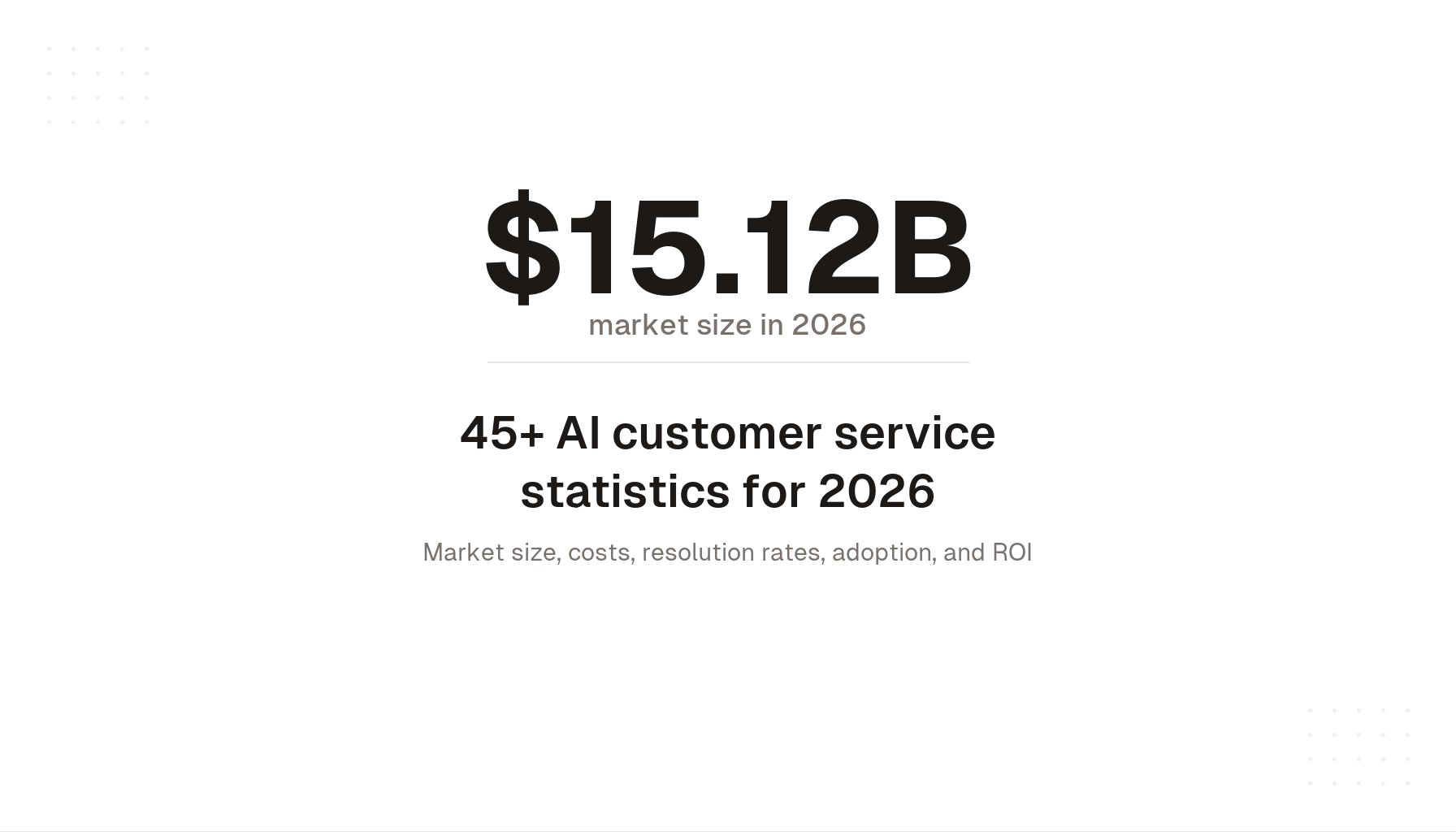
AI is no longer optional for customer service teams. The market hit $15.12 billion in 2026, companies are seeing $3.50 back for every dollar invested, and 91% of customer service leaders say they're under pressure to implement AI this year.
But the numbers tell a more nuanced story than "AI replaces everything." Customers still prefer humans for complex issues.
Half the companies that cut staff are expected to rehire. And the cost advantage over offshore agents may not last.
Here are 45+ data points from Gartner, Zendesk, Freshworks, and others to help you make smarter decisions about AI customer service in 2026.
Hear what AI support calls sound like for your store. Just paste your Shopify URL and get sample calls in under 20 seconds, no email required. Listen to demo calls for my store.
Key highlights
- The global AI customer service market is projected at $15.12 billion in 2026, up from $12.06 billion in 2024 (MarketsAndMarkets)
- Conversational AI will reduce contact center labor costs by $80 billion in 2026 (Gartner)
- Cost per customer interaction dropped 68% after AI implementation, from $4.60 to $1.45 (Freshworks)
- 91% of customer service leaders feel pressure to implement AI in 2026 (Gartner)
- 79% of Americans still prefer interacting with a human over an AI agent (SurveyMonkey)
- Ecommerce brands using autonomous AI agents achieve 76-92% resolution rates depending on ticket type (Kodif)
Market size and growth
The global AI customer service market reached $15.12 billion in 2026. That's a 25% jump from the $12.06 billion valuation in 2024. The market is expected to hit $47.82 billion by 2030 at a 25.8% CAGR. (MarketsAndMarkets)
The voice AI market is growing even faster, at 34.8% CAGR. It went from $2.4 billion in 2024 and is projected to reach $47.5 billion by 2034. Companies want AI that can talk, not just type. For a full breakdown of that segment, see our voice AI statistics roundup. (KaiCalls)
76.4% of voice AI market demand is for fully integrated platforms. Businesses aren't buying point solutions. They want AI voice agents that plug into their existing systems and handle the full call:
- CRM
- Helpdesk
- Order management
(KaiCalls)
The broader AI customer experience market will exceed $117 billion by 2030. This includes AI across all customer-facing functions: support, sales, marketing, and engagement. (AllAboutAI)
The market growth tells a clear story. Companies aren't experimenting anymore. They're buying.
AI adoption rates by industry
91% of customer service leaders say they're under pressure to implement AI in 2026. This came from a Gartner survey of CS leaders conducted in October 2025. The pressure is coming from executive leadership, not just ops teams. (Gartner)
9 in 10 contact centers are now using AI in some capacity. But only 25% have fully integrated it into daily operations. Most are still in the "pilot" or "partial deployment" phase. Our call center statistics page covers the broader contact center landscape. (Zendesk)
Telecom leads with 95% AI adoption in customer support. Banking follows at 92%, healthcare at 79%. These industries handle high volumes of repetitive queries, which is exactly where AI performs best. (AllAboutAI)
Mid-market retailers are adopting AI chatbots 3x faster than small sellers and enterprise retailers. Small businesses lack budget. Enterprise companies move slowly.
Mid-market is the sweet spot for ecommerce customer service automation right now. (eDesk)
80% of companies are either using or planning to adopt AI chatbots for customer service. The remaining 20% are either too small to need it or too slow to realize they do. (Zendesk)
The adoption gap between "using AI somewhere" and "fully integrated" is the real story here.
Most companies are still figuring out how to scale past pilot programs.
Cost savings and ROI
Cost per customer interaction dropped 68%, from $4.60 to $1.45. That's the average after AI implementation across companies surveyed by Freshworks. The savings compound as AI handles more volume. (Freshworks)
Human agents cost $6-$8 per interaction. AI costs $0.50-$0.70. That's roughly a 12x cost advantage per ticket. For a Shopify store handling 500 support interactions a month, that's the difference between $3,500 and $350. (AllAboutAI)
Conversational AI will save $80 billion in contact center labor costs by 2026. Gartner made this prediction in 2022, and current deployment trends confirm it's on track. Contact center labor represents up to 95% of total costs. (Gartner)
Companies see an average return of $3.50 for every $1 invested in AI customer service. Leading organizations report up to 8x ROI.
The gap between average and top performers comes down to how well AI is integrated into existing workflows. (SumGenius)
Year 1 ROI averages 41%. Year 2 hits 87%. Year 3 exceeds 124%. AI systems get better over time as they learn from more interactions. The payoff accelerates, it doesn't flatten. (typedef.ai)
94% of retail companies say AI has helped decrease costs. Early adopters also report a 26.7% lift in revenue and 32.6% gain in customer satisfaction. (AllAboutAI)
If you sell on Shopify, the math is straightforward. Ringly.io handles AI phone support starting at $349/month. That's less than what most stores pay a part-time agent for a single shift.
Important caveat: Gartner's January 2026 report predicts that by 2030, generative AI cost per resolution will exceed $3. That's potentially higher than offshore human agents.
Rising data center costs and AI vendor pricing changes could narrow the cost advantage over time. (Gartner)
Response time and resolution speed
First response time dropped from over 6 hours to under 4 minutes with AI. For context, most customers expect a response within 10 minutes for live chat. AI makes that look slow. (Pylon)
Some AI platforms reduce first response to 23 seconds. That's from a baseline of 15 minutes with human-only support. A 97% reduction. (Pylon)
Resolution time went from 32 hours to 32 minutes in some implementations. That's a 98% improvement.
Even moderate implementations see 37% faster first responses and 50% shorter resolution times. (Freshworks)
Klarna's AI cut average resolution time from 11 minutes to 2 minutes. An 82% improvement. Klarna handles millions of support interactions per month, so this scales to massive time savings. (Lorikeet)
AI customer service agents handle 13.8% more inquiries per hour than human agents. This comes from a Stanford/NBER study.
The productivity boost is even larger for less experienced agents, where AI acts as a knowledge equalizer. (Freshworks)
Freshworks' Freddy AI slashed first response from 12 minutes to 12 seconds. Resolution went from over an hour to 2 minutes. It deflected 53% of retail queries automatically. (Freshworks)
Speed is where AI genuinely outperforms humans. No breaks, no queue times, no "please hold."
For ecommerce phone support, this matters even more. Customers calling about orders want answers now.

Resolution rates and accuracy
AI chatbots resolve up to 86% of customer questions without human intervention. That's the high end. More typical implementations land in the 50-70% range for ecommerce. (Lorikeet)
Ecommerce brands using autonomous AI agents achieve 76-92% resolution rates. The range depends on ticket type:
- Order tracking and FAQ queries hit the high end
- Returns and complaints land lower
(Kodif)
AI agents now deflect over 45% of incoming customer queries. Retail and travel companies see deflection rates above 50%. "Deflection" means the customer got their answer without ever reaching a human agent. (Zendesk)
Traditional self-service (FAQ pages, help docs) resolves only 14% of issues. AI chatbots and voice agents resolve 4-6x more. The gap between static help docs and AI-powered support is enormous. (Gartner)
AI-native platforms achieve 55-70% first contact resolution with average handle times under 3 minutes. Compare that to the 4-7 minute industry average for human-assisted voice calls. (Lorikeet)
Gartner predicts agentic AI will resolve 80% of common customer service issues without human intervention by 2029. That's just three years away. The shift from "AI assists humans" to "AI handles it" is accelerating. (Gartner)
For Shopify stores specifically, the most common support questions are exactly the kind AI handles best:
- Where's my order?
- Return policies
- Product details
Ringly.io resolves 73% of these calls automatically, without any human involved.
Customer satisfaction and preferences
92% of businesses report improved CSAT after implementing AI. But there's a gap between what businesses measure and what customers feel. (AllAboutAI)
79% of Americans prefer interacting with a human over an AI agent. Only 8% actively prefer AI. The remaining 13% don't have a strong preference either way. (SurveyMonkey)
But 51% of consumers prefer bots when they want immediate service. Speed trumps the human touch when customers just need a quick answer. The preference for humans kicks in when issues get complex or emotional. (Zendesk)
75% of customers prefer human agents for complex, sensitive, or emotionally driven issues. This is why the best AI call center setups include smart escalation to humans for the hard stuff. (SurveyMonkey)
Live chat achieves 87% CSAT, compared to 61% for email and 44% for phone. The channel matters. AI-powered live chat consistently outperforms traditional phone support in satisfaction scores. See our live chat statistics for more on this channel. (Lorikeet)
56% of customers believe bots will be able to hold natural conversations by 2026. Customer expectations are shifting. As AI quality improves, resistance will drop. (Zendesk)
The trust gap is real: 93% of marketing leaders think AI understands customer needs, but only 53% of consumers agree. Companies are more optimistic about their AI than their customers are. (CMSWire/Medallia)
The takeaway? Customers don't hate AI. They hate bad AI. Fast, accurate answers get high satisfaction regardless of who (or what) delivers them.
Workforce impact and predictions
Organizations will replace 20-30% of service agents with generative AI by 2026. Gartner's estimate, which tracks with current hiring trends across contact centers. (Gartner)
But 50% of companies that cut CS staff due to AI will rehire by 2027. Gartner's February 2026 prediction suggests many companies will realize they cut too deep, too fast. AI handles volume, not nuance. (Gartner)
There are approximately 17 million contact center agents worldwide. Labor costs represent up to 95% of contact center expenses.
Even a small percentage reduction in headcount saves billions industry-wide. (Gartner)
80% of routine customer interactions will be fully handled by AI in 2026. That includes:
- Ticket categorization
- Common inquiries
- Order tracking
- Basic troubleshooting
Humans focus on exceptions. (Zendesk)
98% of leaders say smooth AI-to-human transitions are essential. But 90% admit they struggle with handoffs. This is the biggest operational challenge in AI customer service right now.
Getting the escalation right matters more than the AI itself. (SupportYourApp)
64% of CX leaders are increasing their investments in evolving chatbots. The investment is shifting from "should we use AI?" to "how do we make it better?" (Zendesk)
The workforce story isn't "AI replaces humans." It's "AI handles the repetitive stuff so humans can focus on what actually requires judgment."
What this means for ecommerce brands
The data points to a clear pattern. AI customer service isn't a competitive advantage anymore. It's what customers expect by default.
If you're running a Shopify store with more than a handful of daily support requests, the ROI math is undeniable:
- 68% reduction in cost per interaction
- 76-92% resolution rates for standard ecommerce queries
- Response times measured in seconds instead of hours
The brands pulling ahead aren't the ones with the most sophisticated AI. They're the ones that deployed it fastest.
Mid-market ecommerce companies are adopting AI chatbots at 3x the rate of everyone else. That gap will show up in their margins within 12 months.
Here's what the numbers suggest you should do:
- Start with high-volume, repetitive queries. Order tracking, return policies, product availability. These have the highest resolution rates (76-92%) and the fastest ROI.
- Don't cut your human team yet. 50% of companies that did are expected to rehire. Use AI to handle volume and let humans handle exceptions.
- Invest in the handoff. 90% of leaders struggle with AI-to-human escalation. Getting this right is more important than the AI's resolution rate.
- Track cost per resolution, not just deflection rate. As Gartner warns, AI costs may rise toward $3 per resolution by 2030. Know your numbers.
For Shopify store owners specifically, Ringly.io plugs into your store in about three minutes and starts handling phone calls automatically:
- Looks up orders
- Processes returns
- Answers product questions
- Transfers to a human when needed
Start a free 14-day trial and see the numbers for yourself.
Frequently asked questions
How much does AI customer service cost compared to human agents?
AI costs $0.50-$0.70 per interaction on average, compared to $6-$8 for human agents. That's roughly a 12x cost advantage, with some companies seeing cost per interaction drop 68%.
What percentage of customer service interactions can AI handle?
AI handles around 45% of incoming queries without human help, rising to 80% for routine interactions like order tracking. Ecommerce brands see 76-92% resolution rates depending on ticket complexity.
Do customers actually like AI customer service?
It depends. 51% of consumers prefer bots for immediate service, but 79% still prefer humans for general support. Customers care more about fast, accurate answers than who provides them.
What's the ROI of AI customer service?
Companies see an average return of $3.50 for every $1 invested, climbing to 124%+ ROI by year three. Leading organizations report up to 8x returns.
How much faster is AI than human customer service?
AI reduces first response times by 37-97%, with some implementations dropping from 15 minutes to 23 seconds. Klarna's AI cut average resolution from 11 minutes to 2 minutes.
Will AI replace customer service agents?
Partially. Gartner predicts 20-30% of service agents will be replaced by AI in 2026. But 50% of companies that cut staff are expected to rehire by 2027, as AI handles routine volume while humans focus on complex issues.
How big is the AI customer service market?
The global market hit $15.12 billion in 2026, growing at 25.8% CAGR toward $47.82 billion by 2030. The voice AI segment is growing even faster at 34.8% CAGR.
Which industries use AI customer service the most?
Telecom leads at 95% adoption, followed by banking at 92% and healthcare at 79%. In ecommerce, mid-market retailers adopt AI chatbots at 3x the rate of small sellers and enterprise.