
Short version: no, AI will not replace customer service. It replaces the part of it that repeats.
- Order status, returns within policy, and the same five FAQ answers move to AI. The complex, emotional, and judgment calls stay with your team.
- The line that decides which is which is not how hard the call is. It's whether the answer is verifiable against a source of truth.
- Written for founders, COOs, and Heads of CX at $10M-$100M Shopify brands running a paid helpdesk and a visible phone number.
No. AI is not going to replace customer service, and anyone selling you that headline is selling you the wrong question. What AI replaces is the repeatable volume inside ecommerce customer service: the order-status calls, the returns that fit your policy, the same product question fifty times a day. The actual support function, the part that keeps customers when something goes wrong, is more human than it's ever been. The interesting work for an operator isn't predicting the apocalypse. It's deciding where the line sits in your own store.
If you run customer experience at a $10M-$100M Shopify brand with a paid helpdesk and a phone number on your site, you already feel both sides of this. The phone backlog is real and the loaded cost of the next hire is real, so the pull toward AI is obvious. But you've also watched AI fail in public, and you're not about to hand your best customers to a bot that can't read a room. We run AI phone support for 50+ Shopify brands, and the most useful thing I can give you isn't a prediction. It's the line we actually draw. Book a 30-min call and we'll map it for your store.
The short answer, and why the question is framed wrong
"Replace" is a verb about people. The thing that's actually changing is tasks. Gartner predicts that by 2029, agentic AI will autonomously resolve 80% of common customer service issues without a human, cutting operational costs by about 30%. Read the word "common." That's the routine volume, not the whole job.
The labor data tells the same story, quietly. The US Bureau of Labor Statistics projects customer service representative employment to dip around 5% between 2024 and 2034, with roughly 341,700 openings still appearing every year from replacement needs. That's a function shrinking at the edges and changing shape, not a profession getting deleted.
So the honest answer is that AI eats the volume, not the role. The rep who used to read a tracking number off a screen now handles the call where a customer is upset and a refund isn't straightforward. The job moves up the value chain. For you, the operator, that's the whole opportunity: stop paying people to do the lookups, keep them on the calls that actually retain revenue.
What AI already handles (the repeatable volume)
Start with what's already true, because the 2029 projection isn't the part you can act on today. Right now, AI reliably closes the calls and tickets that follow a script with a checkable answer.
That covers more of your day than most operators want to admit:
- Order status and WISMO. "Where's my order" runs 30-40% of tickets in a normal week and over 50% at peak, per Salesforce. Every one of those is a lookup, which is why WISMO calls are the first thing brands automate.
- Returns and exchanges within policy. If the rule is clear, the AI can apply it.
- Product and FAQ questions. Sizing, ingredients, compatibility, "do you ship to Canada." The same questions over and over.
- Account and routing. Password resets, address changes, getting the caller to the right place.
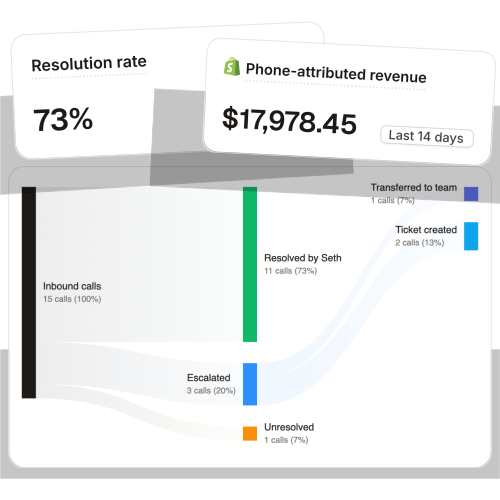
Across the 50+ Shopify brands we run phone support for, the AI resolves about 73% of inbound calls on its own. Industry-wide, roughly 40% of all tickets are closable by AI today, and 82% of support teams had already put money into AI by the end of 2025. The repeatable slice isn't a someday bet. It's the majority of the calls hitting your line this afternoon. That's the volume you can move without touching the calls that need a person.
What stays human, and the real dividing line
Here's the part the "80%" headlines skip. The line between what AI keeps and what a person keeps is not how hard the call is. It's whether the answer is verifiable.
I learned this reading real call logs across brands, not from a deck. "Where's my order" is hard to a customer and trivial to verify: check Shopify, read back the tracking. "I'm furious, my package was stolen, and I want to cancel the subscription I set up for my mother who just passed" is not a lookup. It's judgment, empathy, and a one-off decision nobody wrote a rule for. The first kind, AI handles all day. The second always goes to a person.
That reframe matters because it tells you what to protect. In practice, the calls to keep human cluster into a few buckets:
- Emotional and high-stakes. A grieving customer, a safety scare, a product that failed at the worst moment. These need a person who can adjust tone, not a script.
- Exceptions and goodwill. The refund slightly outside policy, the one-time courtesy that saves a 3-year customer. Judgment calls a rule can't pre-write.
- Disputes and fraud. Chargebacks, "I was double-charged," anything where getting it wrong is expensive or legal. A human verifies and owns the decision.
- Retention and negotiation. The cancel call worth saving, the upgrade conversation. Revenue conversations belong to people.
And customers agree: 75% still prefer a human voice for complex emotional or financial issues, and 63% don't believe AI could ever fully replace people in support. Those aren't the calls to automate. They're the calls your team was hired for. (This is also why the AI voice support versus human debate is the wrong frame: it's not one or the other, it's which call goes where.)
"My customers also feel like it's a normal person. They feel like they can communicate if they have questions."
Claudia Droge, TechCraft Studio
The goal isn't to make every call sound automated. It's to make sure the routine never reaches a human and the hard call never reaches a bot. Get that split right and your CSAT can go up while your cost per call goes down, because the right voice answers the right call.
The channel nobody talks about: phone
Most of the "will AI replace customer service" debate is really about chat and email, where a tidy FAQ answer is closest to fully automatable. The chatbot versus phone support split isn't cosmetic. Phone is the harder channel, and it's the one where the augment model matters most.
Phone carries your high-intent and high-emotion calls. People call when chat failed, when they're frustrated, or when they want to actually buy something and have a question first. That mix means the human-kept slice on the phone is bigger and worth more, which is exactly why "replace the phone team with a bot" goes wrong. The win is the opposite: let an AI voice agent for customer support take the routine calls so your team is free for the ones that pay off. WashCo, a Shopify brand we launched, recovered $22,664 in attributed revenue in its first 7 days on the phone, because calls that used to roll to voicemail after-hours got answered. The phone is where full replacement is least true and smart routing is most valuable. That's the channel to be careful with, not the one to hand over wholesale.
The hype check: what the 80% headlines leave out
If AI were quietly replacing customer service, the biggest case studies wouldn't keep reversing. They do.
- Klarna walked it back. After publicly replacing the equivalent of 700 agents with AI, Klarna started rehiring humans in 2025 once satisfaction dropped and the AI produced lower-quality results on complex cases. The CEO admitted the cuts went too far.
- The failure rate is real. Qualtrics' 2026 Consumer Experience Trends report found nearly 1 in 5 people who used AI for customer service got no benefit from it, a failure rate almost four times higher than AI in other tasks.
- Even the bullish forecast hedges. The same firm projecting 80% by 2029 also predicts that over 40% of agentic-AI projects will be cancelled by the end of 2027, on cost, unclear value, and weak controls.
None of that means AI doesn't work. It means the brands that tried to replace the whole function got burned, and the brands that automated the verifiable volume and kept humans on the rest did fine. The lesson isn't "AI can't do support." It's "AI can't do the part that needs a person, so don't ask it to."
How to draw the line in your own store
This is the part you can run this week. Forget the macro debate and treat it as a routing decision.
- Inventory your call types. Pull a week of calls and bucket them: order status, returns, product questions, cancellations, complaints, sales questions. You'll likely find 70-80% sit in three or four repeatable buckets.
- Tag each bucket verifiable or judgment. Verifiable means the answer is checkable against Shopify, your policy, or your knowledge base. Judgment means it needs discretion, empathy, or an exception.
- Route the verifiable buckets to AI. Order status, in-policy returns, FAQ, routing. This is the volume that's eating your payroll.
- Hard-code the escalation rules. Anything tagged judgment, plus any caller who asks for a human, transfers cleanly to your team with the context attached. No dead ends. This is the core of any support escalation process worth running.
- Measure resolution and CSAT together. Watch both. If resolution climbs and CSAT holds or rises, the line is in the right place. If CSAT slips, you drew it too aggressively and a bucket needs to move back to humans.
Done right, this is how you scale customer service without hiring the next two reps.
The point isn't to maximize automation. It's to put the right answer on the right call. If you want help running this on your actual call data instead of a hypothetical, book a 30-min call and we'll do it live with your last week of calls.
What this does to your CS budget
The reason this question keeps coming up isn't philosophical. It's the payroll line. Repeatable CS work eats 60-80% of a support budget, and most of it is the verifiable volume above.
Here's the shape of it for a typical $50M Shopify brand running a 6-rep team:
| Line item | Today | With AI handling the routine |
|---|---|---|
| 6 reps x $4K loaded per rep | $24,000/mo | n/a |
| AI phone support (~$5K/mo) | n/a | $5,000/mo |
| Net monthly CS spend | $24,000/mo | $5,000/mo |
| Monthly savings | n/a | $19,000/mo |
| Annual savings | n/a | $228,000/yr |
That's roughly 70% of repeatable calls routed to AI. The other 30%, the genuinely complex ones, still go to your team, who now have time to actually solve them. On a per-call basis the gap is just as stark: a resolved AI call runs about $0.42 against $7-$16 per call for human BPO, which is the same reason the in-house versus outsource math keeps shifting. You're not cutting the team to zero. You're cutting the cost of the calls that never needed a person.
Where Ringly fits
Ringly is AI phone support for Shopify brands. Your team wasn't hired to read tracking numbers off a screen all day, so the AI takes the routine inbound calls and your reps keep the ones that need them.
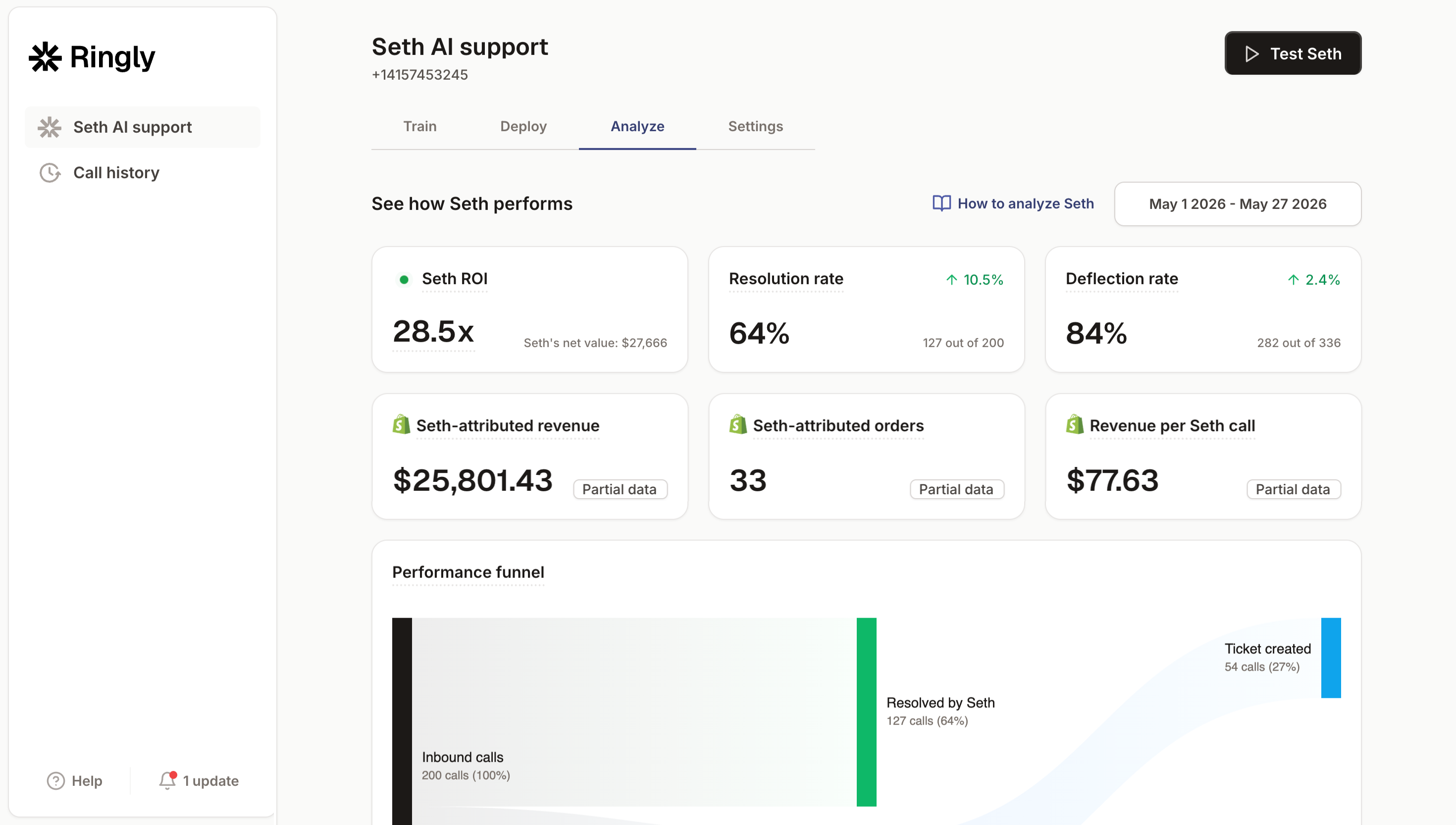
It works like an AI receptionist for ecommerce: the AI answers inbound calls 24/7 in 40 languages, finds orders in your Shopify store, processes returns and exchanges, answers product questions from your knowledge base, and rescues abandoned carts with outbound follow-up. Across 50+ brands it resolves 73% of calls on its own at roughly $0.42 per resolved call. Calls that need a human escalate cleanly to Gorgias, Richpanel, Reamaze, or whatever helpdesk you already run, with the context attached so the customer never repeats themselves.
Plans are Grow at $349/mo (1,000 minutes), Pro at $799/mo (2,500 minutes), and Enterprise by call. There's a 14-day free trial on Pro, and you can be live in under an hour. The 65% resolution guarantee means if the AI resolves under 65% of your calls in 90 days, we refund the last 3 months.
Frequently asked questions
Will AI completely replace human customer service agents? No. AI is on track to handle most common, repeatable issues, but the complex, emotional, and judgment-heavy calls stay with people. Gartner's own 80%-by-2029 figure is specifically about "common" issues, not the whole function.
How much of customer service can AI handle right now? Roughly 40% of all tickets are closable by AI today industry-wide, and on the phone specifically we see about 73% autonomous resolution across 50+ Shopify brands. The exact number depends on how much of your volume is verifiable lookups versus judgment calls.
What customer service tasks should stay human? Anything that needs discretion, empathy, negotiation, or a one-off exception: angry customers, fraud and billing disputes, hardship cases, and high-stakes retention conversations. The rule of thumb is that if the answer isn't verifiable against a source of truth, a person should handle it.
Will AI take customer service jobs? It will shrink and reshape them, not erase them. The US Bureau of Labor Statistics projects a roughly 5% decline in CS rep roles from 2024 to 2034, with hundreds of thousands of openings still appearing yearly. The role shifts from reading scripts to resolving the hard cases.
Can AI handle phone support, not just chat? Yes, and phone is where the routing decision matters most. AI handles the routine inbound calls (order status, returns, FAQ), while emotional and high-intent calls escalate to your team. Phone carries more of those, which is why the human-kept slice stays bigger there.
Is AI customer service worth it for a Shopify brand? For brands with real phone volume and a paid helpdesk, usually yes, because it removes the cost of the repeatable calls without touching the ones that retain customers. The honest test is your own call data: if 70-80% of your calls are verifiable lookups, the math for customer service on Shopify works quickly.
Talk to us

If you run a $10M-$100M Shopify brand and the phone is the channel eating your team's day, a 30-minute call is the fastest way to see where the line should sit for your store. We'll pull your call types, tag what's verifiable, and show you the routing that keeps your humans on the calls that matter.
The 3-layer guarantee.
- Live in 14 days or it's free until launched.
- 65% resolution in 90 days or we refund the last 3 months of subscription fees.
- We keep working free until we hit 65%.
Ruben (Ringly co-founder) takes these calls personally.