

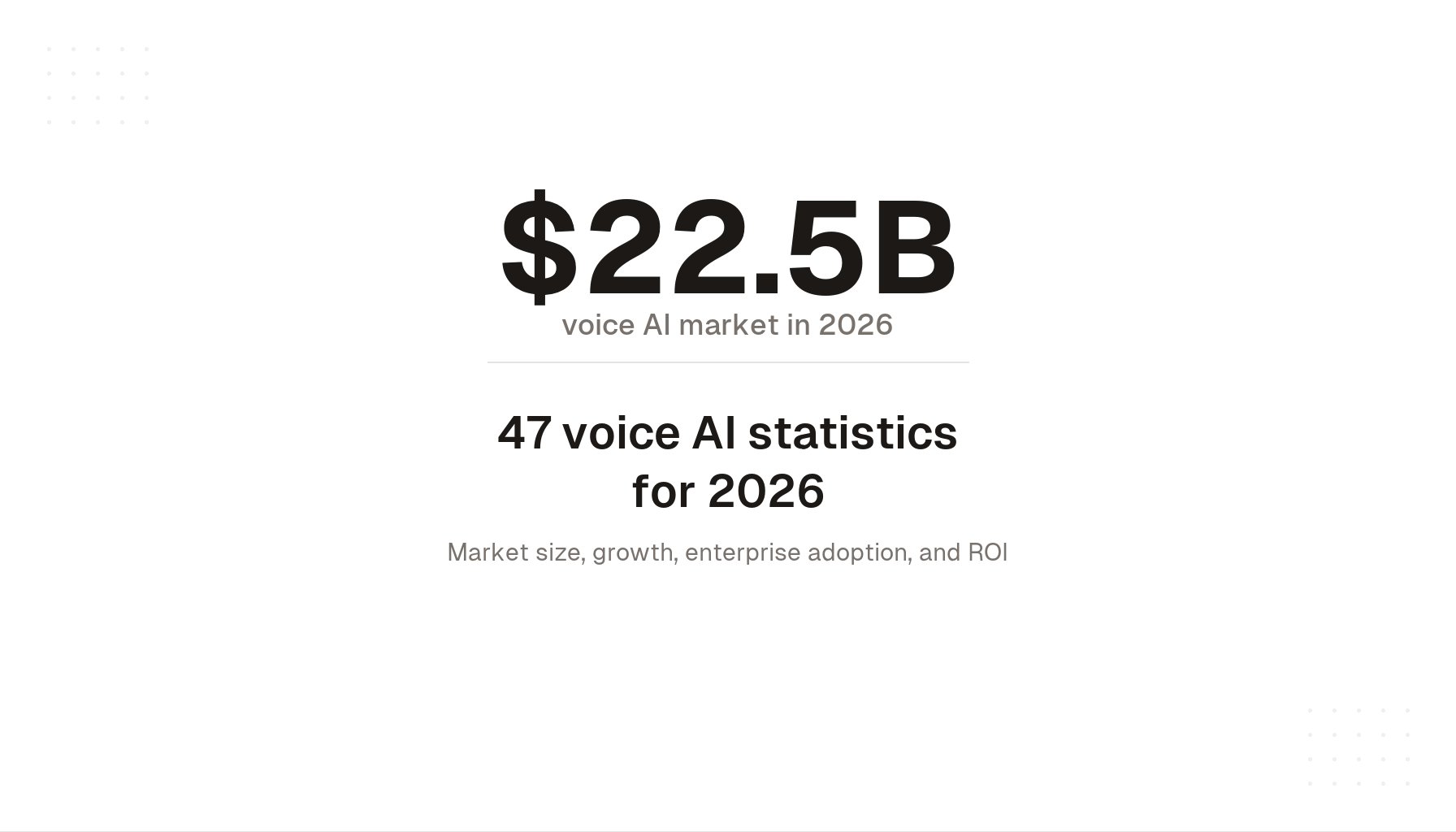
Voice AI isn't a future bet anymore. It's a current reality with real numbers behind it. The market crossed $22 billion in 2026, enterprise adoption tripled, and Gartner says contact centers will save $80 billion this year from conversational AI alone.
Whether you're running an ecommerce brand, managing a contact center, or just trying to understand where voice AI statistics are headed, this roundup of 47 data points gives you the full picture. Every stat is sourced, every number is real.
Hear what AI support calls sound like for your store. Just paste your Shopify URL and get sample calls in under 20 seconds, no email required. Listen to demo calls for my store.
Key highlights
- The global voice AI agents market is valued at $2.4 billion in 2024 and projected to hit $47.5 billion by 2034, a 34.8% CAGR (Market.us)
- Gartner forecasts conversational AI will cut contact center labor costs by $80 billion in 2026 (Gartner)
- 80% of businesses plan to integrate AI voice technology into customer service by 2026 (Nextiva)
- Production voice agent deployments grew 340% year-over-year across 500+ organizations (AI Voice Research)
- Voice AI funding surged eightfold to $2.1 billion in 2025 (AgentVoice)
- Companies using voice AI report 3-year ROI between 331% and 391% (Forrester/PolyAI)
Voice AI market size and growth
The voice AI market isn't just growing. It's accelerating across every segment, from voice agents to speech recognition to voice commerce. Here's what the numbers look like.
1. The global voice AI agents market is expected to reach $47.5 billion by 2034, up from $2.4 billion in 2024, growing at a CAGR of 34.8%. (Market.us)
2. The conversational AI market will grow from $17.97 billion in 2026 to $82.46 billion by 2034. (Fortune Business Insights)
3. Grand View Research puts the conversational AI market at $11.58 billion in 2024, projecting it to reach $41.39 billion by 2030 at a 23.7% CAGR. (Grand View Research)
4. The AI voice generator market is projected to reach $20.71 billion by 2031, up from $4.16 billion in 2025, at a 30.7% CAGR. (MarketsAndMarkets)
5. The voice recognition market is estimated at $22.49 billion in 2026 and expected to reach $61.71 billion by 2031 at a 22.38% CAGR. (Mordor Intelligence)
6. The voice assistant market was valued at $7.08 billion in 2024 and is projected to reach $59.9 billion by 2033, a 26.80% CAGR. (Astute Analytica)
7. The voice and language intelligence market is valued at $20.10 billion in 2025 and is expected to reach $145.03 billion by 2035 at a 21.85% CAGR. (Precedence Research)
8. The global voicebot market is projected to grow from $8.69 billion in 2025 to $54.64 billion by 2034, a CAGR of 22.51%. (Market Research Future)
No matter which segment you look at, the growth rates hover between 20% and 35% annually. That's not steady. That's a market in full sprint.
If you're running an ecommerce store and curious what voice AI for customer service looks like in practice, Ringly.io handles inbound support calls for 2,100+ Shopify stores.
See how it works for your store.
Enterprise adoption and deployment
Enterprise voice AI went from "pilot program" to "production infrastructure" in 2025. These stats show just how fast that shift happened.
9. 80% of businesses plan to integrate AI-driven voice technology into customer service by 2026. (Nextiva)
10. 67% of Fortune 500 companies are now running production voice AI systems. (AI Voice Research)
11. Production voice agent implementations grew 340% year-over-year across 500+ organizations. (AI Voice Research)
12. 78% of the top 50 banks have deployed production voice agents for at least one customer-facing use case, up from 34% in 2024. (AI Voice Research)
13. 76% of contact centers plan to invest in AI solutions in the next two years. (Nextiva)
14. 88% of contact centers already use some form of AI. (Master of Code)
15. 22% of Y Combinator's latest cohort is building voice-first companies. (Speechmatics)
16. Voice agent usage grew 9x in 2025. (Speechmatics)
The 340% growth in production deployments is the stat that matters most here. It means companies aren't just testing voice AI. They're rolling it out across real workflows.
For a deeper look at how AI is changing call centers, we've covered the operational shifts happening right now.
Cost savings and ROI
The financial case for voice AI isn't theoretical. It's backed by Gartner forecasts, Forrester studies, and real enterprise data.
17. Gartner predicts conversational AI will reduce contact center agent labor costs by $80 billion in 2026. (Gartner)
18. Voice AI costs roughly $0.40 per call, compared to $7 to $12 per call for human agents. That's a 90-95% cost reduction per automated interaction. (Teneo.ai)
19. Companies using voice AI report a 3-year ROI between 331% and 391%, according to a Forrester Consulting study. (Forrester/PolyAI)
20. A composite organization in the same Forrester study saved $10.3 million in agent labor costs over three years and cut call abandonment rates by 50%. (Forrester)
21. Payback period for voice AI deployments: under six months. (Forrester)
22. Enterprise contact centers using voicebots report up to 50% reduction in operational costs. (Gnani.ai)
23. AI voice agents deliver 35% faster call handling times. (DesignRush)
24. Average handle time is reduced 25-50% with voice AI. (Forrester)
25. There are approximately 17 million contact center agents worldwide, and labor makes up 95% of contact center costs. (Gartner)
The $0.40 vs. $7-$12 comparison tells you everything about why this technology is spreading so fast.
For ecommerce customer service teams, that cost gap changes the entire support budget equation, especially with voice AI pricing becoming more accessible every quarter.
Performance and resolution rates
Voice AI isn't just cheaper. It's getting better at actually solving problems. These stats cover resolution rates, response times, and containment.
26. AI-native platforms achieve 55-70% first contact resolution rates. (Lorikeet)
27. AI has reduced first response times from over 6 hours to under 4 minutes, an 87% improvement. (Master of Code)
28. 90% of leading CX organizations expect AI and automation to resolve 80% of issues without human intervention. (Master of Code)
29. Agentic AI is now delivering 80% containment rates in production environments. (AssemblyAI)
30. Organizations using AI voice technology report up to 30% gains in customer satisfaction. (DesignRush)
31. Cloud-based IVR system adoption rose 51% year-over-year. (Fortune Business Insights)
32. AI-powered IVR solutions with natural language processing grew 46%. (Fortune Business Insights)
The jump from 6-hour response times to 4 minutes is worth sitting with for a second. That's the kind of improvement that changes how customers feel about your brand.
For ecommerce phone support specifically, faster answers mean fewer abandoned carts and more completed orders.
For context, Ringly.io's AI phone agent (Seth) resolves about 73% of inbound calls for Shopify stores without needing a human. That lines up with the top end of industry benchmarks.
Try it free for 14 days and see the resolution rate for your own store.

Consumer adoption and voice assistant usage
It's not just businesses adopting voice AI. Consumers are using voice technology at scale, from smart speakers to voice shopping.
33. 157.1 million people in the United States will use voice assistants by 2026. (Statista)
34. There are 8.4 billion voice-enabled devices in use worldwide. (DemandSage)
35. Google Assistant leads with approximately 92.4 million users, followed by Siri at 87 million and Alexa at 77.6 million. (eMarketer)
36. Smart speaker revenue is projected to reach $28 billion in 2026. (Statista)
37. 50% of consumers have made a purchase using a voice assistant. (Shopify)
38. 49.6% of US consumers (154.3 million Americans) use voice search for shopping. (Capital One Shopping)
39. 89% of customers say they prefer brands that offer voice AI support. (Verloop)
40. 87% of consumers prefer a hybrid support model that combines human empathy with AI efficiency. (Zendesk)
Those last two stats are interesting together. Customers want voice AI, but they also want the option to reach a human.
Brands that get the handoff right, like AI phone agents with smart call transfer, will win.
Voice commerce statistics
Voice shopping is turning into a real revenue channel. Not just a novelty.
41. The global voice commerce market was valued at $49.6 billion in 2024 and is projected to reach $147.9 billion by 2030 at a 20% CAGR. (Grand View Research)
42. Voice commerce is projected to total $62 billion worldwide in 2025. (Capital One Shopping)
43. The voice user interface market is expected to reach $81.55 billion by 2030 at 21.8% CAGR. (The Business Research Company)
For ecommerce brands tracking trends in 2026, voice commerce is no longer a "nice to have" line item. It's a channel you'll need to plan for.
Investment and funding
The money flowing into voice AI tells you where the smart money thinks this market is headed.
44. Voice AI funding surged eightfold to $2.1 billion in 2025. (AgentVoice)
45. ElevenLabs raised $500 million at an $11 billion valuation in February 2026 (Series D, led by Sequoia). Total funding across five rounds: $781 million. (TechCrunch)
46. ElevenLabs closed 2025 with over $330 million in annual recurring revenue. (TechCrunch)
47. Deepgram raised $130 million at a $1.3 billion valuation in January 2026. (TechCrunch)
When a single voice AI company (ElevenLabs) triples its valuation in 12 months to $11 billion, that tells you something about where the industry is moving.
These aren't pre-revenue startups. ElevenLabs did $330 million in ARR.
What this means for ecommerce brands
So you've seen the numbers. Here's how to actually think about them if you're running a Shopify or ecommerce store.
The cost math changes everything. The $80 billion in contact center savings Gartner forecasts isn't just for Fortune 500 companies. If you're paying $7-$12 per support call and a voice AI agent can handle it for $0.40, the payback period is measured in weeks, not years.
Adoption is becoming the default. Four out of five companies plan to use voice AI in customer service this year. The brands that don't will be the ones with the slowest response times and the most frustrated customers.
Voice commerce is a real channel now. $62 billion means your customers are already buying things by talking to devices. If your store isn't set up for voice interactions, you're leaving money on the table. That includes:
- Voice AI customer support
- Voice search optimization
- AI shopping assistants
Customers want AI plus a human safety net. 89% prefer brands with voice AI support, but 87% still want the option to reach a human. The winning approach is AI-first with smooth escalation.
That's exactly what platforms like Ringly.io are built for: AI handles the common calls (order tracking, returns, product questions) and transfers the complex ones to your team.
If you're a Shopify store owner, Ringly.io gets Seth answering your calls in about three minutes. No code, 40 languages, 73% resolution rate.
Frequently asked questions
How big is the voice AI market in 2026?
The voice recognition market alone is estimated at $22.49 billion in 2026 (Mordor Intelligence). Including voice commerce, assistants, and generators, the total addressable market exceeds $50 billion.
What is the growth rate of the voice AI market?
Growth rates vary by segment but consistently fall between 20% and 35% CAGR. The voice AI agents segment leads at 34.8% (Market.us), while the AI voice generator market grows at 30.7% (MarketsAndMarkets).
How much can voice AI save on customer service costs?
Gartner forecasts $80 billion in contact center labor cost savings by 2026. Per-call costs drop from $7-$12 (human agent) to about $0.40 (voice AI). A Forrester study found one composite organization saved $10.3 million over three years with ROI up to 391%.
How many people use voice assistants?
In the US, 157.1 million people are projected to use voice assistants by 2026 (Statista). Globally, there are 8.4 billion voice-enabled devices in use (DemandSage).
What percentage of businesses use voice AI?
88% of contact centers already use some form of AI (Master of Code). 80% of all businesses plan to integrate AI-driven voice technology into customer service by 2026 (Nextiva). Among Fortune 500 companies, 67% run production voice systems.
Is voice AI good for ecommerce?
Yes. 50% of consumers have already made a purchase using a voice assistant (Shopify). The voice commerce market is projected at $62 billion in 2025. For ecommerce customer service specifically, AI voice agents can handle order tracking, returns, and product questions 24/7 in 40 languages at a fraction of the cost.
What is the ROI of voice AI for businesses?
A Forrester study found that enterprises using voice AI systems report 3-year ROI between 331% and 391%, with payback periods under six months. Contact center operations see up to 50% reduction in costs and 35% faster call handling times.
How accurate is voice AI in 2026?
AI-native platforms achieve 55-70% first contact resolution rates, and some deployments hit 80% containment rates. The industry average for human-staffed call centers is about 71%, so the gap is closing fast.