


Your support team picks up the phone, helps a customer, and hangs up. That interaction has a price tag, and it's directly tied to how long it took. If your average handle time is seven minutes when it could be four, you're burning through budget on every single call.
Most e-commerce businesses obsess over conversion rates and customer lifetime value. But the metric that quietly drains your support budget? Average handle time. It's the total time your agents (or your AI) spend on each customer interaction, from pickup to post-call wrap-up. And once you know how to measure it, you can actually start controlling your support costs.
This guide breaks down what AHT is, how to calculate it with a simple formula, where your numbers should land based on industry benchmarks, and eight practical ways to bring it down without sacrificing the customer experience.
Hear what AI support calls sound like for your store. Just paste your Shopify URL and get sample calls in under 20 seconds, no email required. Listen to demo calls for my store.
What is average handle time?
Average handle time (AHT) measures the total duration of a customer interaction from the moment an agent picks up the call to the moment all follow-up work is done. It's one of the most tracked customer service KPIs in e-commerce, and for good reason: it directly affects your costs, your staffing, and how long other callers sit in the queue.
AHT has three components:
- Talk time: the actual conversation between your agent and the customer
- Hold time: any time the customer spends waiting while the agent looks something up, checks a system, or transfers the call
- After-call work (ACW): everything the agent does after hanging up, like updating the CRM, tagging the ticket, writing notes, or forwarding information to another team
Here's a quick way to think about why it matters. If your average handle time is 7 minutes and you take 50 calls a day, that's 350 minutes of agent time. Cut it to 4 minutes and you free up 150 minutes daily. That's over two hours you can reallocate, or two hours of call center costs you eliminate.
The industry standard for AHT across all sectors is approximately 6 minutes and 10 seconds, according to multiple call center statistics reports. But that number varies wildly depending on your industry and the type of calls you handle.
The average handle time formula
The formula itself is simple:
AHT = (Total Talk Time + Total Hold Time + Total After-Call Work) / Total Number of Calls
Let's run through a real example. Say your support team handled 200 calls last week. Here's what the numbers look like:
| Component | Total time | Per call average |
|---|---|---|
| Talk time | 900 minutes | 4.5 min |
| Hold time | 150 minutes | 0.75 min |
| After-call work | 200 minutes | 1.0 min |
| Total | 1,250 minutes | 6.25 min |
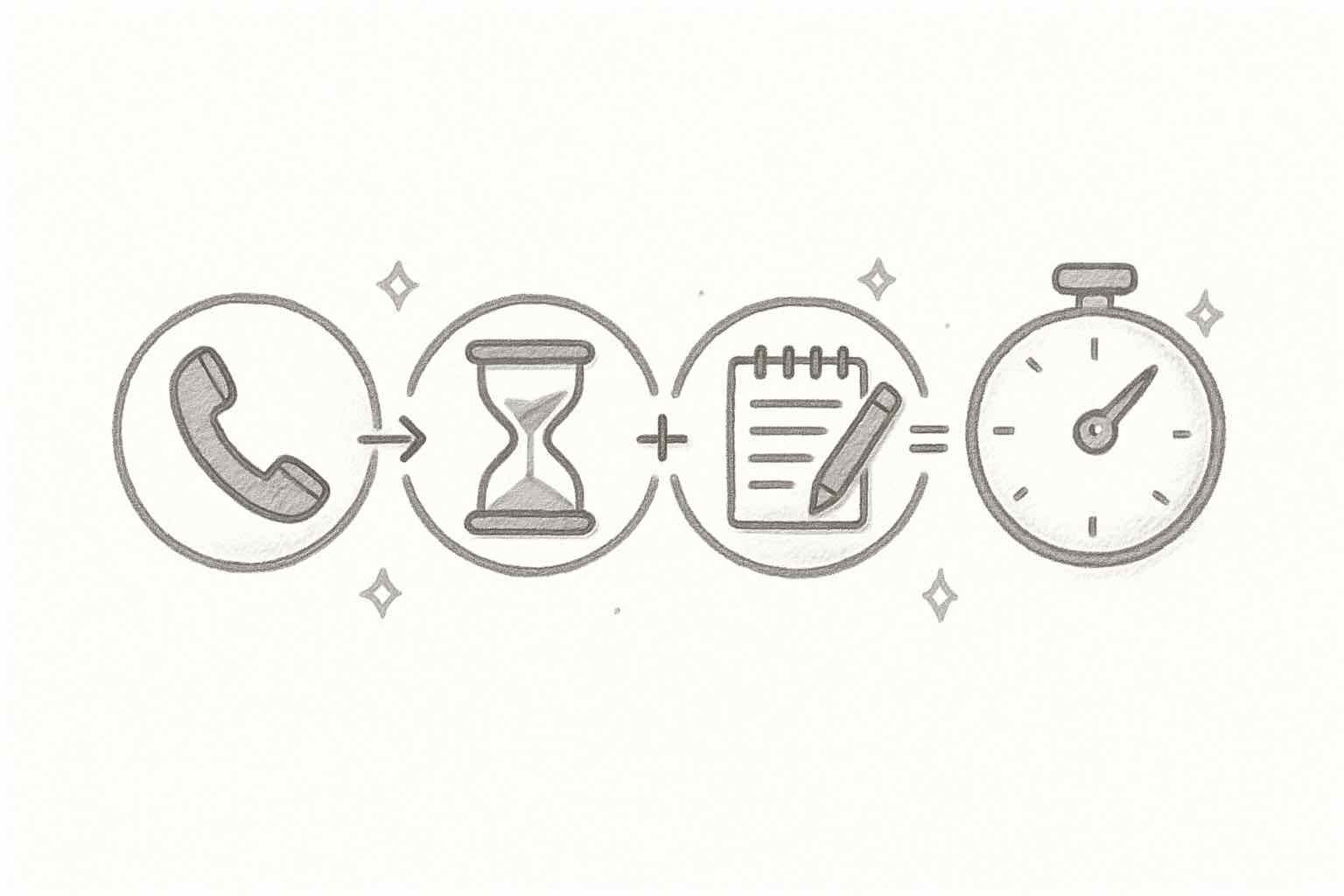
So your AHT is 6 minutes and 15 seconds. That's right around the industry average, but if you're running an e-commerce store with mostly straightforward order inquiries, there's room to push it lower.
Each component tells you something different:
- High talk time usually means agents are explaining things that could be handled by a knowledge base or self-service tool
- High hold time signals that agents are searching for information across multiple systems, or waiting for slow software to load
- High ACW often points to manual processes that could be automated, like typing up call notes or updating order statuses by hand
One common mistake: including abandoned calls in your AHT calculation. If a caller hangs up before reaching an agent, that's not a handled interaction. Leave it out. Another mistake is forgetting ACW entirely. Some teams only track talk time and hold time, which gives you a number that looks great but doesn't reflect reality.
Average handle time benchmarks by industry
Your target AHT depends heavily on what kind of business you're running. A telecom company resolving a billing dispute is a completely different call than an e-commerce store answering "where's my order?"
Here are the current benchmarks, based on data from Cornell University, Kustomer, and industry reports:
| Industry | Average AHT | Notes |
|---|---|---|
| Retail / E-commerce | 3 min 29 sec (excl. ACW), ~5.4 min (incl. ACW) | Simpler, repetitive queries |
| Financial services | 4 min 42 sec | Account inquiries, transactions |
| Business / IT services | 4 min 42 sec | Support tickets, troubleshooting |
| Healthcare | 6 min 12 sec - 6 min 36 sec | Sensitive, detailed conversations |
| Telecommunications | 8 min 48 sec | Complex billing, technical issues |
| Technical support | 8 - 10 min | Troubleshooting, multi-step fixes |
| Overall average | 6 min 10 sec | Across all industries |
For e-commerce specifically, AHT breaks down further by call type:
- WISMO calls (where is my order): 2-4 minutes. These are simple lookups.
- Product questions: 3-5 minutes. Depends on catalog complexity.
- Returns and exchanges: 5-8 minutes. Policy explanation plus return processing.
- Complaints and escalations: 8-15 minutes. These take time, and they should.
Here's something most guides skip: AHT can vary by up to 20% based on issue complexity alone, according to SupportBench research. So setting one flat AHT target for your entire team doesn't make sense. Segment by call type instead.
Why average handle time matters for your business
AHT isn't just an operational metric. It's a cost metric. Let's put some actual numbers on it.
Say you're an e-commerce store taking 500 support calls per month. Your blended cost per minute (agent salary, software, phone system) is around $1.00. Here's what different AHT levels cost:
| AHT | Monthly cost (500 calls) | Annual cost |
|---|---|---|
| 7 min | $3,500 | $42,000 |
| 5 min | $2,500 | $30,000 |
| 4 min | $2,000 | $24,000 |
| 3 min | $1,500 | $18,000 |
Cutting your AHT from 7 minutes to 4 minutes saves $18,000 per year. That's meaningful for any Shopify store managing support costs.
But cost isn't the only factor. When your AHT is high, the ripple effects hit everywhere:
- Longer queues: every extra minute per call means other customers wait longer, and long hold times drive abandonment
- Agent burnout: handling complex calls back-to-back with no breathing room leads to turnover
- Repeat contacts: rushing calls to hit an AHT target creates unresolved issues, and the customer calls back
According to PwC's 2025 Customer Experience Survey, 52% of consumers stopped buying from a brand after a bad experience. And according to industry data, 89% of e-commerce shoppers specifically stopped buying at stores with poor customer service. So while you want AHT low, you never want it so low that quality suffers.
What is a good average handle time?
The honest answer: it depends on your business. But here's some concrete guidance.
For e-commerce phone support, aim for 3-5 minutes as your blended AHT. That's where most retail and e-commerce teams land when they're running efficiently.
Several factors push your target up or down:
- Product complexity: selling supplements with a simple catalog? AHT will be lower. Selling custom furniture with 200 options? Higher.
- Return policy: a generous, no-questions-asked policy means shorter return calls. Strict policies mean longer conversations.
- Order lookup speed: if your agent has to log into three systems to find an order, that's 60-90 seconds added to every call
- Team experience: new agents run 2-3x higher AHT than experienced ones. That's normal.
One thing that gets overlooked: AHT alone doesn't tell the full story. You need to pair it with first call resolution (FCR). A 3-minute AHT with a 50% FCR means half your customers are calling back. A 5-minute AHT with 85% FCR is usually the better outcome.
According to Calabrio, a good FCR rate sits between 70-75%. If yours is below that, focus on resolution quality before trying to push AHT lower.
If you're running a Shopify store and want to see what your AHT would look like with an AI phone agent handling the simple calls, try Ringly.io free for 14 days. Most e-commerce calls resolve in under two minutes.
8 ways to reduce average handle time (without hurting service quality)
The goal isn't to rush through calls. It's to remove the friction that makes calls take longer than they need to. Here are eight strategies that actually work.
1. Build a searchable internal knowledge base
When an agent doesn't know the answer, they search. And if that search means opening three tabs, scrolling through a PDF, or asking a colleague on Slack, you just added 90 seconds to the call.
A single, well-organized knowledge base cuts lookup time dramatically. The key is making it searchable, not just organized. Agents should be able to type a keyword and get the answer in seconds.
2. Use AI to handle simple, repetitive calls
This is the biggest lever for most e-commerce teams. WISMO calls, order status checks, store hours, return policy questions: these are repetitive, high-volume, and perfect for automation.
AI voice agents don't just reduce AHT. They eliminate it for the calls they handle. No hold time (the AI accesses order data instantly). No after-call work (everything is logged automatically). Ringly.io resolves about 73% of e-commerce support calls without human intervention, and most of those wrap up in under two minutes.
According to industry reports, AI tools reduce AHT by nearly 25% on average. But for e-commerce specifically, the impact is often bigger because such a large percentage of calls are simple lookups.
3. Improve call routing
Bad routing kills AHT. When a customer calling about a return gets sent to the billing team, that call gets transferred. Transfers double or triple handle time and frustrate everyone involved.
Smart call routing sends the caller to the right person (or the right AI flow) on the first try. Even basic IVR improvements can make a noticeable difference.
4. Complete after-call work during the call
ACW typically accounts for 20-30% of total AHT, and it's the component most teams overlook. The trick from experienced call center practitioners: do your wrap-up work while the customer is still on the line.
Take notes during the conversation instead of after. Update the order status while confirming details with the customer. This approach turns ACW into a near-zero line item.
5. Create scripts for common scenarios
Not rigid word-for-word scripts. Decision trees. If the customer asks about a return, here are the three questions to ask and the two possible outcomes. If they need an exchange, here's the process.
This helps new agents especially. According to industry data, new agents often run 2-3x higher AHT than tenured ones. Good scripts close that gap fast.
6. Give agents direct access to order data
Every time an agent switches tabs, logs into a separate system, or copies an order number between tools, you're adding 30-60 seconds per call. That adds up fast.
The fix: tools that pull order data directly into the call screen. When an agent can see the customer's order history, shipping status, and previous interactions without leaving their workspace, calls move faster naturally.
7. Offer self-service before the call
The fastest way to reduce AHT is to reduce call volume. Not every customer needs to talk to a human (or an AI phone agent).
Effective call deflection starts with self-service: an order tracking page, a solid FAQ section, or a chatbot that handles basic questions. When the easy stuff gets filtered out before reaching your phone line, the calls that do come through are more complex but fewer in number.
8. Monitor and coach, don't just measure
Tracking AHT without acting on the data is pointless. The real value comes from digging into the numbers.
Pull call recordings for agents with high AHT. Listen for specific bottlenecks: long silences, repeated questions, system delays. Then coach on those specifics. The buddy system (pairing high-AHT agents with low-AHT agents) consistently works well in practice.
Use call monitoring software and a structured quality assurance process. The goal is to find the specific friction points, not just wave a target number at your team.
How AI phone agents are changing average handle time
AI doesn't just shave a few seconds off your handle time. It fundamentally changes how the metric works.
Traditional AHT has three components: talk time, hold time, and after-call work. AI voice agents eliminate two of them almost entirely.
- Hold time drops to zero: AI has instant access to your order data, product catalog, and return policies. There's no "let me put you on hold while I look that up."
- After-call work disappears: AI logs the entire conversation, tags the issue, and updates your system automatically. There's nothing for an agent to do post-call.
- Talk time gets shorter: AI doesn't small-talk. It greets the customer, identifies the issue, pulls the relevant data, and resolves it. Most simple calls wrap up in 60-90 seconds.
Industry reports show that AI tools reduce AHT by 20-25% on average across all sectors. But in e-commerce, the impact is larger. When 60-70% of your calls are order lookups, return questions, and WISMO inquiries, those calls go from 4-5 minutes to under 2 minutes with AI.
There's another angle that doesn't show up in AHT metrics directly: 24/7 availability. Without AI, after-hours calls go to voicemail. The next morning, your team starts the day with a backlog that inflates AHT because agents are rushing through calls. AI handles those overnight calls in real time, so there's no morning pile-up.
Ringly.io's AI agent, Seth, is built specifically for Shopify stores. It handles order lookups, processes returns, answers product questions, and transfers to a human when the situation calls for it. Trusted by 2,100+ stores, it resolves about 73% of calls automatically. See how it sounds for your store.
Common mistakes when optimizing average handle time
Pushing AHT lower sounds great until you do it wrong. Here are the mistakes that trip up most teams.
Treating AHT as the only metric: AHT in isolation is dangerous. If your AHT drops but your customer satisfaction and FCR drop with it, you haven't improved anything. Always pair AHT with other KPIs: first call resolution, CSAT, NPS, and customer effort score.
Setting one target for all call types: A WISMO call should take 2-3 minutes. A complex complaint might need 10-15 minutes. Setting a single AHT target pressures agents to rush the hard calls and inflate the easy ones. Segment your targets by call type.
Penalizing agents for high AHT: When agents feel punished for longer calls, they start rushing. Rushed calls lead to unresolved issues, which lead to repeat contacts, which actually increase your overall AHT. Coach on the process, not the number.
Ignoring after-call work: ACW is often 20-30% of total AHT and the easiest component to fix. But teams that only focus on talk time miss this entirely. Audit your ACW processes before anything else.
Not segmenting by call type: Your blended AHT might look fine at 5 minutes. But if WISMO calls are averaging 5 minutes too (when they should be under 3), you have a problem hiding in the average. Break it down.
Frequently asked questions
What is a good average handle time for e-commerce?
For e-commerce phone support, 3-5 minutes is the benchmark. Simple calls like order status checks should land closer to 2-3 minutes, while returns and complex issues can run 5-8 minutes. The key is segmenting by call type rather than chasing one blended number.
How do you calculate average handle time?
Add up your total talk time, total hold time, and total after-call work, then divide by the total number of calls handled. The formula is: AHT = (Talk Time + Hold Time + ACW) / Total Calls. Make sure you're excluding abandoned calls from the count.
What's the difference between average handle time and average talk time?
Talk time only measures the active conversation between agent and customer. AHT includes talk time plus hold time plus after-call work. AHT is always higher than talk time because it captures the full end-to-end interaction.
Does lower AHT always mean better performance?
No. If you push AHT too low, agents rush calls and leave issues unresolved. That creates repeat contacts and lower satisfaction. The sweet spot is the lowest AHT that maintains a first call resolution rate above 70%.
How does AI affect average handle time?
AI reduces AHT in two ways: handling simple calls entirely (with zero hold time and zero after-call work) and assisting human agents with faster data retrieval. For e-commerce, AI phone agents can cut AHT by 25% or more because they handle high-volume calls like order lookups and return questions in under two minutes.
What is average handle time in a call center?
It's the average total time a call center agent spends on each customer interaction, including the conversation, any hold time, and post-call administrative work. The industry average across all sectors is about 6 minutes and 10 seconds, though this varies significantly by industry and call complexity.
AHT is one of the most actionable metrics you can track in customer support. You know the formula, you know the benchmarks, and you have eight ways to push it lower. For e-commerce stores running on Shopify, the fastest path is offloading repetitive calls to AI. Try Ringly.io free for 14 days and see how fast your average handle time drops when 73% of calls resolve without a human agent.