

Phone support is one of the most expensive channels to scale. Customers call when issues are urgent or complex, and they expect immediate answers. Hiring enough agents to handle peak volumes means overstaffing during slow periods.
Voice AI customer support promises to change this equation by handling routine calls automatically while escalating complex issues to humans. This guide explains what voice AI customer support is, how it works, and which solutions are leading the market in 2026.
Editor's note: Want to hear some sample AI support calls made for your Shopify store?
- Just paste your store URL
- Get sample calls in under 20 seconds (no email required)
- Listen to demo calls for my store

What is voice AI customer support?
Voice AI customer support uses artificial intelligence to handle inbound phone calls without human intervention. Unlike traditional IVR systems that force callers through rigid menu trees ("Press 1 for billing, Press 2 for technical support"), modern voice AI understands natural language and responds conversationally.
The technology stack typically includes:
- Speech-to-text converts the caller's voice into text
- Natural language processing understands intent and context
- Large language models generate appropriate responses
- Text-to-speech delivers responses in a natural voice
Businesses are adopting voice AI now because the technology has crossed a threshold. Resolution rates have improved dramatically, and integrations with CRMs and e-commerce platforms mean AI agents can actually solve problems, not just deflect calls. Companies like Ringly report resolving 73% of calls without human intervention for their e-commerce customers.
Key benefits of voice AI for customer support
24/7 availability without staffing costs
The most obvious benefit is round-the-clock coverage. AI agents don't sleep, take breaks, or call in sick. For businesses with international customers or after-hours support needs, this changes everything. You can offer phone support at 3 AM without paying night-shift premiums.
Voice AI also handles volume spikes effortlessly. During holiday rushes or product launches, the system scales instantly. No more putting customers on hold for 45 minutes because you didn't anticipate demand.
Faster resolution times
Voice AI answers immediately. There's no queue, no hold music, no "your call is important to us" recordings. For common questions like order status or return policies, customers get answers in seconds rather than minutes.
This speed matters for customer satisfaction. Studies consistently show that wait time is one of the biggest drivers of negative support experiences.
Cost reduction and scalability
The math is straightforward. A human agent costs $15-25 per hour (plus benefits, training, and management overhead). AI handles calls for a fraction of that cost. While AI won't replace humans for complex issues, it removes the burden of repetitive calls.
At scale, the savings compound. A business handling thousands of calls monthly can redirect human agents to high-value interactions while AI manages the routine.

Multilingual capabilities
Most voice AI platforms support 40+ languages. This means you can offer phone support in markets where you don't have native-speaking staff. VoiceGenie and Ringly both advertise multilingual support as a core feature, enabling global expansion without proportional hiring.
How voice AI customer support works
The conversation flow
When a customer calls, the voice AI system handles the interaction end-to-end:
- Inbound call handling - The AI answers with a branded greeting
- Speech recognition - Converts spoken words to text in real-time
- Intent understanding - Determines what the caller wants
- Data retrieval - Pulls relevant information from integrated systems
- Response generation - Crafts an appropriate response
- Voice delivery - Speaks the response naturally
Modern systems handle interruptions gracefully. If a caller asks a follow-up question mid-sentence, the AI adapts rather than plowing through a script.
Integration with existing systems
Voice AI isn't useful in isolation. The real power comes from integrations:
- CRM connections let AI access customer history and context
- E-commerce platforms enable order lookups and return processing
- Knowledge bases provide answers to product questions
- Ticketing systems create records for follow-up
Ringly specializes in Shopify integration, allowing their AI to pull order details, process returns, and check inventory directly from the store's data. Zendesk offers deep CRM integration for enterprise support teams.
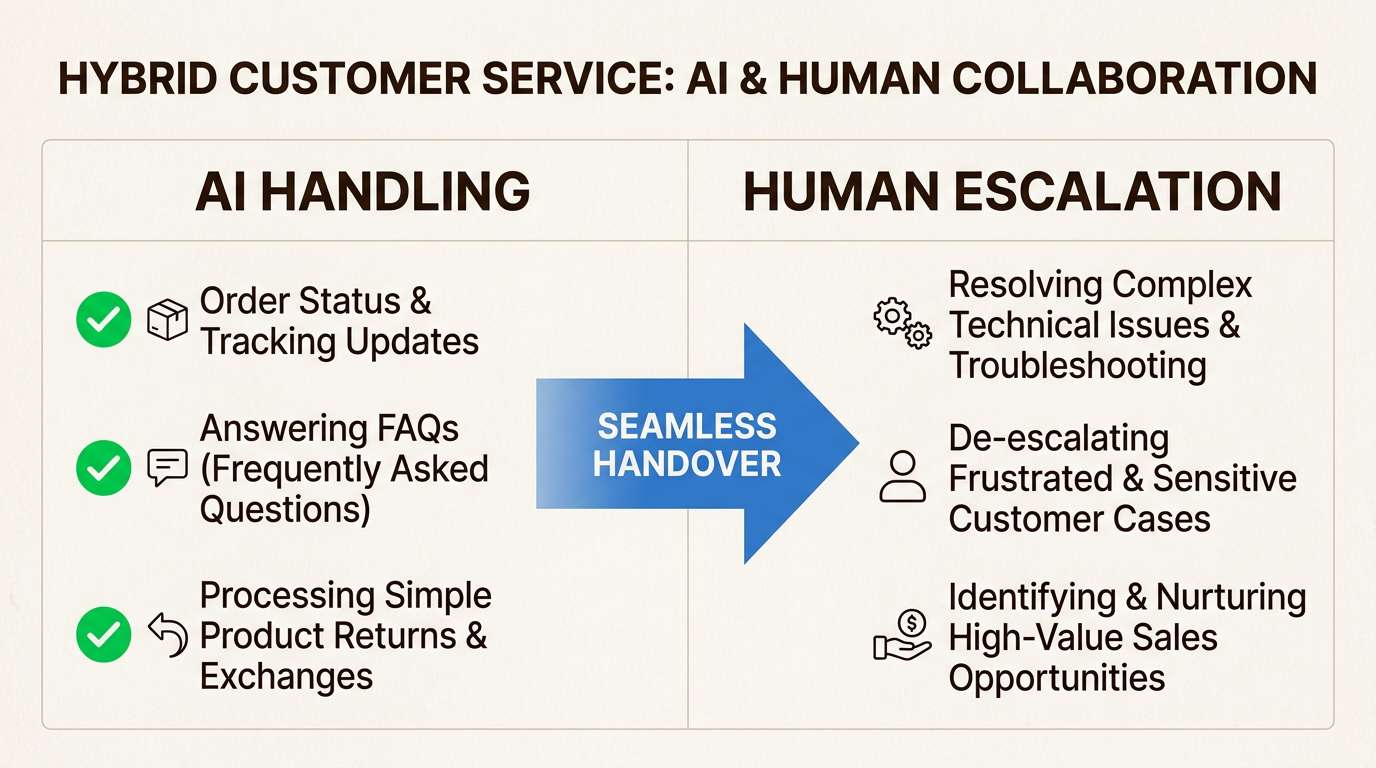
Human handoff when needed
Not every call should be handled by AI. Smart systems recognize when to escalate:
- Complex technical issues beyond the knowledge base
- Angry customers needing human empathy
- Sales opportunities requiring persuasion
- Security-sensitive requests
The key is seamless handoff. When transferring to a human, the AI should provide context so customers don't have to repeat themselves. Assembled emphasizes "context-aware handoffs" as a core feature, preserving conversation history for the human agent.
Top voice AI customer support solutions
1. Ringly

Ringly built their platform specifically for e-commerce businesses using Shopify. Their AI agent, Seth, handles order tracking, returns, exchanges, and FAQs with deep integration into store data.
Key features:
- 73% average resolution rate without human intervention
- with no technical expertise required
- 40+ language support
- Native Shopify integration
| Pricing: | Plan | Monthly Price | Minutes Included |
|---|---|---|---|
| Key Features | Grow | $349 | 1,000 |
| Advanced AI, Shopify integration, recordings | Enterprise | Custom | 5,000+ |
Private Slack channel, custom integrations
Overage: $0.19/minute. Ringly offers a unique pricing guarantee: you get your last 3 months refunded if the AI resolves under 65% of calls in 90 days over your first 100 calls.
2. Zendesk Voice

Zendesk brings enterprise-grade voice AI to their established support platform. Their solution integrates voice, chat, email, and messaging in a unified workspace.
Key features:
- AI agents resolving 50% of voice interactions
- Voice copilot providing real-time assistance to human agents
- Automatic call transcription and summarization
- Quality assurance analyzing 100% of conversations
Pricing: Zendesk uses a per-agent model with voice as an add-on. Contact sales for specific voice AI pricing.
3. VoiceGenie

VoiceGenie focuses on human-like voice interactions for both sales and support. Their platform handles lead qualification, appointment scheduling, and customer support.
Key features:
- 24/7 multilingual support in 40+ languages
- 20+ CRM integrations including HubSpot and Salesforce
- Customizable call flows
- Real-time analytics dashboard
Pricing: Custom quotes only. VoiceGenie targets mid-market to enterprise customers.
4. Assembled

Assembled combines workforce management with AI agents, treating AI as part of the support team rather than a separate system.
Key features:
- Unified scheduling for human and AI agents
- Conversation-based pricing (no per-minute fees)
- Omnichannel deployment (voice, chat, email)
- Capacity-aware routing adjusting AI handoff based on team availability
5. Cresta

Cresta positions itself as a premium enterprise platform with deep conversation intelligence. Their focus is on complex, high-volume contact centers.
Key features:
- Real-time agent assist during live calls
- Automation discovery analyzing historical conversations
- Agent operations center for oversight
- Comprehensive security certifications (SOC 2, ISO 27001, HIPAA)
Pricing: Enterprise-only with custom quotes. Implementation is described as "high-touch" and resource-intensive.
Choosing the right voice AI solution
Key features to evaluate
When comparing platforms, focus on these criteria:
- Resolution rate - What percentage of calls can the AI handle without human intervention?
- Integration depth - Does it connect to your CRM, e-commerce platform, and ticketing system?
- Customization - Can you train it on your products, policies, and brand voice?
- Analytics - What insights do you get about call patterns and performance?
Implementation considerations
Setup complexity varies dramatically. Ringly promises 3-minute deployment for Shopify stores. Enterprise platforms like Cresta require weeks of implementation and ongoing optimization.
Consider your team's technical capacity. Some solutions require developer resources for integration. Others offer no-code setup that non-technical staff can handle.
Pricing models compared
| Solution | Model | Starting Price | Best For | Ringly | Monthly subscription |
|---|---|---|---|---|---|
| $349/mo | E-commerce, Shopify stores | Zendesk | Per agent + add-on | Custom | Enterprise, existing Zendesk users |
| VoiceGenie | Custom quote | Contact sales | Mid-market, sales + support | Assembled | Per conversation |
| $0.99/call | Workforce management needs | Cresta | Enterprise quote | Custom | Large contact centers |
Getting started with voice AI customer support
If you're considering voice AI, here's a practical approach:
Start with a pilot. Pick one use case (like order status inquiries) and test the system with real calls. Measure resolution rates, customer satisfaction, and time savings before expanding.
Audit your call volume. Look at your current call patterns. What percentage are routine questions the AI could handle? The higher this percentage, the faster your ROI.
Match the solution to your stack. If you run Shopify, Ringly offers native integration. If you're already using Zendesk, their voice solution may be the path of least resistance.
Plan for optimization. Voice AI improves with data. Budget time to review transcripts, identify gaps in the knowledge base, and refine responses. The best results come from continuous iteration.
Ready to see how voice AI could work for your store? Start a free trial and test it with your actual customers.
Frequently Asked Questions
How much does voice AI customer support typically cost?
Pricing varies by model. Subscription-based platforms like Ringly start at $349/month for 1,000 minutes. Usage-based options like Assembled charge per conversation ($0.99). Enterprise solutions typically require custom quotes based on volume.
Can voice AI customer support handle complex issues?
Modern voice AI handles routine issues (order status, FAQs, returns) effectively. Complex technical problems or emotionally charged situations should escalate to humans. The best systems recognize their limits and transfer seamlessly.
How long does it take to implement voice AI customer support?
Setup time ranges from minutes to weeks. E-commerce focused solutions like Ringly deploy in about 3 minutes for Shopify stores. Enterprise platforms like Cresta require extensive implementation and training.
Will voice AI customer support replace human agents?
Not entirely. Voice AI handles repetitive calls, freeing humans for complex issues requiring empathy, persuasion, or creative problem-solving. Most businesses use a hybrid model where AI and humans collaborate.
What languages does voice AI customer support support?
Most platforms support 40+ languages. Ringly, VoiceGenie, and Assembled all advertise multilingual capabilities, enabling global support without hiring native speakers for every market.
How do I measure success with voice AI customer support?
Track resolution rate (percentage of calls handled without human intervention), average handle time, customer satisfaction scores, and cost per call. Compare these metrics before and after implementation to calculate ROI.
Want to see the latest data? Read our 47 voice AI statistics for 2026.