

You call a company. "Press 1 for sales. Press 2 for support. Press 3 for billing. Press 4 for..." and you're already annoyed. You press 2, wait through another menu, press 3 again, and end up in the wrong department anyway.
That's a phone tree. And 61% of customers say it's a poor experience, according to industry research from Talkative. More than half have actually abandoned a business because of it.
But there's a different approach now. AI phone agents pick up, listen to what the caller needs in plain English, and handle the request. No menus, no button mashing, no "please listen carefully as our options have changed."
This post breaks down exactly how phone trees and AI phone agents compare, what each one costs, and when it makes sense to switch. If you run an e-commerce store, pay extra attention to the cost section. The numbers might surprise you.
Hear what AI support calls sound like for your store. Just paste your Shopify URL and get sample calls in under 20 seconds, no email required. Listen to demo calls for my store.
What is a phone tree?
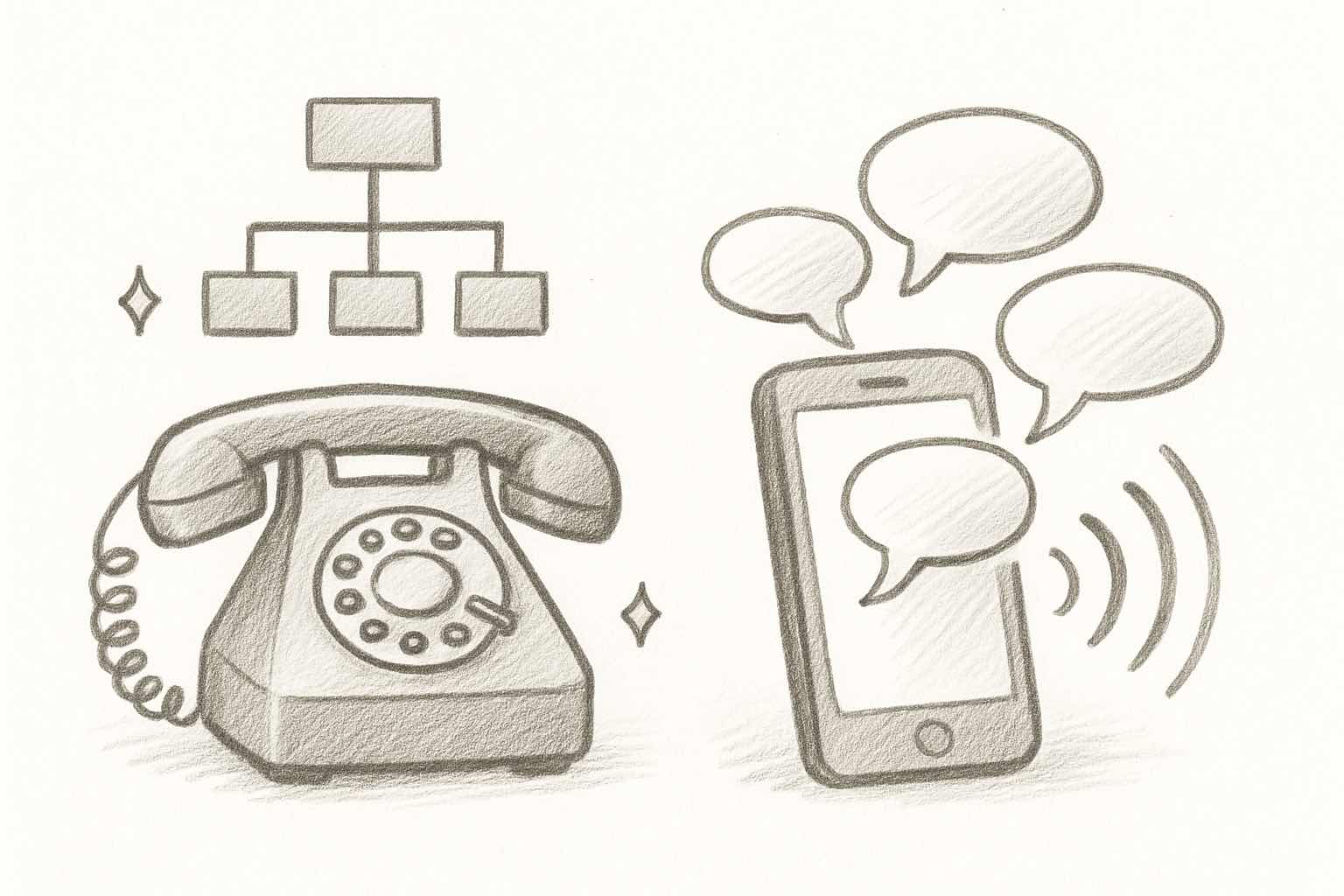
A phone tree (also called an IVR or auto-attendant) is an automated menu system that routes callers using keypad inputs. You've used one. Every time you hear "press 1 for X, press 2 for Y," that's a phone tree.
Here's how it works:
- Pre-recorded prompts: the system plays a message with numbered options
- Keypad input: the caller presses a number to select their choice
- Branching logic: each selection leads to another menu, a voicemail box, or a live agent
- Routing only: the phone tree doesn't answer questions. It just sends callers somewhere.
Phone trees have been around since the 1990s. They replaced the need for a human receptionist to manually route every call, which was a real improvement at the time.
The typical phone tree uses what's called DTMF (dual-tone multi-frequency) signaling. That's a fancy way of saying it recognizes the tone your phone makes when you press a button. Some newer IVR systems added basic speech recognition ("say 'billing' or 'support'"), but even these are limited to matching a handful of keywords to predefined routes.
For very simple setups (a dental office with three departments, a store that just needs to separate sales from support), a phone tree can still work. But there's a ceiling. The moment a caller's question doesn't fit neatly into your menu options, they're stuck.
And when callers get stuck, they hang up. Research shows that call abandonment rates hit 27% on average, with some legacy IVR systems seeing rates as high as 40%. According to NN/g's UX research, callers "highly value autonomy" and become frustrated when they feel trapped in a system they can't control.
What is an AI phone agent?
An AI phone agent is software that answers phone calls using natural language. Instead of menus, the caller just talks. The AI listens, understands the request, and responds like a human would.
Here's what that looks like in practice:
- Natural conversation: caller says "I want to return my order" and the AI responds with the return process
- Real actions: the agent can look up orders, check shipping status, initiate returns, and send confirmation texts
- Smart escalation: if the question is too complex, the AI transfers to a human agent with full context
- 24/7 availability: no hold times, no business hours restrictions, no staffing gaps
The biggest difference from a phone tree? An AI phone agent actually resolves calls. It doesn't just route them.
The technology behind this is natural language processing (NLP) combined with large language models. The AI doesn't match keywords like an old-school speech recognition IVR. It understands context, handles follow-up questions, and remembers what was said earlier in the conversation. If a caller says "actually, never mind the return, can you just tell me when my other order ships?" the AI adapts on the spot.
For e-commerce specifically, this matters a lot. Most customer calls are about order tracking, returns, product questions, and shipping updates. These are repetitive, predictable call types that AI handles extremely well.
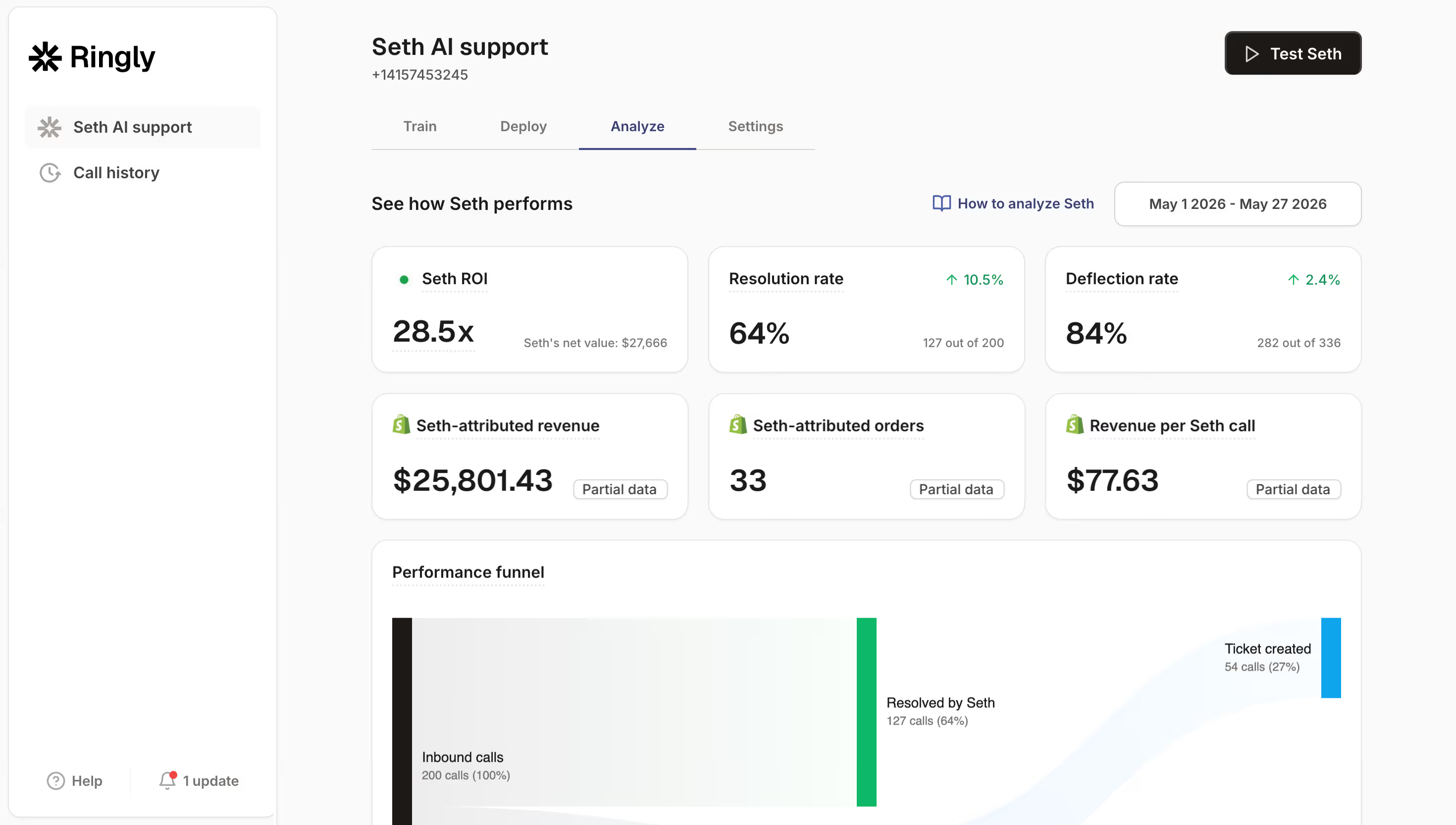
Ringly.io, for example, deploys an AI phone agent called Seth that's built specifically for Shopify stores. Seth resolves roughly 73% of calls without any human stepping in. It connects to your Shopify admin to pull live order data, check inventory, and process returns in real time. Setup takes about three minutes. Try it free for 14 days.
Phone tree vs AI phone agent: head-to-head comparison
Here's how the two stack up across the dimensions that actually matter.
| Feature | Phone tree | AI phone agent |
|---|---|---|
| Customer experience | "Press 1, press 2" menus | Natural conversation |
| Setup time | Hours to days | Minutes to hours |
| Monthly cost | $20-$150/user | $200-$500 flat |
| Can answer questions | No (routing only) | Yes (resolves issues) |
| Order lookups | No | Yes (with store integration) |
| Languages | 1-2 (pre-recorded) | 30-40+ (auto-detected) |
| Availability | 24/7 (for routing) | 24/7 (for resolution) |
| Scalability | Limited by menu depth | Handles unlimited concurrent calls |
| Personalization | None | Recognizes context and caller intent |
| Resolution rate | 0% (routes, doesn't resolve) | 60-73%+ without human help |
| Human fallback | Transfer to voicemail or queue | Smart transfer with full context |
The contrast is stark. A phone tree is a menu. An AI phone agent is a team member.
According to Fortune Business Insights, the conversational AI market is projected to reach $17.97 billion in 2026, growing at 21% annually. That growth is driven by exactly this shift: businesses replacing static menus with agents that actually solve problems.
One stat that makes the case clearly: organizations using agentic AI report containment rates above 80%, while those stuck on legacy IVR see abandonment rates climbing toward 40%. Same phone line, completely different outcomes.
So what does "containment rate" actually mean here? It's the percentage of calls fully handled without needing a human. A phone tree's containment rate is essentially 0%, since it never resolves anything. It just moves people around. An AI phone agent, by contrast, can answer the question, take the action, and end the call with the customer satisfied.
For e-commerce customer service teams, this is the metric that changes the math. When 70-80% of your calls resolve without a human, your support staff can focus on the genuinely complex cases that need personal attention.
The real cost of phone trees (and what most businesses miss)
Phone tree software is cheap. That's the pitch. And it's true, sort of.
A basic cloud IVR plan runs $20-$35 per user per month. For a small team of two, that's $40-$70 monthly. Affordable.
But here's what that price tag doesn't include:
- Abandoned call revenue: with 27% of calls dropping out, you're losing potential orders and repeat customers. Industry data estimates this costs roughly $262 per customer per year in lost revenue.
- Misrouted call cleanup: staff spend 2-5 hours per month dealing with callers who ended up in the wrong place
- Customer churn: callers who hit IVR friction are 3x more likely to switch to a competitor
- Zero resolution: your phone tree doesn't answer a single question. Every call still needs a human eventually.
Now compare that to an AI phone agent for a store handling 200 calls per month:
| Cost factor | Phone tree | AI phone agent |
|---|---|---|
| Software | $50/mo | $349/mo |
| Calls resolved by system | 0 | ~146 (73%) |
| Staff hours saved | 0 | 15-20+ hours/mo |
| Abandoned calls | ~54 | Near zero |
| Customer churn risk | High (3x) | Low |
The phone tree is cheaper on paper. But when you factor in the real cost per contact, the AI agent pays for itself by the second month.
Here's a quick way to think about it: if each call takes your team 5 minutes to handle, 200 calls is roughly 17 hours of staff time per month. At $20/hour, that's $340 in labor alone. An AI agent handling 73% of those calls saves you $248/month in labor, nearly covering the $349 subscription by itself. And that's before counting the revenue saved from fewer abandoned calls and lower churn.
The conversational AI industry is on track to save $80 billion in contact center labor costs by 2026, according to Juniper Research. Small e-commerce stores are seeing the same math play out at their scale. Companies report an average return of $3.50 for every $1 invested in AI customer service.
Want to see the numbers for your store? Paste your Shopify URL and hear sample calls in under 20 seconds.
When a phone tree still makes sense
Phone trees aren't always the wrong choice. Here are the situations where they still hold up:
- Ultra-low call volume: if you get fewer than 20 calls a month, the investment in an AI agent might not be worth it yet
- Pure routing needs: you don't need the system to answer questions, just send callers to the right extension
- Budget under $30/month: if you genuinely can't spend more, a basic auto-attendant does the minimum
- Existing system with built-in IVR: your phone provider already includes it at no extra cost
But here's the honest truth: if your store is growing and customers are calling about orders, returns, or product details, a phone tree is a dead end. It routes those calls to your team instead of resolving them, which means your staff still handles every single one.
And there's a hidden frustration cost too. Customers who call your store and hit a phone tree are already primed to be annoyed. They wanted a quick answer. Instead they got a menu. That first impression shapes the entire interaction, even if they eventually reach a helpful human on the other end.
When an AI phone agent is the clear upgrade
For most e-commerce businesses, the switch to an AI phone agent makes sense the moment call volume starts eating into your team's time. Here are the specific signals:
- Repetitive call types dominate: WISMO calls ("where is my order?"), return requests, and product questions make up 60-80% of e-commerce support calls. AI handles these on autopilot.
- You need after-hours coverage: customers order at 11 PM and want answers by morning. An AI agent picks up at 2 AM in their language.
- Call volume is growing: phone trees don't scale well. Adding more menu branches makes the experience worse. AI agents handle more calls without degrading quality.
- Customer satisfaction matters: the data is clear. Customers who get their question answered in a natural conversation are happier than those who navigate a menu and then wait on hold. Here's how to improve Shopify customer satisfaction with this approach.
- You sell internationally: AI phone agents like Seth speak 40 languages with auto-detection. Try doing that with pre-recorded IVR prompts.
The e-commerce phone support use case is uniquely well-suited for AI. The call types are predictable, the data is structured (orders, tracking numbers, product catalogs), and the return and exchange process follows clear rules.
In our experience, the retail sector averages 78% first-call resolution, with top performers hitting 88%. AI agents are pushing those numbers higher because they never forget a policy, never put a caller on hold to "check with a manager," and never have a bad day.
One documented case study showed a 32% improvement in first-call resolution after deploying AI agents specifically for refund and delivery queries. Another outsourced call center running AI on order tracking calls saw 45% of calls fully handled without a human agent touching them.
How to switch from a phone tree to an AI phone agent
If you've decided to make the move, here's the practical path:
- Step 1: Audit your call types. Pull your last 30 days of calls. What are people actually asking? Most e-commerce stores find that 5-8 question categories cover 80%+ of calls.
- Step 2: Choose an AI agent that fits your stack. For Shopify stores, integration depth matters. You need the agent to pull real order data, not just read from a FAQ script. Ringly.io connects directly to Shopify for live order lookups, return processing, and product catalog access.
- Step 3: Set up your knowledge base. Feed the AI your return policy, shipping info, product details, and any brand-specific language. With Ringly.io, this takes about three minutes because it pulls directly from your store.
- Step 4: Test with real calls. Run a pilot period where the AI handles calls alongside your existing setup. Review call recordings and check first-call resolution rates.
- Step 5: Monitor and optimize. Use call analytics to spot patterns. Which questions come up most? Where does the AI struggle? Refine your knowledge base based on real data.
Most stores are surprised by how fast this goes. The biggest time investment isn't the technical setup. It's reviewing your first batch of call recordings and tweaking responses for edge cases.
A common question here: "Do I need to shut off my phone tree before setting up the AI agent?" No. You can run both in parallel. Forward a percentage of calls to the AI agent first, review how it performs, and gradually increase the volume. There's no need for a hard cutover.
The whole process, from sign-up to live calls, can happen in a single afternoon. No developer needed.
Try Ringly.io free for 14 days and get Seth answering calls for your Shopify store in under three minutes.
What to look for in an AI phone agent
Not all AI phone agents are equal. Here's what separates a good one from a glorified voicemail bot:
- Natural conversation quality: does it sound like a real person or a text-to-speech robot from 2015? The best agents use advanced voice models with natural pauses and intonation.
- Integration depth: can it actually look up orders, check inventory, and process returns? Or does it just read from a static FAQ? Deep Shopify integration is non-negotiable for e-commerce.
- Language support: how many languages, and does it auto-detect? For stores with international customers, this is essential.
- Escalation rules: what happens when the AI hits its limits? The best platforms transfer to humans with full call context so the customer doesn't repeat themselves.
- Analytics and recordings: can you listen to calls, measure resolution rates, and track customer satisfaction? Data is how you improve.
- Pricing transparency: per-minute, per-call, or flat rate? Know exactly what you're paying before calls start flowing. Our AI voice agent pricing guide breaks down the common models.
- Speed to value: how quickly can you go from sign-up to handling real calls? Some platforms need weeks of professional services. Others, like Ringly.io, connect to your Shopify store and go live in minutes.
The AI voice agent market has grown rapidly, and not every product has kept pace with quality. Ask for a demo call before committing. If the AI sounds stilted or can't handle a basic "where's my order?" question, move on.
Frequently asked questions
Is an AI phone agent the same as a chatbot?
No. A chatbot handles text-based conversations on your website or messaging apps. An AI phone agent handles actual phone calls using voice. The underlying AI technology is similar, but the delivery channel and customer experience are completely different.
Can an AI phone agent handle returns and refunds?
Yes, if it has the right integrations. Agents like Ringly.io's Seth connect directly to Shopify, so they can look up orders, check return eligibility, and walk the customer through the return process on the call.
How much does an AI phone agent cost per month?
Pricing varies by provider. Ringly.io starts at $349/month for the Grow plan, which includes 1,000 minutes (roughly 500 calls). Overages run $0.19/minute. Check our AI voice agent pricing guide for a broader comparison.
Will my customers know they're talking to AI?
Modern AI agents sound remarkably natural. Most callers focus on whether their problem gets solved, not whether the voice is human or AI. Ringly.io's Seth uses advanced voice models that handle natural pauses, follow-up questions, and conversational tone. Some stores choose to disclose that the caller is speaking with an AI assistant, which can actually boost trust when the AI resolves the issue quickly.
Can I keep my existing phone number?
Yes. Most AI phone agent platforms work by forwarding your existing number to the AI system. Your customers dial the same number they always have.
What happens when the AI can't answer a question?
Good platforms have smart escalation. The AI recognizes when it's out of its depth and transfers the call to a human agent with full context, so the customer doesn't have to repeat anything.
How long does it take to set up an AI phone agent?
It depends on the platform. Generic solutions can take days or weeks to configure. Ringly.io takes about three minutes for Shopify stores because it pulls your store data automatically. No developer required.
The bottom line
Phone trees route calls. AI phone agents resolve them. That's the fundamental difference.
If your store gets fewer than 20 calls a month and you just need basic routing, a phone tree is fine. But for growing e-commerce businesses where most calls follow predictable patterns (order status, returns, product questions), an AI phone agent handles the volume your team shouldn't have to.
The gap between these two technologies is only getting wider. The conversational AI market is growing at 21% annually for a reason: businesses are seeing real ROI. And with retail leading all industries in conversational AI adoption at a 21.2% market share, e-commerce stores are at the front of this shift.
Your customers didn't call to navigate a menu. They called to get an answer.
Ready to hear what it sounds like? Start your free 14-day trial of Ringly.io. Setup takes three minutes.