


An AI shopping assistant is software that helps online shoppers find products, answer questions, and complete purchases through natural conversation. They matter because conversational commerce is growing fast: shoppers using AI assistants convert at meaningfully higher rates, and adoption across ecommerce is accelerating into 2026.
Why every e-commerce store needs more than a chatbot
Old-school chatbots leak profit.
Phone support that pays for itself. Ringly answers your store’s calls and resolves at least 65% of them, backed by a guarantee. Book a call to see it run on your store.
You spend real money driving traffic, then a dumb bot greets it with "I don't understand" while you sleep. The shopper bounces. The sale dies. And the next morning you have no idea it even happened.
A real AI shopping assistant does the opposite. It understands what a customer actually means, answers in plain language, and can take action: look up an order, recommend the right product, recover an abandoned cart, or handle a return without a human touching it.
This guide ranks the 6 best AI shopping assistants for 2026. We tested each against the work a store owner actually cares about: catalog integration, automation depth, setup speed, channel coverage, and proven impact on revenue or support cost. The top pick is below, followed by the full list, then a short section on which tool fits your store size.
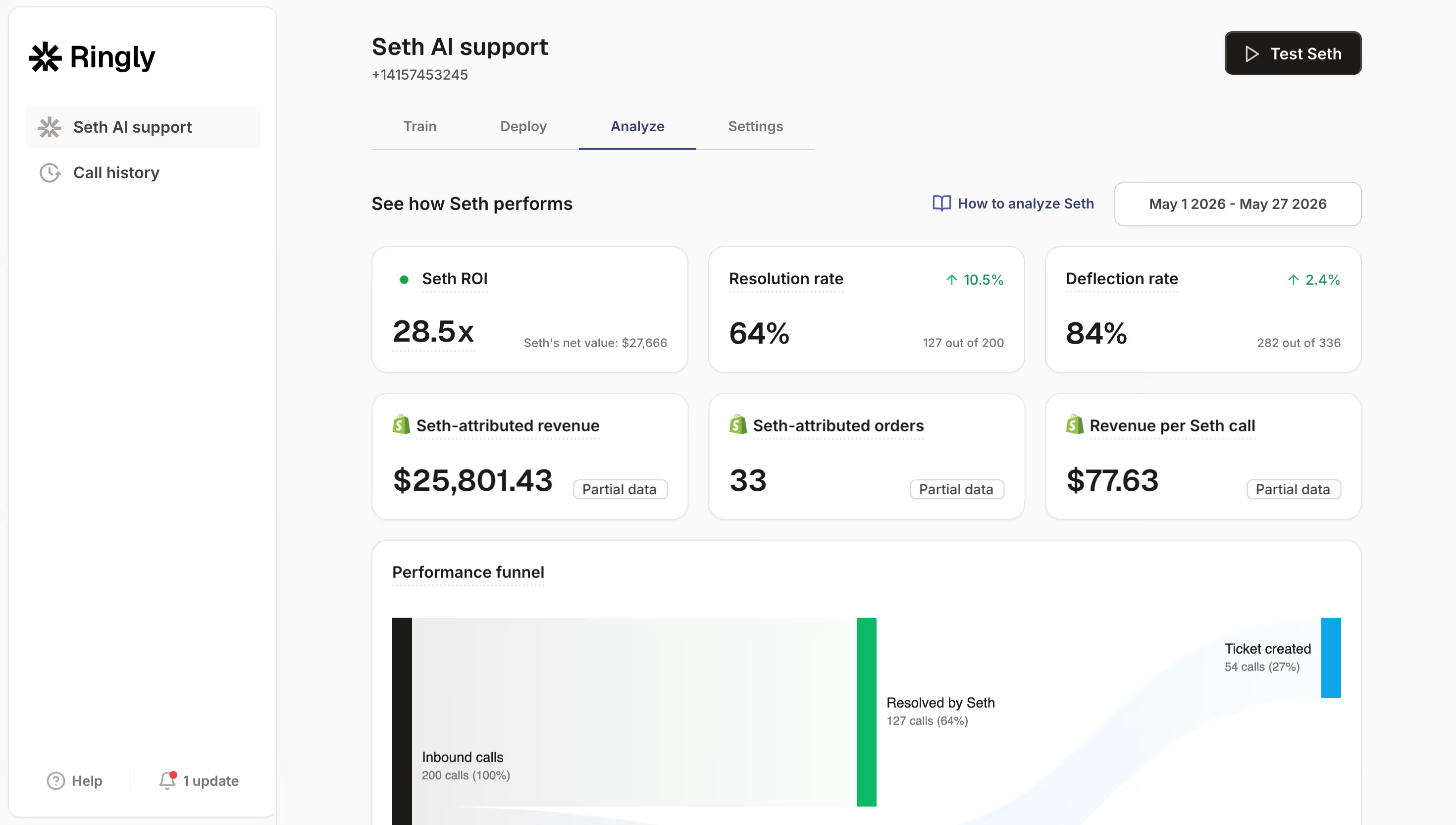
The short version: if WISMO calls and phone support are eating your team, start with Ringly.io. It is the only assistant on this list that covers the phone, it resolves roughly 73% of inbound calls on its own, and if Seth resolves under 65% of calls in a month, you don't pay for that month. For on-site chat and product discovery, the other five are strong, and we cover exactly where each one wins.
What exactly is an AI shopping assistant?
An AI shopping assistant is a conversational agent that helps a shopper before and after they buy. It is a big step up from a simple FAQ chatbot. These tools use natural language processing, which just means they understand intent, not only keywords. They hold a real conversation.

The best of these tools now move into what people call "agentic commerce." That is where the AI takes multi-step actions for a customer on its own: processing a return, applying a discount, or checking and reporting an order status without escalating to a person.
The difference from a classic chatbot is that an AI assistant is proactive. It does not sit and wait. It engages shoppers, offers help, and guides them toward a purchase. A complete strategy covers the whole journey: pre-purchase questions like "do you have this in blue?" and post-purchase ones like "where is my order?" Most tools handle one half well. The job is to cover both.
How we picked these tools
We scored every assistant on the things that decide whether it earns its keep in a real store:
- E-commerce integration: How well it connects to platforms like Shopify. Can it read your live product catalog, inventory, and order data? A bot that cannot is guessing.
- Automation depth: Can it resolve real issues end to end, not just answer the easy questions and hand off the rest?
- Setup speed: How fast you get live without a developer babysitting it.
- Channel coverage: On-site chat only, or also social, email, and the phone?
- Proven impact: Does it move revenue or cut support cost, with numbers to back it up?
The 6 best AI shopping assistants for 2026 at a glance
Here is the quick comparison. Read it top to bottom, then jump to the full write-up for whichever tool fits.
| Tool | Best For | Channels | Key E-commerce Feature | Pricing Model |
|---|---|---|---|---|
| Ringly.io | Automated phone support, done for you | Phone (voice) | AI phone agent that handles order status, returns, and FAQs 24/7, resolves ~73% of calls | Guarantee: If Seth resolves under 65% of calls in a month, you don't pay for that month |
| Alhena AI | All-in-one "agentic" commerce | Web chat, social, voice | Multi-step actions across the whole journey | From $199/mo (billed annually) |
| Shop.app | Native Shopify discovery | Shop app only | ChatGPT-powered search inside the Shop app | Free with Shopify |
| eesel AI | Self-serve setup for sales and support | Web chat, helpdesk | Trains bots on all your scattered knowledge sources | From $239/mo (billed annually) |
| Gorgias AI | Turning helpdesk tickets into revenue | Web chat, email, helpdesk | Resolves up to 60% of tickets and spots upsells | Helpdesk from $50/mo + AI per interaction |
| Rep AI | Proactive cart recovery | Web chat (on-site) | Predicts intent to engage shoppers and cut abandonment | Custom (demo required) |
The 6 best AI shopping assistants for 2026
Here is what makes each tool stand out, with the honest trade-offs.
1. Ringly.io (top pick for phone support)

Description
Ringly.io takes the top spot because it owns the channel almost every other tool ignores: the phone. It is a done-for-you AI phone agent built for Shopify brands. When a customer calls, the AI answers, looks up order statuses, handles returns, and answers questions about your policies in real time. It speaks 40+ languages, so a single agent covers callers most teams cannot.
Phone is where the hardest, most expensive support lives. A shopper who picks up the phone is usually frustrated, mid-purchase, or chasing a package, exactly the moments where a slow answer costs you the order. Ringly handles those calls the way a trained rep would, and because it plugs straight into Shopify, it has live access to order data instead of guessing.
Unlike most tools here, Ringly is not a self-serve app you wire up alone. It is set up for you on a call, where the team configures the agent against your store, your products, and your policies, then gets you live in 14 days. It is trusted by 50+ Shopify brands and has recovered $22k for a single store by catching calls that would otherwise have gone to voicemail.
Pros and cons
The biggest win is that Ringly automates the support channel that is usually the most painful to staff. It independently resolves about 73% of calls, runs 24/7, and answers in 40+ languages. Setup is done for you, so you are not the one building it.
The trade-off: Ringly is a specialist. It handles voice phone support, not on-site chat. That makes it the natural partner to a chat tool further down this list rather than a one-app-does-everything play. If phone is not in your support mix at all, start elsewhere. If your team is drowning in calls, nothing else here touches it.
Pricing
Ringly is sold through a call rather than a public self-serve tier, because the agent is configured for your store before it goes live. Two things make the pricing low-risk:
- Guarantee: If Seth resolves under 65% of calls in a month, you don't pay for that month.
- Fast launch: most brands go live in under an hour, configured against your real catalog and policies.
Because the quote is tailored to your call volume, the right move is to book the call and get a number against your actual store.
2. Alhena AI
Description
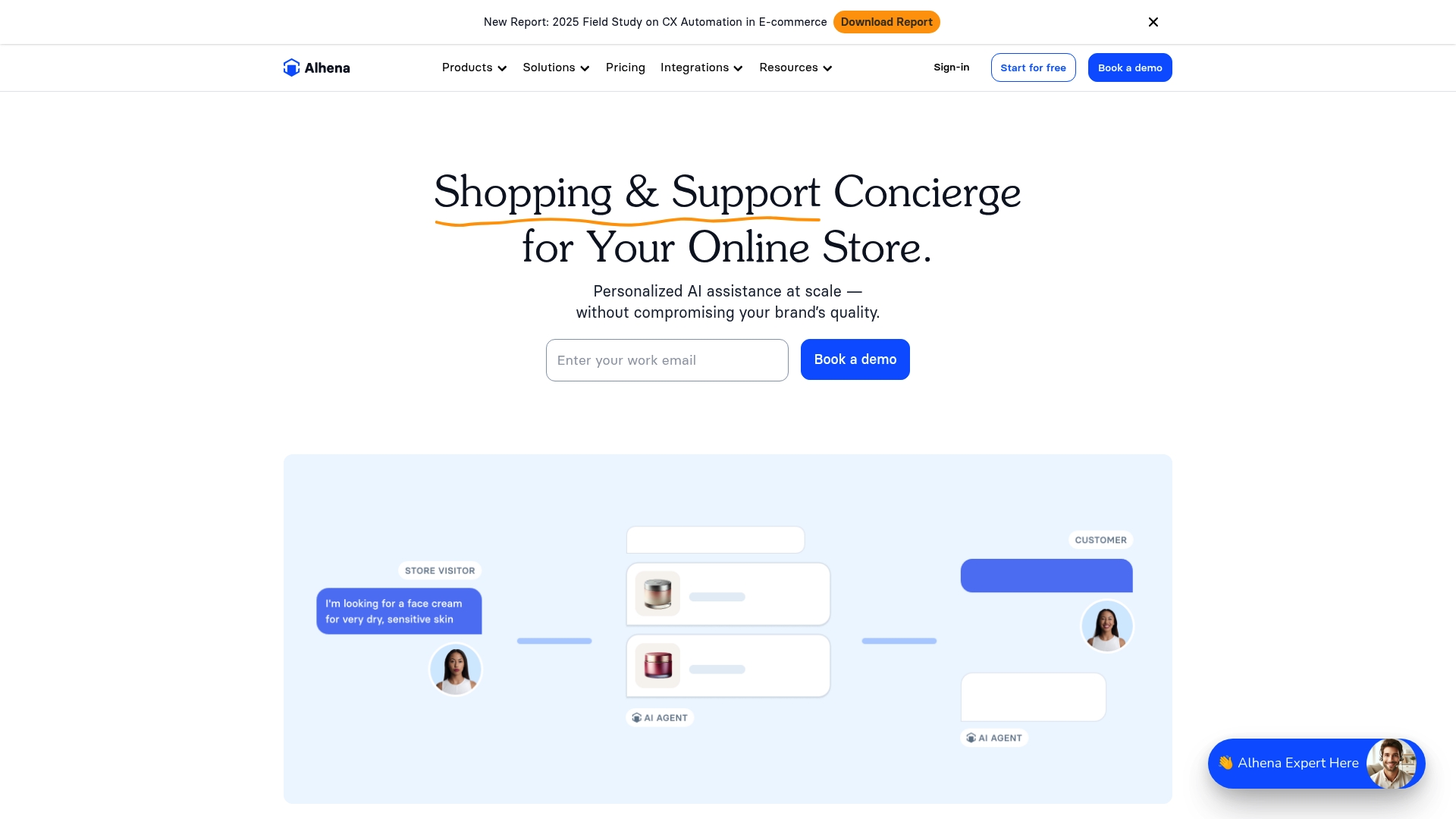
Alhena AI calls itself a complete "agentic commerce" platform. It does not just answer questions, it takes action. It works as a concierge for both shopping and support, handling multi-step tasks across the journey. Alhena says it automates over 80% of incoming queries across web chat, social, and voice.
Pros and cons
Its strength is bringing everything into one system, so you are not stitching separate sales and support tools together. They cite a case study where Victoria Beckham lifted AOV by 20%. The flip side: as an all-in-one platform it can be more than a smaller shop needs if you only have a single-channel problem to solve.
Pricing
- Free plan: 25 conversations per month to test.
- Pro plan: from $199/month billed annually for 200 conversations.
- Enterprise: custom pricing for higher volumes.
3. Shop.app

Description
Shop.app is Shopify's own AI assistant, built into the Shop app. Its job is product discovery. It uses ChatGPT to understand what a shopper wants in plain language and serves personalized recommendations. Customers type what they are after, and the AI helps them find it.
Pros and cons
The best part is how cleanly it fits the Shopify ecosystem. Millions already use the app to track orders, so it feels familiar and fast, and it asks good follow-up questions to narrow a search. The limit: it only works inside the Shop app and its website. It cannot engage shoppers on your actual storefront, so its reach is capped.
Pricing
The assistant is a free feature of the Shop app. If your products are eligible to show in Shop, enabling it is an easy call.
4. eesel AI
Description
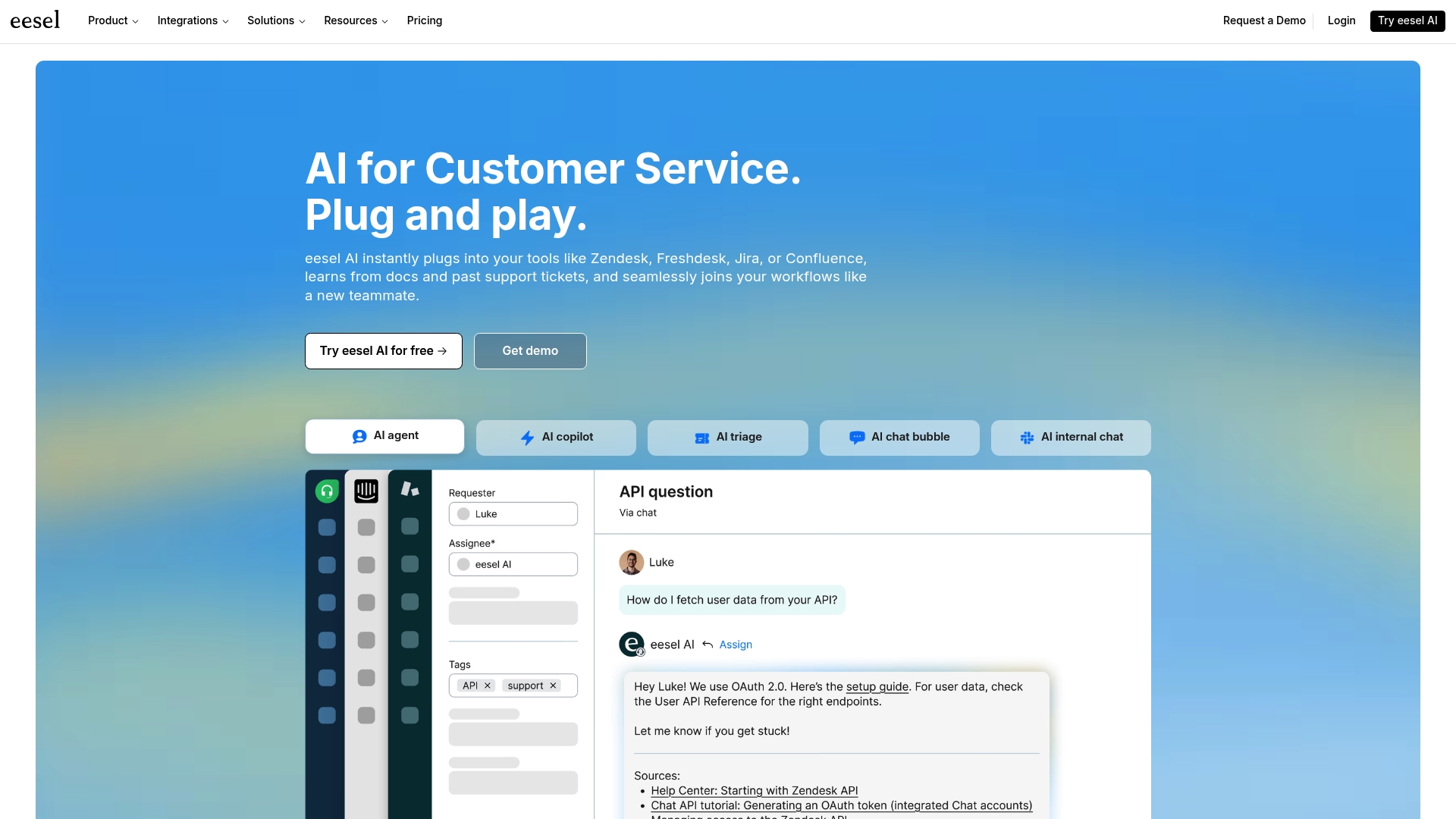
eesel AI lets you build multiple AI bots that learn from all your knowledge sources. Where many assistants only read your public help center, eesel can also train on past support tickets, internal Google Docs, and your site content. That gives it a deeper read on your business, so it answers more accurately for both sales and support.
Pros and cons
The standout is how fast you get going. You set it up yourself without talking to a salesperson, and it has deep integrations with Shopify and Zendesk. They claim it autonomously resolves 81% of support conversations, and pricing is transparent and usage-based. The downside is that it is a focused communication tool, not an all-in-one CRM or marketing platform.
Pricing
- Team plan: $239/month billed annually for 1,000 interactions.
- Business plan: $639/month billed annually for 3,000 interactions, with the AI Agent for helpdesks.
- Custom plan: for unlimited interaction needs.
5. Gorgias AI
Description
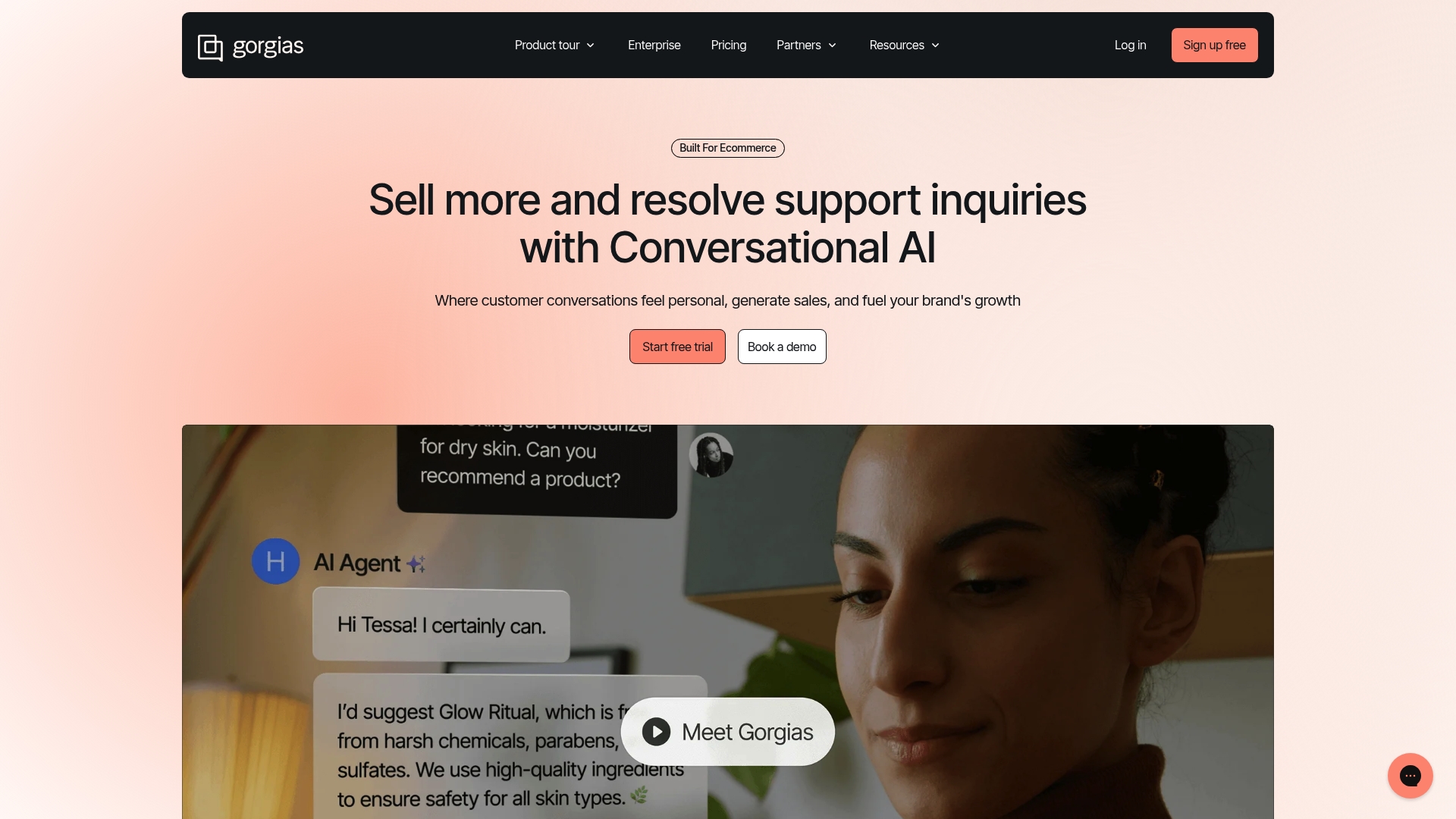
Gorgias is a known name in e-commerce helpdesks, now with a strong AI layer on top. Its AI Agent does two jobs at once: handle common support tickets and drive revenue. It can resolve up to 60% of support inquiries while spotting chances to recommend products or upsell mid-conversation.
Pros and cons
If you already run Gorgias or are considering it, this is a big plus. It turns support from a cost center into a revenue channel, and it has 100+ e-commerce integrations. The catch is the pricing model: you pay for the base helpdesk plan plus a fee per AI interaction, which can make the monthly bill harder to predict.
Pricing
- Helpdesk plans: from $50/month for 300 billable tickets.
- AI Agent interactions: about $0.90 per resolved conversation on most annual plans.
6. Rep AI
Description
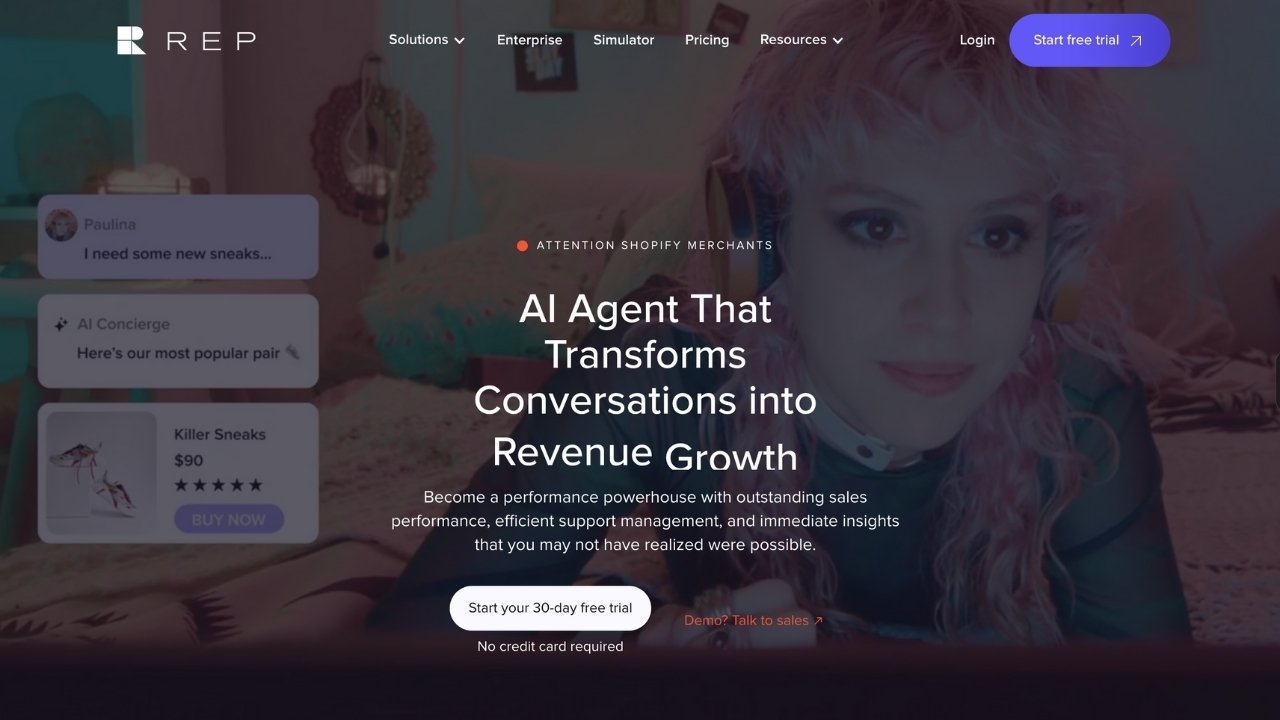
Rep AI is built for one thing: turning conversations into sales. It predicts what a visitor will do next and proactively starts a conversation with personalized recommendations. It is especially good at engaging shoppers about to leave or abandon a cart. Some customers report a 22% lift in conversion rate using it.
Pros and cons
Its strength is the relentless focus on revenue. It treats every interaction as a sales chance, which is great for conversion rate, and it gives deep analytics on why shoppers do not convert. The trade-off is that it leans toward pre-sale engagement and cart recovery, with less weight on post-sale support than the helpdesk-focused tools.
Pricing
Rep AI does not list pricing publicly. You contact sales for a custom quote, which usually means it is aimed at larger, higher-traffic stores rather than brands just starting out.
Key features to demand in an AI shopping assistant
When you compare tools, focus on these:
- Deep catalog integration: it must search your entire catalog in real time, including sizes, colors, and stock. An assistant that only knows your FAQ page is useless for shopping.
- Proactive engagement: the best ones start a conversation based on behavior, like a shopper stuck on one product page for two minutes.
- In-chat or in-call actions: let customers add to cart, apply a coupon, or check an order status without leaving the conversation, whether that is chat or a phone call.
- Omnichannel vs specialist: decide where your customers actually need help. One tool that is decent across chat, email, and social, or a couple of specialists, like one for on-site chat and one for the phone.
- Clean human handoff: when the AI hits its limit, it should pass the conversation to a person with full context, not make the customer repeat themselves.
Reading about these tools is one thing, seeing them work is another. The video below gives a visual rundown of how different AI shopping assistants affect conversion rates.
An overview of leading AI shopping assistants and their effect on Shopify conversion rates.
Which AI shopping assistant fits your store?
The "best" tool depends on where your store is bleeding. Match your situation to the pick:
- Your team is buried in phone calls about orders and returns: Ringly.io. It is the only assistant here that handles voice, resolves ~73% of calls, and if Seth resolves under 65% of calls in a month, you don't pay for that month.
- You are losing sales to cart abandonment: Rep AI for proactive on-site engagement and intent prediction.
- You want one platform for sales and support across channels: Alhena AI's agentic, all-in-one approach.
- You run on a helpdesk and want tickets to drive revenue: Gorgias AI.
- You want fast, self-serve setup trained on your own docs and tickets: eesel AI.
- You sell mostly through the Shop app: Shop.app for native discovery.
Cover the whole journey, not just half of it
After working through these tools, the clearest takeaway is that most of them cover one side of the journey well. If your goal is to lift sales before someone clicks buy, Rep AI shines. If you want to automate your helpdesk, Gorgias or eesel are strong.
But a complete AI strategy has to cover the customer after they pay, not only before. That is where the phone still matters. Most of these tools are great on-site chat, and none of them answer the channel customers reach for when something is urgent: the phone.
That is the gap Ringly.io's AI phone agent is built to fill. It gives customers instant, 24/7 help with orders and returns, resolves the bulk of calls on its own, and makes your support system complete rather than half-finished. For most stores, the strongest setup is a chat tool from this list paired with Ringly on the phone.
Personalization drives measurable results. Our 2026 ecommerce personalization statistics break down the ROI.
Frequently Asked Questions
What is the best AI shopping assistant for 2026?
It depends on the problem you are solving. For automated phone support, Ringly.io is the top pick: it resolves about 73% of inbound calls on its own, speaks 40+ languages, is trusted by 50+ Shopify brands, and you only pay once it resolves at least 65% of your calls. For on-site chat and product discovery, Alhena AI, Rep AI, Gorgias, eesel AI, and Shop.app each win in their lane.
How do I choose the right AI shopping assistant for my Shopify store?
Start with your biggest pain point. Losing sales to cart abandonment points to Rep AI. Swamped with phone calls about order status points to Ringly.io. Want tickets to drive revenue points to Gorgias. Match the tool's strength to where your store is actually leaking money or time, then check it integrates with your live Shopify catalog and order data.
Are these AI shopping assistants suitable for small businesses?
Yes. Several tools, like Alhena AI and eesel AI, have free or lower-priced tiers built for smaller shops. With Ringly.io, if Seth resolves under 65% of calls in a month, you don't pay for that month. That can help a brand watching its budget. Always check the current pricing before you commit.
Why include a phone tool like Ringly.io in an AI shopping assistant comparison?
Because the customer journey does not end at checkout. Web chat is great for sales, but many customers still pick up the phone for urgent post-purchase issues like returns and order tracking. Most assistants ignore that channel entirely. Including Ringly.io shows the importance of covering customers everywhere, not just on your website.
What is the biggest mistake stores make with AI shopping assistants?
Focusing only on the pre-sale experience. An AI that helps shoppers find products is great, but if the support after they pay is poor, you lose them anyway. A genuinely effective strategy covers the whole lifecycle, before and after the sale, which usually means pairing an on-site chat tool with a phone agent like Ringly.io.
Also Read
AI shopping assistant adoption and ROI (2026)
The shift to conversational shopping is backed by the numbers retailers are reporting:
- Shoppers who engage an AI assistant convert at roughly 3.5x the rate of those who don't (AWS)
- Over 300 million shoppers are expected to use AI assistants for buying decisions (AWS)
- AI-assisted shopping is projected to influence nearly $12 billion in sales (AWS)
The market for this software is forecast to keep climbing through the early 2030s (figure cited by Algolia). Sources publish different totals, so treat any single market-size number as directional.
AI shopping assistants: common questions
What is an AI shopping assistant?
It's a conversational tool, on a website, app, or phone line, that helps customers find products, compare options, answer questions, and complete a purchase, using AI to understand natural language rather than menus.
Do AI shopping assistants actually increase sales?
Reported results suggest yes: AWS data points to shoppers who use an AI assistant converting at around 3.5x the rate of those who don't. Results vary by store, catalog quality, and how well the assistant is set up.