

Nearly half of American consumers now use voice search when shopping online.
That's 128.4 million people talking to devices to find products, track orders, and get answers.
The voice commerce market reflects this shift.
Valued at $34.21 billion in 2023, it's projected to reach $286.87 billion by 2033 according to Spherical Insights.
That's a 23.7% compound annual growth rate.
This guide covers what ecommerce voice assistants actually do, the technology that powers them, real business impact with ROI numbers, and how to implement one for your store.
Voice assistants aren't just about smart speakers anymore.
They're handling customer phone calls, processing returns, and answering product questions around the clock.
Editor’s note: Want to hear some sample support calls made for your Shopify store?
- Just paste your store URL
- Get sample calls in under 20 seconds (no email required)
- Listen to demo calls for my store

What is an ecommerce voice assistant?
An ecommerce voice assistant is AI-powered software that uses speech recognition and natural language understanding to interact with customers through voice.
These interactions happen across smart speakers, phone calls, or mobile apps.
The technology has matured significantly. Modern voice assistants don't just recognize words.
They understand intent, context, and can take action on behalf of your customers.
Here's what these systems typically handle:
- Customer questions about products, orders, shipping policies, and return procedures
- Transaction processing including reorders, returns, and exchanges
- Order lookups for status, tracking numbers, and delivery estimates
- Call routing that transfers complex issues to human agents when needed
There are three main categories of ecommerce voice assistant to understand:
Smart speaker assistants like Amazon Alexa and Google Assistant enable shopping through Echo devices, Google Home, and similar hardware. Customers can add items to carts, reorder products, and check delivery times by speaking to their devices.
Phone-based voice assistants answer inbound customer calls automatically. These AI agents handle questions about orders, process returns, and escalate to humans only when necessary. Ringly.io is an example built specifically for Shopify stores.
In-app voice features add voice search and commands within ecommerce apps. Customers can search products by speaking or ask questions without typing.
How ecommerce voice assistants work: the technology explained
Voice assistants combine several technologies to turn spoken words into helpful actions.
Here's what happens in those two seconds between a customer speaking and getting an answer.
Speech recognition (ASR)
Automatic Speech Recognition converts spoken words into text.
Modern ASR systems handle accents, background noise, and natural speech patterns with high accuracy.
The speed advantage matters here. People speak at roughly 150 words per minute compared to typing at 40 words per minute.
That three-to-one speed difference makes voice interactions feel more natural and efficient.
Natural language understanding (NLU)
Once speech becomes text, NLU interprets what the customer actually wants.
This goes beyond matching keywords. The system identifies intent.
"Where's my order?" and "I need to track my package" are different phrases, but NLU recognizes they trigger the same action.
This flexibility lets customers speak naturally instead of using rigid command phrases.
Integration with store systems
Voice assistants connect directly to your business systems:
- Order management for tracking and status updates
- Inventory databases for product availability
- CRM and customer history for personalized responses
- Payment processors for transaction handling
This integration is what separates useful voice assistants from simple voice transcription. The AI can actually do things, not just listen.
Text-to-speech response
The final step generates natural-sounding voice responses. Modern TTS has improved dramatically. Responses sound conversational rather than robotic, which keeps customers engaged.
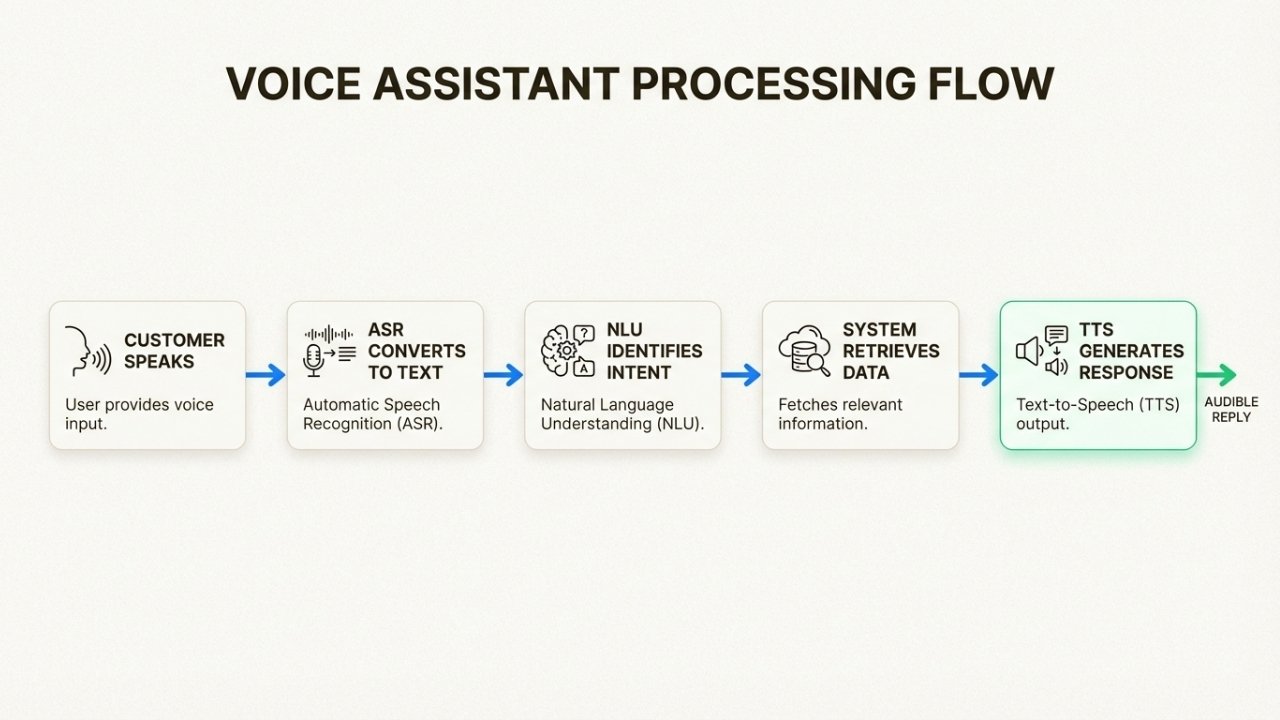
The entire process happens in under 2 seconds for most queries
Business benefits and real ROI numbers for ecommerce voice assistants
The business case for voice assistants comes down to measurable improvements in revenue, efficiency, and customer experience.
Revenue and efficiency gains
McKinsey data shows businesses with AI customer service see 10-15% increases in revenue alongside 10-20% reductions in customer service costs. Those percentages translate to significant dollars.
Real retail examples show even stronger results:
- Sephora reported a 35% increase in average order value with their voice assistant
- Kroger saw a 28% improvement in customer retention rates
- Best Buy achieved a 31% enhancement in product findability
Operational improvements
Voice assistants address fundamental operational challenges:
24/7 availability without proportional staffing costs. Your store never closes, and neither does your support line.
High resolution rates mean most calls never need human involvement. Ringly.io reports 73% of calls resolved without human intervention across Shopify stores.
Faster responses keep customers happy. Voice search loads 52% faster than traditional search according to Yaguara research.
Multilingual support across 40+ languages without hiring multilingual staff. Global stores can serve customers in their preferred language automatically.
Customer experience improvements
Customer satisfaction data supports voice commerce adoption. Approximately 80% of consumers who made voice purchases report satisfaction with the experience.
The convenience factor drives this satisfaction. Customers can shop while cooking, driving, or multitasking. They get from question to answer in fewer steps, with personalized recommendations based on their purchase history.
A simple ROI framework
If your store handles 1,000 support calls monthly at $8-12 per call, automating 70% saves $5,600-8,400/month in support costs alone. That's before accounting for increased availability, faster response times, and potential revenue lift from better customer experiences.
Top ecommerce voice assistant platforms
The right platform depends on whether you need phone support automation, smart speaker presence, or custom voice experiences.
1. Ringly.io
Ringly.io provides AI phone support built specifically for Shopify stores.
Their AI agent The AI handles inbound calls 24/7, answering questions, looking up orders, and processing returns automatically.
Key capabilities:
- Handles inbound calls around the clock
- Looks up orders, processes returns and exchanges automatically
- Escalates complex issues to human agents based on customizable rules
- Supports 30 languages for global customer service
- Achieves approximately 73% call resolution rate without human intervention
The platform stands out for speed. Setup takes roughly 3 minutes with native Shopify integration. No developer work required.
Pricing:
| Plan | Price | Minutes Included | Key Features |
|---|---|---|---|
| Grow | $349/mo | 1,000 | Self-learning AI, handles orders/returns, call insights, performance guarantee |
| Enterprise | Custom | 5,000+ | Custom integrations, dedicated Slack, enterprise setup, dedicated success manager |
Overage runs $0.19 per minute. A 14-day free trial includes full feature access.
Best for: Ecommerce stores wanting to automate phone support without building custom solutions or hiring developers.
2. Amazon Alexa for Business
Amazon Alexa dominates the smart speaker market with more than two-thirds of U.S. market share.
The Alexa Skills Kit lets brands build custom voice shopping experiences.
Key capabilities:
- Voice-activated shopping through Echo devices
- Alexa Skills Kit for custom brand experiences
- Voice Purchasing API for transactions
- Integration with Amazon marketplace
- Alexa Pay for seamless checkout
Development is free. Amazon takes 30% of in-skill purchases and subscriptions. AWS infrastructure costs apply but often fall within free tiers.
Best for: Brands selling on Amazon or wanting smart speaker presence among Echo device owners.
3. Google Assistant Actions
Google Actions enables voice commerce through the Google ecosystem. With over 2 billion Android devices, reach extends beyond smart speakers to phones, tablets, and cars.
Key capabilities:
- Voice shopping through Google Home and Android
- Transaction API for voice purchasing
- Integration with Google Shopping
- Location-based commerce with Google Maps integration
- Superior search capabilities compared to other platforms
Development is free with Google Cloud infrastructure costs for hosting.
Best for: Brands targeting Android users and wanting to leverage Google's search capabilities for product discovery.
4. Voiceflow
Voiceflow offers a no-code platform for building custom voice experiences. Unlike pre-built solutions, it lets teams design unique conversational flows without coding.
Key capabilities:
- Visual drag-and-drop conversation designer
- Multi-platform deployment to Alexa, Google, phone, and web simultaneously
- Pre-built ecommerce templates for common scenarios
- 1,000+ integrations through Zapier
- Real-time testing and analytics
Pricing starts with a free tier (1,000 conversations/month). Pro and Enterprise tiers scale based on volume and feature needs.
Best for: Teams wanting custom voice experiences across multiple platforms without developer resources.
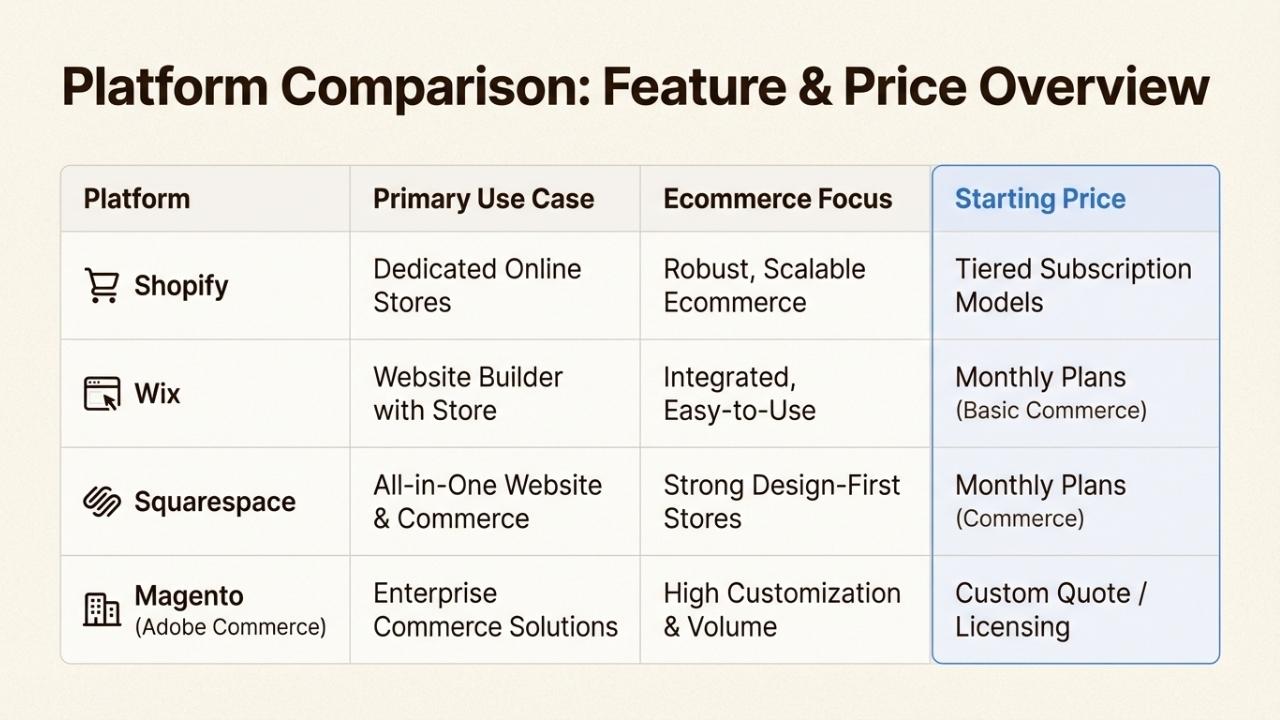
Phone-based assistants like Ringly.io offer the highest automation rates for direct customer support
Implementation guide: adding an ecommerce voice assistant to your store
Getting started with voice support follows a clear path. Here's a practical breakdown.
Step 1: Audit your current support volume
Start with data. How many calls do you receive monthly?
What questions come up most often? Common high-volume topics include order tracking, return policies, shipping timeframes, and product availability.
These are exactly the queries voice assistants handle well. Estimate what percentage could be automated versus what genuinely needs human judgment.
Step 2: Prepare your data
Voice assistants are only as good as the information they can access. Your product catalog needs to be clean and consistent.
Order data must be accessible in real-time. Document your FAQs and policies clearly.
Map common customer questions to specific answers. This knowledge base becomes the AI's brain.
Step 3: Choose your platform approach
Your choice depends on where customers interact with you:
Phone support automation through platforms like Ringly.io offers the fastest path for stores with high call volume. Most stores go live within an hour, not months.
Smart speaker presence through Alexa Skills or Google Actions makes sense for brand reach and voice commerce. This requires more development effort but reaches customers in their homes.
Custom voice assistants through Voiceflow work for unique requirements or multi-channel strategies. More flexible but requires conversational design expertise.
Step 4: Configure and train
Upload your knowledge base including FAQs, policies, and product information. Set escalation rules that define when calls transfer to humans.
Define your brand voice and tone. Test with real scenarios before going live.
Run through common questions and edge cases to identify gaps.
Step 5: Monitor and optimize
Track resolution rates and identify where the AI struggles. Review escalated calls to understand what training improvements are needed.
Measure customer satisfaction to ensure quality stays high. For Shopify stores specifically, tools like Ringly.io can be set up in minutes with native integration.
Challenges and how to address them
Voice assistants have real limitations worth understanding before implementation.
Speech recognition accuracy
Challenge: Accents, dialects, and background noise can cause misunderstandings. A customer in a noisy environment or with a strong regional accent may not be understood correctly.
Solution: Modern ASR has improved dramatically, but choose platforms with demonstrated accuracy. Allow customers to confirm critical information like order numbers or spelling.
Security and fraud concerns
Challenge: Voice-based fraud is growing. Deepfake-enabled fraud exceeded $200 million in Q1 2025.
Voice authentication can be spoofed by sophisticated actors. Solution: Multi-factor authentication for high-value transactions adds protection.
Voice biometrics help too. HSBC prevented 249 million pounds in fraud using voice authentication.
Customer adoption hesitation
Challenge: Some customers prefer human interaction. They may be skeptical of AI or frustrated by past experiences with clunky phone trees.
Solution: Always offer escalation to human agents. Position voice as a faster option rather than a replacement for human support.
Getting started with voice support for your store
Voice commerce is growing at 23.7% annually through 2033. The technology has matured past early-adopter phase into mainstream adoption.
Phone-based voice assistants offer the fastest ROI for customer support. They address a real operational problem with a measurable solution.
Implementation can happen quickly with the right platform. Ringly.io's the AI can be set up in minutes for Shopify stores, not months of custom development.
The ROI math is straightforward. If you handle hundreds of support calls monthly and can automate most of them, the cost savings cover subscription fees many times over.
Add in 24/7 availability and faster response times, and the case builds itself. The technology is mature, the ROI is proven, and the question isn't whether to adopt voice support but how soon you can start.
Start a free trial to see how an ecommerce voice assistant handles your customer calls.
Frequently Asked Questions
What does an ecommerce voice assistant do?
An ecommerce voice assistant handles customer interactions through spoken conversation. It answers product questions, tracks orders, processes returns and exchanges, and routes complex issues to human agents when needed. Phone-based voice assistants automate inbound calls, while smart speaker assistants enable shopping through devices like Amazon Echo.
How much does an ecommerce voice assistant cost?
Costs vary by platform type. Phone-based automation like Ringly.io starts at $349/month for 1,000 minutes. Smart speaker development through Alexa or Google is free to build, with revenue sharing on sales. Custom voice assistant builders like Voiceflow offer free tiers scaling to enterprise pricing based on conversation volume.
Can an ecommerce voice assistant handle returns?
Yes, most ecommerce voice assistants can process returns automatically. Phone-based solutions like Ringly.io connect directly to your order management system to initiate return requests, generate labels, and confirm exchange details without human involvement.
What's the ROI of an ecommerce voice assistant?
Businesses report 10-15% revenue increases and 10-20% customer service cost reductions according to McKinsey data. Phone support automation resolves 70-73% of calls without humans. For a store handling 1,000 calls monthly at $8-12 per call, automating 70% saves $5,600-8,400 per month.
Which ecommerce voice assistant platform is best for Shopify?
Ringly.io is built specifically for Shopify with native integration. Setup takes about 3 minutes and the AI automatically learns from your store data. It handles order lookups, returns, and common questions with 73% resolution rates without human intervention.
How long does it take to set up an ecommerce voice assistant?
Implementation time varies dramatically by platform. Shopify-native solutions like Ringly.io take roughly 3 minutes to deploy. Custom Alexa Skills or Google Actions require weeks of development. No-code builders like Voiceflow fall somewhere in between depending on conversation complexity.
Can an ecommerce voice assistant work in multiple languages?
Yes, most modern voice assistants support multiple languages. Ringly.io offers 40+ languages, Alexa and Google support 20+ languages each. This enables global stores to serve customers in their preferred language without hiring multilingual staff.