


Your marketing is working. Customers are visiting your store, adding items to their carts, and reaching out with questions before they buy.
But here's the problem: sales reps spend only 28% of their week actually selling, according to Salesforce.
The rest goes to admin work, follow-ups, and handling questions that could be resolved automatically.
That gap between customer interest and closed sales is where inbound sales support comes in.
This guide covers what it means for ecommerce, which channels matter most, and how modern AI phone agents are changing the economics of customer support entirely.
Editor’s note: Want to hear some sample support calls made for your Shopify store?
- Just paste your store URL
- Get sample calls in under 20 seconds (no email required)
- Listen to demo calls for my store

What is inbound sales support for ecommerce?
Inbound sales support covers two related things. First, it includes the resources and systems that help your sales team convert leads, from scripts and training to product knowledge and CRM tools.
Second, it means the support services that handle customer inquiries during the buying journey.
The key distinction from outbound sales is simple: with inbound, customers reach out first.
They find you through search, social media, referrals, or your marketing. This self-selection makes inbound leads higher quality since they already have interest and intent.
For ecommerce specifically, inbound support handles the questions that come before and during a purchase.
Where is my order? Can I return this? Does this product work with X? What are your shipping times?
These interactions directly impact whether someone completes a purchase or abandons their cart.
When customers have to wait for answers, or worse, never get them, they leave.
But when support is fast, helpful, and available around the clock, conversion rates go up and cart abandonment drops.
Why inbound sales support matters for online stores
Cost savings
Running a proper support operation gets expensive fast. A traditional 10-agent call center costs around $450,000 per year when you factor in salaries, benefits, office space, and equipment.
Agent salaries alone run $35,000 to $45,000, and benefits add another 30% on top.
Automated systems cut that dramatically. The same volume handled through AI and automation can cost around $36,000 per year, a 70% reduction.
The math is straightforward: automation handles routine inquiries at $0.10 to $0.50 per contact, while human agents cost $5 to $15 per contact.
Better customer experience
Support quality directly affects customer retention.
According to PwC, 37% of consumers leave a brand after just one negative experience.
Quick, helpful responses during the buying process prevent that.
When someone has a question about sizing, shipping, or returns, getting an answer in seconds rather than hours can be the difference between a sale and a lost customer.
Higher conversion rates
The Logical Position case study from LiveChat shows what happens when support is done right.
After implementing live chat support, they saw a 150% increase in inbound leads and 30-40% growth in sales.
Harvard Business Review research adds another data point: companies with formal sales processes generate 18% more revenue than those without.
Structure and responsiveness pay off.
Key channels and tools for ecommerce sales support
Phone support and AI voice agents
Phone support remains critical for high-consideration purchases. When someone is about to spend significant money, they often want to talk to someone rather than type in a chat box.
Traditional phone support meant hiring agents, training them for weeks, and dealing with 30-45% annual turnover rates. That's changing with conversational AI voice agents.
Modern AI phone agents like the AI agent from Ringly.io handle inbound calls automatically.
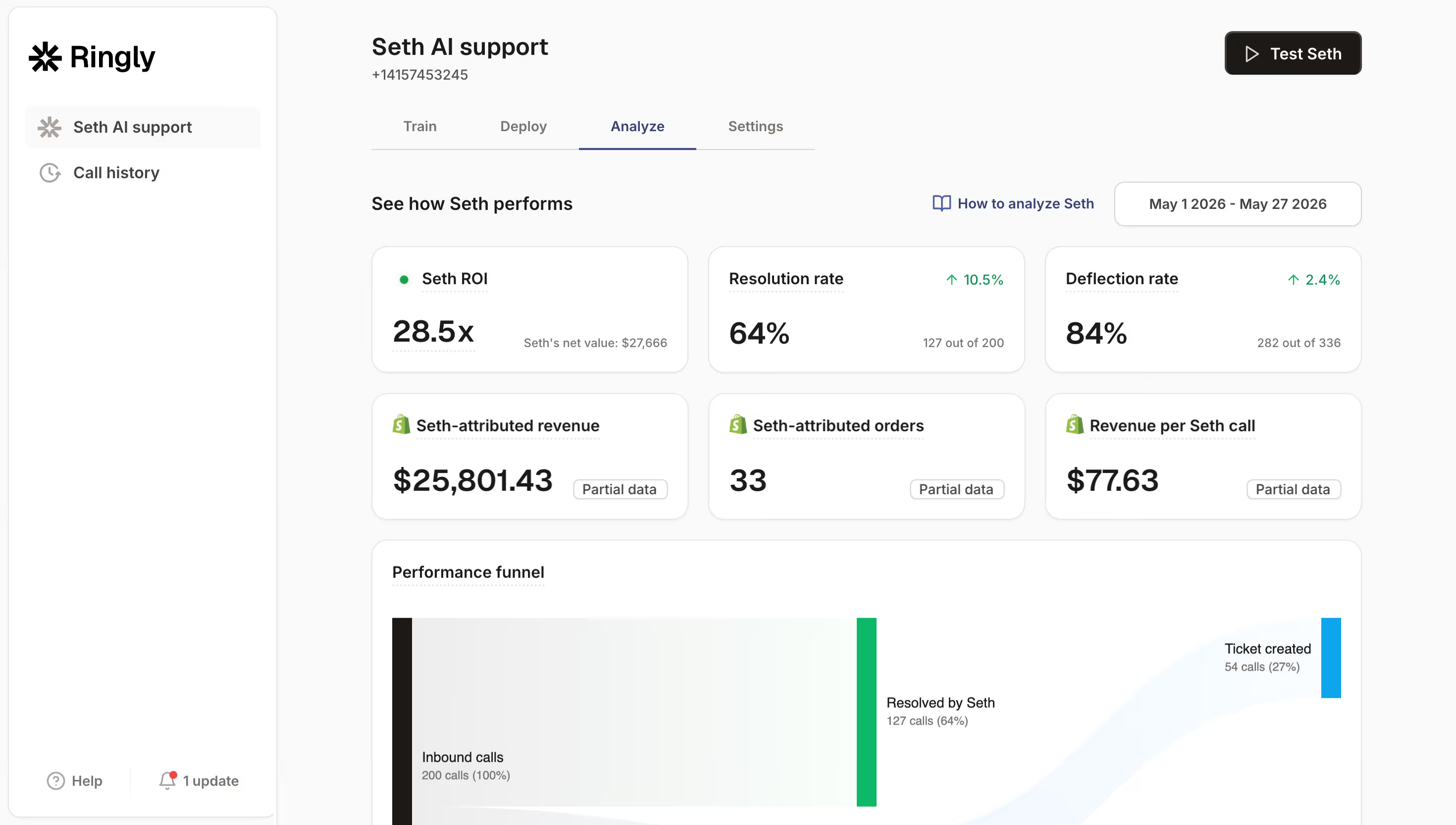
The AI resolves 73% of calls without human intervention, answering questions, looking up orders directly from Shopify, processing returns, and only escalating when genuinely needed. It works 24/7 across 40+ languages with no scheduling or overtime costs.
This isn't the robotic IVR menu pressing from the past. Conversational AI actually understands what callers are asking and responds naturally.
Live chat
Real-time website chat handles pre-purchase questions as customers browse. Someone looking at a product page can ask about compatibility, sizing, or availability without leaving the site.
LiveChat serves 35,000+ companies with chat widgets, social messaging integration, and AI-powered features. Chat works well for quick questions where customers are actively browsing.
Email support
Email handles detailed inquiries, documentation requests, and follow-up sequences.
It's less immediate than phone or chat but important for complex questions that need written records.
Order confirmations, shipping updates, and return instructions all flow through email.
Automation handles most transactional emails while human agents manage the exceptions.
SMS and social media
SMS works for order updates and quick notifications.
Social media handles public-facing support where other customers can see your responsiveness.
Both are secondary channels for most ecommerce operations but worth covering.

In-house vs outsourcing vs hybrid: Choosing your model
Building an in-house team
In-house support gives you full control. Your team knows your brand, products, and customers deeply.
They can handle complex situations with judgment and build institutional knowledge over time.
The challenges are real though. Hiring costs run $35,000 to $45,000 per agent plus 30% for benefits.
Training takes 2-4 weeks before new agents are productive. And annual turnover rates of 30-45% mean you're constantly backfilling.
For 24/7 coverage, you need three shifts minimum. For holiday peaks, you need temporary staff who take weeks to train.
The fixed costs are high regardless of call volume.
Outsourcing to a call center
Outsourced call centers like Helpware offer 24/7 coverage without hiring overhead.
They provide flexible scaling for peak seasons and handle multiple languages across global locations.
Helpware reports 90% CSAT scores and 2.8% monthly attrition rates, well below the industry average.
Other providers like Speed Commerce and Hit Rate Solutions serve similar markets with 11-second average response times.
The trade-offs include less direct control, potential brand voice inconsistency, and ongoing vendor management.
Pricing typically runs per-agent, per-call, or custom quotes based on volume.
The hybrid approach
The modern best practice combines automation and humans. AI and automation handle 60-80% of routine inquiries at $0.10 to $0.50 per contact. Human agents focus on complex cases at $5 to $15 per contact.
This is where AI phone agents fit naturally. Instead of outsourcing everything or building a large team, ecommerce stores can deploy AI to handle repetitive calls (order status, tracking, simple returns) while keeping a small in-house team for escalations.
For Shopify stores, Ringly.io provides this hybrid capability out of the box.
The AI handles routine calls automatically while escalating complex issues to your team. Most stores go live within an hour, not months. No hiring, no training, no managing seasonal fluctuations.
The 80% cost reduction compared to traditional call centers comes from eliminating the bulk of human handling time while maintaining quality for cases that genuinely need human judgment.

Implementation best practices
Phase 1: Foundation building
Start by mapping your current support process. Document every call type you receive: order status, returns, shipping questions, product inquiries, complaints.
Track how many of each type you handle daily and weekly.
Identify the repetitive questions. Chances are 60-80% of your calls are variations of the same 5-10 questions.
These are your automation candidates.
Calculate your baseline metrics: average handle time, cost per contact, resolution rate, customer satisfaction.
You need these numbers to measure improvement later.
Build a comprehensive knowledge base with product information, shipping policies, return procedures, and FAQs.
This becomes the foundation for any AI system you deploy.
Phase 2: Launch your support system
Deploy your chosen solution, whether that's AI agents, chat, an outsourced team, or some combination.
Start with your highest-volume, most repetitive inquiries first.
Monitor performance closely in the first 30 days. Track resolution rates, escalation rates, customer satisfaction, and any edge cases the system mishandles.
Maintain easy escalation paths to human agents for anything complex.
Communicate changes to customers where appropriate.
If you're adding phone support hours or new channels, let them know.
Phase 3: Scale and optimize
Add advanced capabilities based on what the data shows. If certain call types have low resolution rates, improve the knowledge base or training.
If customers frequently ask questions you don't cover, add that content.
Expand self-service options over time. Chatbots, video tutorials, and comprehensive FAQ pages reduce support volume by letting customers help themselves.
Implementation timelines from PreCallAI research suggest basic systems take 1-2 weeks, advanced AI takes 4-8 weeks, and full optimization takes 3-6 months. Plan accordingly.
Metrics to track for sales support success
Conversion and revenue metrics
Track these to understand business impact:
- Conversion rate: What percentage of leads become customers after support interaction?
- Average order value: Are support interactions leading to upsells or cross-sells?
- Sales revenue per call: How much revenue does each support call generate or protect?
- Cart abandonment recovery rate: How many abandoned carts does support recover?
Customer satisfaction metrics
Track these to understand experience quality:
- CSAT: Post-interaction satisfaction ratings (target: 85%+)
- NPS: Net Promoter Score for overall brand sentiment
- First call resolution rate: Higher is better; aim for 70%+ on routine inquiries
Operational efficiency metrics
Track these to understand costs and capacity:
| Metric | Benchmark | Source |
|---|---|---|
| Cost per contact (automation) | $0.10 - $0.50 | PreCallAI / Industry Standard |
| Cost per contact (human) | $5.00 - $15.00 | PreCallAI / Converso (2025) |
| Average speed to answer | Under 20 seconds (80/20 Rule) | Hit Rate Solutions / Talkdesk |
| Abandoned call rate | Under 5% | VCC Live / Industry Standard |
| AI resolution rate | 60% - 80% (Avg. 73%) | Ringly.io (2026 Shopify Data) |
Start with 3-5 core metrics rather than tracking everything. Focus on what directly ties to revenue and customer retention.
You can expand measurement later as your operation matures.

Getting started with AI-powered ecommerce inbound sales support
AI phone agents represent the next evolution in ecommerce support.
Unlike traditional IVR systems with their frustrating menu trees, or basic chatbots that fail on anything complex, modern AI voice agents handle real conversations.
Ringly.io built the AI specifically for ecommerce. Here's what it does:
- Answers calls 24/7 in 40+ languages without staffing constraints
- Looks up order status directly from Shopify in real time
- Handles returns and exchanges automatically using your policies
- Escalates to human agents only when genuinely needed
- Provides full call recordings and analytics for continuous improvement
For ecommerce stores handling significant call volume, this eliminates the outsource-vs-in-house dilemma.
You get the cost efficiency of automation (80% reduction compared to traditional call centers) with the quality control of keeping support in-house.
The pricing model reflects this. With Ringly.io, get your last 3 months refunded if Seth resolves under 65% of calls in 90 days.
Performance-backed, risk-reduced. After that, plans start at $349/month for 1,000 minutes.
Most stores go live within an hour, not weeks. No hiring, no training, no managing seasonal staff fluctuations.
Connect your Shopify store, configure your policies, and the AI starts answering calls.
For stores still debating between building an in-house team, outsourcing to a call center, or some hybrid approach, AI phone agents offer a fourth option that combines the best of each.
Start a free trial to see how The AI handles your inbound calls.
Frequently Asked Questions
What is ecommerce inbound sales support?
Ecommerce inbound sales support includes all the resources, systems, and services that help online stores handle customer inquiries during the buying journey. This covers answering product questions, providing order updates, processing returns, and guiding customers through purchase decisions. Unlike outbound sales where you contact customers, inbound support responds when customers reach out first.
How much does ecommerce inbound sales support cost?
Traditional call center support costs $5-15 per contact with human agents, while AI-powered automation costs $0.10-0.50 per contact. A 10-agent in-house team runs approximately $450,000 per year including salaries, benefits, and overhead. Automated systems handling the same volume cost around $36,000 per year, representing a 70-80% cost reduction.
What channels should ecommerce inbound sales support cover?
The four primary channels are phone support for complex or high-value purchases, live chat for real-time website questions, email for detailed follow-ups and documentation, and social media for public inquiries. Most stores prioritize phone and chat for pre-purchase support since these have the most direct impact on conversion.
Can AI handle ecommerce inbound sales support effectively?
Yes. Modern AI phone agents resolve 70-73% of typical ecommerce calls without human intervention. They handle order status inquiries, returns processing, shipping questions, and product information automatically. The remaining 27-30% of complex cases escalate to human agents. This hybrid approach reduces costs while maintaining quality.
Should I outsource ecommerce inbound sales support or build in-house?
It depends on volume, budget, and control requirements. In-house teams offer full control but high fixed costs. Outsourcing provides flexibility but less brand alignment. The hybrid approach using AI for routine calls plus a small internal team for escalations often provides the best balance of cost, quality, and control.
How long does it take to implement ecommerce inbound sales support systems?
Basic systems deploy in 1-2 weeks. Advanced AI phone agents take 4-8 weeks for full optimization. Building an in-house team requires 2-4 weeks for hiring plus 2-4 weeks for training per agent. AI solutions like Ringly.io can be set up in minutes since they connect directly to your Shopify store.
What metrics matter most for ecommerce inbound sales support?
Focus on conversion rate, customer satisfaction (CSAT), cost per contact, first call resolution rate, and cart abandonment recovery. These metrics directly tie to revenue and retention. Start with 3-5 core metrics and expand measurement as your operation matures.