
Rep AI has built a solid reputation as an AI concierge for e-commerce stores. It handles guided selling, product recommendations, and chat-based support.
But it's not the only option, and depending on your needs, it might not even be the best fit.
I spent time with seven alternatives to see how they stack up. Some excel at chat automation. Others focus on enterprise scale.
One does something none of the others offer: AI phone support.
Here's what I found.
Editor’s note: Want to hear some sample AI support calls made for your Shopify store?
- Just paste your store URL
- Get sample calls in under 20 seconds (no email required)
- Listen to demo calls for my store

What is Rep AI and why look for alternatives?
Rep AI (also known as HelloRep) is an AI-powered concierge for e-commerce.
It engages shoppers on your site, answers questions, recommends products, and helps with common support tasks.
The goal is to reduce your team's workload while keeping customers happy.
So why do stores look elsewhere?
Pricing is a common concern. Rep AI uses visitor-based pricing, which can get expensive if you have high traffic but low conversion.
Feature gaps matter too. Some businesses need deeper Shopify integration, better post-purchase support, or more control over the AI's responses.
But the biggest gap I noticed: Rep AI, like most alternatives, is chat-only. If your customers prefer calling, you're out of luck.
Let's break down what to look for in an alternative.
How I evaluated these Rep AI alternatives
I tested each tool against five criteria that matter for e-commerce support:
- Ease of setup: How quickly can you get the AI handling real conversations?
- Shopify integration: Does it pull order data, handle returns, and sync with your store?
- AI sophistication: Can it actually resolve issues, or just deflect them?
- Pricing transparency: Are costs predictable, or do they balloon at scale?
- Support quality: Does the AI handle pre-sale questions, post-purchase issues, or both?
I focused on real e-commerce use cases: answering "where's my order," handling returns, recommending products, and escalating when needed.
The 7 best Rep AI alternatives compared
Here's the quick comparison before we dive into each option:
| Tool | Best For | Starting Price | Key Feature | Support Channels |
|---|---|---|---|---|
| Tidio | Small Shopify stores | $0 (14-day free trial) | Lyro AI chatbot | Chat, email |
| Zendesk | Enterprise | $19/agent/mo | AI agents + ticketing | Chat, email, phone, social |
| Intercom | Growing teams | $29/seat/mo | Fin AI at $0.99/resolution | Chat, email, WhatsApp |
| Gorgias | Shopify merchants | $10/mo | E-commerce automations | Chat, email, social |
| Freshdesk | Budget-conscious | $0 (14-day free trial) | Freddy AI add-on | Chat, email, phone |
| Kodif | End-to-end automation | Custom | AI that takes actions | Chat, email |
| Ringly.io | Phone support needs | $349/month | AI phone agent (Seth) | Phone only |
1. Tidio

Tidio is a live chat and chatbot platform popular with Shopify stores.
It's designed for businesses that want to automate common questions without a complex setup.
The standout feature is Lyro AI, their AI chatbot powered by Anthropic's Claude.
Lyro can solve up to 67% of customer problems automatically according to Tidio's data. It handles FAQs, order tracking, and basic troubleshooting.
Setup is straightforward. You can have Lyro running on your site in under an hour.
The 14-day free trial includes 50 AI conversations, which is enough to test whether it works for your store.
Pricing: Free plan available. Paid plans start at $29/month. Lyro AI add-on starts at $32.50/month for 50 conversations.
Pros:
- Easy setup with no technical expertise needed
- Affordable entry point with a free tier
- Good Shopify integration for order lookups
Cons:
- AI capabilities are more limited than enterprise tools
- Costs can add up at scale (per-conversation pricing)
- Primarily focused on chat, no phone support
Best for: Small to medium Shopify stores wanting simple, affordable chat automation.
2. Zendesk

Zendesk is the heavyweight in customer service software.
If you're running a large e-commerce operation with hundreds of agents, you've probably already considered it.
The platform includes AI agents that can handle routine inquiries across email, chat, and social media.
The Suite Team plan at $55 per agent per month (annual) gets you messaging, live chat, phone support, and basic AI features.
Where Zendesk shines is scalability. It handles complex workflows, custom integrations, and massive ticket volumes.
Companies like Uber and Siemens use it for a reason.
But that power comes with complexity. Setup requires dedicated resources, and the learning curve is steep. For smaller stores, it's overkill.
Pricing: From $19/agent/month (Support Team) to $169/agent/month (Suite Enterprise). Add-ons like Advanced AI Agents and Copilot cost extra.
Pros:
- Comprehensive feature set for complex operations
- 1,000+ integrations through the marketplace
- Handles any scale of support volume
Cons:
- Complex setup and steep learning curve
- Expensive for small teams
- Per-agent pricing adds up quickly
Best for: Larger e-commerce businesses with high support volumes and dedicated support teams.
3. Intercom
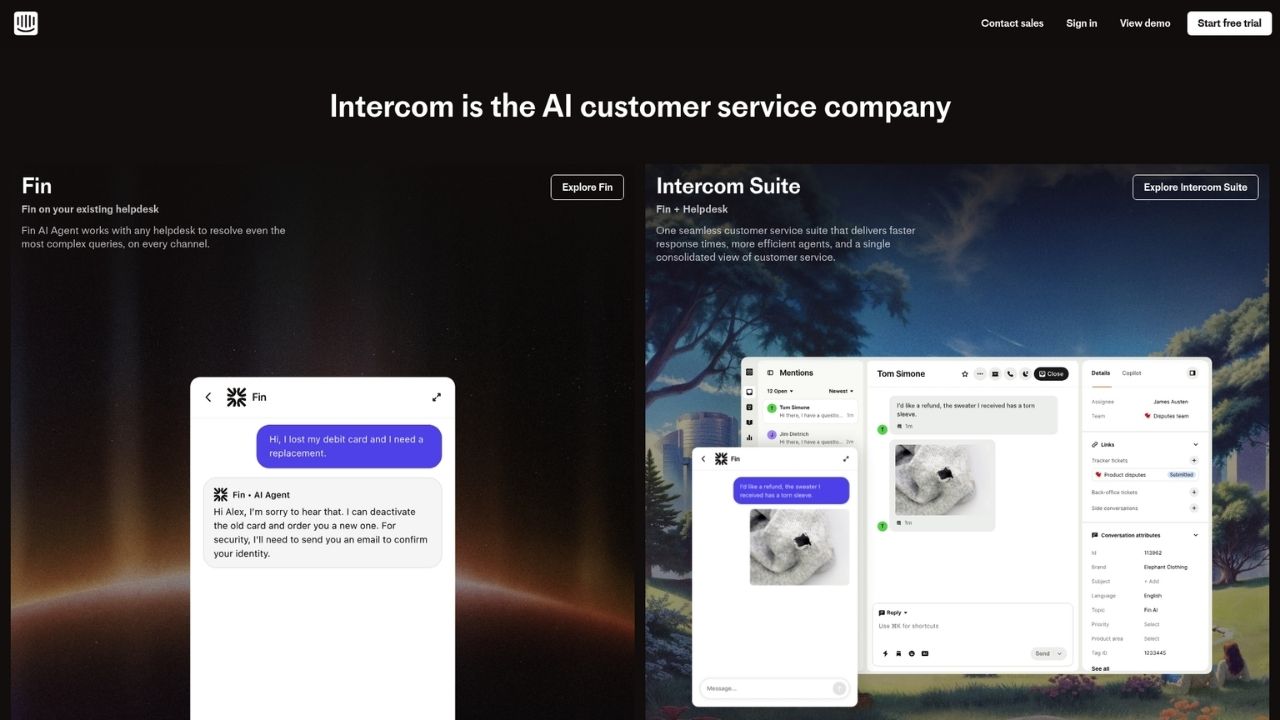
Intercom positions itself as "the AI customer service company."
Their flagship product is Fin AI Agent, which they claim is the highest-performing AI agent for customer service.
Fin costs $0.99 per resolution, meaning you only pay when the AI actually solves a customer's problem.
This is different from per-seat or per-ticket pricing. If Fin can't resolve an issue, you don't pay for that interaction.
The platform also includes proactive messaging, product tours, and a shared inbox.
The interface is clean and modern, which matters when your team spends hours in it daily.
Pricing: Essential plan starts at $29 per seat per month (annual) plus $0.99 per Fin resolution. Advanced features require higher tiers at $85 or $132 per seat.
Pros:
- Beautiful, intuitive interface
- Resolution-based pricing aligns costs with value
- Strong proactive engagement tools
Cons:
- Expensive at scale with per-seat plus per-resolution costs
- Limited phone support capabilities
- Pricing jumps significantly between tiers
Best for: Mid-market businesses focused on customer engagement and willing to pay for quality AI.
4. Gorgias

Gorgias is built specifically for e-commerce, and it shows.
The platform integrates deeply with Shopify, pulling order data, tracking info, and customer history directly into the support interface.
Their AI Agent handles returns, refunds, order edits, and product recommendations. It can even generate dynamic discount codes to save sales.
Pricing is based on ticket volume, not seats, which can save money for teams that handle high volumes.
The Starter plan is just $10 per month for 50 tickets, making it accessible for small stores.
The Pro plan at $300 per month includes 2,000 tickets and 600 AI interactions.
Pricing: From $10/month (Starter, 50 tickets) to custom Enterprise pricing. AI Agent interactions cost $0.90 each on annual plans.
Pros:
- Built for e-commerce with deep Shopify integration
- Ticket-based pricing can be cost-effective
- Revenue statistics show support-driven sales
Cons:
- Limited to e-commerce use cases
- Can get pricey with high ticket volumes
- AI Agent not available on Starter plan
Best for: Shopify merchants wanting e-commerce-specific features and ticket-based pricing.
5. Freshdesk

Freshdesk by Freshworks offers a solid entry point for budget-conscious businesses.
The free plan supports up to 2 agents for 6 months, which is generous enough to test the platform thoroughly.
Freddy AI is their AI add-on. It includes an email AI agent, AI copilot for agents, and AI-powered insights.
Pro and Enterprise plans include 500 free AI sessions, after which you pay $49 per 100 sessions.
The platform covers all the basics: ticketing, knowledge base, automation, and reporting.
It's less e-commerce focused than Gorgias but integrates with Shopify and other platforms.
Pricing: Free tier available. Paid plans from $15/agent/month (Growth) to $89/agent/month (Enterprise).
Pros:
- Generous free tier for small teams
- Affordable AI add-on pricing
- Easy to use with minimal training
Cons:
- Less e-commerce focused than alternatives
- AI capabilities more limited than premium tools
- Per-agent pricing structure
Best for: Budget-conscious businesses needing solid basics without enterprise complexity.
6. Kodif
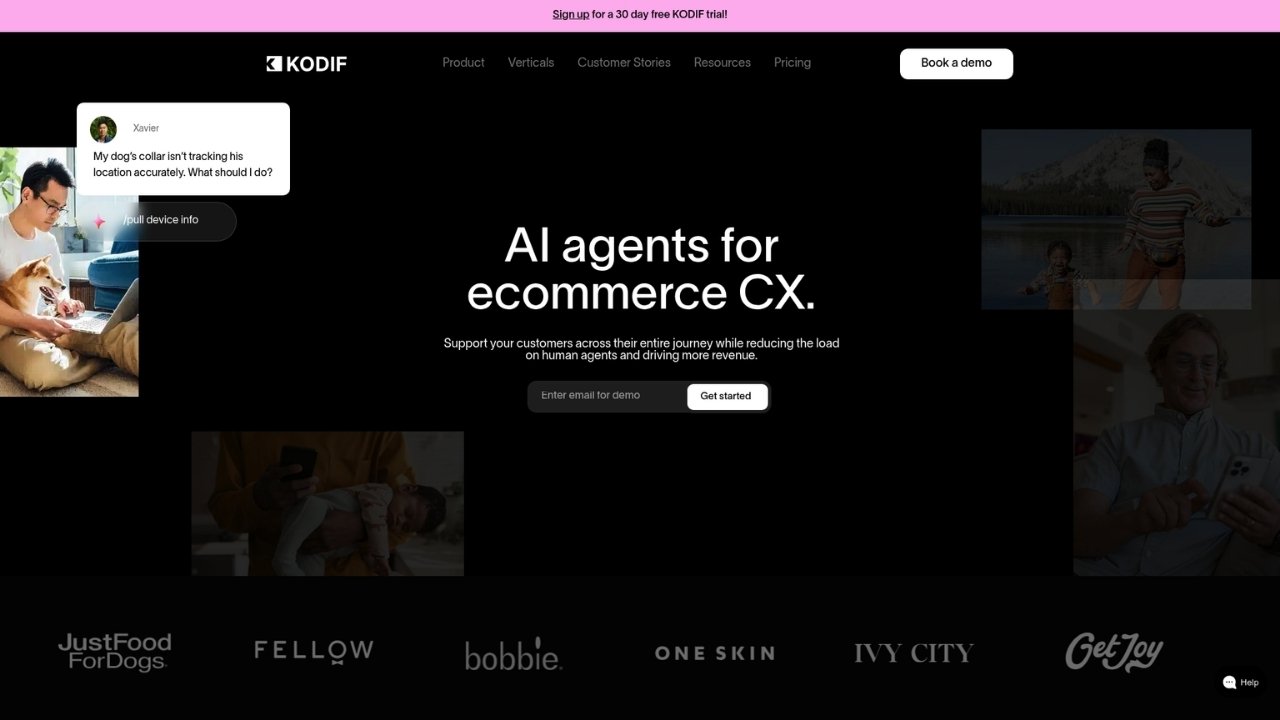
Kodif takes a different approach. Instead of just answering questions, their AI takes actions.
It can process refunds, update subscriptions, and handle returns without human intervention.
The platform uses an "AI workforce" concept with specialized agents for different tasks.
There's a no-code workflow builder, so non-technical teams can create automated experiences.
Kodif focuses on the full customer journey, from pre-sale questions to post-purchase support.
They work with brands like Dollar Shave Club and JustFoodForDogs.
Pricing: Custom pricing based on business needs. Contact sales for quotes.
Pros:
- AI that takes real actions, not just chats
- No-code builder for custom workflows
- Handles pre and post-purchase automation
Cons:
- No transparent pricing
- Enterprise focus may be overkill for small stores
- Newer player with less market presence
Best for: Brands wanting end-to-end automation where AI actually performs tasks, not just answers questions.
7. Ringly.io

Here's where things get interesting. Every alternative I've covered so far is chat-based. Ringly.io is the only option for AI phone support.
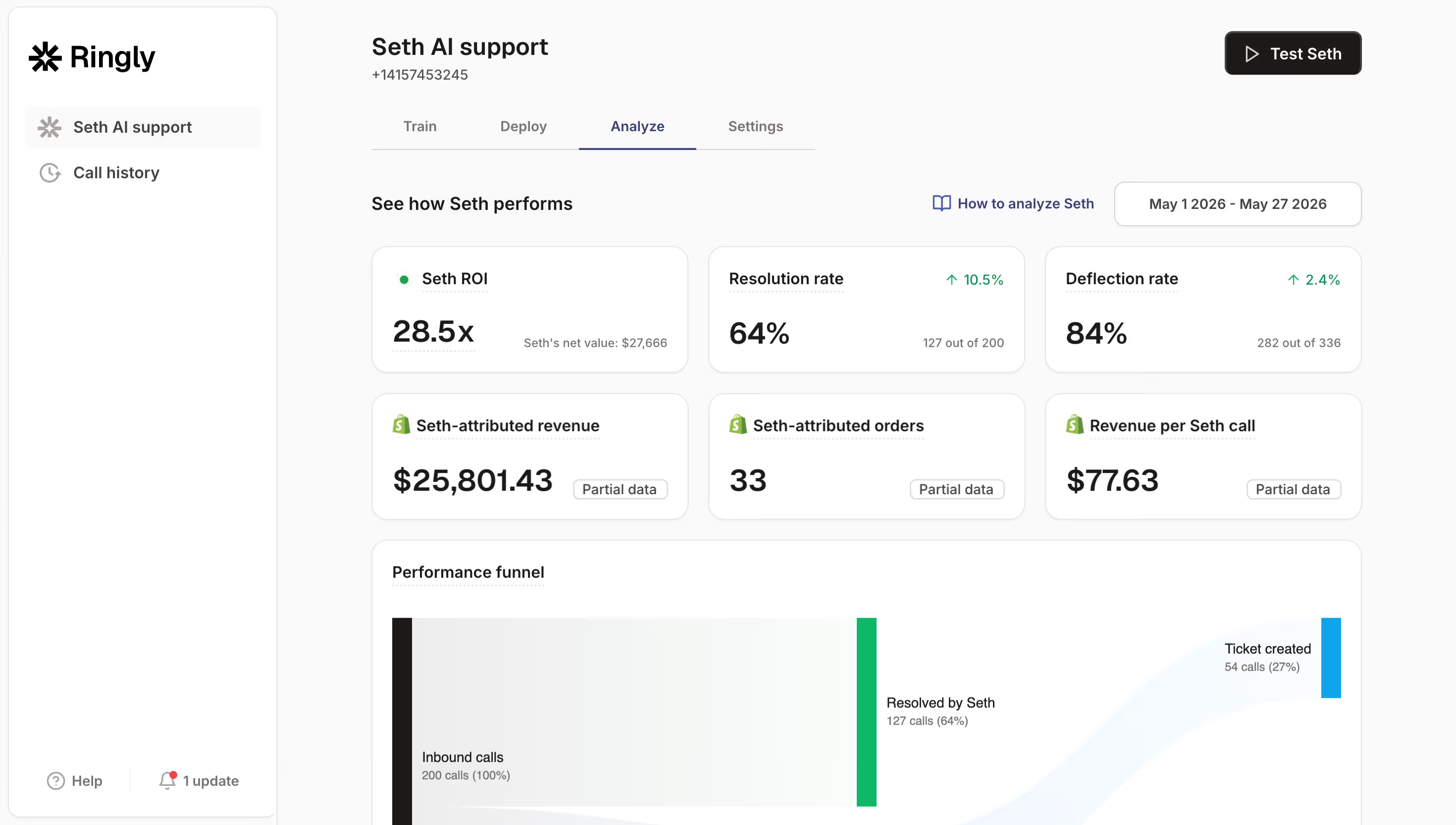
Their AI agent, the AI, answers incoming calls 24/7. It can look up orders, handle returns and exchanges, answer FAQs, and escalate to your team when needed.
According to Ringly.io, The AI resolves approximately 73% of calls without human intervention.
Setup takes about 3 minutes. You connect your Shopify store, choose a phone number (or port your existing one), and the AI starts handling calls.
It supports 30 languages, which is useful if you sell internationally.
The key insight: not every customer wants to chat. Some prefer calling, especially for complex issues or high-value orders.
If you're only offering chat, you're forcing those customers into a channel they don't prefer.
Pricing: Grow plan at $349/month for 1,000 minutes. Grow plan at $349/month for 1,000 minutes. Enterprise plan (custom pricing for 5,000+ minutes)nth for 3,000+ minutes.
Overage is $0.19 per minute.
Pros:
- Only AI phone support option for Shopify stores
- Resolves ~73% of calls without human help
- quick setup with no technical expertise needed
- 30 languages supported
Cons:
- Phone-focused (not a chat solution)
- Best for stores with existing call volume
- Per-minute pricing requires monitoring usage
Best for: Shopify stores that want to automate phone support, not just chat.
Feature comparison: What each Rep AI alternative does best
Here's a detailed breakdown of how these tools compare across key dimensions:
| Feature | Tidio | Zendesk | Intercom | Gorgias | Freshdesk | Kodif | Ringly.io |
|---|---|---|---|---|---|---|---|
| AI sophistication | Good | Excellent | Excellent | Good | Good | Excellent | Good |
| Shopify integration | Good | Good | Good | Excellent | Good | Excellent | Excellent |
| Setup ease | Excellent | Fair | Good | Good | Excellent | Good | Excellent |
| Pricing transparency | Excellent | Good | Good | Excellent | Excellent | Poor | Excellent |
| Support channels | Chat | All | Chat/Social | Chat/Social | All | Chat | Phone |
| Multilingual | Yes | Yes | Yes | Yes | Yes | Yes | 40 languages |
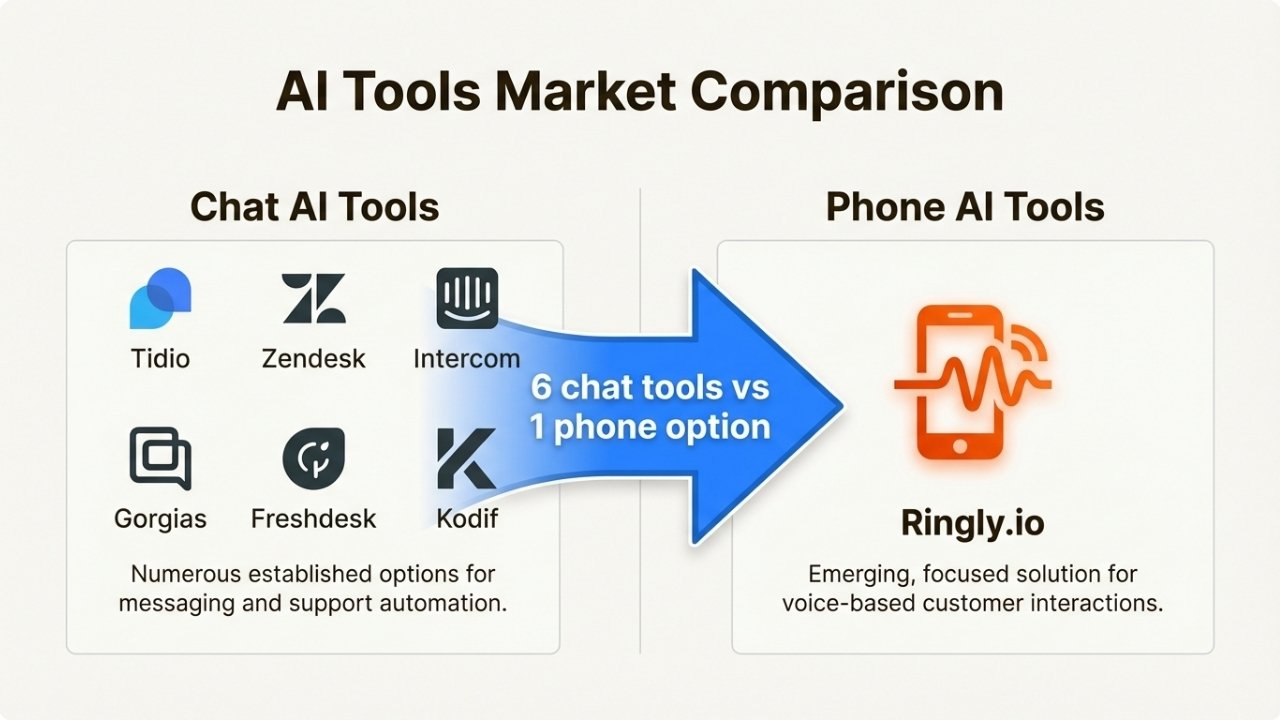
The pattern is clear: six of these tools compete on chat features, while Ringly.io owns the phone channel. If your customers call you, Ringly.io is literally the only AI option available.
Pricing breakdown: What you'll actually pay
Let's look at real costs for a store handling 500 customer interactions per month:
| Tool | Starting Price | At 500 Interactions/Month | Cost at Scale |
|---|---|---|---|
| Tidio | $29/mo | ~$90/mo (with Lyro) | $200-400/mo |
| Zendesk | $55/agent/mo | $165/mo (3 agents) | $500+/mo |
| Intercom | $29/seat + $0.99/resolution | ~$350/mo (assuming 300 resolutions) | $800+/mo |
| Gorgias | $50/mo | $140/mo (Basic + AI) | $500+/mo |
| Freshdesk | $15/agent/mo | $95/mo (3 agents + AI) | $300+/mo |
| Kodif | Custom | Custom | Custom |
| Ringly.io | $349/month (Grow) | $799/month (Pro) | Custom (Enterprise) |
Hidden costs to watch for:
- Per-agent pricing adds up with larger teams
- Overage fees can surprise you if volume spikes
- AI add-ons often cost extra beyond base plans
- Some platforms charge for integrations or advanced features
Chat vs phone: Choosing the right support channel
Most Rep AI alternatives assume chat is the answer. But is it?
Chat makes sense when:
- You have high volumes of simple, repetitive questions
- Your customers skew younger and prefer texting
- Issues are straightforward (order status, password resets, FAQs)
Phone matters when:
- Issues are complex or high-stakes
- Customers need immediate, real-time resolution
- The order value justifies personal attention
- Your demographic prefers voice communication
Here's the problem: if you only offer chat, you're forcing phone-preferring customers into a channel they don't want.
They might abandon the conversation, leave negative feedback, or take their business elsewhere.
Ringly.io exists because this gap is real. While every other tool fights over chat features, Ringly.io automated the phone channel that others ignore.
Which Rep AI alternative should you choose?
The right tool depends on your business size, support volume, and channel preferences.
Small stores (under 100 orders/month): Start with Tidio or Freshdesk. Both have free tiers. Tidio is simpler.
Freshdesk offers more room to grow.
Growing Shopify merchants (100-1,000 orders/month): Gorgias is built for you.
The Shopify integration is deep, and ticket-based pricing aligns costs with volume. Intercom is worth considering if you want the best AI and don't mind paying for it.
Enterprise (1,000+ orders/month): Zendesk or Kodif. Zendesk handles scale and complexity.
Kodif goes further by having AI take actions, not just answer questions.
Stores with phone support needs: Ringly.io is your only option for AI phone automation.
If customers call you and you want to automate those calls, this is the tool.
Start automating your customer support today
Most Rep AI alternatives compete on the same playing field: chat.
They offer slightly different features, pricing models, and integrations, but they're all variations on the same theme.
The gap in the market is phone support. While chat works for many situations, some customers prefer calling.
Complex issues, urgent problems, and high-value orders often demand a voice conversation.
Ringly.io fills this gap with the AI, an AI phone agent that handles calls 24/7.
It resolves approximately 73% of calls without human intervention, integrates deeply with Shopify, and sets up in about 3 minutes.
If you're only offering chat, you're missing customers who want to call.
Try Ringly.io free for 14 days and see how AI phone support fits your business.
The best support strategy matches your customers' preferences. Some want chat. Some want email.
Some want to pick up the phone. The tools you choose should cover all the channels your customers actually use.
Frequently Asked Questions
Which Rep AI alternative offers the best value for small Shopify stores?
For small stores, Tidio and Freshdesk offer the best value with their free tiers. Tidio is simpler to set up, while Freshdesk provides more features for future growth. Both let you test AI support without upfront costs.
Do any Rep AI alternatives support phone calls, or are they all chat-based?
Most Rep AI alternatives are chat-only. Ringly.io is the only alternative that offers AI phone support with their product the AI. Zendesk and Freshdesk offer phone support, but it's traditional human agent calling, not AI automation.
How much should I budget for a Rep AI alternative at scale?
At 500+ interactions per month, expect to pay $200-500 monthly for most tools. Tidio and Freshdesk stay on the lower end. Intercom and Zendesk scale higher. Ringly.io's phone pricing is competitive at $349-$799 monthly depending on call volume.
Which Rep AI alternative has the best Shopify integration?
Gorgias and Ringly.io both offer deep Shopify integration. Gorgias focuses on chat with order lookups and returns management. Ringly.io specializes in phone support with the same order data access. Both pull real-time store data to answer customer questions.
Can I use multiple Rep AI alternatives together?
Yes, many stores use different tools for different channels. For example, you might use Gorgias for chat and email, while using Ringly.io for phone calls. Just ensure your team has clear escalation paths between systems.
What's the main difference between Tidio's Lyro and Intercom's Fin AI?
Lyro uses Anthropic's Claude and is included as an add-on with per-conversation pricing. Fin charges $0.99 per resolution, meaning you only pay when the AI actually solves a problem. Both are capable, but Fin tends to handle more complex queries while Lyro is more straightforward and affordable for basic automation.