


Research shows that 85% of customers whose calls go unanswered will never call your brand again.
You spend thousands on ads to get the phone to ring, only to watch your team answer the same 5 questions.
It is a cycle of high costs and missed sales that keeps even the best founders up at night.
This guide will go over how Zendesk Voice AI agents for eCommerce can resolve over 50% of your calls.
First, we will break down the top features for phone support.
Then, we will look at the setup and hidden costs you must know before you buy.
Editor’s note: Want to hear some sample AI support calls made for your Shopify store?
- Just paste your store URL
- Hear sample calls for your store (no email required)
- Listen to demo AI calls for my store
What are Zendesk voice AI agents?
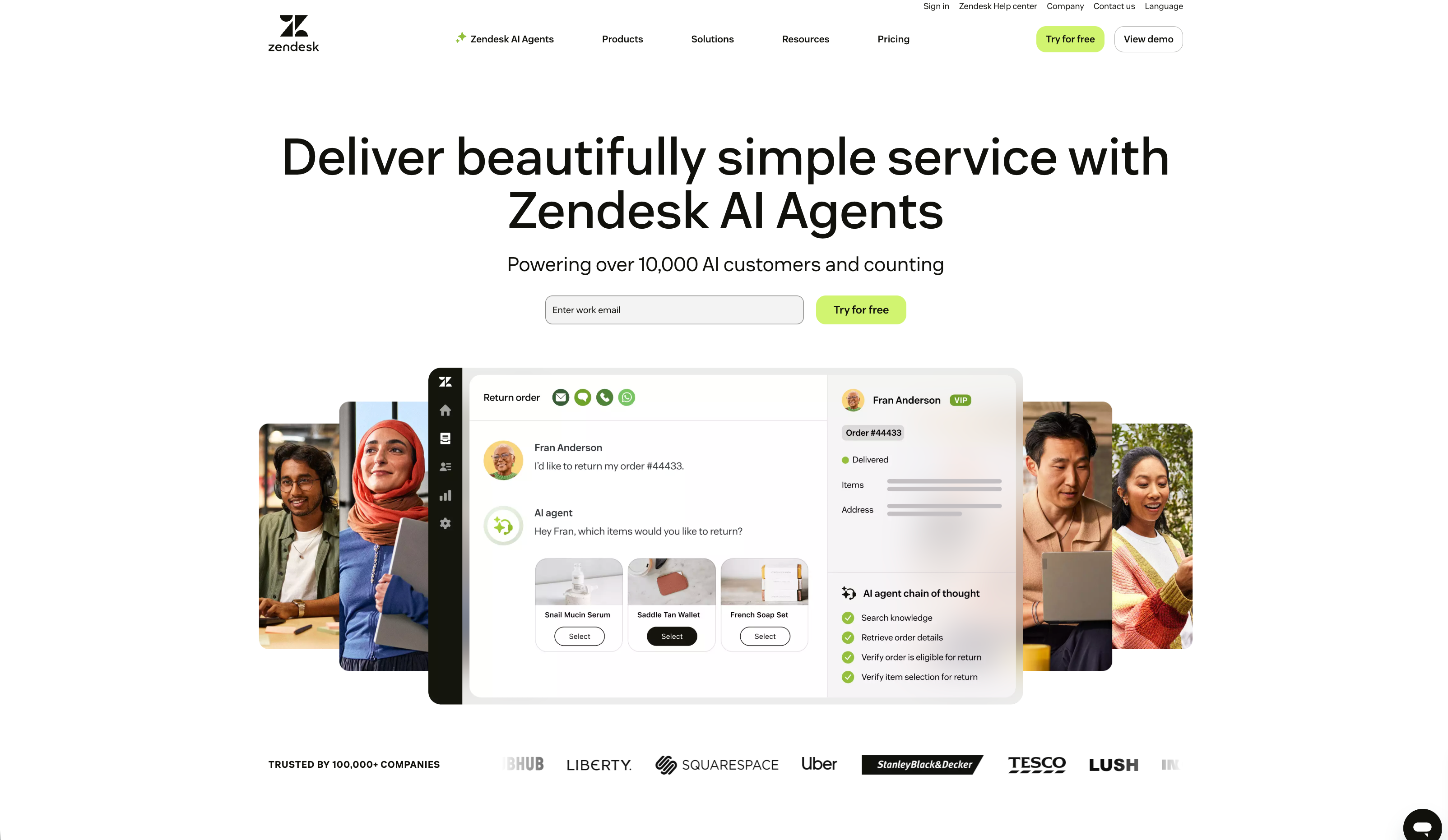
A Zendesk voice AI agent is an AI-powered bot within the Zendesk platform that handles customer phone calls.
It is built to do more than route callers to the right department. Using generative AI, it can understand natural, conversational language, allowing customers to speak to it as they would a person.
This represents an evolution from traditional Interactive Voice Response (IVR) systems that typically listen for specific keywords in a rigid script.
The goal is to facilitate a smooth, human-like conversation that resolves a customer's problem without an immediate handoff to a human agent.
Zendesk states its AI agents can handle and resolve over 50% of incoming calls on their own.
The objective is to let the AI take care of simple, repetitive questions. This allows human agents to have more time and energy for complex issues that require a person's touch.
Key Zendesk voice AI features for ecommerce phone support
Zendesk's primary strength is its all-in-one platform. The voice AI is not an add-on; it is built-in, working with the other support and analytics tools. This deep integration enables several useful features.
Autonomous call resolution
Zendesk’s AI is made to handle the entire call from start to finish. It can greet the customer, confirm their identity, understand multi-part questions, and even handle simple transactions by itself.
It’s designed to be a conversational partner.
Of course, AI can't solve everything. When a call becomes too complicated or a customer is clearly frustrated, the AI performs a smart handoff. It transfers the call to the appropriate human agent and includes the full conversation history.
This means customers do not have to repeat themselves, which can improve the experience for them and your agents.
AI-powered transcripts and summaries
A significant portion of a support agent's time can be spent on post-call work. They have to log notes, summarize the conversation, and create a ticket before they can help the next person.
Zendesk’s voice AI automates much of this. The moment a call is over, it creates a full transcript and a concise summary. This information appears directly in the agent’s workspace.
This can save significant time, reduce errors, and allow agents to get to more customers, faster.
Native integration with Zendesk QA and analytics
Since the voice AI is a native part of the platform, every call is automatically logged, transcribed, and available for review. All that data goes straight into the Zendesk dashboard, giving you a clear overview of your phone support performance.
This is where the Zendesk QA feature is especially useful. It allows managers to evaluate 100% of conversations, both with AI and humans, without listening to hours of recordings.
You can easily check on performance, identify agents who might need more training, spot customers who might be at risk of churn, and ensure every interaction meets your standards.
Setting up and pricing the Zendesk voice AI agent
Getting started with Zendesk’s voice AI involves a few steps. The features are bundled into their larger Zendesk Suite plans, so you must be on the right plan to gain access. Let’s walk through the setup process and cost structure.
The implementation process
Typically, the setup involves going into the Zendesk Admin Center, enabling the AI features, and then connecting your AI agent to a knowledge source.
This is where the AI will get its answers when customers call.

An important detail to note is that to provide generative, conversational answers, Zendesk's AI is built to primarily use the Zendesk Help Center as its knowledge base.
The AI works best when it's pulling information from articles you've written and published within Zendesk's system.
For some ecommerce stores, this presents a consideration. The information customers often need most, such as real-time order status, stock levels, and shipping updates, is dynamic and not typically found in a static help article.
It’s inside your Shopify store. This reliance on an internal knowledge base is an important factor for fast-paced online stores to consider.
A breakdown of Zendesk pricing
Zendesk's pricing is based on a per-agent, per-month fee. You pay for each human agent on the platform. The more advanced AI features are usually in the pricier plans or require separate add-ons.
Here’s a look at the Zendesk Suite plans that include their voice and AI features:
| Plan | Base Price (Billed Annually) | Included AI | Key Phone & Workflow Features |
|---|---|---|---|
| Suite Team | $55 /agent/month | Standard bots, generative replies, 5 AI resolutions/agent. | Email, Chat, Voice, & Social; 1 Help Center. |
| Suite Professional | $115 /agent/month | Standard bots, 10 AI resolutions/agent, eligible for Copilot. | IVR (Phone trees), 5 Help Centers, HIPAA compliance, SLAs. |
| Suite Enterprise | $169 /agent/month | Standard bots, advanced triage, eligible for Copilot. | Custom roles, sandboxes, 300 Help Centers, advanced security. |
| Copilot (Add-on) | +$50 /agent/month | Proactive agent assistance, auto-summaries, "Next Step" suggestions. | Available on Professional & Enterprise plans only. |
| Advanced AI (Add-on) | +$50 /agent/month | Advanced triage, sentiment analysis, macro suggestions. | Includes the Copilot features in most enterprise bundles. |
On top of the monthly fee, Zendesk also has a pay-as-you-go charge for automated resolutions. If you don't have a bulk plan, this can be around $2 per resolution.
That might not seem like a lot, but for an ecommerce business with high call volumes during peak seasons, these costs can accumulate and lead to variable monthly bills.
Key considerations for using the Zendesk voice AI agent in ecommerce
While Zendesk is a powerful platform, there are a few key considerations for ecommerce store owners. When running a fast-moving ecommerce business, you need tools that fit your specific needs.
Reliance on a knowledge ecosystem
As mentioned earlier, Zendesk’s AI provides its best answers when it's pulling from its own system, mainly the Zendesk Help Center.
For an ecommerce brand, this can be a significant challenge. The most common customer questions are not about general policies; they are about specific, live data.
"Where is my order?" "Is this shirt in stock?" "Can I return the sweater I just bought?" The answers to these questions are inside your Shopify store, not in a help article from last month. To answer them correctly, an AI needs direct, live access to your store’s backend.
This is where solutions built specifically for ecommerce, such as Ringly.io, offer a different approach.
Its AI agent, the AI, was designed with ecommerce in mind. It integrates natively with Shopify, so it can pull live order data in real time. When a customer calls about their package, it can look up the actual tracking number and provide a precise answer.
Setup for advanced automation
While setting up a basic AI agent in Zendesk is straightforward, achieving end-to-end automation for common ecommerce tasks can be more involved.
If you want your AI to do more than just answer questions, such as processing a return or exchange in Shopify, you may need to configure advanced workflows or use API integrations.
This can be a technical challenge, especially for smaller teams or store owners who are not developers. You might have to hire outside help to get the AI to perform the tasks you wanted to automate in the first place.
Alternatively, solutions like Ringly.io are designed for quick setup. It offers a no-code setup in under 1 hour that connects to a Shopify store, with its AI agent, Seth, pre-trained to handle common ecommerce requests like order lookups and return processing.
Per-agent pricing model
Zendesk's pricing model is designed around human agents. You pay per seat, which makes sense if your goal is to make your current team more efficient. But for many ecommerce stores, a primary reason for using AI is to reduce the need for human agents and automate as many calls as possible.
For businesses focused on reducing agent headcount through automation, a per-agent pricing model may seem counterintuitive to their goals.
Your bill increases as your team size increases, not necessarily as your automation improves.
Ringly.io's pricing is structured differently. It’s a usage-based model where plans are based on call minutes. This aligns your costs with your automation goals. You pay for the work the AI is doing. Ringly.io also offers a guarantee that can reduce risk: get that month back as credit if Seth resolves under 65% of your calls in a month (after 90 days on Pay per call). It’s an investment tied directly to results.
The verdict: Choosing a voice AI agent for ecommerce
Zendesk’s voice AI is a solid tool and a powerful part of its all-in-one customer service platform.
For larger companies that are already deep into the Zendesk ecosystem and want to add AI to their human-led support, it can be a great choice.
However, for some Shopify stores, the factors mentioned previously are important to consider.
The reliance on an internal knowledge base, the potential for technical complexity with deep ecommerce automation, and a pricing model that scales with team size can make it a challenging fit.
For ecommerce brands looking for a solution designed for phone support automation, a purpose-built tool like Ringly.io presents another option.
It’s built to connect seamlessly with your store, handle the questions your customers are actually asking, and scale in a way that makes sense for a growing business.
Ready for an AI voice agent built for your Shopify store?
Are you missing customer calls after hours? Does your team spend too much time answering the same questions about order status and returns over and over?
Meet the AI, the AI phone support rep from Ringly.io. You can set him up in under 1 hour to handle those exact tasks for you, 24/7.
He picks up every call, looks up orders directly from your Shopify store, and processes returns automatically. He only escalates to your team when a human touch is really needed.
You can try it completely risk-free. With our 65% resolution guarantee, a month where Seth resolves under 65% of your calls comes back as credit (after 90 days on Pay per call). It’s time to give your customers the instant answers they want and give your team the freedom to focus on growing your business.
For more on ai voice agents for ecommerce, bestaiansweringservices.com has a helpful overview.
Frequently Asked Questions
What is the main difference between a Ringly and a Zendesk voice AI agent for ecommerce phone support?
The biggest difference is specialization. The Zendesk voice AI agent is part of a large, all-in-one customer service platform, while Ringly's AI agent, the AI, is built specifically for ecommerce stores, particularly on Shopify. This means Ringly integrates directly with your store's live data (like order status and inventory) out of the box, which may require additional setup in Zendesk.
Which is easier to set up: a Ringly or Zendesk voice AI agent for ecommerce phone support?
For a Shopify store, Ringly is generally faster to set up. It offers a no-code installation that connects directly to your store and is live in under 1 hour. Setting up a Zendesk voice AI agent for deep ecommerce tasks, like processing returns, often requires more technical configuration and reliance on its internal Help Center for information.
How does the pricing compare for a Ringly vs. Zendesk voice AI agent for ecommerce phone support?
Their pricing models are quite different. Zendesk typically charges per human agent, per month, with AI features often included in higher-tier plans or as add-ons. Ringly uses a usage-based model based on call minutes, which aligns your costs with automation success rather than your team's size.
Can a Zendesk voice AI agent for ecommerce phone support access live Shopify data like Ringly can?
Not natively. Zendesk's AI is optimized to pull information from its own knowledge base, like Help Center articles. To get live data from Shopify for things like order tracking, you would likely need to configure custom API integrations, which adds complexity. Ringly is built to do this automatically.
What should I consider when choosing between a Ringly and a Zendesk voice AI agent for ecommerce phone support?
You should consider your current tech stack, your team's technical skills, and your main goal. If you're already heavily invested in the Zendesk ecosystem and want to enhance your human agents' workflow, Zendesk is a strong option. If your primary goal is to quickly and affordably automate a high volume of common ecommerce phone queries with minimal setup, a specialized tool like Ringly is likely a better fit.
Is the Ringly Zendesk voice AI agent ecommerce phone support solution a single product?
No, it's not a single product. Ringly and Zendesk are two separate companies offering different voice AI solutions. This blog compares the Zendesk voice AI agent with Ringly's AI agent to help ecommerce businesses decide which platform is better for their phone support needs.