
The phrase "call center" doesn't mean what it used to.
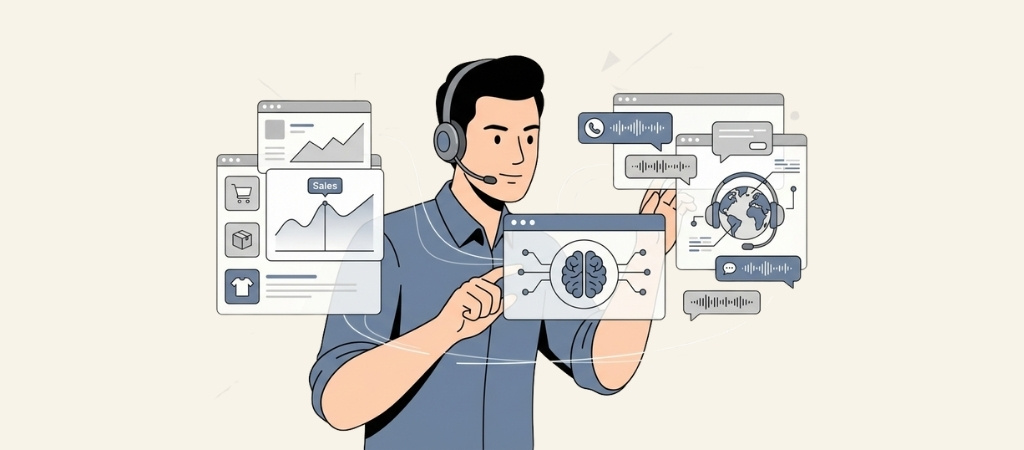
When ecommerce brands talk about AI call centers today, they're rarely referring to rooms full of headsets and hold music.
They're talking about AI agents that handle phone calls, chat messages, emails, and social DMs, often resolving issues without a human ever getting involved.
This shift matters because customer expectations haven't changed. People still want fast answers.
They still get frustrated when they have to repeat themselves.
The difference is that AI can now handle most of those interactions automatically, 24/7, across every channel your customers use.
Editor’s note: Want to hear some sample AI support calls made for your Shopify store?
- Just paste your store URL
- Get sample calls in under 20 seconds (no email required)
- Listen to demo calls for my store

Let's look at six platforms leading this change, what they actually do, and which one might fit your store.
What to look for in an AI call center solution
Not every platform suits every business. Here's what actually matters when you're evaluating options:
Automation rate tells you what percentage of inquiries the AI resolves without human help.
Most platforms claim 60-80%, but real-world results vary based on your product complexity and ticket types.
Channel coverage matters because your customers don't stick to one medium.
Some platforms are phone-first, others excel at chat and email. Know where your volume actually lives.
Ecommerce integrations determine how much context the AI has. Deep Shopify or WooCommerce connections let the AI check order status, process returns, and access customer history without escalating.
Pricing models vary widely. Some charge per resolution, others per minute, others flat monthly fees.
Match the pricing structure to your ticket volume and average resolution complexity.
Setup time ranges from three minutes to several weeks. Be realistic about your technical resources and how quickly you need results.

Comparison table: All 6 solutions at a glance
Here's how these platforms stack up on the metrics that matter most:
| Platform | Best for | Automation rate | Starting price | Primary channel |
|---|---|---|---|---|
| Gorgias | Shopify stores | 60% | Contact sales | Chat/email |
| Bland AI | Enterprise voice | Not stated | Contact sales | Voice |
| Siena AI | Brand experience | Up to 80% | Contact sales | Omnichannel |
| Fin | Complex queries | Up to 65% | $0.99/resolution | Chat/email |
| Yuma AI | Multichannel | 40-70% | Contact sales | Omnichannel |
| Ringly.io | Shopify phone support | ~73% | $349/month | Voice |
The right choice depends on your specific situation. A store getting 50 calls per day has different needs than one getting 5,000. Let's break down each option.
1. Ringly.io – Best for Shopify phone support

Ringly.io takes a focused approach: AI phone support specifically for Shopify stores.
While competitors try to be everything to everyone, Ringly built the AI (their AI phone agent) to do one thing extremely well: handle inbound phone calls for ecommerce merchants.
The numbers are compelling. The AI resolves approximately 73% of phone calls without human intervention across more than Shopify stores.
Setup takes about three minutes. The AI speaks 30 languages and can look up orders, process returns, handle exchanges, and escalate only when necessary.
Pricing is transparent, which stands out in this market. The Grow plan runs $349 per month for 250 call minutes.
Grow jumps to $349 for 1,000 minutes plus self-learning AI and deeper store integration. Enterprise: custom pricing for 5,000+ minutes with custom setups and private Slack support. Overage minutes cost $0.19 each.
The 14-day free trial includes full features, and billing only kicks in after The AI resolves at least 65% of calls over 100 calls in the first 21 days.
That performance-based guarantee reduces the risk of paying for something that doesn't work for your specific situation.
Pros:
- Transparent pricing with clear tiers
- Phone-specific focus (not chat repurposed for voice)
- Fast quick setup with no technical work
- 40-language support for global stores
- Performance-based trial (pay only if it works)
Cons:
- Phone-focused (no chat or email handling)
- Shopify-only (no WooCommerce or other platforms)
- Per-minute pricing can spike during busy periods
Ringly.io suits Shopify stores where phone support still matters. If your customers call to check order status, ask about returns, or get product advice, The AI handles those conversations while your team focuses on complex issues that actually need human judgment.
2. Bland AI – Enterprise voice-first automation

Bland AI takes a different approach. While most platforms started with chat and added voice later, Bland built for voice from day one.
They claim to be "the fastest conversational AI in the world" and can handle up to one million concurrent calls.
That's not a typo. One million calls at once.
This scale matters for enterprises running massive operations: airlines during weather events, healthcare systems during open enrollment, retailers during Black Friday.
If your peak volume dwarfs your normal volume, Bland's infrastructure is built for that reality.
The platform offers custom trained models using your own recordings and transcriptions.
You can choose unique voice actors to match your brand. Data stays on dedicated servers with encryption, which matters for companies in regulated industries.
Bland works across any use case and vertical, from financial services to healthcare to logistics.
They're fully multi-regional and multi-lingual, so your data never crosses borders and your AI speaks whatever languages your customers do.
Pros:
- True voice-first architecture (not chat with voice added)
- Massive scale: up to 1M concurrent calls
- Custom model training on your data
- Dedicated infrastructure for security
Cons:
- Enterprise-focused with no self-serve option
- No public pricing (expect significant investment)
- Overkill for small to mid-size merchants
- Not ecommerce-specific (generic by design)
Bland AI suits large enterprises that need massive call volume handling with strict security requirements. If you're a Shopify store doing $10M a year, this is probably more than you need. If you're a Fortune 500 company, it's worth the conversation.
3. Siena AI – Best for empathic automation

Siena positions itself as "empathic AI agents for commerce." That word "empathic" isn't just marketing fluff.
They've built the platform to mirror brand tone, voice, and customer behavior across every interaction.
The automation rate is impressive: up to 80% of customer interactions.
Siena claims 98% faster response times and 90% faster resolution times compared to human-only support. Their customers report a 94.7% average CSAT score, which suggests the empathy angle actually works.
What makes Siena different is the focus on brand intelligence.
The platform turns customer interactions into strategic business insights, activating intelligence across teams to drive revenue and retention. It doesn't just answer questions; it anticipates needs and makes personalized recommendations.
The platform handles the full post-purchase workflow: order status, returns, exchanges, subscription management.
It can update addresses, generate labels, issue refunds, and send replacements in a single flow. For subscription businesses, it handles skip, pause, and swap requests while capturing insights and boosting AOV with smart recommendations.
Pros:
- Highest claimed automation rate (up to 80%)
- Strong focus on brand voice and empathy
- Revenue-driving product recommendations
- Excellent customer testimonials from brands like Simple Modern and Coterie
Cons:
- No transparent pricing
- Newer player (founded 2022, less track record)
- May require more setup to get brand voice right
Siena works best for brands where customer experience is a core differentiator.
If you sell premium products where every interaction shapes perception, Siena's focus on empathy and brand alignment makes sense.
4. Fin by Intercom – Best for complex queries
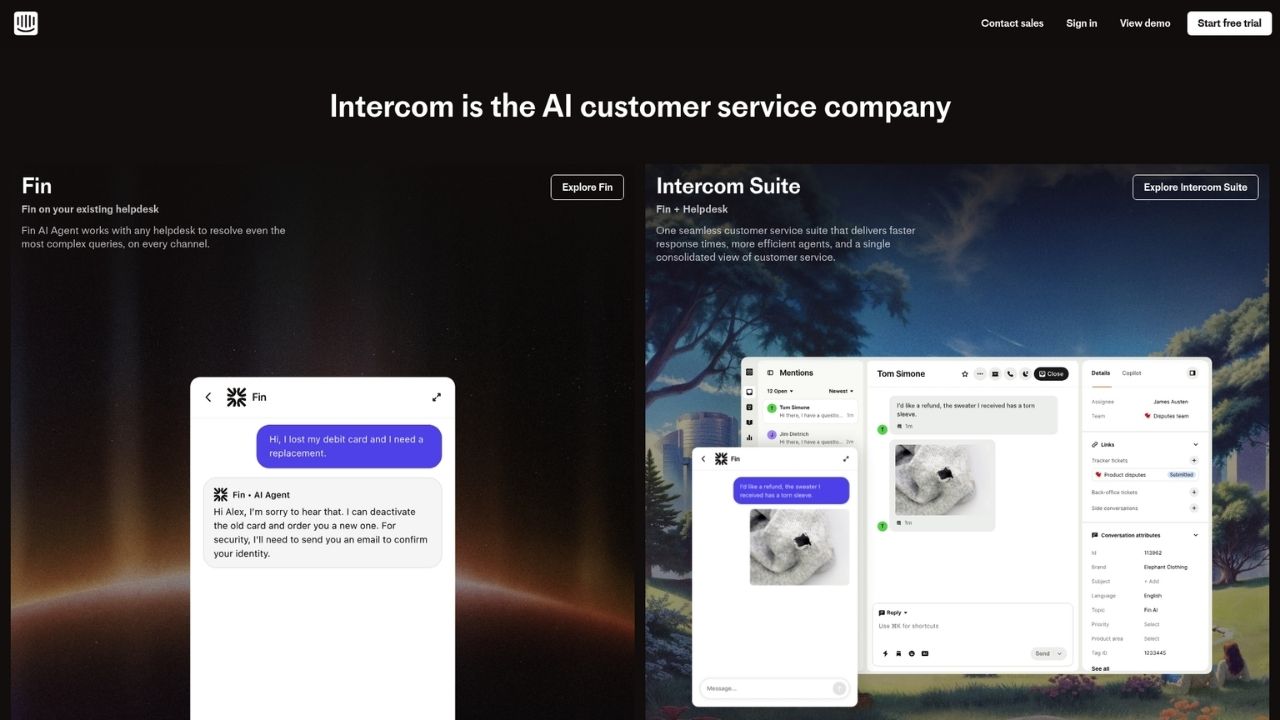
Fin takes a different approach to pricing and positioning. Instead of hiding pricing behind "contact sales," they publish it clearly: $0.99 per resolution when used standalone, or $0.99 per resolution plus $29 per helpdesk seat when bundled with Intercom's full suite.
That transparency is refreshing, and it makes Fin attractive for budget-conscious teams who want predictable costs.
The platform resolves up to 65% of conversations end-to-end, with Fin involved in 99% of conversations at customer sites like Lightspeed.
The key differentiator is the Fin AI Engine, which uses a six-step process to ensure accuracy: refine the query, retrieve relevant content, rerank for precision, generate a response, validate accuracy, and optimize continuously.
Fin works with any helpdesk, not just Intercom. They have native integrations for Zendesk and Salesforce, plus support for custom channels.
This matters if you're not looking to rip and replace your entire support stack.
The platform also offers something rare: a testing environment where you can run fully simulated customer conversations before going live.
This reduces the risk of embarrassing AI failures on day one.
Pros:
- Transparent, predictable pricing ($0.99/resolution)
- Works with existing helpdesks (Zendesk, Salesforce)
- Strong testing and validation tools
- #1 rated AI Agent on G2
Cons:
- Per-resolution pricing adds up at high volume
- Requires Intercom suite for full features
- Primarily chat and email (voice is limited)
Fin suits companies with complex products where answer accuracy matters more than speed.
If you sell software, technical equipment, or anything requiring detailed explanations, Fin's validation engine reduces the risk of AI hallucinations giving wrong answers.
5. Yuma AI – Best for multichannel accuracy
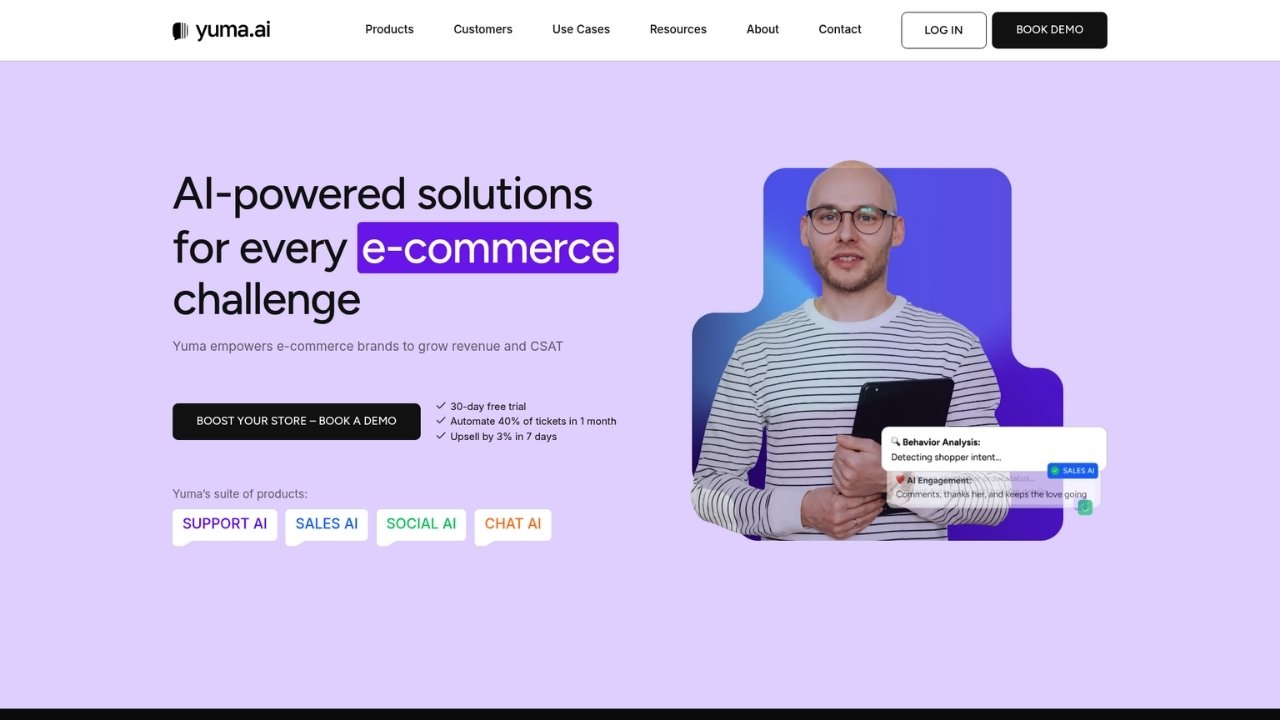
Yuma focuses on ecommerce brands that need consistent support across every channel.
Their customers include Glossier, Petlibro, and EvryJewels, brands that can't afford to deliver different experiences on email versus Instagram versus live chat.
The platform offers four distinct products: Support AI, Sales AI, Social AI, and Chat AI.
Support AI handles tickets and WISMO (Where Is My Order) queries. Sales AI boosts revenue with personalized interactions. Social AI turns comments and mentions into conversions. Chat AI provides instant assistance on your website.
Automation rates range from 40-60% for most merchants, with some reaching 70%+ after optimization.
Yuma offers a 30-day free trial, which lets you test actual performance before committing.
Case studies show impressive results. Glossier slashed first response time by 87%.
EvryJewels achieved 70% automation and processed 150,000 tickets in December 2024 alone. Petlibro saved 20% annually while hitting 49% automation.
Pros:
- Strong multichannel consistency
- Impressive case studies from recognizable brands
- 30-day free trial with full features
- Good G2 reviews and customer testimonials
Cons:
- No public pricing (contact sales)
- Lower baseline automation than some competitors
- Requires optimization to reach claimed rates
Yuma works best for fast-growing brands that need to maintain consistent voice across multiple channels.
If your customers reach out on Instagram, email, and chat interchangeably, Yuma's unified approach prevents fragmented experiences.
6. Gorgias – Best for Shopify stores

Gorgias has built its reputation as the conversational AI platform specifically for ecommerce.
With over 15,000 brands using it, they've got the receipts to back up their claims.
The platform resolves about 60% of support inquiries automatically.
That number drops for complex issues but holds steady for the routine stuff that eats up most of your team's time: order status checks, return initiations, and basic product questions.
Where Gorgias stands out is its Shopify integration. The AI can edit orders directly, access real-time product information, and even run promotional campaigns without leaving the support conversation.
This matters because customers hate being transferred between departments or hearing "let me check on that."
The platform also includes a Marketing Suite that proactively engages shoppers with personalized recommendations.
Gorgias claims this increases conversions by 2.5x compared to standard support interactions.
Whether that holds for your store depends on your product catalog and average order value, but the mechanism makes sense: helping customers find what they need while they're already engaged.
Pros:
- Deep Shopify integration that actually works
- 15,000+ brands trust it, including Reebok and MrBeast
- Strong G2 rating (4.6/5)
- Includes marketing automation, not just support
Cons:
- No transparent pricing (contact sales only)
- Primarily chat and email focused (voice is secondary)
- May be overkill for stores with simple product lines
Gorgias works best for mid-size Shopify brands that want unified support and sales in one platform. If your support team also drives revenue through recommendations and upsells, this is worth a look.
How to choose the right AI call center solution
With six solid options, how do you pick? Here's the short version based on your situation:
Small stores (under 100 tickets per month): Start with Fin.
Mid-size Shopify brands: Gorgias or Siena make sense. Both have deep Shopify integration and proven track records with growing brands.
Enterprise or high volume: Bland AI or Yuma handle scale that would break smaller platforms. Bland for pure voice volume, Yuma for omnichannel consistency.
Phone-heavy support: Ringly.io or Bland AI. Everyone else treats voice as secondary.
Chat-heavy support: Gorgias, Siena, or Fin. All three excel at text-based automation.
Budget-conscious: Fin at $0.99 per resolution gives you predictable costs. Ringly.io at $349 per month is the cheapest transparent option for phone support.
Getting started with AI phone support
Most platforms offer free trials or demos. Use them. Automation rates vary significantly based on your product complexity, customer demographics, and ticket types.
A platform that works brilliantly for a fashion brand might struggle with technical equipment.
Typical setup ranges from three minutes (Ringly.io) to several weeks (enterprise deployments with Bland). Start with one channel, prove the concept, then expand to omnichannel. Don't try to automate everything on day one.
Monitor both automation rates and customer satisfaction together.
A platform that resolves 80% of tickets but tanks your CSAT isn't helping. The goal is deflection without frustration.
If phone support is your priority and you run a Shopify store, start a free 14-day trial with Ringly.io.
The AI resolves about 73% of calls automatically, and you only pay if he hits performance targets. For stores where customers still pick up the phone, that's a low-risk way to see if AI phone support actually works for your specific situation.
Frequently Asked Questions
What is an AI call center for ecommerce?
An AI call center for ecommerce is a platform that uses artificial intelligence to handle customer inquiries across phone, chat, email, and social channels. These systems can check order status, process returns, answer product questions, and escalate complex issues to human agents when needed.
How much does an AI call center solution cost?
Pricing varies widely. Some platforms charge per resolution (around $0.99), others charge per minute ($0.19+), and others use flat monthly fees ranging from $99 to $1,000+ depending on volume. Enterprise solutions like Bland AI require custom quotes.
What percentage of calls can AI actually resolve?
Most platforms claim 60-80% automation rates, but real-world results depend on your product complexity and ticket types. Simple order status and return requests automate easily. Complex technical issues or emotional complaints typically require human escalation.
Do AI call center solutions work with Shopify?
Yes, most major platforms integrate with Shopify. Gorgias, Ringly.io, Yuma, and Siena all have deep Shopify integrations that let the AI access order data, process returns, and check inventory directly. Some platforms like Ringly.io are Shopify-exclusive.
How long does it take to set up an AI call center?
Setup time ranges from three minutes (Ringly.io) to several weeks (enterprise deployments). Simple implementations involve connecting your helpdesk and uploading a knowledge base. Complex deployments require custom training, voice tuning, and workflow configuration.
Can AI call centers handle multiple languages?
Yes, most modern platforms support multiple languages. Ringly.io supports 30 languages. Bland AI is fully multi-lingual. Gorgias, Siena, and Yuma all handle international customers. Check specific language support during your trial to ensure your markets are covered.