


Every minute your team spends on the phone looking for tracking numbers is a minute they aren’t scaling your brand.
You have built a successful store, but now you are stuck managing a growing support team that costs more than it should.
It feels like you are constantly burning cash on human labor for simple tasks that a machine could handle.
And it gets worse.
Generic AI tools often fail because they don’t understand your store data, but choosing the right tool can automate 70% of your calls.
First, we will look at why standard AI tools frustrate Shopify owners.
Then, we will break down the top five Bland alternatives that actually integrate with your backend.
Editor’s note: Want to hear some sample support calls made for your Shopify store?
- Just paste your store URL
- Get sample calls in under 20 seconds (no email required)
- Listen to demo calls for my store
What are AI phone agents for ecommerce?
An AI phone agent is like a digital employee who is always available to answer your support calls, 24/7.
This means no missed calls after hours or on holidays.
These agents use AI to understand a customer's speech, determine their needs, and provide a helpful, spoken response.
The interaction is designed to feel like a natural conversation, unlike traditional automated phone menus.

For an online store, the main benefit comes when these agents connect directly to backend systems like Shopify.
This allows them to handle common questions such as “Where is my order?” or “How do I start a return?” autonomously.
This is a significant advantage over a generic tool that doesn't have built-in knowledge of ecommerce operations.
Why ecommerce stores seek alternatives to Bland AI
Bland AI is a capable platform for building voice AI, but it presents a few considerations for the average ecommerce business owner.
For starters, its pricing model has shifted. As of December 2025, rates are now plan-based, starting at $0.14/min on the free plan and decreasing to $0.11/min on their $499/month Scale plan.
This shift may make it more challenging to predict monthly costs.
It is also a technical platform. Setting it up often requires engineering resources, which may not be readily available to all store owners.
The platform is designed for developers rather than merchants who may prefer a solution that works out of the box.
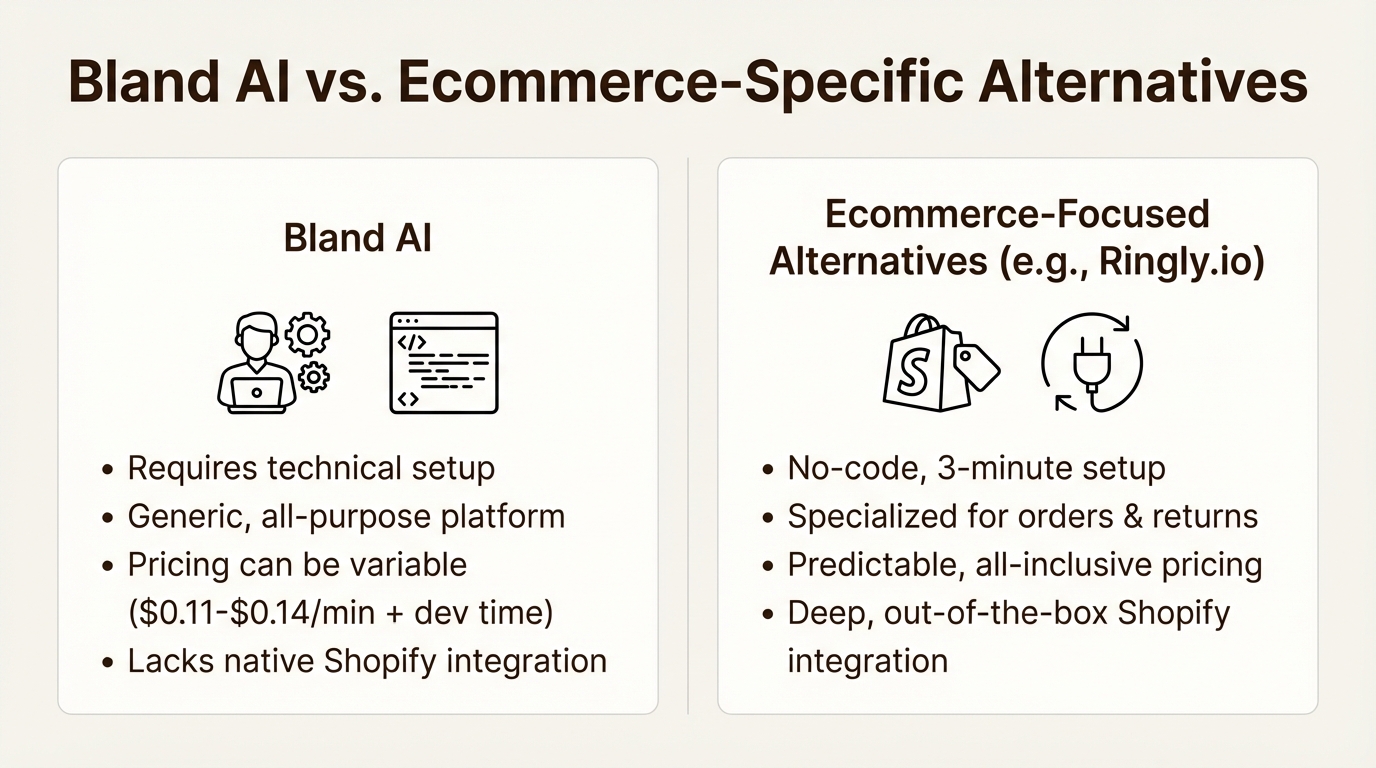
Finally, it was not built with a primary focus on commerce. It lacks out-of-the-box integrations for platforms like Shopify, meaning users need to build those connections themselves.
For these reasons, many merchants explore alternatives that offer simpler setup, different pricing models, and are designed specifically for ecommerce.
How we chose the best Bland AI alternatives
To put this list together, we focused on what matters to an online store owner. Here is a look at our criteria:
- Ecommerce integration: Does the tool connect easily with platforms like Shopify? Can it understand orders and returns right away?
- Ease of setup: Can someone without a technical background get it running quickly, or does it require a developer?
- Pricing transparency: Are the costs straightforward and predictable, or are there additional fees to consider?
- Core features: Does it handle basics like order lookups, return processing, and answering common product questions effectively?
- Reliability and voice quality: Does it sound natural and hold a conversation without technical issues or robotic pauses?
Comparing the top Bland AI alternatives
Here's a quick look at the platforms we're reviewing.
| Tool | Best For | Starting Price | Key E-commerce Feature |
|---|---|---|---|
| Ringly.io | Shopify stores wanting an out-of-the-box solution | $349/month | Deep, native Shopify integration for orders & returns |
| Retell AI | Developers building custom voice solutions | $0.07/min + provider costs | High flexibility with different AI models |
| Synthflow | Agencies needing a no-code, re-sellable builder | $0.09/min + provider costs | White-labeling and subaccount features |
| Quo | Small teams needing a full business phone system | $15/user/month + AI add-on | All-in-one calling, texting, and AI receptionist |
| Vapi | Engineering teams wanting maximum control | $0.05/min + provider costs | API-first platform for low-latency apps |
The 5 best Bland AI alternatives
Let's get into the details of each platform.
1. Ringly.io

Ringly.io was created to provide Shopify merchants with an AI phone representative that understands their business. Its AI agent is designed to be a digital employee for your store.
Description
Ringly.io is notable for its focus on ecommerce. It connects directly to your Shopify store in minutes, giving the AI immediate access to order details, product info, and return policies.
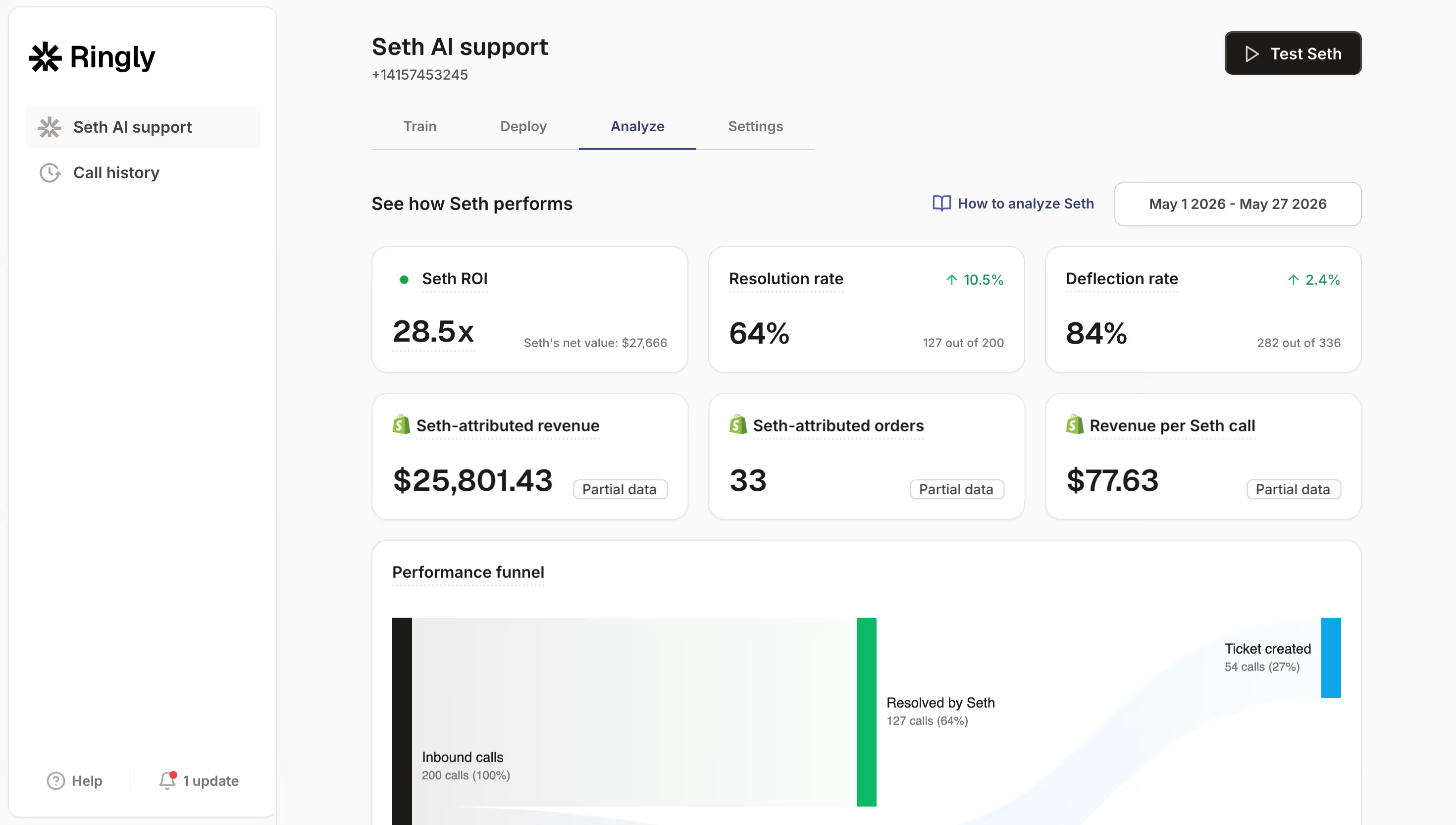
This allows it to give customers accurate, real-time answers and is built to resolve up to 73% of calls on its own.
Pros
A key advantage of Ringly.io is its no-code setup, which takes about three minutes. The deep Shopify integration is a key feature, handling core ecommerce questions out of the box. The pricing model includes a guarantee where you pay nothing until the agent resolves 65% of calls, which can reduce financial risk.
Cons
Because it is focused on Shopify, it is not designed for businesses outside of ecommerce. Its price reflects its nature as a complete, managed solution rather than a developer toolkit.
Pricing
- Grow: $349/month for 1,000 minutes and deep Shopify integrations.
- Enterprise: custom pricing for 5,000+ minutes and custom support.
Best for:
Shopify store owners who want to automate phone support with a tool that works immediately without developer assistance.
2. Retell AI

Retell AI is a flexible platform for developers and tech-savvy teams who want to build their own voice agents from the ground up.
Description
Retell AI provides the components to build voice agents, allowing you to choose your own language models (like GPT-4o) and speech engines (like ElevenLabs). This gives you control over the agent's performance, voice, and cost.
Pros
The main appeal of this platform is control. You can fine-tune every component to optimize for speed or cost.
Cons
As a developer-focused platform, Retell AI is not a plug-and-play solution. It requires technical skills to connect it to store data and build the logic for handling order questions, which can be an investment of time and resources.
Pricing
- Pay-as-you-go: But you also have to pay separate costs for the language model, telephony, and any other services you use.
- Enterprise: Custom pricing for high-volume users.
Best for:
Businesses with an in-house development team that wants to build a completely custom voice AI solution.
3. Synthflow

Synthflow is a no-code platform made for agencies and businesses that want to build AI phone agents using a visual, drag-and-drop interface.
Description
It is a general-purpose tool that can be used for many different industries. You can map out conversation flows visually without writing code, which makes it more approachable than a pure developer platform.
Pros
Its main features are the easy-to-use visual builder and tools for agencies, like white-labeling and a reseller toolkit.
Cons
While flexible, it lacks the specialized, built-in ecommerce features found in other tools, so connecting it to Shopify for tasks like order tracking requires manual setup. Its pay-as-you-go pricing can also be variable.
Pricing
- Pay-as-you-go: But has extra costs for the language model and telephony.
- Enterprise: Custom plans for businesses using over 10,000 minutes a month.
Best for:
Marketing agencies or consultants who manage multiple clients and need a re-sellable, no-code AI calling solution.
4. Quo (formerly OpenPhone)

Quo is a modern business phone system that has added AI features to its core calling and texting platform.
It is more of an all-in-one communication tool than a dedicated AI agent builder.
Description
Quo is designed to serve as a complete phone system, offering shared numbers, call routing, and texting in one application. Its AI component, an agent named "Sona," assists with basic tasks and provides insights after calls.
Pros
If you are looking for a new business phone system, Quo is a solid choice. It is well-designed, easy to use, and the per-user pricing is accessible for small businesses. The AI features, like automatic call summaries, are a useful addition.
Cons
The AI functionalities are not as extensive as those in a dedicated platform. Sona can handle basic FAQs or take messages, but it cannot perform data-driven tasks like checking an order status in Shopify without custom integration.
Pricing
- Plans start at $15/user/month (billed annually).
- The Sona AI agent includes 1,000 free credits per month. After that, 100 calls cost an extra $49/month.
Best for:
Small businesses that need a complete, modern phone system and are more interested in AI for summarizing calls than for fully resolving them.
5. Vapi

Vapi is another API-first platform built for engineers who want total control when building voice AI applications.
Description
It acts as an "orchestration layer," which allows you to plug in your preferred providers for every part of the process, including speech recognition, language models, and text-to-speech. You bring the different services, and Vapi connects them.
Pros
Vapi is built for speed and control, targeting sub-500ms response times to make conversations feel natural.
The ability to mix and match providers means you can build a highly customized solution if you have the technical expertise.
Cons
Similar to other API-first platforms, Vapi is a tool for developers. It requires engineering work to build, integrate with Shopify, and maintain. Managing different vendors can also add complexity and lead to variable costs.
Pricing
- Pay-as-you-go: You pay the rates for the telephony, speech recognition, language model, and text-to-speech services you choose.
- Enterprise: Custom pricing with volume discounts.
Best for:
Tech startups or companies with engineering teams that want to build a high-performance, custom voice application from scratch.
How to choose the right Bland AI alternative
Feeling a bit overwhelmed by the options? Here are three simple tips to help you choose the right tool.
Prioritize deep ecommerce integration
A generic AI can answer questions, but an integrated one can solve problems. Look for a platform that connects directly to your store's order and return data. This is a primary feature of specialized tools like Ringly.io.
Calculate your total cost
Don’t just look at the low per-minute rate. For developer tools like Vapi and Retell AI, you have to add up the costs of the language model, voice engine, telephony, and engineering hours. This is important because a tool with a low per-minute rate can become more expensive when all costs are factored in.
Look for a fast setup
Consider how long it will take to go from signing up to having an AI agent handling customer calls. For a busy merchant, a solution that works in minutes, not weeks, can make a significant difference.
Finding the right fit for your ecommerce store
While many powerful voice AI platforms are available, they often fall into two categories: technical, developer-focused tools or more generic, all-purpose solutions. To effectively automate phone support, many stores find they need a tool that understands the specifics of ecommerce, such as orders, SKUs, and returns.
Ringly.io is one such tool, built with a focus on solving common ecommerce support tasks through an integrated platform.
Ready to see how much time you can save? Start your free Ringly.io trial and get your AI phone rep, the AI, answering calls in minutes.
Frequently asked questions
What's the main advantage of choosing specialized Bland AI alternatives for ecommerce over generic tools?
Specialized alternatives connect directly to your store's data (like Shopify), allowing them to handle specific tasks like order lookups and returns automatically. Generic tools require you to build these connections yourself.
How quickly can I set up most Bland AI alternatives for ecommerce?
Setup times vary widely. Developer-heavy platforms can take weeks or months to get right. However, solutions built specifically for ecommerce, like Ringly.io, can be up and running in just a few minutes.
Are there any free Bland AI alternatives for ecommerce?
Most platforms have pay-as-you-go or subscription models. While some might offer a free trial or a limited number of free credits (like Quo), fully free solutions that can handle complex ecommerce tasks are rare due to the underlying costs of AI and telephony.
What kind of integration should I look for in Bland AI alternatives for ecommerce?
The most important integration is a deep, native connection to your ecommerce platform, like Shopify. This allows the AI to access real-time order status, product information, and return policies without any custom coding.
How do the costs of developer-focused Bland AI alternatives for ecommerce compare to all-in-one solutions?
Developer tools often have a lower per-minute rate but come with additional costs for language models, telephony, and engineering time. All-in-one solutions like Ringly.io have a higher monthly cost but are typically all-inclusive, making the total cost of ownership more predictable.
Can Bland AI alternatives for ecommerce handle complex customer issues?
The best ones are designed to handle common, repetitive questions to free up your human team. For truly complex or sensitive issues, they are programmed to intelligently escalate the call to a human agent so your customers always get the help they need.