
Updated May 2026
What is 24/7 ecommerce phone support and how do brands deliver it?
24/7 ecommerce phone support means a real voice answers every inbound call, day or night. Brands deliver it three ways: human BPO call centers ($7 to $16 per call, slow ramp), hybrid teams (humans plus overflow chat), or AI voice agents. Across 50 Shopify stores, Ringly resolves 73% of calls autonomously at roughly $0.42 per resolved call.
Every ecommerce store owner knows the feeling.
You wake up to a voicemail from someone who was ready to buy, but had a question about shipping, sizing, or returns. By the time you call back, they've already ordered from a competitor.
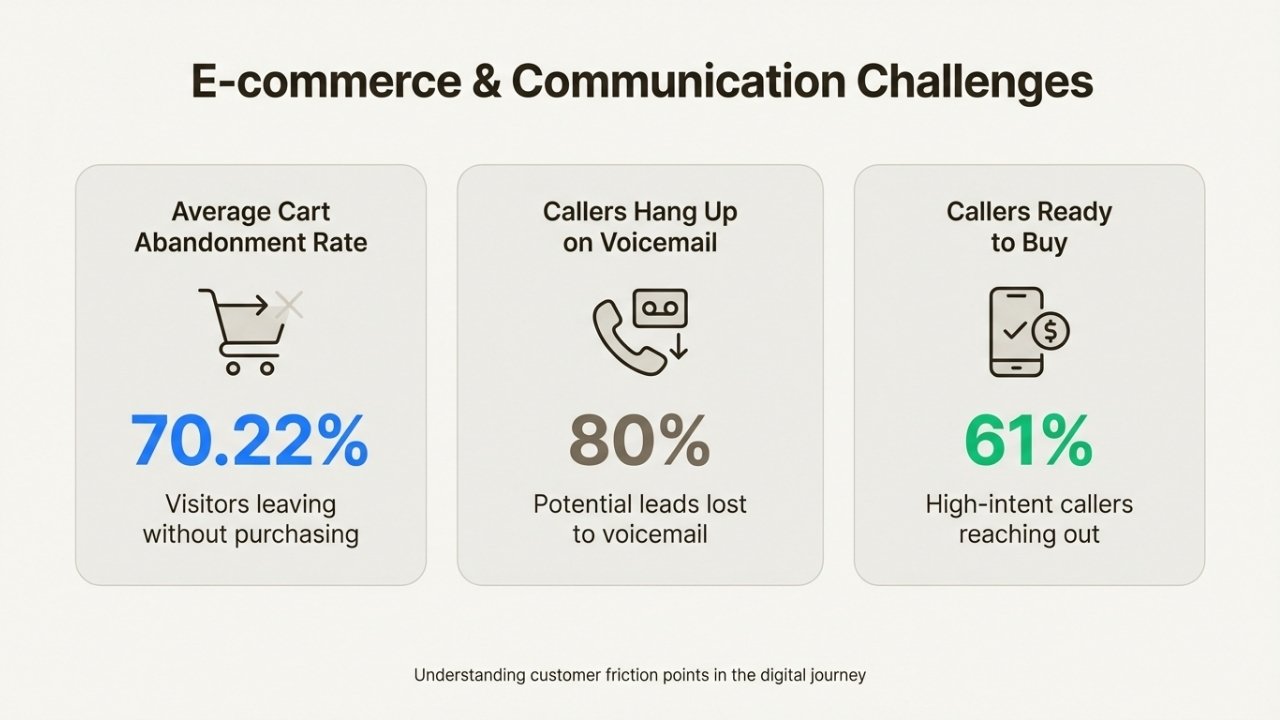
According to Baymard Institute, the average cart abandonment rate sits at 70.22%.
And while checkout friction plays a role, unanswered questions push customers away just as quickly.
Research from AnswerConnect shows that 80% of callers hang up when they reach voicemail, and 61% of mobile users call a business when they're ready to buy.
These aren't casual browsers, these are people ready to hand you money if you can just pick up the phone.
Editor’s note: Want to hear some sample support calls made for your Shopify store?
- Just paste your store URL
- Get sample calls in under 20 seconds (no email required)
- Listen to demo calls for my store
The math is simple: missed calls equal missed revenue.
With over 30% of online shopping happening outside the traditional 9-to-5 window, the question isn't whether you need 24/7 phone support. It's how to make it work for your budget and business.
What is 24/7 ecommerce phone support?
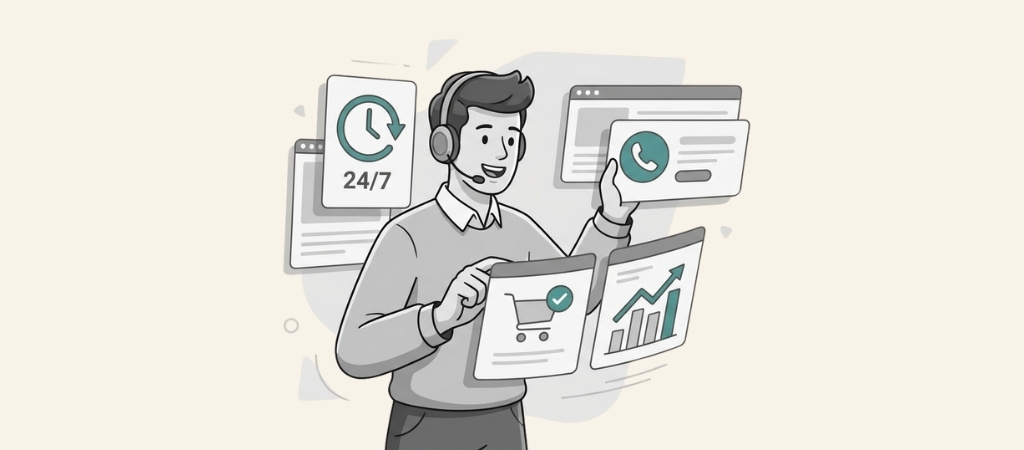
24/7 ecommerce phone support means your customers can reach a real person (or a capable AI) by phone at any hour, any day.
That includes weekends, holidays, and 2 AM on a Tuesday.
This is different from email or chat support. Phone calls carry urgency.
When someone picks up the phone, they usually have a problem that needs solving right now, or they're ready to place an order but need one question answered.

Common phone support needs for ecommerce include order tracking, returns and exchanges, product questions before purchase, shipping cost clarifications, and payment issues.
These queries seem simple, but they're high-stakes moments.
Harvard Business Review data shows that 74% of customers would choose another business after a bad phone experience.
That's not just a lost sale, that's a lost customer.
The goal of 24/7 support isn't just to answer calls. It's to resolve issues, reduce friction, and recover sales that would otherwise disappear into competitor carts.
Use the MTA Score to compare options: Minutes saved (labor your team avoids) plus Tickets deflected (calls resolved without human escalation) plus AOV recovered (after-hours revenue rescued). Each option below scores against this framework. We define MTA in full on our call center outsourcing breakdown.
What are the best options for 24/7 ecommerce phone support in 2026?
There are three main approaches to covering phones around the clock. Each has tradeoffs in cost, quality, and complexity.
In-house support teams
Building an internal team gives you full control over brand voice and training.
Your employees know your products inside and out, and you can adjust scripts and processes in real time.
The challenge is coverage. Running a true 24/7 operation requires multiple shifts, which means hiring for nights, weekends, and holidays.
In the US, customer support agents typically earn $15-25 per hour, plus benefits and management overhead.
To cover all hours, you'll need at minimum 4-5 full-time employees rotating through shifts.
That adds up to $200,000-375,000 per year in labor costs alone, before training, software, and turnover expenses.
High turnover rates in support roles mean constant recruiting and retraining.
In-house teams make the most sense for larger operations with complex products, high call volumes, and the budget to match.
For most small-to-midsize ecommerce stores, it's overkill.
Outsourced call centers
Outsourcing shifts the staffing burden to a third-party provider.
You pay for minutes or calls handled, and the provider supplies trained agents who work from their facility.
This model comes with different pricing structures. AnswerConnect charges $350-575 per month for 200-400 minutes, with overage rates of $1.85-2.50 per additional minute.
SupportYourApp offers tiered pricing based on team size, supporting 60+ languages, though you'll need custom quotes and a 30-45 day setup timeline.
For stores wanting a hybrid approach, Quo (formerly OpenPhone) offers their Sona AI agent at $49 per month for 50 calls, plus $0.99 per additional call.
Outsourcing works well for businesses that need human agents but don't want to hire internally.
The tradeoffs include less control over agent training, potential inconsistencies in brand voice, and setup times measured in weeks rather than minutes.
AI phone agents
AI phone support uses speech recognition, natural language understanding, and text-to-speech to handle calls automatically.
The AI answers, understands the question, pulls relevant data (like order status), and responds conversationally.
Modern AI agents can handle order tracking, return requests, FAQ responses, and basic troubleshooting.
When a call exceeds the AI's capabilities, it routes to a human agent or takes a message.
Pricing typically runs lower than traditional options.
For example, Ringly.io offers AI phone support starting at $349 per month for 1,000 minutes, with overage at $0.19 per minute.
Their AI agent, the AI, integrates directly with Shopify stores to pull order information automatically.
The main advantage is consistency and cost.
AI doesn't get tired, doesn't need breaks, and handles the same query with the same quality at 3 PM or 3 AM.
The limitation is complexity, edge cases, angry customers, and unusual situations still benefit from human judgment.
How to choose the right 24/7 ecommerce phone support solution
The best option depends on your specific situation. Here's how to think through the decision.
Decision factors to consider
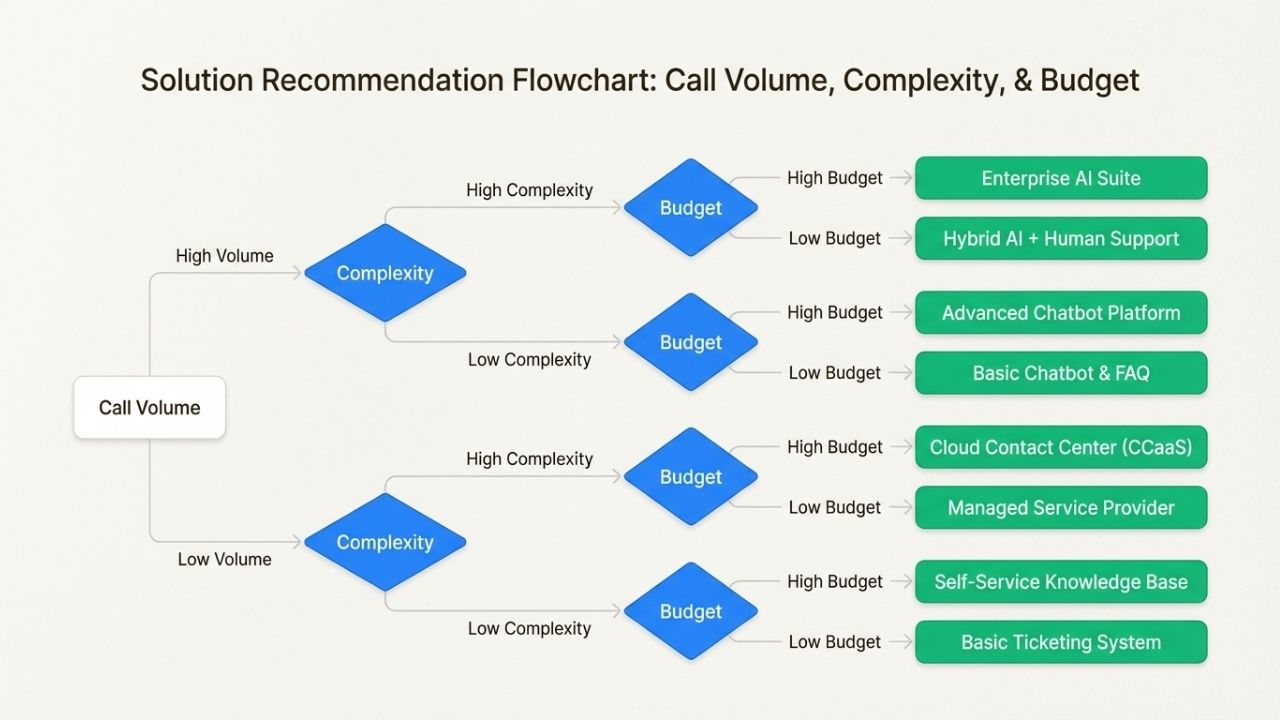
Start with your monthly call volume. If you're handling fewer than 100 calls per month, sophisticated solutions are likely unnecessary.
If you're above 500, scalability matters more. Next, assess call complexity.
Are most queries simple order status checks, or do your customers need technical troubleshooting and personalized recommendations?
Simple queries are perfect for automation.
Complex ones need human expertise. Budget constraints are real.
A small store with tight margins can't justify $375,000 in annual staffing costs.
But even budget-conscious stores can afford $99-350 per month for AI or outsourced coverage.
Consider your growth stage too. Startups need flexibility and low fixed costs.
Scaling businesses need systems that grow with them.
Established companies may prioritize brand consistency over cost savings.
Finally, think about languages and integrations. Do you sell internationally?
Do you need your phone system to connect with Shopify, WooCommerce, or your CRM?
When to choose each option
| Scenario | Best option | Why |
|---|---|---|
| Under 100 calls/month, simple queries | AI phone agent | Cost-effective, instant setup |
| 100-500 calls/month, mixed complexity | AI + human escalation | Automation handles routine, humans get complex |
| 500+ calls/month, high complexity | Outsourced or hybrid | Scale without hiring, trained agents |
| Premium brand, high-touch experience required | In-house team | Full control over brand experience |
| Seasonal spikes (Black Friday, launches) | Outsourced overflow + AI | Flexible scaling without fixed overhead |
There's no single right answer. Many stores find that hybrid approaches, combining AI for routine queries with human backup for escalations, deliver the best balance of cost and quality.
For Shopify stores handling routine queries like order tracking and returns, AI-first solutions like Ringly.io often make the most sense.
The platform's the AI agent resolves 73% of calls without human intervention, which covers the majority of typical ecommerce support needs.
Setting up 24/7 phone support for your store
Once you've chosen an approach, implementation follows a predictable path. Here's how to get started.
Step 1: Audit your current support needs
Before spending money, understand what you're actually dealing with.
Track your call volume for 30 days if you aren't already.
Categorize every call by type: order status, returns, product questions, complaints, other.
Identify your peak hours and how many calls come in after business hours.
Calculate your missed call rate.
If you're missing 40% of incoming calls, that's your baseline for measuring improvement.
Step 2: Choose your approach
Use the decision framework from the previous section. Match your volume, complexity, and budget to the right solution type.
Start with one approach rather than trying to build a complex hybrid system from day one.
You can always add human backup to an AI system or add AI routing to an outsourced provider later.
If budget allows, consider building in escalation paths from the start.
Even the best AI or outsourced agent will encounter calls they can't handle.
Step 3: Set up your phone system
Get a dedicated support phone number. This can be a local number (which builds trust) or a toll-free number (which removes barriers for customers).
Configure your routing and escalation rules.
Decide what happens when the AI can't resolve a query, or when an outsourced agent needs to transfer a call.
Connect your phone system to your ecommerce platform.
For Shopify stores, native integrations like Ringly.io mean Most stores go live within an hour rather than weeks.
The AI can pull order data, customer history, and product information automatically.
For AI solutions, upload your knowledge base: FAQs, return policies, shipping information, and product details.
The more context the AI has, the better it performs.
Step 4: Train and test before going live
Script out responses for your most common call types. Even with AI, you want to define how certain situations should be handled.
Run test calls internally. Have team members call in with various scenarios and evaluate the responses.
Fix issues before real customers encounter them. Set up clear escalation paths.
Define when calls should transfer to humans, and make sure those humans are ready to receive them.
Step 5: Monitor and optimize
Track resolution rates, average call duration, and customer satisfaction scores. These metrics tell you whether your system is working.
Review call recordings regularly. You'll find gaps in your knowledge base, common questions you hadn't anticipated, and opportunities to improve.
Update your FAQs and policies based on real conversations. Customer questions reveal what information is missing from your website and support materials.
What 24/7 phone support actually costs
Here's the honest breakdown by approach. Use these numbers for budgeting, but get specific quotes for your situation.
In-house (US-based)
| Cost element | Estimate |
|---|---|
| Agent salary (per person) | $50,000-75,000/year |
| FTEs needed for 24/7 coverage | 4-5 minimum |
| Total annual labor | $200,000-375,000 |
| Plus | Training, benefits, management, turnover, software |
In-house support makes financial sense only at high volumes where the per-call cost drops significantly. For most ecommerce stores, this approach is prohibitively expensive.
Outsourced
| Provider | Monthly cost | Included | Overage rate |
|---|---|---|---|
| AnswerConnect | $350 | 200 minutes | $2.50/min |
| AnswerConnect | $395 | 300 minutes | $1.85/min |
| AnswerConnect | $575 | 400 minutes | $1.85/min |
| SupportYourApp | Custom quote | Team-based | Varies |
| Quo + Sona | $49 | 50 calls | $0.99/call |
Mid-volume stores (1,000+ minutes monthly) can expect to pay $1,000-2,500 per month for outsourced human support.
AI phone agents
| Provider | Monthly cost | Included | Overage rate |
|---|---|---|---|
| Ringly.io Start | $349 | 1,000 minutes | $0.19/min |
| Ringly.io Grow | $349 | 1,000 minutes | $0.19/min |
| Ringly.io Pro | $799 | 2,500 minutes | $0.19/min |
| Ringly.io Enterprise | Custom | 5,000+ minutes | Contact sales |
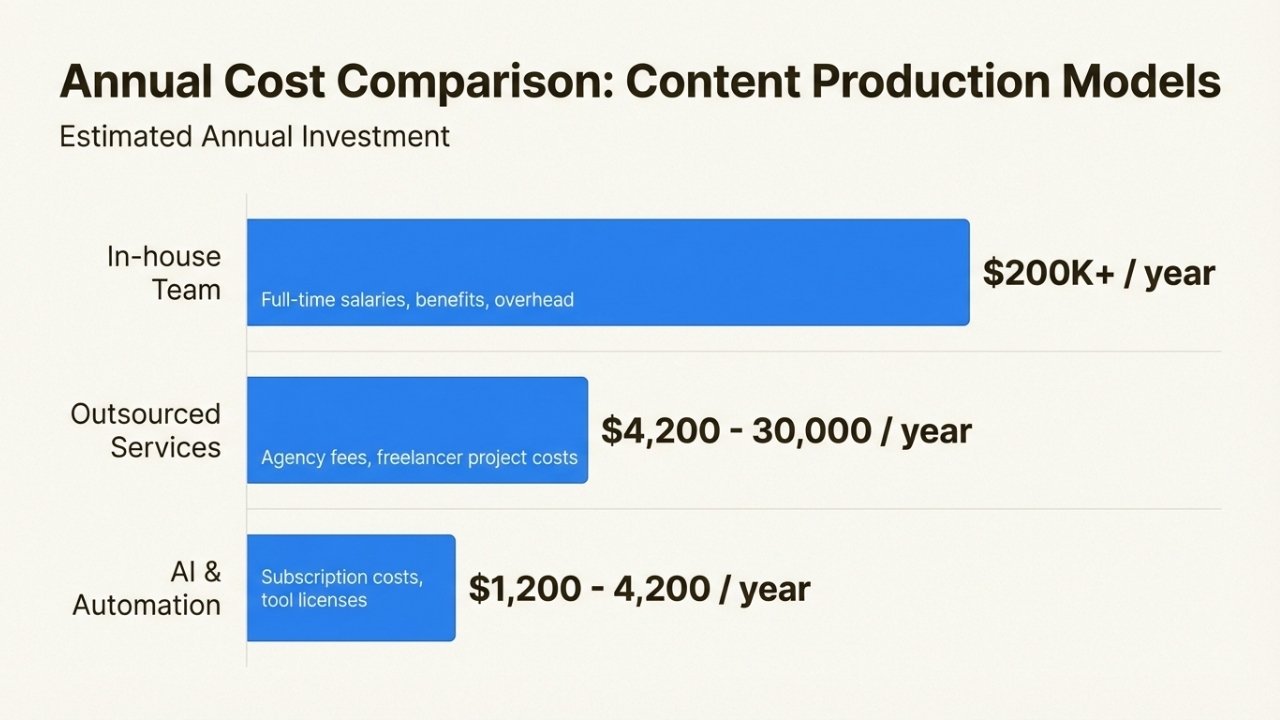
Cost comparison between AI and outsourced phone support
ROI considerations
The raw cost comparison favors AI, but ROI depends on your specific situation.
Consider revenue recovered from reduced cart abandonment.
If better phone support prevents even 5% of abandoned carts from leaving, and your average order is $100, the math works in your favor quickly.
Factor in time saved for your internal team.
Hours not spent answering routine phone calls can go toward marketing, product development, or growth initiatives.
For Shopify stores with routine query patterns (order status, returns, product questions), AI solutions like Ringly.io deliver the strongest ROI.
The 73% resolution rate means only about a quarter of calls need human attention, dramatically reducing per-call costs.
Getting started with AI phone support for ecommerce
AI-first approaches make particular sense for ecommerce.
The query patterns are predictable: where's my order, how do I return this, what's your shipping policy?
These are exactly the questions AI handles well. The benchmark for good AI phone support is a 70%+ resolution rate.
That means seven out of ten calls handled completely without human involvement.
Ringly.io currently achieves 73% across their customer base.
When evaluating AI options, look for platform integration (does it connect to Shopify or your ecommerce platform?), multilingual support (if you sell internationally), clear escalation rules (what happens when AI can't help?), and transparent pricing (no surprises on your bill). Setup speed matters too.
Traditional call centers require 2-4 weeks to train agents on your business.
AI solutions like Ringly.io deploy in minutes, because they pull product and order data directly from your store.
The safest approach is to test with real calls before committing.
Ringly.io offers a 14-day free trial, and you can get your last 3 months refunded if the AI resolves under 65% of calls in 90 days over your first 100 conversations.
That's a risk-free way to see whether AI phone support works for your store.
For Shopify stores looking to add 24/7 phone coverage without major budget commitments, starting with an AI agent like the AI makes practical sense.
You can always add human escalation paths later as your needs evolve.
For more on shopify live chat app, themexpert.com has a helpful overview. See ecommerce phone support.
inappstory.com also covers this space in more depth.
For more on ai customer support tools, botpress.com has a helpful overview.
Frequently Asked Questions
What is 24/7 ecommerce phone support and why does it matter?
24/7 ecommerce phone support means customers can reach your store by phone at any time, day or night. It matters because over 30% of online shopping happens outside business hours, and 80% of callers hang up rather than leave voicemail. Missed calls translate directly to missed sales.
How much does 24/7 ecommerce phone support cost per month?
Costs vary by approach. In-house teams run $200,000+ annually. Outsourced call centers charge $350-2,500 monthly depending on volume. AI phone agents like Ringly.io start at $349/month for 1,000 minutes. Most small ecommerce stores find AI solutions the most cost-effective.
Can AI handle 24/7 ecommerce phone support effectively?
Yes, for routine queries. Modern AI phone agents resolve 70-73% of typical ecommerce calls without human intervention. This includes order tracking, returns, shipping questions, and FAQs. Complex issues or upset customers still benefit from human escalation.
What are the best providers for 24/7 ecommerce phone support?
Top options include AnswerConnect for human agents ($350-575/month), SupportYourApp for multilingual support (custom pricing), Quo with Sona AI ($49/month plus per-call), and Ringly.io for Shopify-focused AI support ($349-$799/month). The best choice depends on your call volume and complexity.
How do I set up 24/7 ecommerce phone support for my Shopify store?
Start by tracking your current call volume and types for 30 days. Choose between in-house, outsourced, or AI based on your budget and needs. For Shopify, AI solutions like Ringly.io integrate directly with your store data and deploy in minutes. Test with real calls before committing.
What's the difference between outsourced and AI 24/7 ecommerce phone support?
Outsourced support uses human agents employed by a third-party provider. AI support uses speech recognition and natural language processing to handle calls automatically. Outsourcing offers human judgment but costs more and takes 2-4 weeks to set up. AI costs less and deploys instantly but works best for routine queries.
Is 24/7 ecommerce phone support worth it for small stores?
Yes, if customers are calling and you're missing sales. Even small stores can afford AI options starting at $349/month. The ROI calculation is straightforward: if better phone support saves even a few orders per month, it pays for itself. Start with a free trial to test before committing.