

Running a Shopify store is simple until it isn't. At some point, the manual work catches up with you.
You're exporting CSVs to update inventory. Your accounting team is reconciling Shopify payouts by hand.
Customer service doesn't know if an item is actually in stock.
This is where Shopify ERP integration comes in. It connects your storefront to your back-office systems so data flows automatically between them.
No more duplicate entry. No more wondering which system has the right numbers.
Let's break down what this actually means for your business.
Editor’s note: Want to hear some sample AI support calls made for your Shopify store?
- Just paste your store URL
- Get sample calls in under 20 seconds (no email required)
- Listen to demo calls for my store
What is Shopify ERP integration?
ERP stands for Enterprise Resource Planning. Think of it as the central nervous system for your back-office operations.
It handles inventory management, order fulfillment, accounting, purchasing, and often manufacturing or supply chain functions.
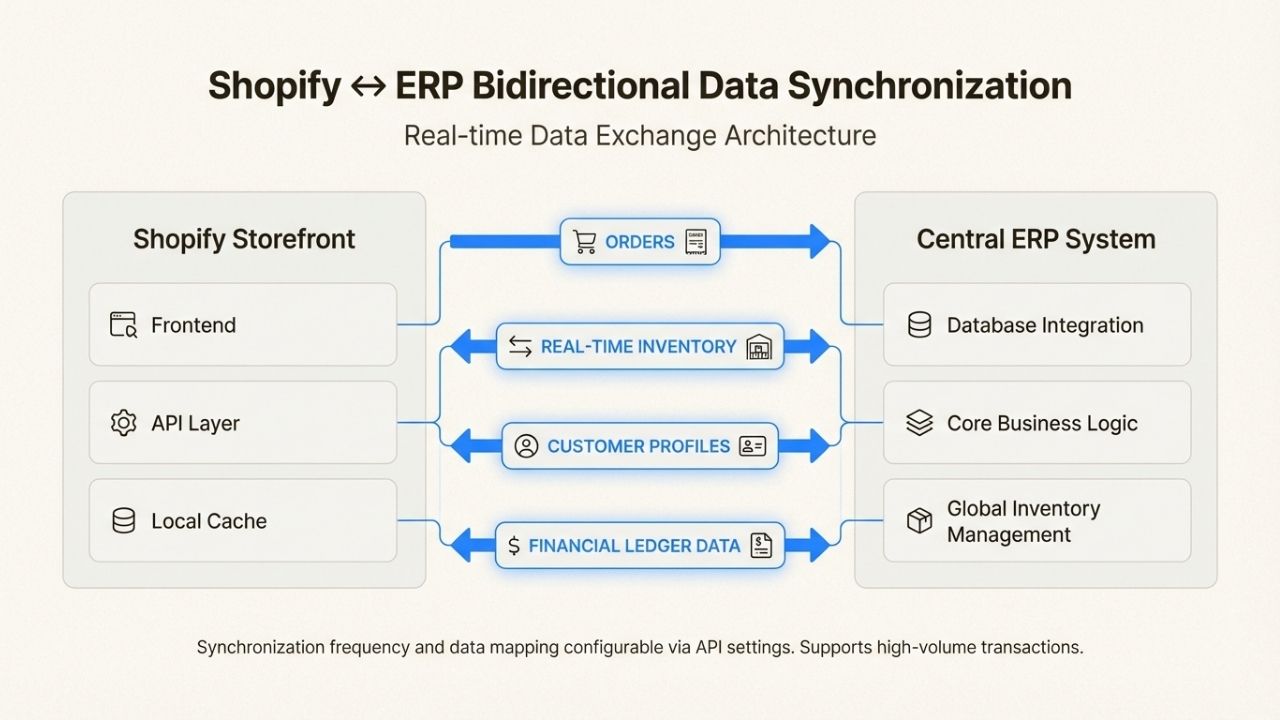
Shopify ERP integration creates a bridge between your ecommerce platform and this back-office system.
When a customer places an order on your Shopify store, that order automatically appears in your ERP.
When your warehouse receives new stock, inventory levels update in Shopify within minutes.
The key data that flows between systems includes:
- Orders and customer data - New orders sync to the ERP for fulfillment; customer profiles stay consistent across platforms
- Inventory levels - Stock counts update in real time, preventing overselling
- Product information - Pricing, descriptions, and SKUs stay synchronized
- Financial data - Sales, refunds, and payouts flow directly to your accounting system
Without integration, you're playing a game of telephone between systems. Someone has to manually transfer data, which means delays and errors.
At low volumes, this is annoying but manageable. At scale, it becomes a full-time job for multiple people.
Why your store needs ERP integration
The problems start small. You sell an item on Shopify that your ERP says is out of stock. A customer orders something that actually isn't available.
You have to cancel the order and apologize.
Then the issues compound. Your accounting team spends days each month reconciling Shopify data with your books.
Your warehouse team is working from outdated pick lists. You're hiring more people just to move data between systems.
Here's what changes when you integrate:
Real-time inventory visibility. When inventory updates in your ERP (from a warehouse receipt, return, or adjustment), it reflects immediately in Shopify.
Customers see accurate stock levels. You stop overselling.
Automated order-to-fulfillment workflow. Orders flow from Shopify to your ERP without manual intervention.
The ERP handles fulfillment logic, prints pick lists, and updates tracking information that syncs back to Shopify.
Accurate financial reporting. Sales data flows directly to your accounting system. No more manual reconciliation of Shopify payouts.
Your books close faster and with fewer errors.
Scalability without proportional headcount growth. The businesses that struggle most are the ones growing fast but still operating like they're small.
Integration lets you handle 10x the order volume without 10x the administrative staff.
A word of caution though. Research from Gartner suggests 55% to 75% of ERP projects fail to meet their objectives.
The integration itself isn't magic. Success depends on choosing the right system and implementing it properly.
Top ERP systems that integrate with Shopify
The Shopify Global ERP Program certifies five major platforms.
These aren't the only options, but they're the ones Shopify has vetted for security, performance, and reliability.
Microsoft Dynamics 365 Business Central
Microsoft Dynamics 365 is a cloud-based ERP with strong financial management capabilities.
The Business Central connector for Shopify handles order sync, inventory updates, and customer data transfer.
This system works well for mid-market businesses that need robust accounting features alongside their ecommerce operations.
It integrates deeply with other Microsoft tools like Office 365 and Power BI.
Oracle NetSuite
NetSuite is the most popular choice for Shopify Plus merchants running at scale.
The NetSuite ERP Connector in the Shopify App Store starts at $199.92 per month and provides comprehensive order-to-cash automation.
NetSuite handles complex scenarios well: multiple subsidiaries, international operations, advanced revenue recognition, and sophisticated inventory management across multiple warehouses.
Acumatica
Acumatica is a cloud ERP built specifically for small and medium businesses, with particular strength in distribution and manufacturing.
The connector handles orders, inventory, and customer synchronization.
Acumatica's pricing model is based on resource consumption rather than user count, which can make it more affordable for growing teams.
Brightpearl by Sage
Brightpearl positions itself differently from traditional ERPs. It's a "retail operating system" built specifically for omnichannel merchants.
The Shopify integration is native and handles high order volumes without third-party middleware.
Brightpearl focuses on post-purchase operations: order management, inventory, warehousing, fulfillment, and accounting.
It skips the manufacturing and heavy supply chain features that many retailers don't need.
Infor M3 CE
Infor serves larger enterprises with complex requirements.
The M3 CE connector links Shopify to Infor's ERP for businesses with sophisticated manufacturing, distribution, or supply chain needs.

Shopify ERP integration methods compared
You have three main approaches for connecting these systems.
The right choice depends on your technical resources, budget, and how customized your operations are.
Native and vendor-built integrations
These are pre-built connectors, typically found in the Shopify App Store.
The vendor (Microsoft, NetSuite, etc.) maintains the integration and keeps it updated as APIs change.
Pros: Fastest setup, no coding required, maintained by the vendor, often no additional subscription beyond the ERP license
Cons: Limited customization, you're dependent on the vendor's roadmap, may not handle edge cases specific to your business
Best for: Standard use cases, smaller teams without dedicated developers, businesses that can adapt their processes to match the integration's capabilities
Custom API integrations
Your development team (or an agency) builds a direct connection between Shopify and your ERP using both platforms' APIs.
You own the code and control exactly how data flows.
Pros: Complete flexibility, tailored to your exact workflows, no ongoing subscription fees to middleware vendors
Cons: High upfront development cost, requires ongoing maintenance as APIs change, needs technical team for troubleshooting
Best for: Unique business processes that don't fit standard integrations, connections to legacy systems without modern connectors, companies with in-house development resources
iPaaS platforms (Integration Platform as a Service)
Cloud-based middleware like Celigo, DCKAP Integrator, or Zapier sits between your systems and handles data translation and workflow logic.
Pros: Scalable, low-code interfaces for configuration, can connect multiple systems beyond just Shopify and ERP, pre-built templates for common scenarios
Cons: Additional subscription cost, learning curve for the platform, another vendor relationship to manage
Best for: Multi-system environments where Shopify and ERP are just two of many platforms, growing businesses that need flexibility without full custom development
Implementation best practices
A failed ERP integration is expensive and disruptive. Here's how to avoid becoming a statistic.
Clean your data first. This is the step everyone skips and everyone regrets.
If your product SKUs don't match between systems, if your inventory counts are wrong, if your customer data is messy, integration will amplify those problems.
Spend time normalizing formats, removing duplicates, and validating accuracy before you connect anything.
Define requirements before choosing a solution. Start by mapping what data needs to flow where.
Which system is the "source of truth" for each data type? What are your actual pain points? Don't buy features you don't need.
Plan for change management. Integration changes how people work. Your warehouse team will see orders in a different system.
Your customer service team needs to know where to look for information. Communicate early and train thoroughly.
Test with real scenarios. Don't just verify that data syncs. Test refunds. Test partial fulfillments.
Test what happens when an order is edited after it's been sent to the ERP. These edge cases are where integrations break.
Consider security from day one. Your ERP contains your most sensitive business data. Use OAuth instead of static API keys.
Implement role-based access control. Encrypt data in transit and at rest. The Shopify Global ERP Program requires partners to meet enterprise security standards.
Common challenges and how to avoid them
Even well-planned integrations hit roadblocks. Here are the most common ones.
Data model mismatches. Shopify and your ERP probably organize data differently.
Product structures, tax calculations, and customer fields may not align one-to-one. You'll need mapping logic to translate between them.
Underestimating total cost. The ERP license is just the start. Add implementation fees, data migration, training, and potential customization work.
Budget for 1.5-2x the software cost for a complete implementation.
Scope creep. Every department wants their specific workflow automated. Be ruthless about prioritizing. Phase 1 should handle your core order flow.
Edge cases can come later.
3PL and multi-warehouse complexity. If you're using third-party logistics providers or fulfilling from multiple locations, the integration gets more complex.
Inventory needs to sync from multiple sources, and fulfillment logic needs to route orders correctly.
Timeline overruns. Enterprise ERP implementations can take months or even years.
Be realistic about timelines and plan for parallel operation (running old and new systems simultaneously) during transition.
Streamline your operations beyond ERP
An ERP handles your back-office beautifully. But what about customer-facing operations?
Many Shopify stores still handle phone support manually, even after integrating their inventory and order systems.
This is where AI phone support fills the gap.
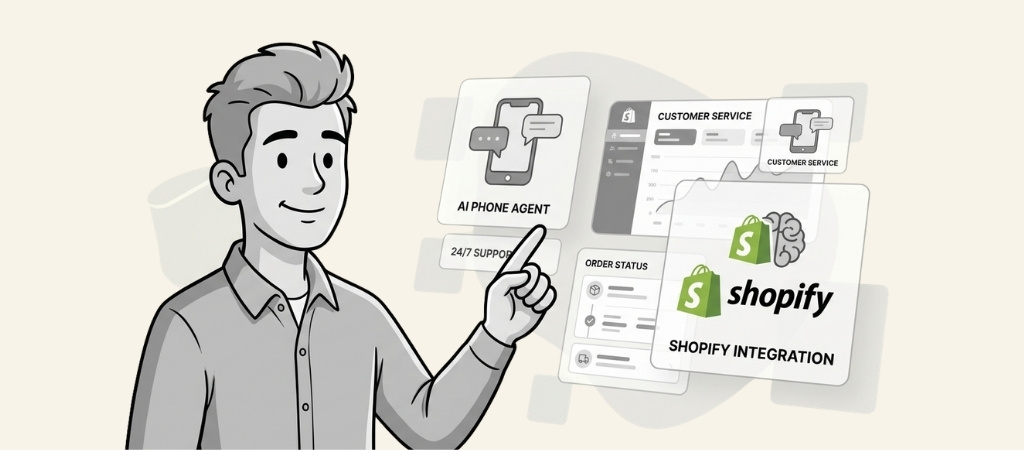
While your ERP manages the back end, an AI phone agent like the AI agent from Ringly.io handles inbound customer calls 24/7.
the AI integrates with your Shopify store to look up orders, process returns and exchanges, and answer common questions.
When a customer calls asking "where's my order," the AI pulls the tracking information instantly.
For complex issues, the call escalates to your human team with full context.
The numbers are compelling. The AI resolves around 70-73% of calls without human intervention.
For stores handling hundreds of calls monthly, that's significant time savings for your support team.
The integration ecosystem works together: ERP handles inventory and fulfillment, Shopify manages the storefront, and AI phone support automates customer interactions.
You get end-to-end automation without hiring proportional headcount.
If phone support is still a manual bottleneck in your operation, try Ringly.io free for 14 days.
Setup takes about three minutes, and you only pay once The AI resolves at least 65% of your calls.