
Customer retention is the difference between a thriving e-commerce business and one that burns cash on endless acquisition.
While everyone's obsessed with driving traffic and converting first-time buyers, the real profit lives in getting those customers to come back.
Here's a number that should wake you up: e-commerce brands are now losing $29 for every new customer acquired, compared to just $9 back in 2013.
That's a 222% increase in customer acquisition costs. Meanwhile, it costs 5-7 times less to retain an existing customer than to acquire a new one.
Let's break down what actually works for ecommerce customer retention in 2026.
Editor’s note: Want to hear some sample AI support calls made for your Shopify store?
- Just paste your store URL
- Get sample calls in under 20 seconds (no email required)
- Listen to demo calls for my store

Why ecommerce customer retention matters more than ever
The math is brutal but simple. According to Harvard Business Review, a 5% increase in customer retention can increase profits by 25% to 95%.
Meanwhile, Forbes reports that rising privacy regulations and the end of third-party cookies are making acquisition even more expensive and less precise.
Repeat customers also spend more. Research from Business.com shows returning customers spend up to 67% more than new customers.
They're also more likely to refer friends, leave reviews, and try new products.
So what does good retention look like? Yotpo's research puts the average e-commerce retention rate at 30-40%.
LoyaltyLion suggests that anything below 25% signals a problem.
Subscription businesses typically see higher rates (40-60%) while one-off purchase models hover lower.
The hidden cost of churn isn't just lost revenue.
It's the wasted acquisition spend, the negative word-of-mouth, and the constant pressure to feed the top of your funnel.
Understanding your ecommerce customer retention metrics
You can't improve what you don't measure. Here's the metrics framework every e-commerce store should track.
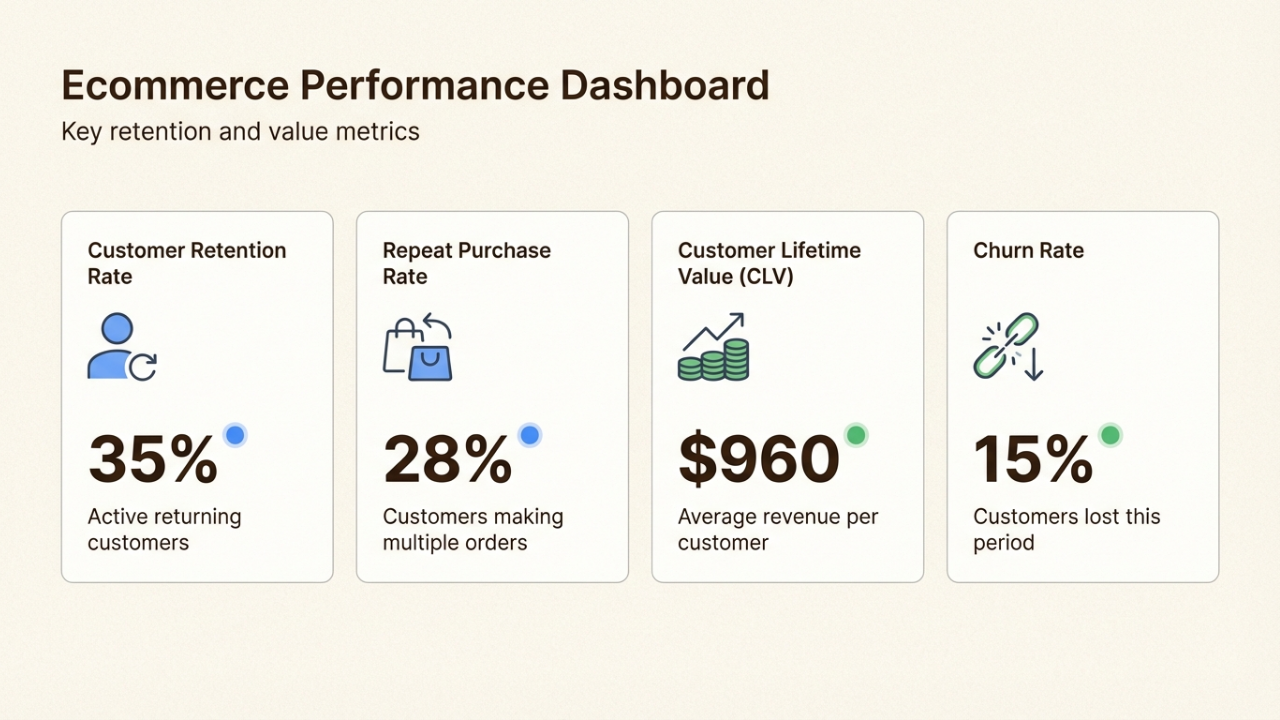
Customer Retention Rate measures the percentage of customers who make repeat purchases.
The formula: (End customers - New customers) / Starting customers × 100. So if you started with 1,000 customers, ended with 1,100, and acquired 300 new ones, your retention rate is 80%.
Repeat Purchase Rate is often more actionable for product-based businesses. It's the percentage of customers who buy more than once.
Divide customers with 2+ purchases by total customers and multiply by 100.
Customer Lifetime Value (CLV/LTV) projects the total revenue a customer brings over their relationship with your brand.
Calculate it by multiplying average purchase value by purchase frequency by customer lifespan.
If your average order is $80, customers buy 4 times per year, and stay active for 3 years, your CLV is $960.
Churn Rate is retention's evil twin. It measures the percentage of customers who stop purchasing.
LoyaltyLion notes that a churn rate between 10-25% is typical, but you want it as low as possible.
Average Order Value (AOV) and Time Between Purchases help you understand buying patterns.
Returning customers often increase their basket size over time, especially with good loyalty incentives.
Net Promoter Score (NPS) measures satisfaction and referral likelihood. It's an early warning system for churn.
Cohort analysis groups customers by acquisition date or channel to track behavior over time.
This reveals why some groups retain better than others. Without cohorts, you'd average a 20% Instagram cohort with a 45% referral cohort into a misleading 32%.
Strategy 1: Personalized post-purchase engagement for ecommerce customer retention
The 30 days after first purchase are critical. This is when customers decide whether you're worth remembering.
Timing matters. A thank-you email within 24 hours feels personal. A replenishment reminder two days before a product runs out shows you're paying attention.
A win-back email after 60 days of silence might be too late.
Email sequences should feel human, not automated. Use the customer's name, reference their specific purchase, and offer genuinely useful content.
Product recommendations based on purchase history perform significantly better than generic bestseller lists.
SMS marketing has emerged as a high-intent channel. Yotpo reports that 76% of consumers say convenience is a key priority in selecting a retailer.
SMS cuts through the noise with open rates as high as 98%, according to Campaign Monitor.
For consumable products, replenishment reminders are low-hanging fruit. If someone buys a 30-day supply of supplements, email them on day 25.
Make reordering frictionless.
Strategy 2: Loyalty programs that drive real behavior
Not all loyalty programs are created equal. Points-based systems work, but tiered programs that create status and exclusivity often perform better.
The key is rewarding actions beyond purchases. Points for reviews, referrals, social shares, and survey participation create engagement loops that keep customers connected to your brand between transactions.
Redemption friction is the silent killer of loyalty programs. If customers can't easily understand how to redeem points or the process feels clunky, engagement drops.
Yotpo recommends combining SMS with loyalty programs so customers can check points and redeem via text with one click.
Surprise and delight tactics create emotional connections that pure transactions can't match.
Unexpected birthday gifts, anniversary rewards, or random "just because" perks turn satisfied customers into loyal advocates.
Blume, a skincare brand, uses "Blume Bucks" that arrive straight to customer inboxes.
These points unlock special prizes and create a gamified experience that keeps shoppers engaged.
Strategy 3: Subscription and auto-replenishment models
Subscriptions create predictable revenue and naturally high retention rates. But they only work for the right products and with the right approach.
Subscriptions make sense for consumables (supplements, skincare, pet food), curated experiences (beauty boxes, book clubs), and products with predictable usage cycles.
They don't make sense for one-time purchases or products with highly variable usage.
Flexibility is essential. Customers should be able to pause subscriptions instead of canceling them. Multiple delivery cadences accommodate different usage rates.
Easy skip options prevent frustration.
BPN, a performance nutrition brand, worked with Saras Analytics to optimize their subscription retention.
By analyzing renewal behavior and identifying patterns where customers tended to cancel, they created targeted interventions.
The result was a 12% re-purchase rate from previously churned customers.
Strategy 4: Exceptional customer service as an ecommerce customer retention strategy
Here's a stat that should terrify you: 96% of customers will leave a brand after a poor experience, regardless of price competitiveness.
Customer service isn't a cost center. It's your most powerful retention tool.
Response time expectations have shifted dramatically. In 2026, customers expect immediate answers. A 24-hour email response feels like an eternity.
Chatbots help, but they have limits.
Phone support has become the forgotten retention channel.
While everyone's investing in chat and email, phone calls create human connections that digital channels can't replicate.
A frustrated customer who reaches a helpful human voice is more likely to stay than one who gets stuck in chatbot loops.
24/7 availability matters more than you think. Problems don't wait for business hours.
A customer with a shipping issue at 9 PM on Sunday is deciding right then whether to order from you again. If they can't reach you, they might not come back.
This is where the AI agent from Ringly.io changes the equation. the AI is an AI phone agent that handles inbound calls 24/7, answers questions, looks up orders, processes returns, and escalates to your team only when necessary.
With a 73% call resolution rate without human intervention, the AI captures retention opportunities that would otherwise become churn.
Turning support interactions into loyalty moments means proactive outreach when things go wrong.
Don't wait for customers to complain about delayed shipments. Contact them first with updates and solutions.
Strategy 5: Data-driven personalization
Personalization isn't optional anymore. Accenture research shows 91% of consumers are more likely to shop with brands that remember their preferences and provide relevant offers.
First-party data strategies are essential in a post-cookie world. Encourage customers to create accounts, set preferences, and share information that improves their experience.
Epsilon research found that 80% of consumers are more likely to make a purchase from brands offering personalized experiences.
Customer segmentation should go beyond demographics. Segment by shopping habits, purchase history, engagement level, and predicted lifetime value.
Recharge recommends analyzing browsing behavior, site search queries, and in-session activity to inform personalization efforts.
Cross-sell and upsell recommendations work when they're genuinely relevant.
Verve Coffee Roasters shows items "customers also love" when shoppers add anything to their cart, creating natural opportunities to increase order value.
Strategy 6: Building community and brand advocacy
User-generated content campaigns turn customers into marketers.
The #EyesLipsFace campaign from e.l.f. Cosmetics became the most viral campaign in U.S. TikTok history by asking shoppers to show off their makeup.
It generated massive engagement and reinforced brand loyalty.
Customer communities create exclusivity and belonging. Forums, private groups, and loyalty program tiers that offer events or connection opportunities make shoppers feel like they're part of something special.
Referral programs leverage the trust customers have in their friends. Referred customers have higher lifetime value because they come in with pre-existing trust.
Campaign Monitor reports that 54% of marketers say referrals cost less than other channels.
The loyalty momentum effect occurs when initial loyalty creates a positive cycle of increased engagement and advocacy.
Forbes describes how best-in-class brands transform single-purchase customers into brand ambassadors who bring in new prospects without marketing spend.
Strategy 7: Omnichannel consistency
Your customers don't live in one channel. They browse on Instagram, open emails occasionally, and interact through mobile apps.
Strong ecommerce customer retention requires consistent messaging across all touchpoints.
True Classic used unified data to understand which customer groups drove the highest lifetime value.
With that insight, they focused rewards on the segments that mattered most.
Saras Analytics reports this approach ensured loyalty campaigns lifted retention instead of draining margins.
Faherty, a U.S. apparel brand, connected ad performance directly to revenue outcomes.
By seeing which channel mixes drove the most profitable customers, they adjusted spend and creative, generating $1.1 million in incremental revenue.
Attribution beyond last-click matters because retention is influenced by touchpoints spread across weeks or months.
A TikTok ad might bring in a buyer, but retention depends on email campaigns weeks later.
Strategy 8: Proactive churn prevention
The most advanced retention strategies don't just react to churn. They prevent it.
Predictive analytics combines order frequency, engagement signals, and cohort data to flag at-risk customers before they lapse.
BPN used this approach to identify subscribers most likely to drop off, then launched interventions at the right time.
This proactive approach protected recurring revenue without overspending on acquisition.
Early warning signals include declining engagement, increased time between purchases, customer service complaints, and lower NPS scores.
Watch these metrics closely.
Win-back campaigns targeted at lapsed customers perform 14 times better than average promotional emails, according to LoyaltyLion.
The key is timing and relevance.
Strategy 9: Acting on customer feedback
Retention depends on listening. NPS surveys and follow-up questions help you catch churn signals before customers walk away.
Closing the feedback loop means telling customers what you changed based on their input.
When shoppers see their feedback leading to actual improvements, their connection to your brand deepens.
Complaints are retention goldmines. Every complaint represents a customer who cared enough to tell you what went wrong instead of silently leaving.
Fix the issue, communicate the fix, and you've often created a more loyal customer than if the problem never happened.
Quantitative data tells you what's happening. Qualitative feedback tells you why. You need both to make informed retention decisions.
Your ecommerce customer retention action plan
Start with an honest audit. Calculate your current retention rate and identify where customers are dropping off.
Is it after first purchase? After three months? During subscription renewals?
Pick 2-3 strategies to implement first. Don't try to do everything at once.
If your retention rate is below 20%, focus on post-purchase engagement and customer service.
If you're at 30% and want to reach 40%, look at loyalty programs and personalization.
Set up proper tracking before you start. You need baseline metrics to measure improvement.
Track retention rate, repeat purchase rate, and CLV monthly.
Iterate based on data. Test different approaches, measure results, and double down on what works.
Retention is a continuous optimization process, not a one-time fix.
Keep more customers with better support
While everyone's focused on email flows and loyalty points, many e-commerce stores are forgetting the retention power of a human conversation.
Phone support isn't dead. It's an underserved channel that can become your competitive advantage.
the AI agent from Ringly.io handles inbound calls 24/7, so you never miss a retention opportunity.
the AI answers questions, looks up orders, processes returns, and escalates to your team only when necessary.
With 73% of calls resolved without human intervention, you capture customers who would otherwise churn due to frustration.
The best retention strategy is solving problems before customers decide to leave.
Start your free trial and see how 24/7 phone support can transform your retention rate.
DTC brands consistently outperform on retention. Our 2026 DTC ecommerce statistics quantify the advantage.
Marketing automation is a key retention lever. If you are looking beyond Maropost, see our Maropost alternatives roundup.
Frequently Asked Questions
What is a good customer retention rate for ecommerce?
According to Yotpo, the average ecommerce customer retention rate is 30-40%. LoyaltyLion suggests that anything below 25% indicates a problem, while rates above 50% show exceptional loyalty strategies. Subscription businesses typically see higher rates (40-60%) compared to one-off purchase models (25-30%).
How do you calculate ecommerce customer retention rate?
Use the formula: (End customers - New customers) / Starting customers × 100. For example, if you started with 1,000 customers, ended with 1,100, and acquired 300 new ones, your retention rate is ((1,100 - 300) / 1,000) × 100 = 80%.
Why is ecommerce customer retention more important than acquisition?
Retention is 5-7 times cheaper than acquisition, and a 5% increase in retention can increase profits by 25-95%. With customer acquisition costs up 222% since 2013, focusing on retention creates more sustainable growth than constantly chasing new customers.
What are the most effective ecommerce customer retention strategies?
The most effective strategies include personalized post-purchase engagement, loyalty programs, subscription models, exceptional customer service, data-driven personalization, community building, omnichannel consistency, proactive churn prevention, and acting on customer feedback.
How does customer service impact ecommerce customer retention?
Customer service is critical for retention. 96% of customers will leave a brand after a poor experience. Fast response times, 24/7 availability, and proactive problem-solving turn support interactions into loyalty moments. Phone support, in particular, creates human connections that digital channels cannot replicate.
What metrics should I track for ecommerce customer retention?
Track Customer Retention Rate, Repeat Purchase Rate, Customer Lifetime Value (CLV), Churn Rate, Average Order Value, Time Between Purchases, Net Promoter Score (NPS), and conduct cohort analysis to understand which customer groups retain best.
How can AI phone support improve ecommerce customer retention?
AI phone support like the AI agent from Ringly.io provides 24/7 availability to capture at-risk customers outside business hours. With 73% of calls resolved without human intervention, it handles order lookups, returns, and questions immediately, preventing frustration that leads to churn.