
There are over 2 billion digital shoppers worldwide. That is a massive opportunity, but also fierce competition.
With 1.2 billion websites live today, simply having an online store is not enough.
You need a deliberate strategy to attract the right visitors, convert them into buyers, and keep them coming back.
That is where ecommerce marketing comes in. It is the art and science of driving traffic, converting visitors, and turning customers into loyal advocates.
When done right, it lowers acquisition costs, increases average order value, and builds a sustainable business.
Editor’s note: Want to hear some sample AI support calls made for your Shopify store?
- Just paste your store URL
- Get sample calls in under 20 seconds (no email required)
- Listen to demo calls for my store
What is ecommerce marketing?
Ecommerce marketing is the process of promoting and selling products online using digital strategies to attract customers and increase sales.
It covers every effort to drive awareness, traffic, and conversions for your online store.
At its core, ecommerce marketing answers three questions:
- How do you attract the right traffic?
- How do you convert visitors into buyers?
- How do you keep them coming back?
The benefits add up quickly. Strong ecommerce marketing lowers customer acquisition costs, boosts average order value, and increases lifetime customer value.
Global advertising spend is expected to reach $1.87 trillion in 2025, with U.S. ecommerce stores alone spending $3.5 billion on advertising in 2024.
But effective marketing is not just about pouring money into ads. It is about building a holistic strategy that blends SEO, content, email, social media, and data-backed insights.
The 8 essential ecommerce marketing channels
Successful ecommerce marketing covers the full funnel, from attracting visitors to converting them into loyal customers. Here is how top brands approach each channel.
Search engine optimization (SEO)
SEO ensures your site gets found when shoppers search for your products.
Pages that rank at the top of Google get 10 times more clicks than those at the bottom.
Key strategies include:
- Keyword research: Identify what potential customers are searching for
- Search intent: Tailor content to match whether users are browsing or ready to buy
- On-page SEO: Optimize product pages, headers, URLs, meta descriptions, and images
- Technical SEO: Ensure fast load times, mobile responsiveness, and secure HTTPS
- Site structure: Make navigation intuitive for both shoppers and search engines
SEO pairs best with content marketing to attract organic traffic and establish your site as an authority.
Content marketing
Content is the foundation of any ecommerce strategy. By creating helpful, entertaining, or inspiring material, you attract customers and position your brand as an authority.
Think blog posts, how-to guides, buying guides, and social posts, all designed to educate or engage.
High-quality content reduces friction in the customer journey.
Shoppers who find answers to their questions are more likely to stay on your site, explore products, and eventually convert.
Social media marketing
Social media is where your customers already spend time. In 2025, 83% of marketers use Facebook, 78% Instagram, and 69% LinkedIn to reach audiences.
But social is about more than posting. Paid campaigns, hashtags, Reels, Shorts, and TikTok clips can bring your products front and center.
Shoppable posts are a big win.
Brands like THE UPSIDE let customers check out directly via Instagram or Facebook, streamlining the path from discovery to purchase.
Email marketing
Email marketing remains one of the most powerful tools in ecommerce because it combines personalization, longevity, and measurable results.
Nearly 59% of campaigns have open rates between 20-50%, and 23% exceed 50%.
Use marketing automation to send welcome emails, abandoned cart reminders, promotions, or post-purchase follow-ups.
Email works for storytelling and nurturing. SMS shines for time-sensitive offers and alerts. Together, they help move shoppers down the funnel efficiently.
Pay-per-click advertising (PPC)
PPC is your fast lane to visibility. When someone searches for a keyword or visits a related site, your ad shows up instantly.
Platforms like Google Ads, Bing Ads, Meta Ads Manager, and LinkedIn Ads let you control targeting, messaging, and budget.
Success comes from testing: tweak copy, images, offers, and targeting until you find the combination that converts.
PPC is especially useful when you want quick results or are launching a new product.
Influencer and affiliate marketing
Influencers bring your products to audiences who already trust them.
HubSpot reports that 22% of Gen Z and 29% of Millennials discover new products via influencers.
Affiliate marketing is performance-driven: affiliates promote your products and earn a commission on sales. U.S. spending grew from $9.56 billion in 2023 to a projected $12 billion in 2025.
Use platforms like ShareASale or Refersion to track links and manage partners.
SMS marketing
SMS marketing is all about keeping the conversation going with time-sensitive offers.
Text messages have open rates as high as 98%, making them perfect for flash sales, shipping notifications, and abandoned cart recovery.
The key is permission-based marketing. Customers must opt in, and you must provide clear value with every message.
Customer reviews and UGC
For digital marketers, customer reviews are essential. Positive reviews build trust, while even negative ones give valuable feedback.
Display reviews on product pages using tools like Yotpo or Trustpilot.
Testimonials and user-generated content act as social proof. Showing that real customers vouch for you makes new shoppers far more confident.
Building your ecommerce marketing strategy
A clear plan aligns every tactic with your business goals. Follow this framework to build one that adapts as you grow.
Step 1: Set SMART goals
Start by defining what success looks like. Do you want to increase revenue, expand your audience, or launch a new product line?
Use the SMART framework (specific, measurable, attainable, relevant, time-based) to define your goals and KPIs.
Example: Increase ecommerce sales by 20% in six months. Track KPIs like sales revenue, conversion rate, and average order value.
Step 2: Know your audience
Not every shopper online is your customer, and that is okay. The key is knowing exactly who you are trying to reach and what makes them click buy.
Start by looking at your existing customer data. Find patterns in who is already buying.
Look at demographics such as age, location, online shopping habits, and favorite products. Then build buyer personas that represent your ideal customers and their paths to purchase.
Step 3: Choose your channels
You do not need to be everywhere. You just need to be where your customers are.
Focus on the channels that make sense for your audience and product.
Visually driven brands might shine on Instagram or Pinterest. B2B companies often see more success through content marketing or LinkedIn.
Choose channels that fit your customers' habits, and make every interaction feel seamless from scroll to checkout.
Step 4: Create a content calendar
Planning campaigns around seasons and events helps maintain consistency. Balance promotional content with educational material.
Your audience wants value, not just sales pitches.
A good rule of thumb: 70% proven content that works, 20% iterative improvements to existing content, and 10% experimental new ideas.
Step 5: Measure and optimize
Data is the story of how your ecommerce marketing performs. Tracking the right metrics helps you see what is working, spot new trends, and make smarter decisions.
Keep an eye on key KPIs like conversion rate, revenue, customer acquisition cost, and average order value.
Pull data from across your ecosystem to get the full picture.
Ecommerce marketing best practices
Personalization at scale
Customers expect you to understand their unique needs. In fact, 60% of high-performing marketers personalize their efforts from discovery to post-purchase support.
The key lies in delivering the right message when customers are most receptive.
Send strategic follow-ups like cart abandonment emails with targeted incentives, retargeting ads featuring products customers have viewed, or notifications about restocked items.
Mobile-first optimization
Since 2018, mobile traffic has represented the majority of global web traffic.
Today, online shoppers are making more purchases via their mobile device than on their PC. Around 51% of all shoppers purchase items using their smartphones.
Mobile marketing is not just about your app.
It is about optimizing your ecommerce site for mobile users and connecting SMS, email, and social to your mobile marketing efforts.
Customer retention focus
The cost of acquiring a new customer is five times more expensive than the cost of retaining an existing customer.
Loyal customers even spend 67% more on products and services when compared to new customers.
Focus on turning first-time buyers into repeat, loyal customers. Retention campaigns that focus on winning back defecting customers or those with abandoned carts, along with loyalty programs that offer incentives for multiple purchases, can be of great help.
AI and automation
AI analyzes vast customer data in real-time to enable hyper-personalization, predicting individual preferences for product recommendations and dynamic pricing.
This drastically enhances the shopping experience.
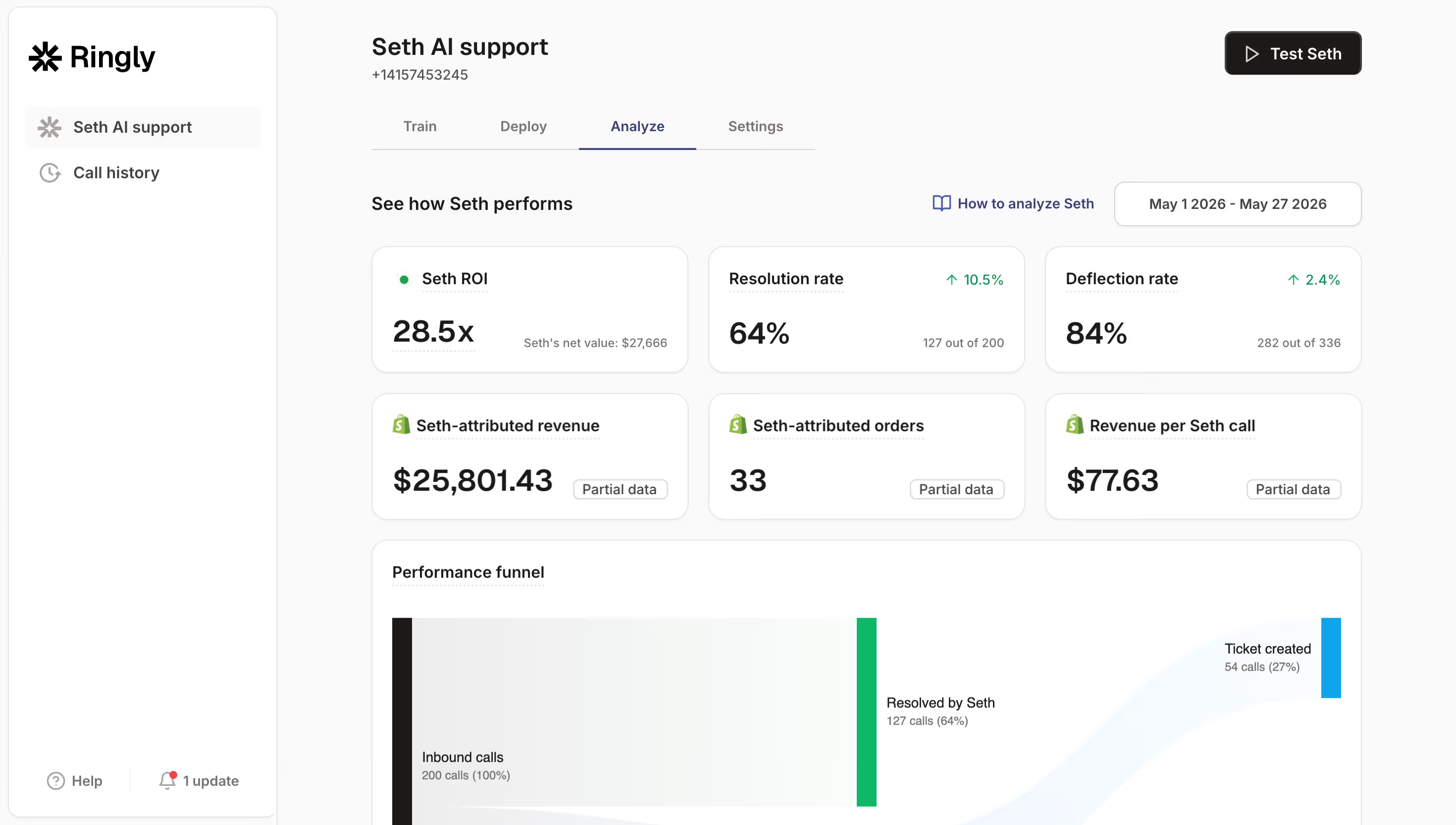
For phone support specifically, AI agents like the AI agent from Ringly.io can handle inbound calls 24/7, answering questions, looking up orders, and processing returns.
With a 73% resolution rate without human intervention, it is a practical way to scale support without scaling headcount.
Common ecommerce marketing mistakes to avoid
Even experienced marketers make these errors:
- Ignoring mobile experience: Over half of traffic comes from mobile devices. A poor mobile experience kills conversions.
- Neglecting email list building: Email is your owned channel. Social platforms can change algorithms; your email list is yours.
- Focusing only on acquisition: It is cheaper to retain customers than acquire new ones. Balance your efforts.
- Inconsistent branding across channels: Your brand should feel the same whether someone finds you on Instagram, Google, or email.
- Not tracking the right metrics: Vanity metrics like traffic mean nothing without conversion data.
- Overlooking customer service as marketing: Great support creates word-of-mouth and repeat purchases.
Measuring ecommerce marketing success
The old adage, "If you cannot measure it, you cannot manage it" is especially true for ecommerce marketing. Track these core KPIs:
| Metric | What It Measures | Benchmark |
|---|---|---|
| Conversion Rate | Percentage of visitors who buy | 2-3% average |
| Customer Acquisition Cost (CAC) | Cost to acquire one customer | Varies by industry |
| Average Order Value (AOV) | Average spend per transaction | $50-100 typical |
| Customer Lifetime Value (CLV) | Total revenue per customer | 3x CAC is healthy |
| Return on Ad Spend (ROAS) | Revenue per dollar of ad spend | 4:1 or higher |
| Cart Abandonment Rate | Percentage who leave without buying | 70% average |
Use tools like Google Analytics, your ecommerce platform's native analytics, and your CRM to get a complete picture. When you measure the right things, you can directly link data to real business growth.
Getting started with ecommerce marketing today
If you are just starting out, here is your quick-start checklist:
- Set up analytics: Install Google Analytics and conversion tracking before you spend a dollar on ads.
- Optimize your product pages: Write compelling descriptions, use high-quality images, and ensure fast load times.
- Start collecting emails: Add signup forms with an incentive like a discount or free guide.
- Pick one social channel: Master one platform before trying to be everywhere.
- Create a content plan: Start with one blog post per week answering customer questions.
- Set up abandoned cart emails: This alone can recover 10-15% of lost sales.
- Automate where it makes sense: Tools like Ringly.io's the AI can handle phone support automatically, freeing your team to focus on growth.
You do not need to do everything at once. Start with the fundamentals, measure your results, and scale what works.
Ready to automate your phone support? Try Ringly.io free for 14 days and see how the AI can resolve up to 73% of your customer calls without human intervention.
Direct-to-consumer brands are reshaping ecommerce. See the numbers in our DTC ecommerce statistics for 2026.
If you are evaluating email and marketing platforms, our Maropost alternatives guide compares the top options for ecommerce brands.
Frequently Asked Questions
What is ecommerce marketing?
Ecommerce marketing is the process of promoting and selling products online using digital strategies like SEO, social media, email campaigns, and paid advertising to attract customers and increase sales.
What are the most effective ecommerce marketing channels?
The most effective channels vary by business, but SEO, email marketing, and social media consistently deliver the highest ROI. PPC advertising works well for quick results, while content marketing builds long-term organic traffic.
How much should I spend on ecommerce marketing?
New brands often allocate 12-20% of revenue to marketing. Established businesses may shift toward organic and retention channels. A common framework is 40% awareness, 30% consideration, 20% conversion, and 10% testing.
What is a good conversion rate for ecommerce?
The average ecommerce conversion rate is around 2.86%. Top-performing stores achieve 3-5% or higher. Focus on improving your rate through better product pages, streamlined checkout, and personalized offers.
How can I reduce cart abandonment?
Address high costs by displaying all final costs upfront. Simplify checkout with guest options and multiple payment methods. Use abandoned cart emails to recover 10-15% of lost sales.
What role does AI play in ecommerce marketing?
AI enables personalization at scale, from product recommendations to dynamic pricing. It also automates repetitive tasks like customer service. AI phone agents like the AI agent from Ringly.io can handle support calls 24/7, resolving most issues without human intervention.
How do I measure ecommerce marketing success?
Track key metrics including conversion rate, customer acquisition cost, average order value, customer lifetime value, and return on ad spend. Use these to optimize your strategy over time.