


Organic search drives 43% of all ecommerce traffic. Yet most online store owners treat search engine optimization as an afterthought rather than a priority.
They pour money into paid ads while neglecting the channel that delivers the highest return on investment over time.
Here's the reality: Google dominates the digital landscape, responsible for nearly 90% of web traffic.
When your store ranks organically for the terms your customers are searching, you capture high-intent visitors who are actively looking to buy. Not browsers. Not researchers. Buyers.
This guide covers everything you need to know about ecommerce SEO in 2026.
From keyword research to technical optimization, you'll learn practical strategies that drive qualified traffic and increase sales without increasing your ad spend.
Editor’s note: Want to hear some sample AI support calls made for your Shopify store?
- Just paste your store URL
- Get sample calls in under 20 seconds (no email required)
- Listen to demo calls for my store
What is ecommerce SEO?
Ecommerce SEO is the process of optimizing your online store to rank higher in search engine results.
Unlike general SEO, which covers any type of website, ecommerce SEO focuses specifically on product pages, category pages, and the unique challenges of selling online.
The goal is simple: when someone searches for products you sell, your store appears at the top of the results.
This matters because organic traffic converts better than paid traffic. Visitors from search results view organic listings as more trustworthy than ads.
They believe these sites earned their positions through quality rather than advertising dollars.
Ecommerce SEO differs from paid advertising in one crucial way: time. Paid ads deliver immediate visibility but stop the moment you stop paying.
SEO requires upfront work but provides lasting advantages. After achieving strong positions, maintaining them becomes less expensive over time, reducing your dependency on ads.
The core components include keyword research to understand what your customers search for, on-page optimization to make your pages relevant, technical SEO to ensure search engines can crawl your site, content strategy to attract links and authority, and link building to boost your site's credibility.
Keyword research for ecommerce SEO
Great ecommerce SEO begins with understanding how people search. It is rarely a straight line. Product names alone are not enough.
Shoppers move through a journey: they ask questions, weigh their options, hesitate, and return. Each search reflects a step in that journey.
Some visitors are just beginning. They enter broad, question-based searches like "best shoes for standing all day."
These are seekers of guidance who are not yet ready to make a purchase but are forming opinions and building trust.
As they continue, their questions grow more focused. In the middle of the funnel, they compare, analyze, and weigh options.
Searches like "leather boots versus synthetic" or "hiking boots with arch support" reveal uncertain intent. They want help deciding, not pushing.
Then comes the moment of clarity. A search like "men's Danner Mountain 600 black size 11" is stripped of ambiguity.
No fluff, no hesitation. This is a buyer ready to purchase.

Amazon is one of the most powerful keyword research tools available. When shoppers search on Amazon, they are actively looking to buy.
Begin typing your seed term and notice how Amazon suggests popular completions. Capture these valuable suggestions as they reflect actual customer language and purchasing patterns.
Long-tail keywords deserve special attention. These are longer, more specific phrases that fewer people search for but tend to attract targeted traffic. "Blue bamboo maxi dresses" or "best organic dog food" may have lower search volume, but the people searching them know exactly what they want.
Build a keyword matrix to organize your efforts. Group keywords not by volume, but by meaning.
A category page that answers five connected questions will consistently outperform five pages competing for the same space. This is the heart of semantic SEO. It makes your site feel coherent to both people and search engines.
Tools like Ahrefs, Semrush, and Google Keyword Planner can help you discover search volumes, competition levels, and related terms.
But never let tools replace your understanding of your customers. The best keyword research comes from listening to the language your customers actually use.
On-page SEO for product pages
Product pages are where intent turns into action. They are the final step in a searcher's journey and carry the full weight of conversion.
When crafted with care, these pages do more than display a product; they answer questions, remove doubt, and invite action.
Start with your page titles. Let them echo the way your customers think and speak.
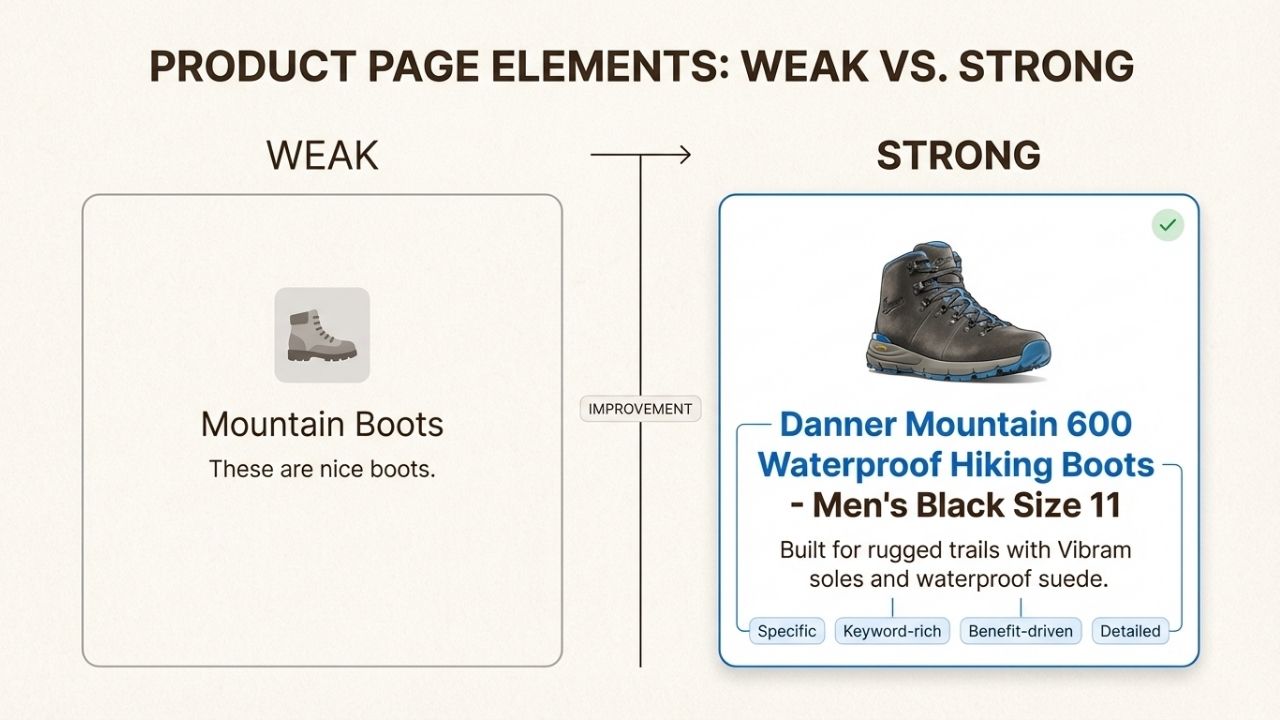
Avoid robotic keyword strings and instead use phrasing that offers clarity and connection. A title like "Danner Mountain 600 Waterproof Hiking Boots – Men's Black Size 11" works better than "Mountain Boots" because it matches exactly what the searcher typed.
Your meta description should invite the click. Offer more than a summary; offer a reason.
Speak to the benefit, set the tone, and create a small spark of confidence that nudges them forward. Keep descriptions under 160 characters for maximum impact.
Product descriptions deserve your full attention. Do not use manufacturer copy.
Write unique descriptions that reflect your brand voice while incorporating relevant keywords naturally.
Describe the item as someone who knows it well would. Highlight not just the features, but also the experience of using it: how it feels, how it fits, and how it solves a problem.
Images should do more than please the eye. Show how the product looks when worn, used, or held. Let the photos answer unspoken questions.
Then support them with alt text that brings those visuals to life for those who cannot see them. Alt text also gives you another opportunity to include keywords and helps you appear in Google image results.
Structured data, also called schema markup, should do its quiet work beneath the surface.
Use it to tag essential product information such as name, price, reviews, and availability. This gives search engines the context they need to generate rich results, and gives shoppers the confidence they need to click.
Internal linking guides visitors to your product pages from blog posts that answer early questions, from category pages that sort and compare, and from curated collections or seasonal guides.
The more paths leading inward, the more likely it is that the right customer will find the right product.
Category page optimization for ecommerce SEO
Category pages do the heavy lifting for scalable ecommerce SEO.
These are the hubs that organize discovery, connect intent to inventory, and serve as natural landing spots for high-intent search queries. If your site is a library, category pages are the aisles, not glamorous, but essential for helping people find what they need.
Category pages match how people search when they know the type of product they want, but not the exact one.
Searches like "trail running shoes," "baby shower gifts," or "vegan protein snacks" land here. These are mid-to-bottom-of-funnel queries with high conversion potential.
Optimized correctly, these pages can rank for non-branded, high-volume terms, capture comparison and navigational intent, consolidate internal link equity from across the site, and scale across hundreds or thousands of product groupings.
Write meaningful intro copy for each category page. Above the fold, include one to two short paragraphs that define the collection in natural, customer-friendly language. Use synonyms, context, and user questions to enhance your writing.
A page titled "Winter Jackets" could mention warmth ratings, waterproofing, and prevalent subtypes like parkas or puffers.
Faceted navigation helps users refine by size, material, brand, or use case.
When implemented with care, filters also expose long-tail variations without fragmenting ranking potential. Use canonical tags wisely to consolidate filter variations to their primary page. Only index filtered URLs when they map to clear search demand and show substantial product depth.
Technical SEO essentials for ecommerce
Search engines judge your store before a single product is seen.
If your site loads slowly, breaks on mobile devices, or fails to convey its contents clearly, you lose the race before it even begins.
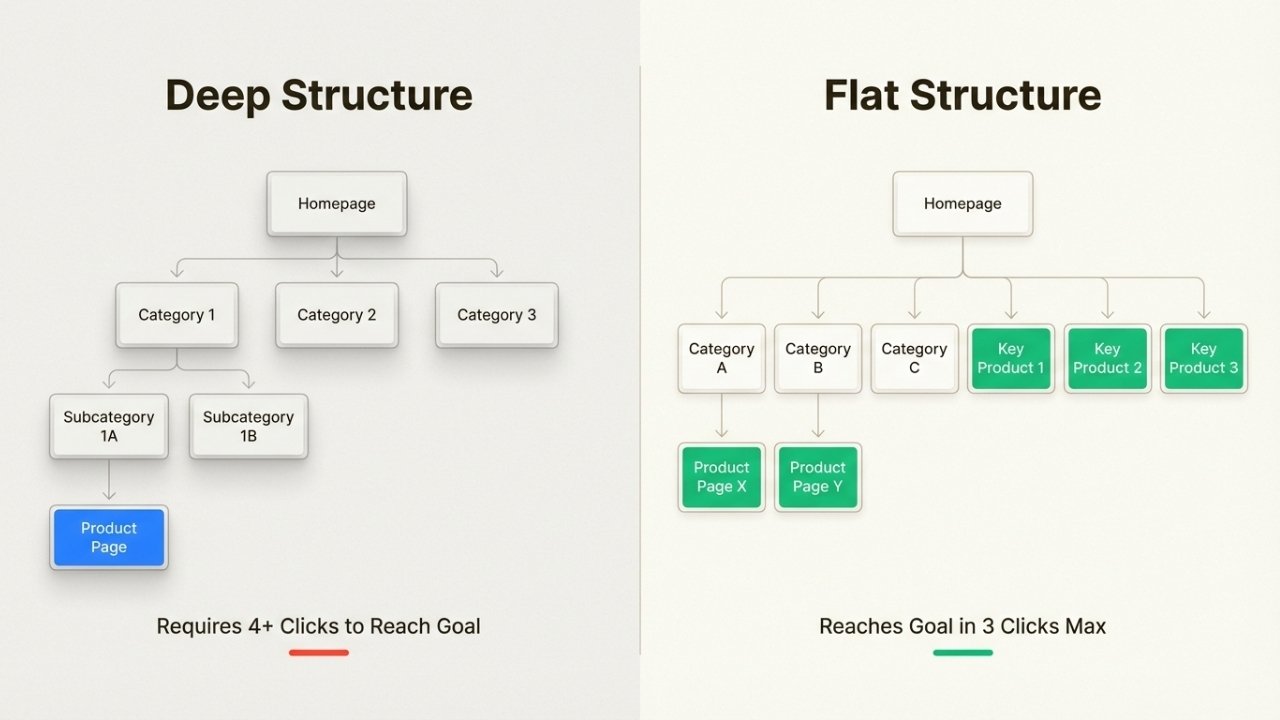
Site architecture is the foundation. A flat structure ensures that every product is reachable in three clicks or fewer from the homepage.
This minimizes orphaned pages and maximizes crawl depth. Deep structures bury your products and waste the crawl budget. Think hierarchy, not haphazard menus.
Core Web Vitals affect how quickly and smoothly your site loads, especially on mobile devices.
Google expects ecommerce sites to be fast, stable, and responsive. Your Largest Contentful Paint should be under 2.5 seconds, First Input Delay under 100 milliseconds, and Cumulative Layout Shift under 0.1. Use tools like PageSpeed Insights to track and improve your performance.
Mobile-first indexing means Google uses your mobile site as the primary source of truth.
If your mobile version lacks important content or structure, your entire SEO performance suffers. Ensure all content, structured data, and metadata appear on your mobile view.
Page loading speed directly impacts your bottom line. Conversion rates drop by 7% with just a one-second delay in loading time.
Three-second delays cause an alarming 20% reduction in completed purchases. Properly size and compress your product photos to minimize file sizes without sacrificing quality.
Products won't last forever, but the way you handle them can protect or destroy your SEO gains.
For temporarily out-of-stock items, leave the page live with expected restock information.
For permanently discontinued items, redirect to the closest relevant product or category using a 301 redirect. Preserve SEO equity by avoiding problematic 404 errors unless the product has no successor and no remaining traffic.
Content strategy beyond product pages
The most effective ecommerce content marketing starts by understanding what your shoppers are searching for and why.
Blog posts, buying guides, and comparison pages capture interest early in the funnel. "Best of" lists and "how to" articles cater to high-intent queries from users seeking advice or reassurance before making a purchase.
Buying guides target transactional keywords and earn backlinks naturally. Gift guides target seasonal keywords.
Comparison posts like "brand X vs brand Y" target long-tail keywords from shoppers in the evaluation phase. FAQ pages provide helpful content that earns backlinks and captures voice search queries.
Quality content naturally attracts backlinks, strengthening your site's authority and improving page rankings across hundreds of long-tail keywords.
Better rankings drive increased traffic and sales. Content isn't just an add-on; it's essential to your ecommerce marketing strategy, driving engagement, building loyalty, and generating revenue.
User-generated content like reviews also contributes to SEO. Reviews add fresh content to your pages, incorporate natural language and long-tail keywords that customers use, and build trust signals that improve conversion rates.
Encourage customers to leave detailed reviews and display them prominently on product pages.
Link building for ecommerce SEO
While content draws users in, authority helps you outrank competitors.
That's where link building becomes essential, not as an afterthought, but as a central part of your ecommerce SEO strategy.
High-quality backlinks drive authority, and authority drives visibility.
To compete in search, your product and category pages need more than just good content; they need external validation.
Evergreen content is a powerful strategy for earning inbound links. These are well-researched, often data-driven resources that remain relevant over time.
Annual guides or regularly updated "Best of" lists are especially effective. When hosted on a consistent URL, these pages can grow in authority as media outlets and industry-related businesses reference and share them over time.
Influencer outreach involves connecting with individuals in your industry who have a strong online presence.
Create a seasonal or topic-focused guide related to your niche and invite influencers to contribute a quote, tip, or product recommendation.
After publishing, let them know you featured them. This approach encourages them to link back from their website while expanding your reach to new audiences.
Broken link building is a proactive and mutually beneficial approach. Identify broken links on other websites and offer your relevant content as a replacement. T
ools like Check My Links or Ahrefs Broken Link Checker can help you find opportunities.
Contact site owners with a courteous email explaining the broken link and suggesting your page as a high-quality alternative.
Guest posting isn't just a link-building tactic; it's a way to build lasting relationships through content collaboration.
When you contribute to another brand's blog or newsletter, you're not just borrowing their audience; you're adding value to it.
Look for opportunities with niche blogs in your industry, popular newsletters read by your target audience, and SaaS partner blogs.
Measuring ecommerce SEO success
Unlike pay-per-click advertising, which delivers immediate results, SEO is a long-term investment that builds sustainable growth over time.
This difference in timeframe affects how you measure success.
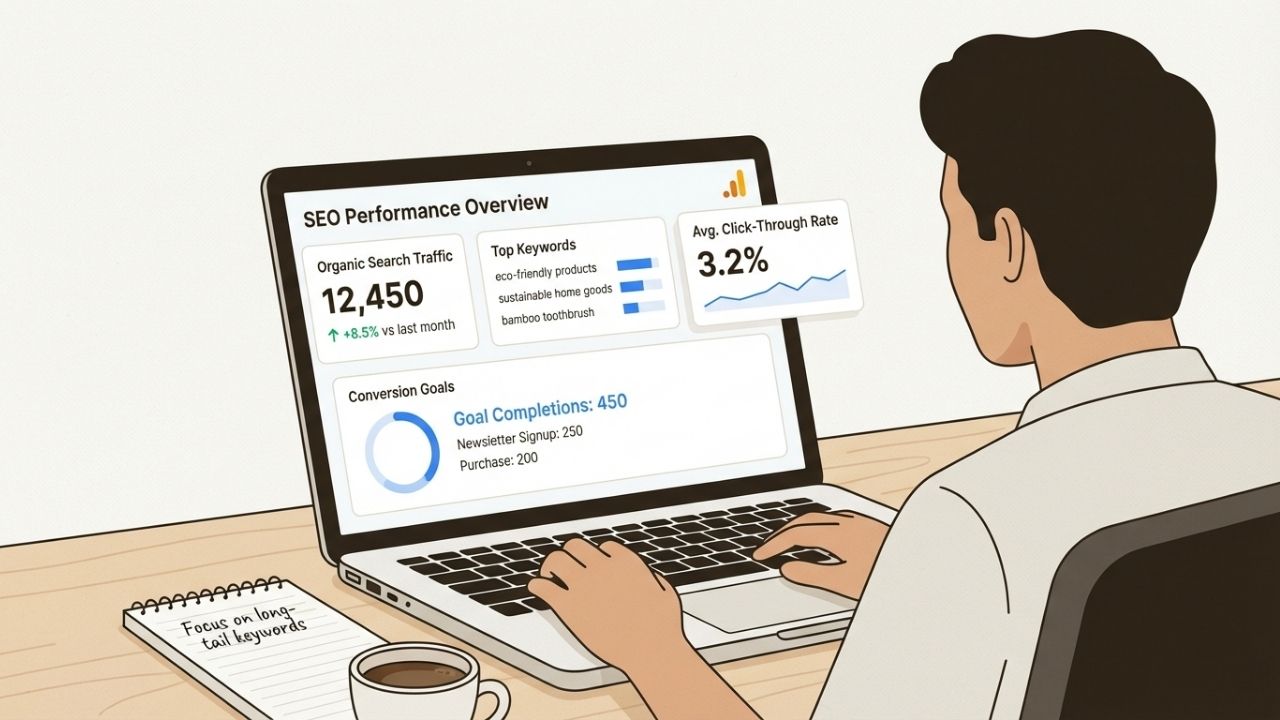
Start with three core KPIs. Organic sessions signal visibility and demand. Revenue from organic search is the most precise measure of bottom-line impact.
Conversion rate reveals how well your pages are turning traffic into sales.
For larger ecommerce sites, track growth-oriented KPIs such as the number of indexed pages, the volume of keywords driving traffic, and trends in impressions or click-through rates. These reveal how your SEO presence is expanding across search engines.
Google Analytics 4 shows you how organic visitors behave once they land, whether they browse, bounce, or make a purchase.
Google Search Console reveals how they found you in the first place, including the specific queries used, your rankings, and click-through rates over time.
Together, these tools provide a comprehensive view of the whole funnel, from search to sale.
Use GA4 to track ecommerce revenue, funnel behavior, and conversion paths. Use Search Console to monitor changes in top queries, page impressions, and click-through rates.
SEO often plays a supporting role in the customer journey. Customers may search first, then return to convert later through another channel.
Use GA4 attribution reports to demonstrate how SEO supports assisted conversions, particularly for purchases that require more consideration or involve longer sales cycles.
Future-proofing your ecommerce SEO
Organic visibility is no longer guaranteed. As search continues to evolve, zero-click experiences, personalized results, and AI-generated summaries are reshaping how users discover products.
SEO strategies must adapt, shifting from focusing solely on rankings to building presence across multiple discovery formats.
AI-driven tools like Google's AI Overviews, ChatGPT Search, and Perplexity increasingly summarize content within search results, reducing the need for users to click through.
To stay visible, your brand needs to be referenced in those summaries, not just listed in the top 10.
An AI search visibility tool can help businesses track how their products and content appear across AI-powered search experiences and identify gaps in their discovery strategy.
To increase your chances of being featured in AI-generated responses, use structured data to help AI tools parse your content more effectively. Write concise, answer-focused content with summaries and scannable key takeaways near the top of each page.
Build topical authority by creating tightly connected content clusters around key product categories. Cite sources and share original insights to build credibility.
Voice search optimization means using conversational phrasing that matches how people speak rather than type.
Visual search requires descriptive image alt text and high-quality product photography. Ensure your content is accessible to devices beyond the desktop screen.
E-E-A-T signals (Experience, Expertise, Authoritativeness, Trustworthiness) matter for ecommerce.
Display author bios for your content, cite credible sources, maintain transparent business information, and showcase customer reviews and testimonials. These signals build trust with both users and search engines.
Start driving organic traffic to your store
Ecommerce SEO is about more than showing up in results. It's about aligning your site with how people search.
Match keywords to intent. Build product pages that answer real questions. Strengthen your category architecture to support the full journey.
Every search is a signal. Every page should respond with purpose.
The brands that succeed will be the ones that create findable, fast, and useful experiences wherever search happens.
This means resilient architecture, technical precision, and a strategy that connects content, links, systems, and performance.
While you're building your organic traffic strategy, don't forget about the customers who prefer to call. Ringly.io offers AI phone support that handles inbound calls 24/7, answering questions, looking up orders, and processing returns.
the AI, their AI phone rep, resolves around 73% of calls without human intervention, letting you focus on growing your business while maintaining excellent customer service.
Start with the fundamentals. Conduct your keyword research. Optimize your product pages.
Fix your technical issues. Create content that earns links. Measure what matters. And remember: SEO is a long game, but it's one worth playing.
Product search and discovery tools shape how shoppers find items in your store. See our comparison of Attraqt alternatives for other options.
Frequently Asked Questions
How long does ecommerce SEO take to show results?
Ecommerce SEO typically takes 3-6 months to show meaningful results, and 6-12 months for significant traffic growth. Unlike paid ads, which deliver immediate visibility, SEO compounds over time. Early efforts focus on technical fixes and content creation, while later months see the cumulative effect of rankings, backlinks, and authority building.
What is the most important factor for ecommerce SEO success?
Understanding and matching search intent is the most critical factor. It's not just about ranking for high-volume keywords; it's about ranking for the right keywords that indicate buying intent. A page ranking for 'buy running shoes online' will convert better than one ranking for 'history of running shoes,' even if the latter has more search volume.
Should I use manufacturer product descriptions for ecommerce SEO?
No. Using manufacturer descriptions creates duplicate content issues and provides no unique value to search engines or customers. Write original product descriptions that reflect your brand voice while incorporating relevant keywords naturally, and address specific customer questions or concerns about the product.
How do I handle out-of-stock products for SEO?
For temporarily out-of-stock items, keep the page live with expected restock dates and alternative product suggestions. For permanently discontinued items, use a 301 redirect to the closest relevant product or category page. Avoid 404 errors when possible, as they waste the SEO equity those pages have built.
What are the best tools for ecommerce SEO?
Essential tools include Google Search Console and Google Analytics 4 (free), Ahrefs or Semrush for keyword research and competitor analysis, Screaming Frog for technical audits, and PageSpeed Insights for performance monitoring. For Shopify stores, additional apps like SEO Manager or Plug in SEO can help automate common optimization tasks.
How important are customer reviews for ecommerce SEO?
Customer reviews are very important. They add fresh, unique content to your product pages, incorporate natural language and long-tail keywords that real customers use, improve click-through rates when displayed in search results through review schema, and build trust signals that improve conversion rates. Encourage detailed reviews and respond to them to show engagement.
Can I do ecommerce SEO myself or should I hire an agency?
You can handle ecommerce SEO yourself if you have the time to learn and implement best practices. Start with the fundamentals: keyword research, on-page optimization, and technical fixes. As your store grows or if you lack the time, consider hiring an SEO consultant or agency. Look for providers with ecommerce experience and case studies showing measurable results for online stores.