
Here's a number that should keep ecommerce owners up at night: 64% of online shopping happens in the evening, when most human support teams have clocked out.
Your customers are browsing, asking questions, and ready to buy while your support inbox sits empty.
This is where conversational AI chatbots come in. These aren't the rigid, rule-based bots from five years ago that could only respond with "Please select from the following options."
Modern conversational AI understands context, generates human-like responses, and learns from every interaction.
The conversational AI market is growing fast, from $12.24 billion in 2024 to a projected $61.69 billion by 2032.
For ecommerce businesses, this technology has shifted from a nice-to-have to a competitive necessity.
This guide covers what these chatbots actually do, where they deliver ROI, and how to choose the right platform for your store.
Editor’s note: Want to hear some sample AI support calls made for your Shopify store?
- Just paste your store URL
- Get sample calls in under 20 seconds (no email required)
- Listen to demo calls for my store
What is a conversational AI chatbot for ecommerce?
A conversational AI chatbot for ecommerce is software that simulates human conversation to help online shoppers.
Unlike traditional chatbots that follow rigid decision trees, modern conversational AI uses natural language processing (NLP) and machine learning to understand what customers actually mean, even when they phrase things differently than expected.
The evolution happened quickly. Early chatbots were essentially interactive FAQs.
They could handle "What are your shipping times?" but would break if someone asked "How long until my package arrives?"
Today's systems understand that these are the same question. They can also generate responses in real-time rather than pulling from pre-written scripts.
The technology stack typically includes:
- Natural Language Processing (NLP) to interpret customer intent
- Generative AI to create contextual responses
- Machine learning to improve from each conversation
- Integrations with your ecommerce platform, inventory, and order management systems

These chatbots fit into the customer journey at multiple points. Before purchase, they help with product discovery.
During checkout, they reduce abandonment. After the sale, they handle tracking, returns, and support.
The goal isn't to replace human agents entirely but to handle the repetitive 70-80% of inquiries so your team can focus on complex issues.
7 proven use cases for ecommerce chatbots
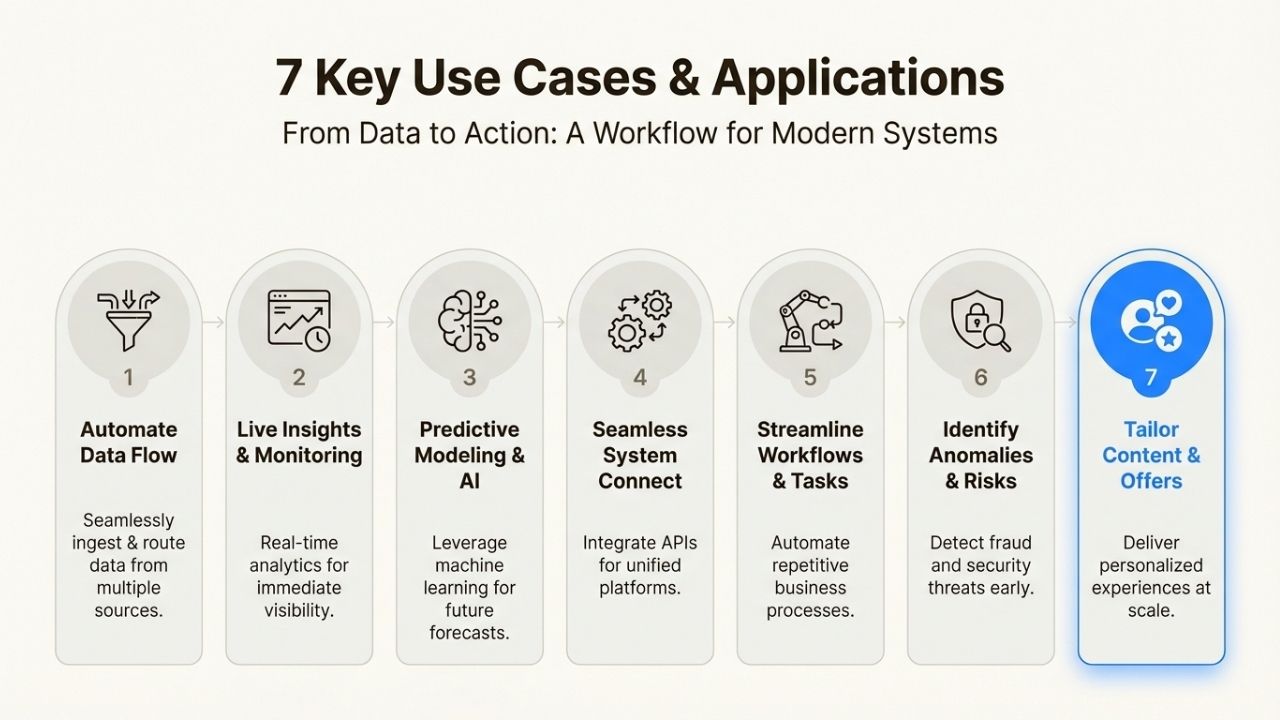
Let's break down where these chatbots actually deliver value. The use cases fall into three buckets: driving sales, reducing costs, and improving experience.
1. Product discovery and recommendations
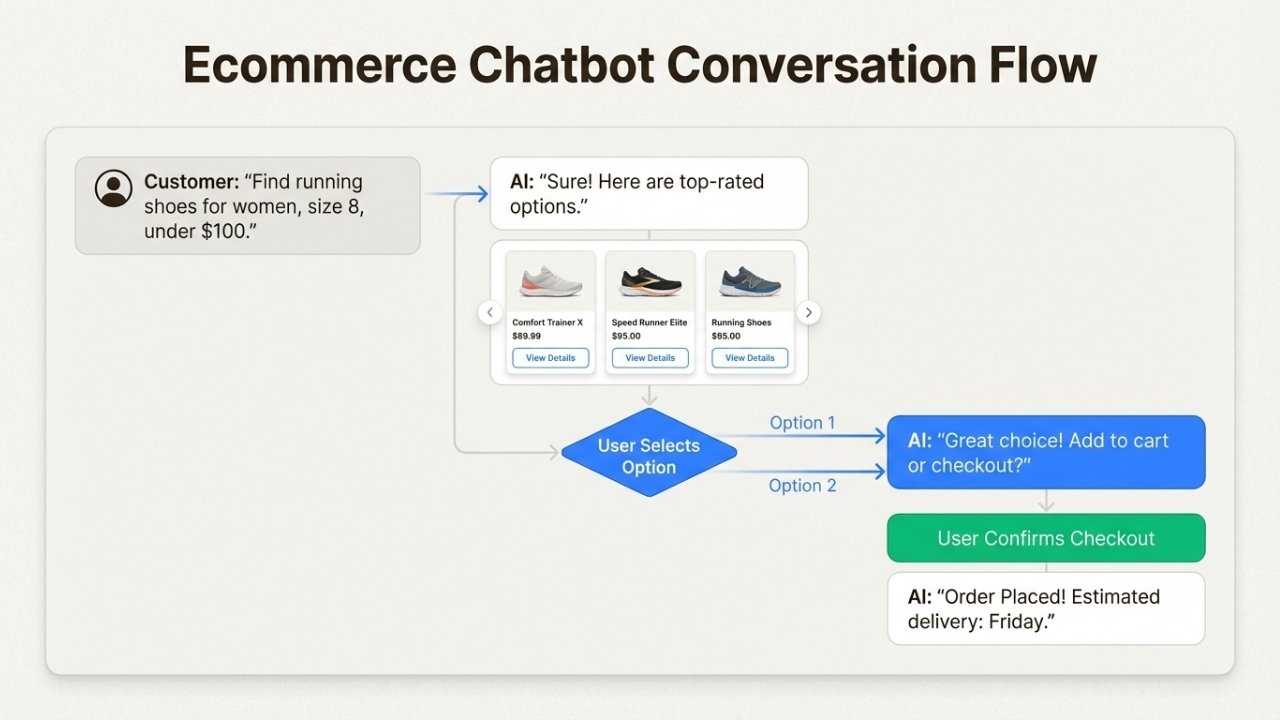
Shoppers often know what they need but not what to search for. A conversational AI chatbot acts like an in-store associate, asking questions to narrow down options.
Instead of scrolling through 500 pairs of jeans, a customer can say "I need dark-wash slim jeans for a summer wedding under $100."
The AI filters your catalog instantly and shows the top matches. It can also suggest alternatives if items are out of stock.
This matters because 69% of consumers go straight to the search bar when visiting an ecommerce site, but 80% leave because the search experience disappoints. Conversational AI catches the browsers who need guidance.
2. Customer support automation
This is the most mature use case. Chatbots handle the repetitive questions that eat up agent time: order status, return policies, shipping costs, and product availability.
The metrics here are compelling. Gorgias reports their AI resolves 60% of support inquiries without human intervention.
Rep AI claims 95%+ resolution rates for website inquiries. Mister Spex, a European eyewear retailer, automated 70% of their identity verification queries and 52% of "where's my order" issues.
The savings add up. IBM research shows conversational AI can decrease customer service costs by up to 30%.
3. Cart abandonment recovery
Average cart abandonment rates sit at 70.22%. That's a lot of potential revenue walking out the virtual door.
Conversational AI helps by engaging customers at the moment of hesitation.
When someone pauses at checkout, the chatbot can proactively offer help with pricing questions, shipping concerns, or product specs.
Research from Rep AI shows proactive conversation approaches can achieve 35% recovery rates.
The key is timing. A popup five seconds after arrival is annoying. A helpful message when someone's been staring at the checkout page for 30 seconds is welcome.
4. Order management and post-purchase support
The sale isn't the end of the relationship. Customers want tracking updates, delivery notifications, and easy returns processing.
Conversational AI handles these workflows end-to-end. Customers can ask "Where's my order?" and get real-time tracking.
They can initiate returns, generate labels, and receive refunds without waiting for an agent.
This matters for retention. How you handle problems often matters more than the transaction itself.
A smooth returns experience builds loyalty; a frustrating one drives customers to competitors.
5. Upselling and cross-selling
AI chatbots can increase average order value through personalized suggestions. The approach differs from static "You might also like" banners.
- Strategic upselling: When a customer views a mid-range camera, the AI might suggest a premium model, explaining the specific benefits (4K video, better battery) that justify the price jump.
- Contextual cross-selling: If someone adds a tent to their cart, the AI asks if they need a sleeping bag or lantern, bundling complementary items in the conversation.
- Smart timing: Unlike static banners, conversational AI chooses the right moment, whether during discovery, at checkout, or post-purchase.
Clerk.io reports their AI increases order value by 35.4% on average.
6. Lead generation and qualification
Not every visitor is ready to buy. Chatbots can capture contact information and qualify leads through conversational forms.
Instead of a static form asking for name, email, and company, the chatbot can ask "What brings you to our site today?" and route the conversation based on the response. Hot leads get transferred to sales immediately. Cooler leads enter nurture sequences.
7. Market research and analytics
Every conversation is data. Chatbots collect zero-party data (information customers voluntarily share) that would be expensive or impossible to gather otherwise.
You can identify:
- Common questions that aren't answered on your site
- Reasons customers hesitate at checkout
- Product requests you don't currently offer
- Language and terminology your customers actually use
Key benefits and ROI metrics
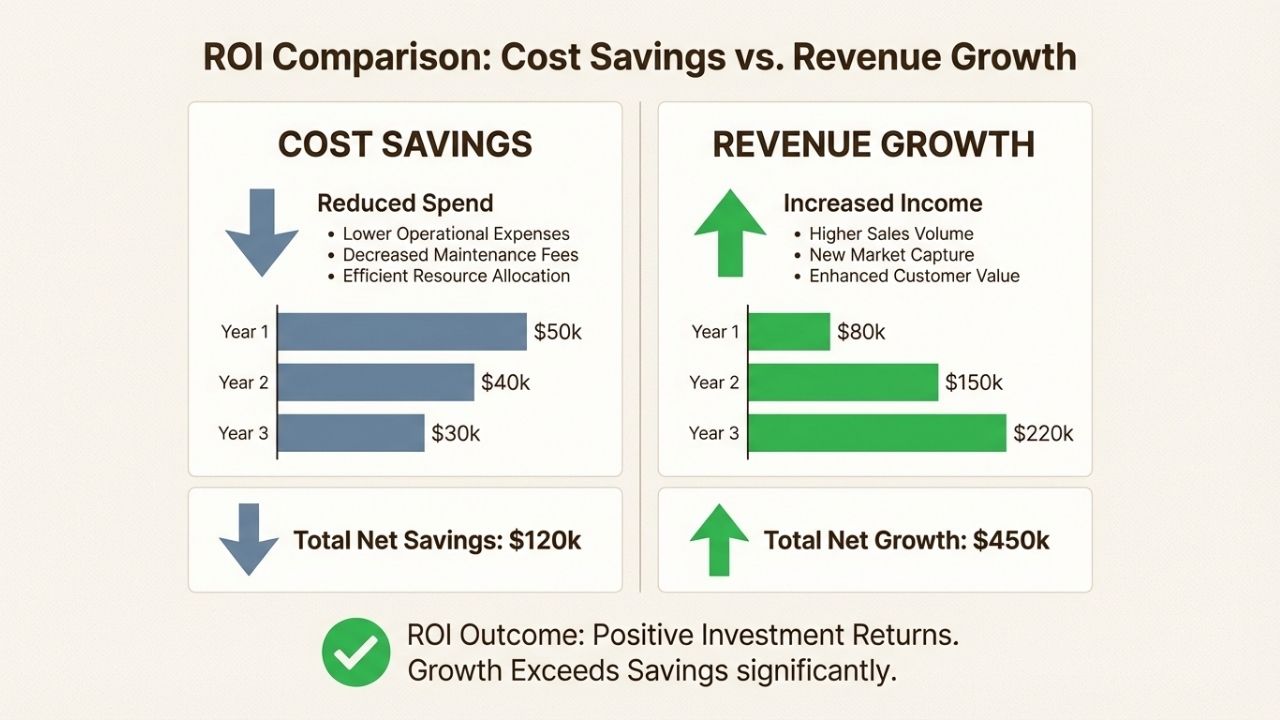
Let's talk numbers. Businesses don't adopt technology because it's cool. They adopt it because it moves metrics that matter.
Operational efficiency
The cost argument is straightforward. A chatbot can handle thousands of simultaneous conversations. Humans cannot.
- IBM research: up to 30% reduction in customer service costs
- Rep AI reports 20x+ return on investment for their customers
- Mister Spex saved 30 seconds per call on identity verification alone
The efficiency gains aren't just about replacing humans.
They're about letting humans do what humans do best (complex problem-solving, empathy, judgment) while automation handles the repetitive work.
Revenue impact
Chatbots aren't just cost centers. They're revenue generators.
- Rep AI customers report 12%+ conversion rates with AI sales chatbots
- Average order value increases of 16%+
- Underoutfit (a Rep AI customer) saw a 315% increase in conversion rate
- NutraBio reported 17% sales increase and 20%+ conversion rates
The mechanism is simple: faster answers, better recommendations, and 24/7 availability convert more browsers into buyers.
Customer experience improvements
The experience benefits are harder to quantify but equally important.
- 88% of customers are willing to pay more for great customer experience
- 72% of consumers are more likely to be loyal to brands offering personalization
- 24/7 availability means no more "Our support hours are 9-5 EST" frustration
Top conversational AI platforms compared
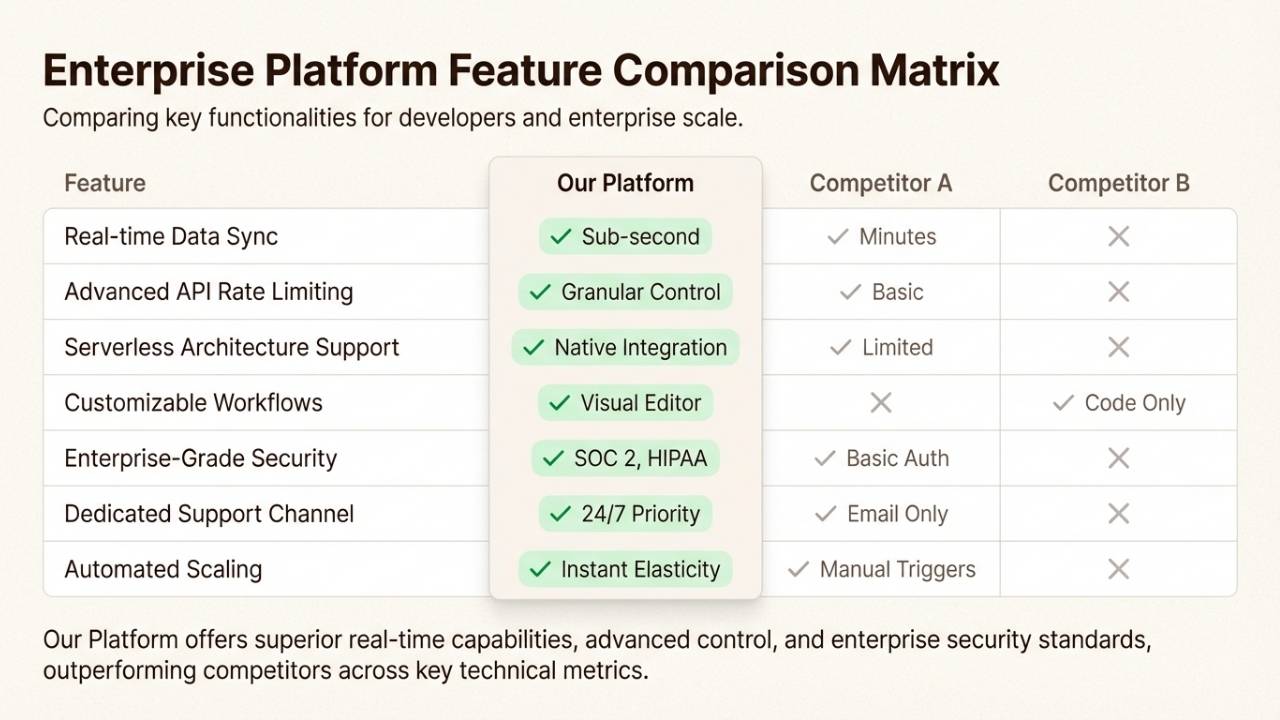
The platform landscape is crowded. Here's how the major players stack up.
| Platform | Best For | Starting Price | Key Strength |
|---|---|---|---|
| Gorgias | Shopify stores needing unified support | Custom pricing | Resolves 60% of inquiries, deep Shopify integration |
| Rep AI | Shopify sales and support automation | Custom pricing | 95%+ inquiry resolution, 20x ROI |
| Clerk.io | Product recommendations + chat | Custom pricing | 35.4% AOV increase, predictive AI |
| Tidio | Small businesses wanting live + AI | Free plan, $29/mo | Lyro AI, easy setup |
| Intercom | Omnichannel messaging | $74/mo | Fin AI, workflow automation |
| ChatBot.com | Visual bot building | 14-day free trial | Drag-drop builder, multichannel |
| ManyChat | Social media messaging | Free, $15/mo | Instagram/WhatsApp focus |
Platform selection criteria
Choosing the right platform depends on your specific situation:
Integration capabilities: Does it connect to your ecommerce platform? Shopify stores have the most options (most platforms offer native apps). Magento and BigCommerce users need to check API availability.
AI sophistication: Some platforms offer simple FAQ bots. Others use advanced NLP and generative AI. Match the sophistication to your needs. A small store doesn't need enterprise-grade AI.
Pricing transparency: Some platforms publish clear pricing. Others require sales calls. If you're price-sensitive, start with the transparent options.
Implementation complexity: Can you set it up yourself, or do you need a developer? Most modern platforms offer no-code setups, but complexity varies.
Multilingual support: If you sell internationally, check language capabilities. Some platforms support 40+ languages; others are English-only.
How to choose the right conversational AI chatbot for your store
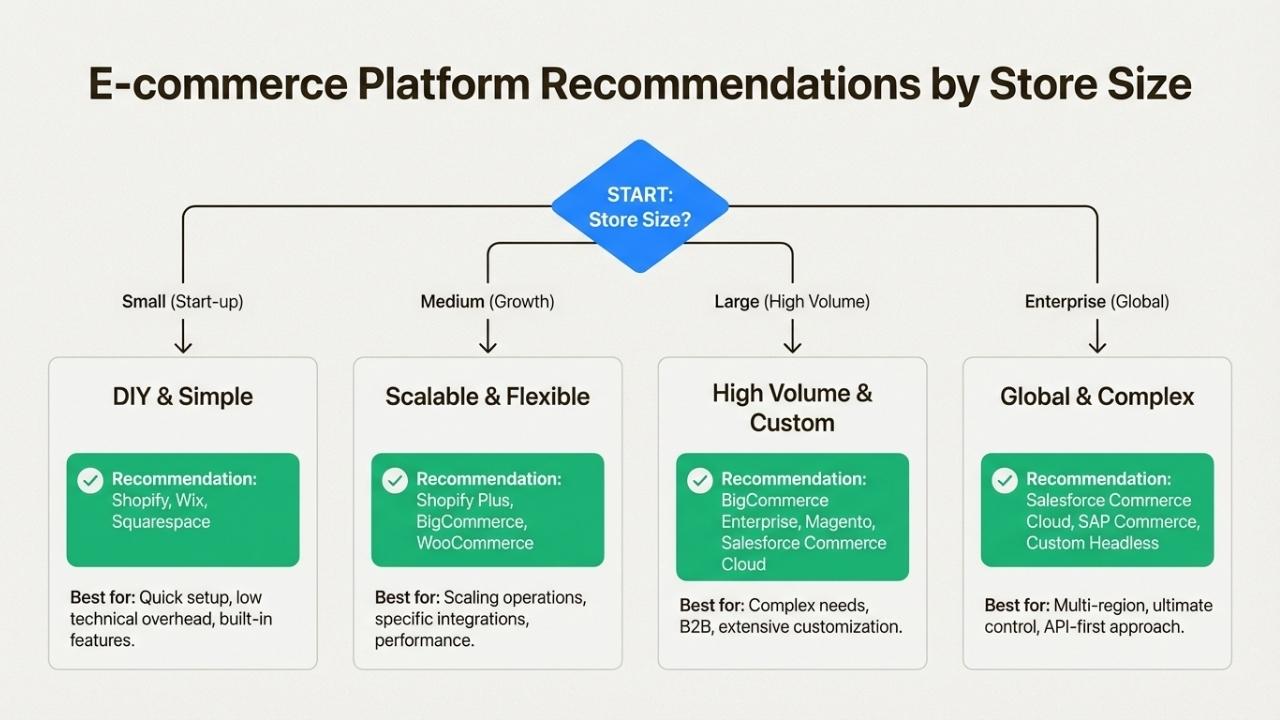
Let's get practical. Here's a framework for matching your needs to the right platform.
Small stores (under 1,000 monthly visitors)
Start simple. You probably don't need advanced AI or complex workflows.
- Tidio offers a free plan with 100 chatbot triggers
- ManyChat is free for Instagram and Facebook Messenger
- ChatBot.com has a 14-day free trial to test the waters
Focus on answering common questions and capturing leads. You can always upgrade as you grow.
Growing stores (1,000-50,000 monthly visitors)
At this stage, automation starts delivering real ROI.
- Rep AI specializes in Shopify sales and support
- Gorgias offers unified support across channels
- Clerk.io combines chat with product recommendations
Look for platforms that integrate deeply with your store data. The more context the AI has (order history, browsing behavior, inventory levels), the better it performs.
Enterprise stores (50,000+ monthly visitors)
You need robust infrastructure, custom integrations, and dedicated support.
- Intercom offers enterprise features and SLAs
- Cognigy provides advanced AI for complex use cases
- Crescendo.ai specializes in multimodal AI for retail
At this scale, implementation support matters as much as features. You'll want a dedicated success team and custom integration help.
Key questions to ask vendors
Before committing, get answers to these questions:
- What's your average resolution rate for businesses like mine?
- How long does implementation typically take?
- What integrations do you offer beyond Shopify/Magento/BigCommerce?
- How do you handle escalation to human agents?
- What's your pricing model (per conversation, per month, per agent)?
- Do you offer a free trial or pilot program?
Implementation best practices
Buying the platform is just the start. Here's how to get actual results.
Start narrow
Don't try to automate everything on day one. Pick one high-volume, low-complexity use case. Order tracking is a common starting point. It's repetitive, customers want it 24/7, and the data is structured.
Once that works, expand to returns, then product recommendations, then sales assistance.
Train with quality data
Your chatbot is only as good as what you teach it. Upload your:
- Knowledge base articles
- FAQ documents
- Return and shipping policies
- Product catalogs
The more context the AI has, the better it performs. Review and update this content quarterly.
Design for brand voice
Your chatbot is an extension of your brand. If you're a playful fashion brand, your bot should sound different than a serious B2B supplier.
Most platforms let you customize tone, language, and response style. Take the time to get this right. A chatbot that sounds robotic undermines the personal experience you're trying to create.
Plan human handoffs
Some conversations need humans. The best chatbots know when to step aside.
Set clear escalation triggers:
- Customer requests a human
- Sentiment detection shows frustration
- Query falls outside trained topics
- High-value transaction at stake
The handoff should include full conversation context so the human agent doesn't make the customer repeat themselves.
Monitor and optimize
Launch is just the beginning. Review transcripts weekly. Look for:
- Questions the bot couldn't answer
- Responses that confused customers
- Opportunities to add new capabilities
Most platforms offer analytics dashboards. Use them.
Common pitfalls to avoid
- Overpromising: Don't claim your bot can do things it can't. Set realistic expectations.
- Hiding the human option: Always make it easy to reach a person. Forcing customers to fight through a bot creates frustration.
- Set and forget: AI models need ongoing training. Schedule regular review sessions.
- Ignoring edge cases: Plan for angry customers, unusual requests, and system failures.
Getting started with AI-powered customer support
Let's recap. Conversational AI chatbots for ecommerce have evolved from simple FAQ tools to sophisticated sales and support assistants.
They drive revenue through better recommendations and reduced abandonment.
They cut costs by automating repetitive inquiries. They improve experience with 24/7 availability and instant responses.
The technology is mature enough that early adoption advantages have passed. Now it's about keeping up.
Your competitors are implementing these tools. Your customers are coming to expect them.
If you're just starting, pick a platform with a free trial. Set up a simple use case. Measure results. Expand from there.
And remember: chatbots handle text conversations, but phone support still matters for complex issues and high-value customers.
That's where Ringly.io comes in. Our AI phone agent, the AI, handles inbound calls with the same sophistication as chatbots handle text.
He answers questions, looks up orders, processes returns, and escalates when needed. All while you focus on growing your business.
Ready to see what AI can do for your support? Start your free trial today.
Frequently Asked Questions
What is a conversational AI chatbot for ecommerce?
It's AI-powered software that simulates human conversation to help online shoppers. Unlike old rule-based bots, modern conversational AI understands natural language, generates contextual responses, and learns from interactions to handle product recommendations, support questions, and sales assistance.
How much does a conversational AI chatbot for ecommerce cost?
Pricing varies widely. Entry-level options like Tidio and ManyChat offer free plans. Mid-tier platforms typically run $29-74 per month. Enterprise solutions like Intercom or Gorgias use custom pricing based on volume. Most platforms charge based on conversations, features, or agent seats.
Can a conversational AI chatbot for ecommerce really increase sales?
Yes. Rep AI customers report 12%+ conversion rates and 16%+ higher average order values. Clerk.io shows 35.4% increases in order value. The mechanism is simple: instant answers, personalized recommendations, and 24/7 availability convert more browsers into buyers.
How long does it take to implement a conversational AI chatbot for ecommerce?
Simple setups take hours. Most platforms offer no-code implementations that connect to Shopify or other stores in minutes. More complex configurations with custom workflows and extensive training data might take 1-2 weeks. Enterprise implementations with custom integrations can take 1-3 months.
What's the difference between a chatbot and conversational AI for ecommerce?
Traditional chatbots follow rigid scripts and decision trees. They can only respond to specific phrases they've been programmed to recognize. Conversational AI uses natural language processing and machine learning to understand intent, generate unique responses, and improve over time. It's the difference between 'Press 1 for sales' and having an actual conversation.
Will a conversational AI chatbot for ecommerce replace my human support team?
No. The goal is augmentation, not replacement. Chatbots handle the repetitive 60-70% of inquiries (order tracking, FAQs, returns) so humans can focus on complex issues requiring empathy and judgment. Most successful implementations use a hybrid approach with seamless handoffs between AI and humans.
What are the main use cases for conversational AI chatbots in ecommerce?
The seven primary use cases are: product discovery and recommendations, customer support automation, cart abandonment recovery, order management and post-purchase support, upselling and cross-selling, lead generation and qualification, and market research through conversation analytics.
Also read: