

Crescendo AI has made a name for itself with a fully managed approach to customer support automation.
Their pitch is simple: you get AI agents plus human support services bundled together, all for a per-resolution price starting at $1.25.
But that model is not for everyone. Some teams want to keep support in-house and just need better tools.
Others prefer software-only solutions without the bundled services.
And some need specialized features for ecommerce, phone support, or specific integrations.
This guide covers 7 of the best Crescendo AI alternatives, comparing their pricing models, key features, and ideal use cases.
Whether you are looking to switch or just exploring your options, you will find a platform that fits your needs.
Editor’s note: Want to hear some sample AI support calls made for your Shopify store?
- Just paste your store URL
- Get sample calls in under 20 seconds (no email required)
- Listen to demo calls for my store
What is Crescendo AI?
Crescendo AI is a fully managed customer experience platform that combines AI automation with human support services. Unlike software-only solutions, Crescendo handles deployment, integration, ongoing maintenance, and even provides human agents for escalations.

Their pricing starts at $1.25 per resolution plus a fixed monthly fee (around $2,900 for managed services).
They claim 99.8% accuracy and support 50+ languages across chat, voice, email, and SMS.
The appeal is clear: you outsource your entire support operation.
But that also means less control, higher costs at scale, and dependence on their team for changes and optimization.
Why consider Crescendo AI alternatives?
There are several reasons teams look for alternatives:
Different pricing preferences. Crescendo uses per-resolution pricing, which can get expensive if you have high ticket volumes.
Per-agent or flat-rate models might work better depending on your volume.
In-house teams. If you already have a skilled support team, you might just want tools to make them more efficient, not a full outsourcing solution.
Technical requirements. Some platforms require engineering resources (like Decagon), while others are no-code and quick to set up (like Ringly.io).
Industry-specific needs. Ecommerce brands often need deep Shopify integration. SaaS companies might prioritize proactive messaging.
Phone-heavy businesses need voice-first solutions.
Comparison at a glance
Here is how the 7 alternatives stack up across key dimensions:
| Platform | Best for | Pricing model | Key differentiator |
|---|---|---|---|
| Zendesk | Enterprise teams | Per-agent ($19-169/mo) | 1200+ app marketplace |
| Intercom | SaaS companies | Per-agent + per-resolution ($29-132/mo + $0.99/resolution) | Modern AI-first messaging |
| Decagon | Technical enterprises | Custom quote | Full code-level control |
| Gorgias | Ecommerce brands | Per-ticket ($10-900/mo) | Deep Shopify integration |
| HubSpot Service Hub | HubSpot CRM users | Per-agent ($15-150/mo) | Unified CRM data |
| Forethought | Complex workflows | Custom quote | Modular AI agents |
| Ringly.io | Phone support | Flat rate ($349-$799/month) | 3-minute setup, phone-focused |
1. Zendesk
Zendesk is the established leader in customer support software, serving over 130,000 brands globally.
If you need a mature platform with extensive customization and an app ecosystem, this is it.

Key features
- AI agents for email and messaging (5-15 automated resolutions per agent/month included)
- Omnichannel support across email, chat, phone, social, and WhatsApp
- 1,200+ app integrations via the Zendesk Marketplace
- Advanced analytics and customizable reporting
- Skills-based routing and SLA management
Pricing
| Plan | Annual price | Key features |
|---|---|---|
| Support Team | $19/agent/month | Email, ticketing, basic automations |
| Suite Team | $55/agent/month | + AI agents, messaging, live chat, phone |
| Suite Professional | $115/agent/month | + 5 help centers, CSAT, skills-based routing |
| Suite Enterprise | $169/agent/month | + 300 help centers, sandbox, audit logs |
Add-ons like Advanced AI Agents, Copilot ($50/agent), and Quality Assurance ($35/agent) can add up quickly.
Best for
Mid-to-large enterprises that need an established platform with extensive integrations and do not mind the complexity that comes with it.
Pros and cons
- Pros: Mature ecosystem, extensive customization, strong analytics, industry standard
- Cons: Higher cost at scale, complex setup, many features require upgrades
2. Intercom
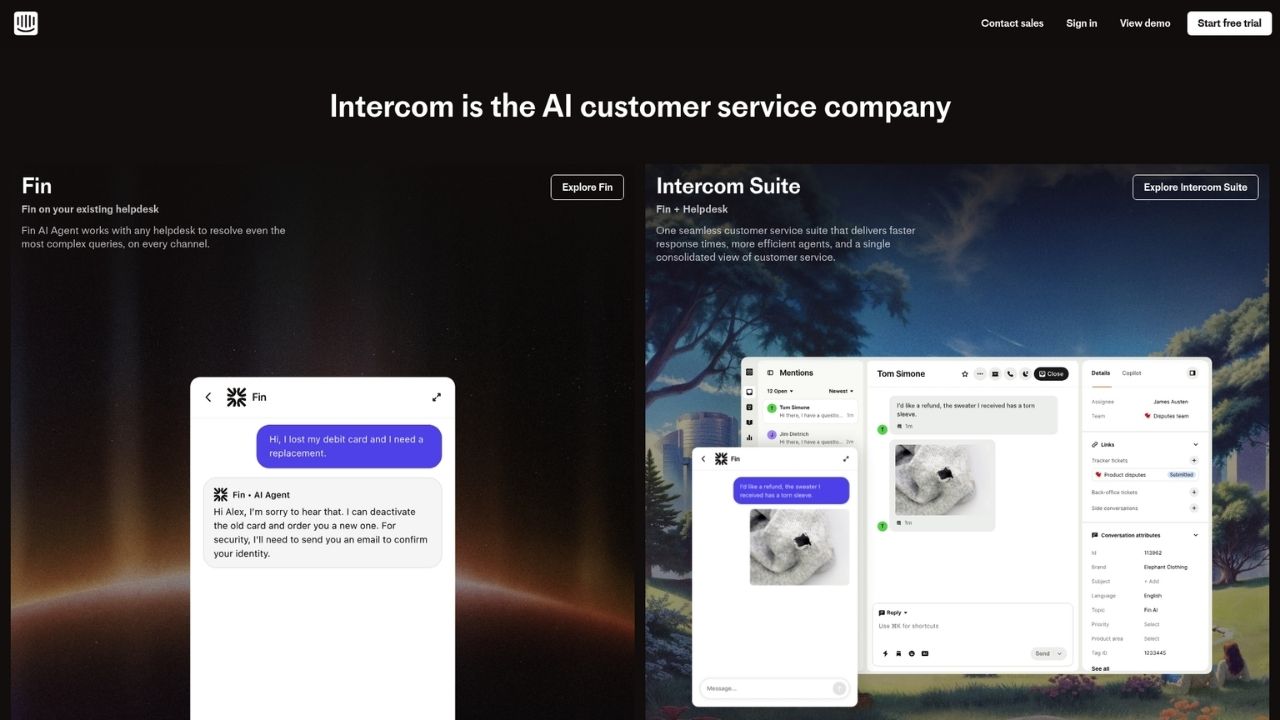
Intercom has repositioned itself as an AI-first customer service platform.
Their Fin AI Agent is one of the more advanced options, and the modern interface appeals to tech-forward teams.
Key features
- Fin AI Agent at $0.99 per resolution
- AI-powered inbox and ticketing system
- Proactive messaging and outbound campaigns
- 450+ app integrations
- Real-time and asynchronous messaging
Pricing
| Plan | Annual price | Key features |
|---|---|---|
| Essential | $29/seat/month | Fin AI Agent, messenger, shared inbox, help center |
| Advanced | $85/seat/month | + Multiple inboxes, workflow automation, 20 Lite seats |
| Expert | $132/seat/month | + SSO, HIPAA, SLA, multibrand, 50 Lite seats |
Fin AI Agent resolutions are $0.99 each across all plans. Copilot add-on is $29/agent/month for unlimited usage.
Best for
SaaS companies and startups wanting a modern messaging platform with strong AI capabilities.
Pros and cons
- Pros: Modern interface, strong AI, good for product-led growth
- Cons: AI features cost extra, can get expensive with add-ons, per-seat pricing adds up
3. Decagon
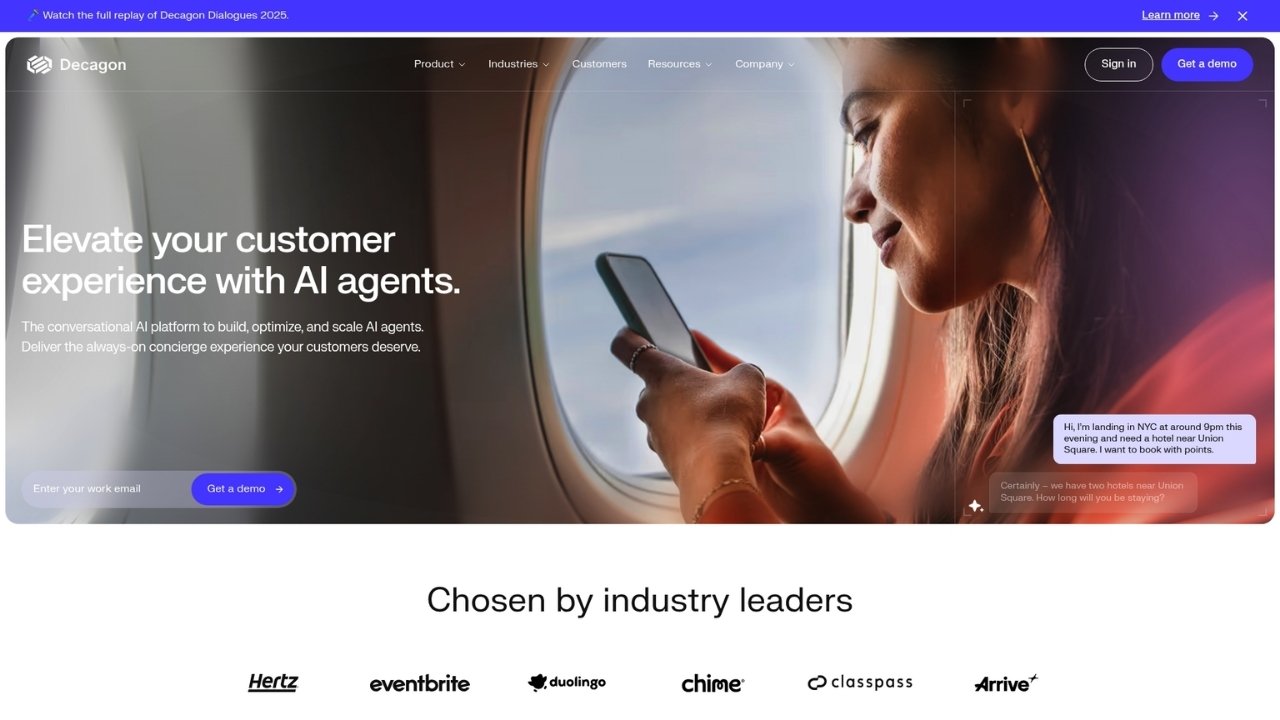
Decagon takes a different approach. Instead of a managed service, they give you the tools to build your own AI agents with code-level control. This is for teams with engineering resources who want full customization.
Key features
- Agent Operating Procedures (AOPs) configured in plain English
- Agent Assist copilot for human agents
- Multi-agent architecture for complex workflows
- Deep integrations built by your engineering team
- Used by Rippling, Sonos, and WeightWatchers
Pricing
Decagon does not publish pricing. They offer two models:
- Per-conversation: Flat rate per interaction
- Per-resolution: Higher rate, only pay when AI solves without human
You will need to book a demo for a custom quote.
Best for
Large enterprises with dedicated engineering teams who want full control over AI behavior and deep system integrations.
Pros and cons
- Pros: Highly customizable, powerful for complex workflows, deep integrations
- Cons: Requires engineering team, no managed services, opaque pricing
4. Gorgias
Gorgias is built specifically for ecommerce. If you run a Shopify store and want support automation that understands orders, shipping, and returns, this is worth considering.

Key features
- Deep Shopify, Shopify Plus, Magento, and BigCommerce integration
- Order-aware automation (returns, refunds, tracking)
- AI Agent for ecommerce-specific tasks
- Omnichannel support including social media
- 150+ integrations including Klaviyo, Recharge, Yotpo
Pricing
| Plan | Monthly Price | Tickets Included | AI Agent Price |
|---|---|---|---|
| Starter | $10/month | 50/month | $1.00/resolution |
| Basic | $60/month | 300/month | $1.00/resolution* |
| Pro | $360/month | 2,000/month | $1.00/resolution* |
| Advanced | $900/month | 5,000/month | $1.00/resolution* |
| Enterprise | Custom | 5,000+/month | Custom |
Overage costs range from $32-40 per 100 tickets depending on your plan.
Best for
Ecommerce brands on Shopify wanting deep store integration and order-aware automation.
Pros and cons
- Pros: Ecommerce-native, automates order lookups, strong integrations
- Cons: Limited outside ecommerce, pricing scales with volume
5. HubSpot Service Hub
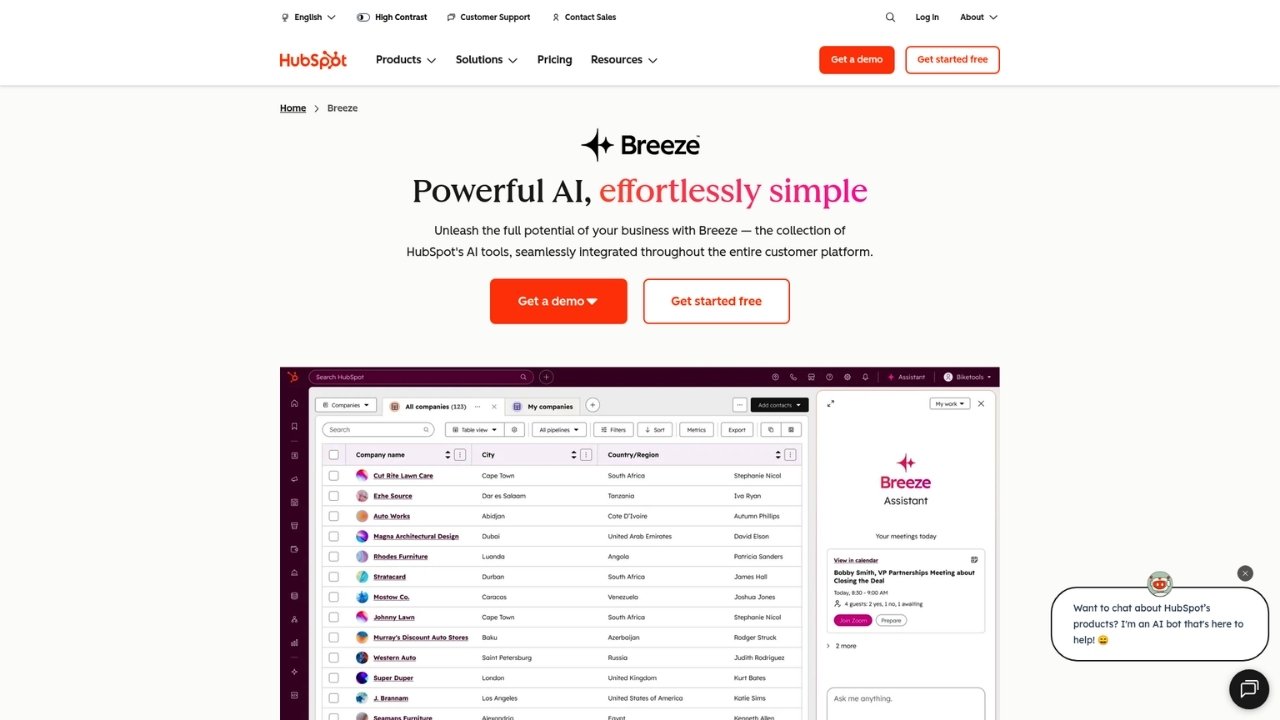
If you are already using HubSpot for marketing or sales, Service Hub gives you a unified view of customer interactions across departments. The CRM integration is the main selling point.
Key features
- Native CRM integration for unified customer data
- AI-powered chat and automation
- Ticketing and help desk
- Knowledge base and self-service portal
- Advanced reporting and forecasting
Pricing
| Plan | Annual Price | Key Features |
|---|---|---|
| Free | $0 | Basic ticketing, email, live chat, shared inbox |
| Starter | $15/seat/month | Simple automation, 500 calling mins, meeting scheduling |
| Professional | $90–100/seat/month (+$1,500 onboarding) | AI chatbot, knowledge base, SLAs, custom reporting |
| Enterprise | $150/seat/month (+$3,500 onboarding) | Advanced AI agents, playbooks, conversation intelligence, SSO |
Advanced permissions, forecasting, conversation intelligence
Note that AI chatbot features cost extra on Professional and Enterprise plans.
Best for
Teams already invested in the HubSpot ecosystem who want unified customer data across marketing, sales, and support.
Pros and cons
- Pros: CRM integration, comprehensive reporting, scalable
- Cons: AI chatbot costs extra, expensive onboarding, overkill for simple needs
6. Forethought
Forethought uses a modular approach with specialized AI agents for different support functions.
This is useful if you have complex routing needs or operate in regulated industries.
Key features
- Multi-Agent Architecture (Discover, Solve, Triage, Assist)
- Autoflows reasoning engine for complex workflows
- AI Copilot for agent assistance
- Industry-specific deployments (fintech, healthcare)
- Smart ticket classification and routing
Pricing
Forethought does not publish pricing. They offer three tiers (Basic, Professional, Enterprise) with quote-based pricing.
Many features are add-ons, so costs can add up.
Best for
Enterprise teams needing modular AI with smart routing, especially in regulated industries with complex workflows.
Pros and cons
- Pros: Specialized AI agents, good for regulated industries, workflow automation
- Cons: Many features are add-ons, requires configuration, higher total cost
7. Ringly.io
Ringly.io takes a different approach from the others on this list. Instead of trying to handle every channel, they focus specifically on phone support for ecommerce stores.

Their AI agent, the AI, handles inbound calls 24/7. It can look up orders, process returns and exchanges, answer FAQs, and escalate to humans when needed.
Setup takes about 3 minutes, and the platform integrates directly with Shopify.
Key features
- 24/7 AI phone support (not just chat)
- Shopify integration for real-time order data
- Handles returns, exchanges, and order tracking
- 30 languages supported
- ~70-73% of calls resolved without human intervention
- Call recordings and transcripts
Pricing
| Plan | Price | Minutes Included | Best for |
|---|---|---|---|
| Grow | $349/month | 1,000 minutes | Growing stores with regular call volume |
| Enterprise | Customnth | 5,000+ minutes | High-volume stores needing custom setup |
Overage is $0.19 per minute. You can try it free for 14 days, and billing only starts after The AI resolves at least 65% of your first 100+ calls.
Best for
Ecommerce stores that want to offer phone support without hiring a team. If your customers prefer calling over chat, or if you want to capture sales calls that might otherwise go unanswered, this is worth considering.
Pros and cons
- Pros: Phone-specific (not chat), quick setup, resolves most calls automatically, transparent pricing
- Cons: Phone-focused (not omnichannel), ecommerce-centric
You can try Ringly.io free for 14 days and see how it handles your specific call types.
How to choose the right Crescendo AI alternative
The best choice depends on your team size, technical resources, and support strategy.
Choose Zendesk if: You need an enterprise-grade platform with extensive integrations and do not mind the complexity and cost.
Choose Intercom if: You are a SaaS company wanting modern messaging with strong AI capabilities.
Choose Decagon if: You have engineering resources and want full control over AI behavior and workflows.
Choose Gorgias if: You run an ecommerce store on Shopify and need order-aware automation.
Choose HubSpot Service Hub if: You are already using HubSpot CRM and want unified customer data.
Choose Forethought if: You need modular AI for complex routing, especially in regulated industries.
Choose Ringly.io if: Phone support is a priority and you want quick setup without technical work.
Final recommendations
If you want the safest, most established option, go with Zendesk. You will get comprehensive features and a massive app ecosystem, though you will pay for it.
For ecommerce specifically, Gorgias is hard to beat if you are on Shopify. The order-aware automation saves significant time.
If you need phone support specifically, Ringly.io offers the fastest setup and most transparent pricing for that use case.
For teams with technical resources who want maximum control, Decagon gives you code-level customization that Crescendo cannot match.
The key is matching the platform to your actual needs, not just the feature list. A simpler tool that your team actually uses beats a comprehensive platform that sits unused.
Frequently Asked Questions
What are the best Crescendo AI alternatives for small businesses?
For small businesses, Intercom Essential ($29/seat/month) and Gorgias Starter ($10/month) offer affordable entry points. Ringly.io Start ($349/month) is also worth considering if phone support is important to your customers.
How does Crescendo AI pricing compare to alternatives?
Crescendo charges $1.25-2.99 per resolution plus a monthly fee. Alternatives use different models: Zendesk and HubSpot charge per agent, Intercom uses a hybrid (per agent + per resolution), Gorgias charges per ticket, and Ringly.io uses flat-rate pricing based on call minutes.
Which Crescendo AI alternative is best for ecommerce?
Gorgias is specifically built for ecommerce with deep Shopify integration. Ringly.io is also strong for ecommerce if phone support is a priority. Both understand order data and can automate returns, tracking, and refunds.
Are there Crescendo AI alternatives that do not require technical setup?
Yes. Zendesk, Intercom, Gorgias, and Ringly.io all offer no-code setup. Ringly.io specifically advertises quick setup. Decagon requires engineering resources for configuration.
What is the most cost-effective Crescendo AI alternative for high ticket volumes?
For high volumes, per-agent pricing (Zendesk, HubSpot) often works out cheaper than per-resolution pricing. Gorgias Advanced or Enterprise plans also offer better per-ticket rates at Enterprise: custom pricing for 5,000+ minutes) can be cost-effective for phone-heavy operations.
Which Crescendo AI alternative offers the best AI capabilities?
Intercom's Fin AI Agent is highly rated at $0.99 per resolution. Zendesk's AI agents are solid but many advanced features require add-ons. Decagon offers the most customization if you have technical resources. Forethought's modular approach works well for complex workflows.
Can I switch from Crescendo AI to one of these alternatives easily?
Migration complexity depends on your setup. Platforms like Zendesk and HubSpot offer migration tools and professional services. Ringly.io and Gorgias have streamlined onboarding for ecommerce. Plan for 2-4 weeks for full migration including knowledge base transfer and agent training.