

Phone support for ecommerce is having a moment.
Despite the rise of chatbots and self-service portals, customers still reach for the phone when orders go missing, returns get complicated, or they just want to talk to someone.
Intercom launched its native phone solution in 2023, bringing voice calls into the same inbox where chat and email already live.
For ecommerce teams juggling multiple tools, the promise of everything in one place is appealing.
But is it the right fit for your store?
This guide covers what Intercom Phone actually offers, how the pricing works, where it falls short, and when a purpose-built alternative might make more sense.
Editor’s note: Want to hear some sample AI support calls made for your Shopify store?
- Just paste your store URL
- Get sample calls in under 20 seconds (no email required)
- Listen to demo calls for my store
What is Intercom Phone?
Intercom Phone is an omnichannel voice solution built directly into the Intercom platform.
Unlike third-party integrations that sync data between separate systems, calls happen natively within Intercom's unified inbox.
Your support agents see phone calls, video calls, chat messages, and emails in a single view.
When a customer calls, the agent already has their order history, previous conversations, and account details on screen before picking up.
The platform supports inbound calls from 32 countries and outbound calling worldwide.
Intercom handles the telephony infrastructure through Twilio, so you don't need to set up separate phone systems or worry about hardware.
One important caveat: Intercom Phone is only available to customers who joined after November 15, 2023.
If you're on an older Intercom plan, you can't access it unless you were part of the early beta program.
Key features for ecommerce phone support
Intercom Phone includes a solid set of features designed for support teams handling customer calls.
Here's what matters most for online stores.
Omnichannel inbox integration
Every conversation lives in one place. Phone calls, video calls, chats, emails, and tickets all appear in a single inbox.
When a customer who chatted last week calls today, agents see the full history immediately.
This eliminates the context-switching problem.
Agents don't need to toggle between a phone system, a help desk, and a CRM to piece together what happened with an order. The customer's entire journey is visible at a glance.
IVR workflows and call routing
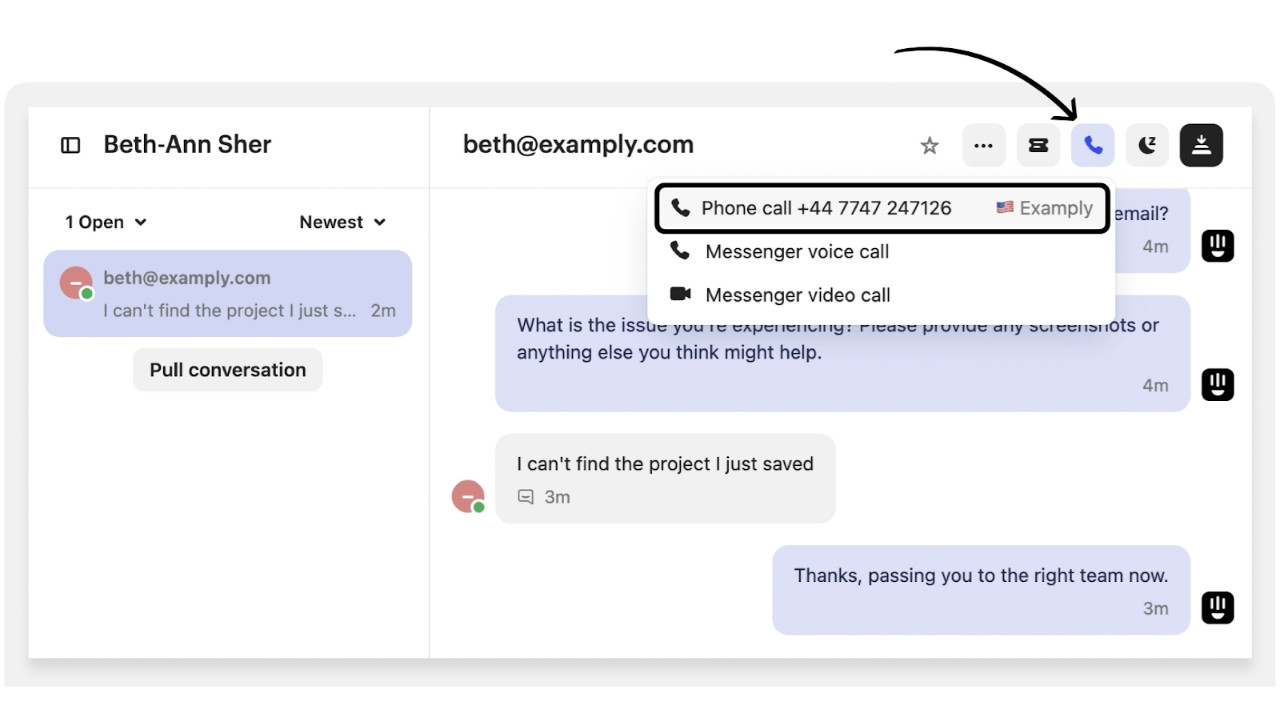
Intercom's no-code IVR builder lets you automate call routing without involving developers.
You can create phone menus, set office hours, offer callbacks instead of hold queues, and route calls based on customer attributes.
For ecommerce, this means sending VIP customers to a dedicated team, routing order issues to fulfillment specialists, or deflecting simple tracking questions to chat.
The workflows support branching logic, so you can build fairly complex routing without writing code.
Messenger calls, video, and screen sharing
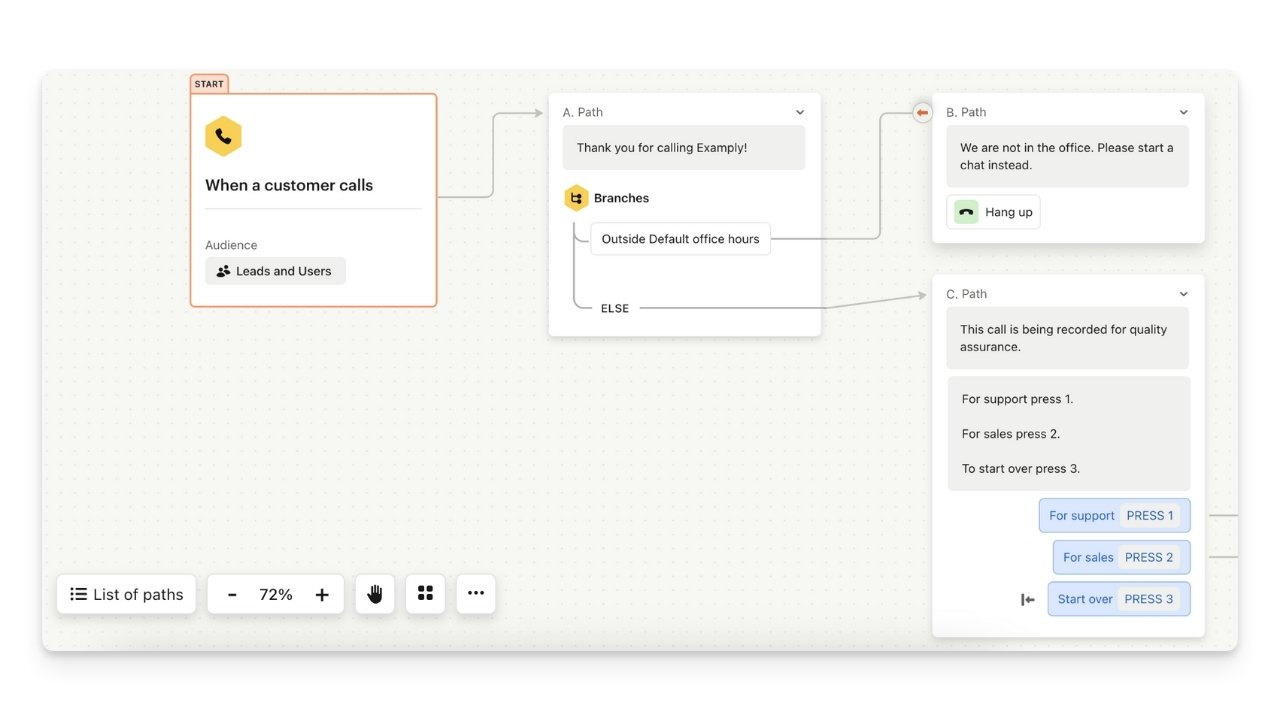
Sometimes a chat conversation needs to become a call. Intercom lets agents transition from text to voice or video without losing context.
The customer doesn't need to repeat themselves.
Screen sharing is particularly useful for complex troubleshooting.
If a customer can't find the right button in your checkout or is struggling with a return portal, seeing their screen directly saves time.
Call management tools
The platform includes a real-time dashboard for monitoring team availability and call volume.
Call recording and transcription are built in for quality assurance and training purposes.
Voicemail gets automatically transcribed, making it easier to triage messages.
You can set up custom greetings using text-to-speech or upload your own audio files.
Fin AI for ecommerce phone support
Intercom's Fin AI agent brings automation to phone support. It's designed to handle customer queries automatically before escalating to human agents.
Fin uses retrieval-augmented generation (RAG) to ground its answers in your actual support content.
The company claims it resolves over 50% of customer queries automatically with a hallucination rate under 1%. It works across 45+ languages with real-time translation.
For phone support specifically, Fin Voice handles natural conversations, answers questions, and connects callers to agents when needed.
You can deploy it on a percentage of calls first, then scale up as confidence grows.

Ecommerce use cases for Fin AI
The AI capabilities map well to common ecommerce support scenarios:
- Order tracking: Fin pulls real-time shipping status, delivery estimates, and tracking links from your order system.
- Returns and exchanges: It guides customers through your return policy and process steps.
- Product availability: Stock levels, size availability, and store locations can be answered automatically.
- Peak season scaling: Black Friday and Cyber Monday volume gets handled without emergency hiring.
The results from actual ecommerce deployments are solid. GoodBuy Gear reported a 50% resolution rate with Fin handling 20% of all customer interactions. Nuuly saw an 11% reduction in monthly contact volume after implementation.
Intercom Phone pricing breakdown
Intercom Phone uses usage-based pricing, which means your monthly bill depends on how much you actually use it.
This is different from flat-rate models where you pay the same amount regardless of call volume.
How the pricing model works
You pay across multiple dimensions:
| Pricing Component | How It's Charged |
|---|---|
| Phone numbers | $1/month per active local or toll-free number |
| Inbound minutes (US local) | $0.012/minute |
| Outbound minutes (US/Canada) | $0.022/minute |
| Messenger calls | $0.03/minute |
| Call recordings/transcripts | $0.0035/minute |
Rates vary significantly by region. Alaska calls cost $0.116/minute while Hawaii is $0.022/minute.
International rates add another layer of complexity.
Billing rounds to the nearest minute. A 2:35 call gets billed as 3 minutes. On short calls, this rounding adds up.
Limitations and drawbacks to consider
Intercom Phone has real strengths, but it also has gaps that matter for ecommerce businesses. Here's an honest assessment.
Plan availability restrictions
This is the biggest blocker: you must have joined Intercom after November 15, 2023 to access Phone.
Legacy customers can't use it unless they were in the early beta program.
If you're already running Intercom on an older plan, you'd need to migrate to new pricing to get phone support.
That's a significant decision that affects your entire customer service stack.
Unpredictable monthly costs
Usage-based pricing sounds flexible, but it creates budget uncertainty. Your bill will spike during peak seasons.
Black Friday, Cyber Monday, and holiday sales can easily double or triple your normal call volume.
There's no monthly cost cap. The minute rounding means short calls cost more per actual second of conversation.
If your customers frequently call with quick questions, those 30-second calls are getting billed as full minutes.
Missing caller ID and number control
You can't customize your assigned phone number or control how your company name displays on caller ID.
Customers see a generic number when you call them.
Worse, these numbers sometimes get flagged by phone carriers. Your outbound calls might show up as "Scam Likely" on customer phones.
The workaround involves manually registering with carrier databases, which is time-consuming and not guaranteed to work.
Credit card handling limitations
Intercom Phone is not PCI-DSS compliant for processing card information.
If a customer needs to share payment details over the phone, agents must manually pause the recording.
This is a manual workaround, not a system-enforced control.
It creates compliance risk if agents forget to pause, and it's awkward in the middle of a customer conversation.
Geographic restrictions
Inbound phone numbers are only available in 32 countries.
If your ecommerce store sells globally, some markets won't have local number options.
Toll-free numbers are limited to the US and Canada.
For customers outside North America, they're either paying international rates or calling a US number.
Mobile SDKs don't support Messenger calls, which limits the in-app calling experience for customers using your mobile app.
Ringly.io: a purpose-built alternative for ecommerce phone support
If you want AI phone support designed specifically for online stores, Ringly.io takes a different approach.
Instead of adding phone features to a broader platform, it focuses entirely on ecommerce phone automation.
Ringly.io's AI agent, the AI, handles inbound calls 24/7. It answers questions, looks up orders, processes returns and exchanges, and escalates to your team only when necessary.
The platform resolves approximately 70-73% of calls without human intervention, based on data from over 2,100 Shopify store deployments.
Setup takes about 3 minutes. You install the Shopify app, pick a phone number, and deploy.
No workflow configuration, no developer involvement, no complex IVR building.

The pricing model is more predictable. Instead of pure usage-based billing, you get included minutes with each plan:
| Plan | Price | Included Minutes | Overage Rate |
|---|---|---|---|
| Grow | $349/mo | 1,000 minutes | $0.19/min |
| Enterprise | Custom | 5,000+ minutes | $0.19/min |
You know your base cost upfront. Overages are straightforward at $0.19 per minute.
When to choose Ringly.io over Intercom Phone
The right choice depends on your situation. Here's how they compare:
| Factor | Intercom Phone (Fin Voice) | Ringly.io |
|---|---|---|
| Primary focus | Omnichannel platform with phone add-on | Purpose-built ecommerce phone AI |
| Pricing model | Usage-based ($0.99/resolution + seat fees) | Included minutes with flat overage ($0.19/min) |
| Shopify integration | Deep native integration (Certified Plus Partner) | Native, direct integration (3-minute setup) |
| AI resolution rate | ~60-65% (Fin AI Engine) | ~70-73% (Seth AI) |
| Setup time | Requires workflow & procedure configuration | Average 4 minutes to live |
| Plan availability | Sales quote required for Fin Voice | Publicly available (Start, Grow, Scale) |
| Languages | 45+ (Fin) / 28+ (Fin Voice) | 40+ |
If you're already on Intercom's new plans and want everything in one inbox, Intercom Phone makes sense.
The omnichannel integration is genuinely useful when your team handles chat, email, and phone together.
If you're running a Shopify store and want the highest AI resolution rate with predictable costs, Ringly.io is built for exactly that use case.
The native Shopify integration means the AI knows your products, orders, and policies out of the box.
Start a free trial to see how The AI handles your customer calls.
Getting started with ecommerce phone support
Choosing a phone support solution comes down to a few key factors.
Current tech stack matters. If you're already deep in Intercom's ecosystem, adding Phone keeps everything unified. If you're starting fresh or primarily use other tools, a specialized solution might integrate better.
Budget predictability needs vary. Usage-based pricing works well when call volumes are steady and predictable. If your business has significant seasonal swings, included-minute plans make forecasting easier.
Ecommerce platform integration counts. Shopify stores benefit from native integrations that automatically pull order data. Generic solutions require more setup to achieve the same context-awareness.
Resolution rate affects staffing. The difference between 50% and 70%+ automated resolution means fewer calls reaching human agents. That translates directly to headcount and response time.
For teams already on Intercom's new plans, Phone integrates seamlessly into existing workflows. For Shopify stores prioritizing AI resolution and cost predictability, Ringly.io offers a more focused solution that gets up and running faster.
Frequently Asked Questions
What is Intercom phone support for ecommerce, and how does it work?
Intercom Phone is a native voice solution that brings phone calls into Intercom's unified inbox alongside chat and email. For ecommerce, it provides customer context (order history, previous conversations) before agents answer, plus IVR automation for routing common queries.
How much does Intercom phone support for ecommerce cost?
Intercom Phone uses usage-based pricing. You pay per minute for inbound calls (from $0.012/min for US local), outbound calls ($0.022/min for US/Canada), and recordings ($0.0035/min), plus $1/month per phone number. Costs vary by region and number type.
Can small ecommerce stores afford Intercom phone support?
It depends on call volume. The usage-based model means low-volume stores pay less, but there's no cost cap during busy periods. Stores with unpredictable or seasonal volume may find flat-rate alternatives more budget-friendly.
What are the main limitations of Intercom phone support for ecommerce businesses?
Key limitations include plan availability (only for customers who joined after November 2023), no caller ID customization, unpredictable monthly costs, no PCI-compliant card handling, and inbound numbers limited to 32 countries.
How does Fin AI improve Intercom phone support for ecommerce?
Fin AI resolves 50%+ of queries automatically by pulling answers from your knowledge base. For ecommerce specifically, it handles order tracking, returns guidance, and product availability questions without human intervention.
Is there an alternative to Intercom phone support for ecommerce with better Shopify integration?
Ringly.io offers purpose-built AI phone support with native Shopify integration. Its AI agent the AI achieves 70-73% resolution rates and includes predictable pricing with bundled minutes, making it a strong option for Shopify-focused stores.
What's the setup time for Intercom phone support for ecommerce?
Setup requires configuring IVR workflows, provisioning phone numbers, and training any AI components. The process takes longer than specialized solutions because you're building within a broader platform. Purpose-built alternatives like Ringly.io can deploy in about 3 minutes.