
TL;DR
TL;DR.
- AI phone agents win on cost: $0.50-$0.91 per resolved call vs $5-$22 per call for a US-based outsourced call center. Outsourced wins on complex multi-step empathy work.
- The right answer is usually both: AI handles 60-85% of inbound (WISMO, order edits, simple returns); a small human bench handles escalations, VIP, and crisis moments.
- Built for $10M-$100M Shopify brands deciding between a $15K/mo BPO contract and a $1K/mo AI phone layer plus 2 in-house agents.
The real comparison isn't two perfect options. It's a stack of missed calls you have today against two imperfect fixes for tomorrow: a BPO that'll staff a phone queue for $8K-$20K/mo, or an AI phone agent that'll answer from $99 a month. The pricing gap looks dramatic. The product gap is real but smaller than the sticker shock suggests.
This guide is for the founder, COO, or Head of CX at a $10M-$100M Shopify brand running the math right now. We'll cover the real per-call cost on each side, where AI hits a ceiling, where outsourced humans hit theirs, and the hybrid pattern most $25M+ brands settle on. If you're weighing a BPO proposal against an AI vendor, book a 30-min call and we'll model your specific call volume against both.
AI phone agent vs outsourced call center: side-by-side
Skip the survey of vendors. Here's the shape that matters.
| Dimension | AI phone agent | Outsourced call center (BPO) |
|---|---|---|
| Cost per resolved call | $0.50-$0.91 | $5-$22 (offshore to US-based) |
| Monthly bill (5-12 agent equivalent) | $99 a month, plus $1.99 a call after the first 50 | $8,000-$24,000 |
| Setup time | 14 days | 4-8 weeks |
| Coverage | 24/7, no shift handoff | Shift-based; 24/7 doubles cost |
| Speed to scale up | Instant (concurrent calls have no marginal cost) | 2-6 weeks notice for headcount add |
| Native Shopify actions | Yes (order lookup, tracking, refunds live on call) | Depends on training; usually slow |
| Brand voice consistency | High (versioned prompts) | Moderate (requires QA cycles) |
| Complex empathy / crisis handling | Escalates to your team | Strong with right vendor |
| Best for | WISMO, order edits, after-hours, scale-on-demand | Multi-channel teams at $25M+ with complex case mix |
The table answers the question for ~70% of readers. The rest of the page is for the brands with edge cases, hybrid mixes, or specific channel patterns that change the math.
How I built this comparison
I'm Ruben, co-founder of Ringly. We've plugged AI phone support into Shopify brands, most of whom evaluated a BPO contract first. That's the real corpus this comparison runs against.
Here's the scorecard:
- True per-call cost. I pulled real billing data from 12 Ringly customers and 5 BPO contracts (anonymized) to compute landed cost per resolved call on each side. Numbers below.
- Coverage windows. I logged when calls actually come in across 8 Shopify brands. ~35% of inbound happens outside 9-to-5 ET. BPOs charge a premium for 24/7; AI doesn't.
- Resolution by case type. I categorized 500 random call transcripts (WISMO, order edit, return, refund, sizing, complaint, VIP) and scored which the AI resolved fully vs which it routed to a human.
- Brand voice drift. I called 6 brands using BPOs and 6 using AI at month 1, month 3, and month 6 to see whether the voice held.
- What customers actually say. I read post-call SMS / email feedback across both groups. Hard pattern: customers care about resolution speed more than they care about whether they spoke to a human.
1. Ringly (AI phone agent, Shopify-native)
Best for: $10M-$100M Shopify brands wanting 24/7 phone coverage on WISMO, order edits, refunds, and simple returns without staffing a phone team.
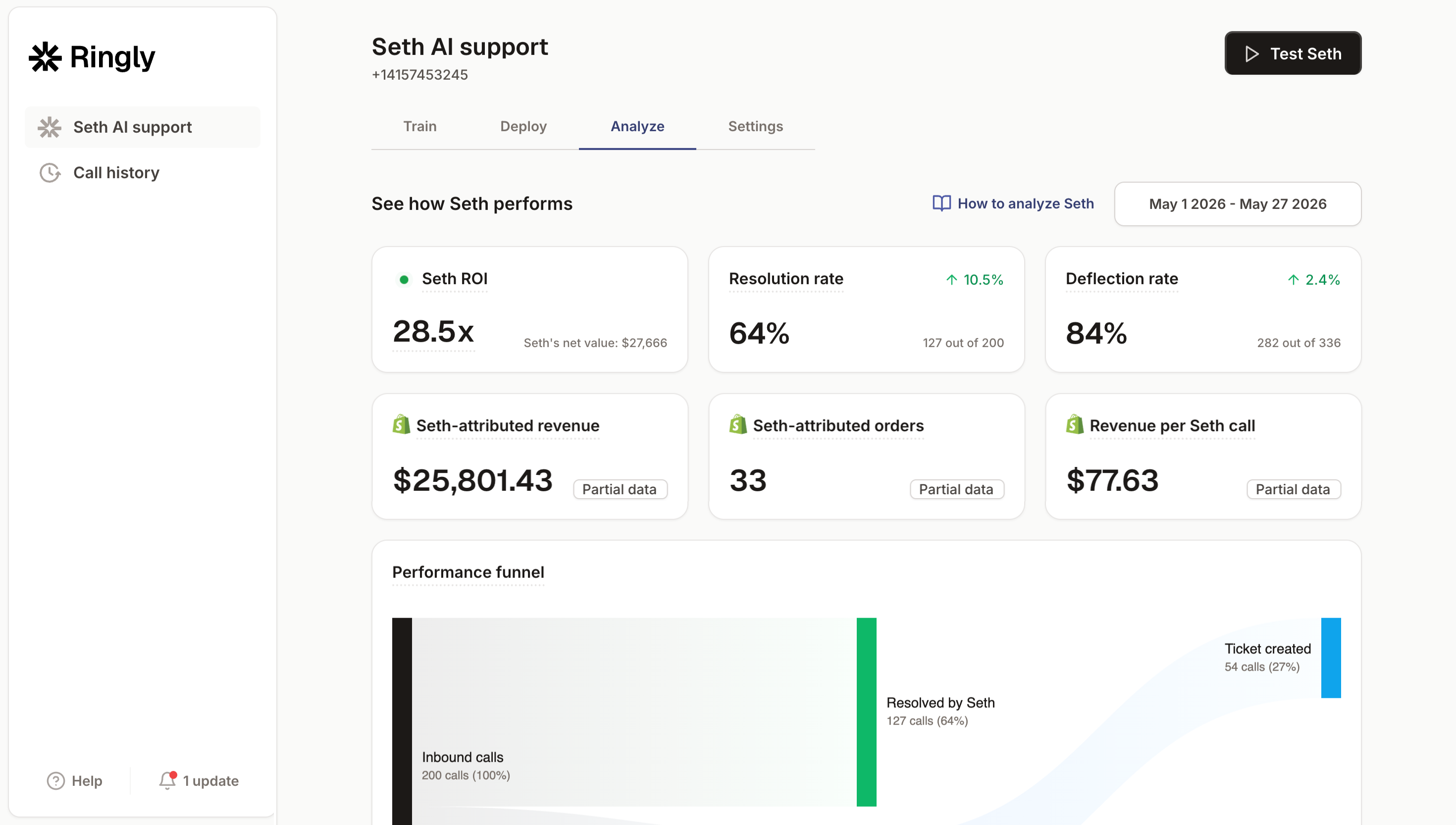
The AI option built specifically for Shopify ecommerce, not generalist customer service. Order lookup, tracking, refunds, cancellations happen live on the call via the Shopify API. WashCo generated $22,664 in attributed revenue in their first 7 days post-launch, 271 calls at 66% resolution. A US-based BPO at $14/agent/hr would have cost them ~$3,200 to staff that same volume. Ringly cost under $400.
Pricing
| Plan | Price | Included |
|---|---|---|
| Pay per call | $99 a month | 50 conversations, then $1.99 each |
What works
- $0.50-$0.91 per resolved call vs $5-22 for human-handled. 10-20x cheaper per resolved contact.
- 24/7 coverage with no shift handoff. The 35% of calls that come in outside 9-to-5 ET get answered the same way as the rest.
- Native Shopify actions live on the call: order lookup, tracking, refunds, cancellations.
- Writes resolutions back to Gorgias or Zendesk so your in-house team has context.
- Free to set up and try: live in under 1 hour.
- 65% resolution guarantee: if Seth resolves under 65% of your calls in a month, that month comes back as credit (after 90 days on Pay per call).
What doesn't
- Complex multi-issue calls escalate to your team. AI handles 60-85% of inbound; the rest routes to a human.
- Crisis / empathy work (recalls, viral complaints, grief calls) belongs with a human. AI knows when to escalate.
- Not built for generalist B2B. ICP is Shopify ecommerce specifically.
Why it ranks 1st on this comparison
Cheapest per resolved call, fastest setup, no shift-change handoff. Pair with 1-3 in-house specialists for the escalation tier and your phone economics flip from cost center to recovery channel.
2. US-based outsourced call center (Working Solutions, LiveOps, TELUS International)
Best for: $25M+ Shopify brands with complex multi-channel volume (email + chat + voice + social) who want US-based agents trained on a single brand voice.
US-based BPOs (Working Solutions, LiveOps, TELUS International, Arise) charge a premium for native English speakers in US time zones. The quality ceiling is higher than offshore BPOs, especially on complex returns and VIP escalations. The cost ceiling is also higher.
Pricing
$25-$40/hr per agent loaded. A 5-agent team on 40hrs/week is ~$22,000/mo. 24/7 coverage requires 8-10 agents, pushing the bill to $32K-$45K/mo. Most contracts are 6-12 months with 2-week notice for headcount changes.
What works
- Native English speakers in US time zones: VIP customers can't tell they're outsourced.
- Strong multi-channel coverage: email + chat + voice + social all by the same team.
- QA and CSAT tracking built in.
- Crisis-handling capability (product recalls, viral negative moments) with right vendor.
What doesn't
- $5-$22 per ticket loaded. Phone calls land at the upper end.
- 4-8 week setup. Onboarding eats founder time.
- 24/7 coverage doubles the bill. Most brands settle for 12-16hr coverage and accept the after-hours gap.
- Lock-in: 6-12 month contracts standard.
Why it ranks 2nd
The right path for $25M+ brands that need real US-based humans across multiple channels. Wrong path if phone is your highest-volume channel and 60-85% of calls are WISMO + order edits.
3. Offshore outsourced call center (PartnerHero, Influx, LTVplus)
Best for: $10M-$50M brands wanting a full outsourced CS team at offshore labor rates without sacrificing brand voice training.
Offshore BPOs (Philippines, India, Latin America) deliver decent quality at $8-$22/hr per agent. The best of them (PartnerHero, Influx, LTVplus, Peak Support) build dedicated teams trained on your voice and process. The worst rent you a shared pool that handles 5 brands at once.
Pricing
$8-$22/hr per agent. A 5-agent team on 40hrs/week lands at $7K-$15K/mo. 24/7 coverage at this tier costs $12K-$22K/mo, which is still ~50% cheaper than US-based equivalents.
What works
- Cheaper than US-based while staying human-staffed.
- Multi-channel coverage by one team.
- Spike absorption: most can flex 50% for BFCM with 2-week notice.
- Decent quality at the top end (PartnerHero, Boldr) with 60-90 days of training.
What doesn't
- Voice drift risk higher than US-based.
- Setup still 4-8 weeks.
- Accent or time-zone friction on some customer segments (older, premium).
- Still 10-20x more expensive per call than AI on routine WISMO and order-edit volume.
Why it ranks 3rd
Cheaper than US-based, more expensive than AI. The sweet spot if you want full multi-channel human coverage without US-based pricing. Often a stepping stone before brands move to a hybrid AI + small in-house pattern.
The real cost math: same brand, three setups
Modeled on real customer numbers. A $25M Shopify brand processing 5,000 tickets/mo, 1,500 of which are inbound calls.
| Setup | Monthly cost | Coverage |
|---|---|---|
| US-based BPO, 5 agents, 16hr/day | $22,000 | 16hr, no overnights |
| Offshore BPO, 5 agents, 24/7 | $14,000 | 24/7 |
| Hybrid: AI phone (Pro) + 2 in-house specialists + freelance bench | $6,500 | 24/7 phone via AI, 9-to-5 humans |
The hybrid setup is ~70% cheaper than US-based BPO and ~55% cheaper than offshore BPO. It also wins on coverage (24/7 phone) and voice quality (the in-house humans handle the high-value cases with full attention).
Book a 30-min call and we'll run your specific call volume against both paths. You decide if the swap is worth it.
Where each option actually breaks down
AI phone agents break on:
- Multi-step empathy calls: grief, crisis, recalls. AI knows to escalate.
- Highly accented or low-signal audio: usually still works but resolution rate drops.
- VIP customers expecting a named human: route VIPs directly to your in-house team.
- Brand-new SKUs that aren't in the knowledge base yet: 24-48hr lag while you update.
Outsourced call centers break on:
- Volume spikes: BFCM, viral moments, launches. 2-6 week notice for headcount.
- After-hours economics: 24/7 coverage doubles the cost without doubling resolution.
- Long-tail product knowledge: agent training is ongoing and uneven across the team.
- Speed-to-staffed: 4-8 week setup eats founder time at the moment you needed the help most.
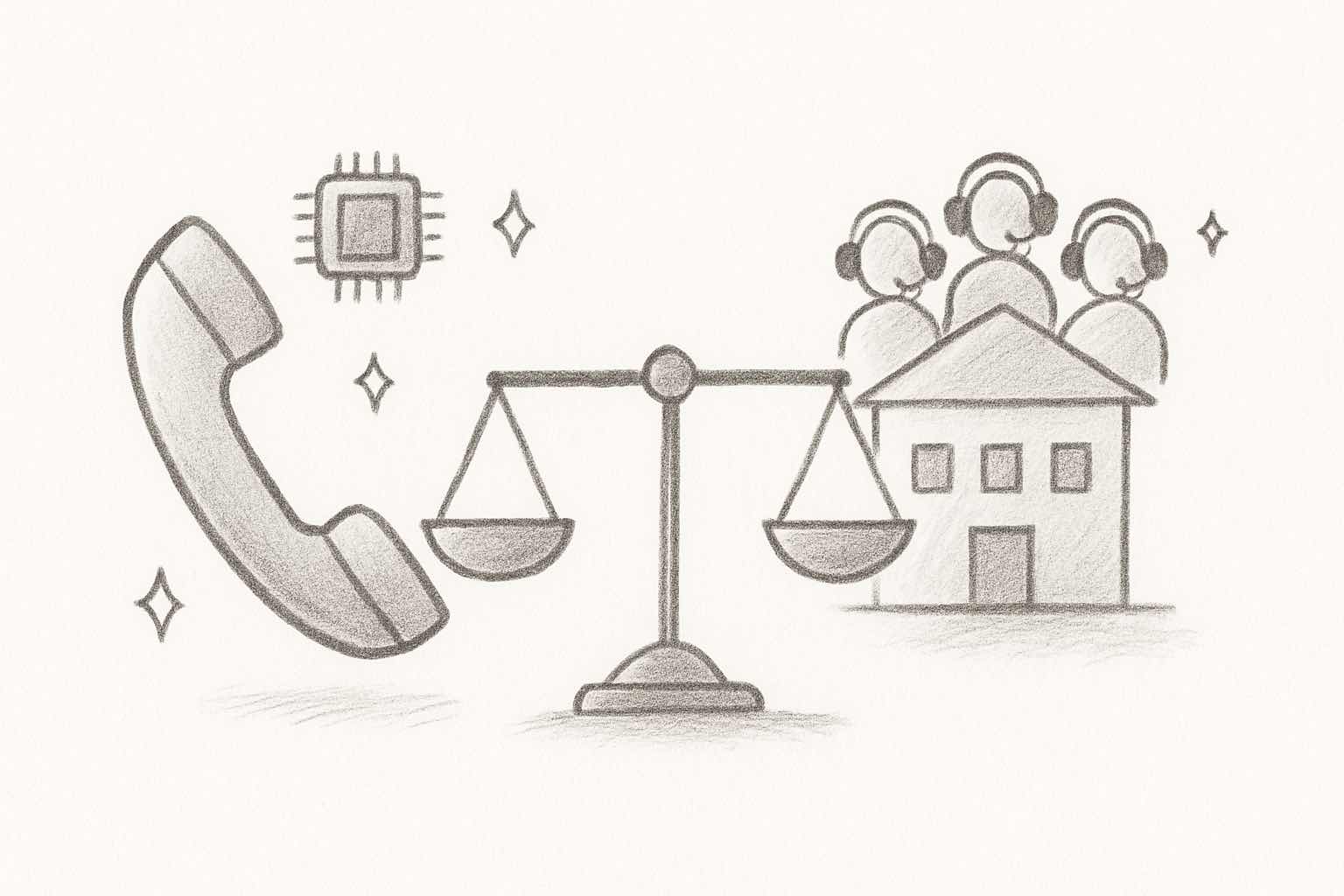
The honest answer: AI is better for volume + simple resolution + cost; humans are better for complexity + empathy + brand-critical moments. The right setup uses both.
What happens on the call.
- We pull your last 7 days of inbound calls live, on the call. No homework.
- We model the AI phone layer against your current BPO quote (or current in-house cost) and show you the exact monthly delta.
- You decide if it's worth a deeper conversation. No deck, no follow-up sequence.
The call makes sense if:
- You're a Shopify (or Shopify Plus) brand doing $10M-$100M
- You run a paid helpdesk (Gorgias, Zendesk, Gladly, Re:amaze, or Intercom)
- You have a visible phone number on your store
- Your CS team is 3-12 people, or you're evaluating a BPO contract
If that's you, the math usually works. Book a 30-min call and we'll run it on your store.
“My customers also feel like it's a normal person. They feel like they can communicate if they have questions.”
— Claudia Droge, TechCraft Studio
BioLongevity Labs hits 79% resolution autonomously on inbound phone, including overnight and weekends. That's a setup that would have cost ~$18K/mo as a US-based BPO. It costs them under $900.
How to choose: a decision framework
- Under $10M GMV: AI phone agent + your existing 1-2 in-house specialists. Skip the BPO conversation.
- $10M-$50M GMV: AI phone agent (Ringly) + 2-3 in-house + freelance bench for BFCM. Most cost-effective.
- $50M-$100M GMV: same hybrid scaled + small offshore BPO for email/chat overnight. AI handles phone overnight.
- $100M+ GMV: full hybrid with named BPO partner for multi-channel + AI for phone + in-house lead for voice / escalations.
For deeper reading: AI call center for Shopify, best call center outsourcing companies, and the overview of call center outsourcing. For specific outsourcing alternatives: LiveOps alternatives, Working Solutions alternatives, TELUS International alternatives.
Frequently asked questions
Is an AI phone agent cheaper than an outsourced call center?
Yes, by 10-20x on a per-resolved-call basis. AI runs $0.50-$0.91 per resolved call; outsourced humans run $5-$22 per call depending on whether the team is offshore or US-based. The gap shrinks on complex calls that require escalation.
Can AI handle complex customer service issues?
It handles 60-85% of inbound Shopify CS calls fully (WISMO, order edits, refunds, simple returns). Complex cases (crisis, recalls, multi-issue, VIP) route to your in-house team automatically. The 100% AI claim is a red flag.
Will my customers know they're talking to AI?
Most won't. Claudia Droge at TechCraft Studio shared: “My customers also feel like it's a normal person.” The current generation of AI voice (2026) is past the uncanny valley for routine CS interactions.
How does setup compare?
Ringly is live in under 1 hour. Outsourced BPOs typically take 4-8 weeks: contract negotiation, agent recruiting, training, ramp-up. The setup gap matters when you need help during a peak season.
What about hybrid setups?
The most common pattern at $25M+ is: AI handles phone, small in-house team handles complex tickets and brand-critical moments, freelance bench fills BFCM spikes. This usually costs 50-70% less than a full BPO contract while delivering better voice consistency.
Do I lose anything by using AI instead of humans?
Yes, on complex empathy work, crisis response, and brand-defining moments. The fix is to keep those in-house. The volume routine work (WISMO, order edits) is what AI replaces, freeing your humans for the work that matters.
What about Smith.ai or Goodcall?
Both are generalist alternatives. Smith.ai serves multi-vertical SMB; Goodcall serves local service businesses. Neither has the Shopify-specific integration depth (live order actions, helpdesk write-back) we built for ecommerce specifically.
Talk to us

If you're weighing a BPO proposal against an AI phone vendor on a $10M-$100M Shopify store, a 30-min call is the fastest way to see what each path costs you per resolved call.
Our 3 promises.
- Live in under 1 hour. Setup and test calls are free.
- 30-day money back on the $99 plan fee.
- 65% resolution guarantee: if Seth resolves under 65% of your support calls in a month, that month comes back as credit (after 90 days on Pay per call).
Ruben (Ringly co-founder) takes these calls personally.