

Every human support interaction costs your store between $6 and $8. An AI-handled one? About 50 cents.
If you're processing 1,000 support tickets a month (and growing), that gap alone could be worth $5,000+ in monthly savings. Yet most ecommerce stores still run customer service the way they did five years ago: a small team, an overflowing inbox, and a phone that nobody wants to pick up.
This guide breaks down ecommerce customer service automation channel by channel, with real cost data, specific tools, and an honest look at what you should and shouldn't automate.
Editor's note: We run Ringly.io, an AI phone agent for Shopify stores. We'll mention it in the phone automation section because that's what we know best. Everything else in this guide is tools and data we've researched independently.
Why ecommerce stores can't afford to skip customer service automation
The pressure is real and it's accelerating. A 2026 Gartner survey of 321 customer service leaders found that 91% feel pressure to implement AI this year. That's not a trend. That's a mandate.
And your customers aren't waiting around:
- 67% of consumers expect their support ticket resolved within 3 hours, per HubSpot research
- 95% say customer service directly impacts whether they'll buy from you again
- Hiring a new support rep costs $35,000-$50,000/year fully loaded, yet ticket volume doesn't grow linearly. It spikes during sales, launches, and holiday season, then dips.
On DTC margins (which are already thin), every support interaction you handle manually chips away at profit.
Here are the clearest signs you need to automate:
- Response times are slipping past 4 hours: customers are leaving before you reply
- The same 5 questions make up 60%+ of tickets: "where's my order?" shouldn't require a human
- Your phone goes to voicemail after hours: that's lost revenue, not just a missed call
- Support costs are growing faster than revenue: the math doesn't work without automation
- Your team is burned out on repetitive work: good agents quit when the job is just copy-paste
The Salesforce State of Service report (surveying 6,500 service professionals) found that AI jumped from the #10 to #2 priority for service leaders in a single year. The shift isn't coming. It already happened.
The five channels you can automate (and how they stack up)
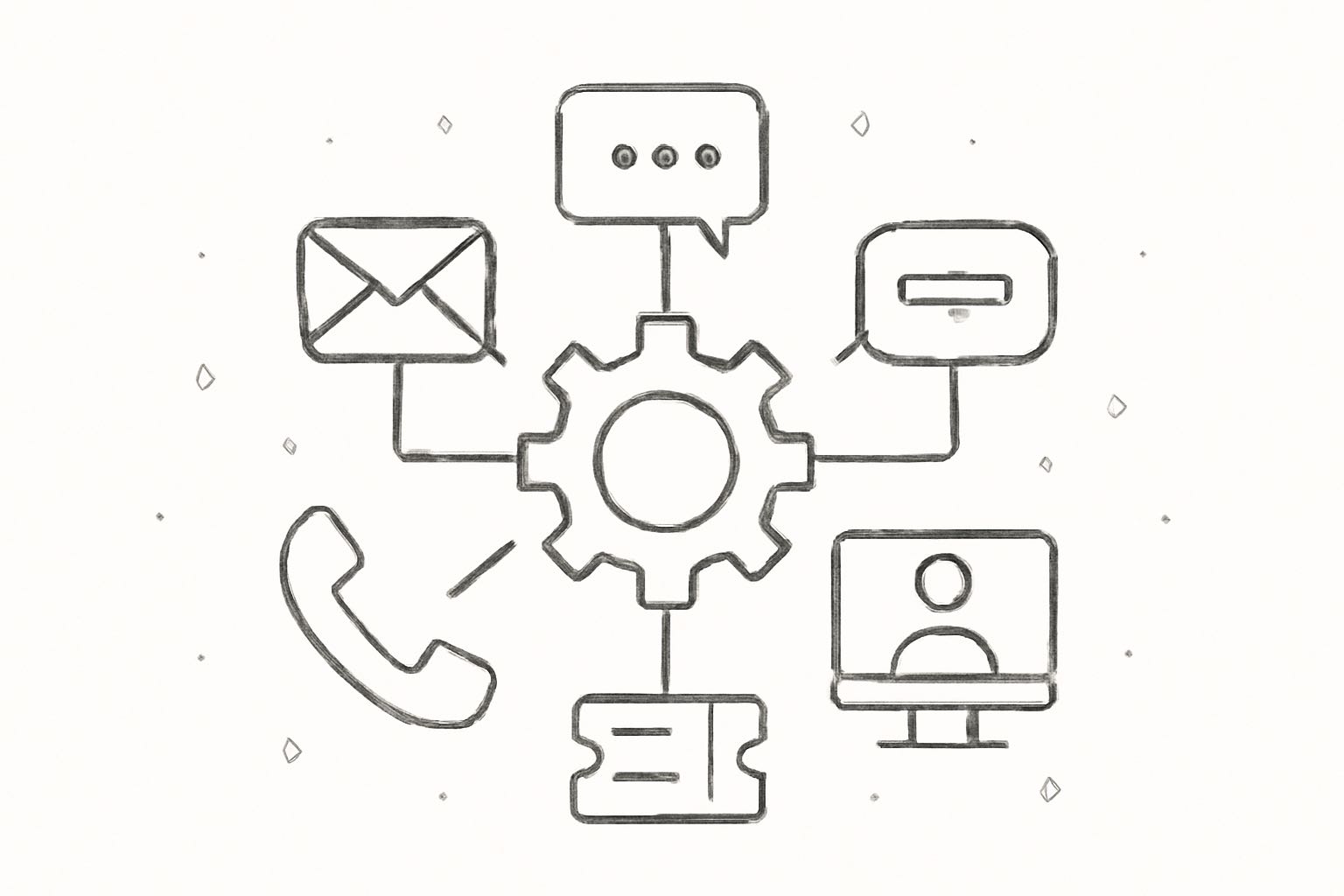
Before picking tools, you need to understand what you're working with. Ecommerce customer service runs across five main channels, and each one has different automation potential.
| Channel | Cost per interaction (human) | Cost per interaction (AI) | Typical automation rate | Best for |
|---|---|---|---|---|
| Live chat | $3-$5 | $0.50-$1.00 | 50-67% | FAQs, product questions, order status |
| $4-$6 | $0.50-$1.50 | 40-60% | Returns, complaints, detailed inquiries | |
| Phone | $6-$12 | $0.19-$0.70 | 45-73% | Order issues, urgent problems, complex questions |
| Self-service | $2-$3 | $0.10-$0.25 | 70-90% | Order tracking, FAQ lookups, return initiation |
| Ticketing/routing | $1-$2 (overhead) | Near zero | 80-95% | Categorization, assignment, SLA management |
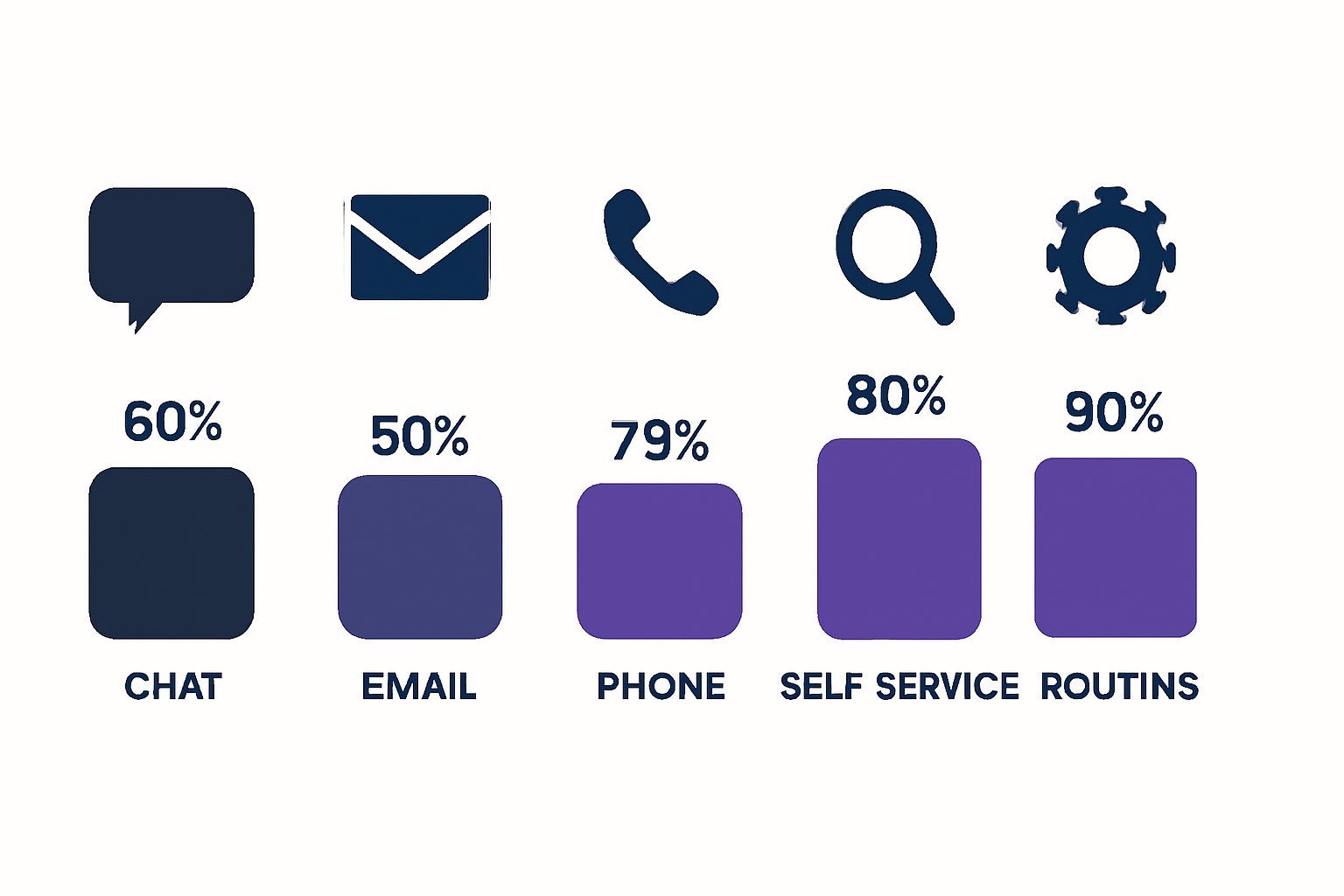
The pattern is obvious. Phone is the most expensive channel to handle with humans and one of the cheapest to automate on a per-interaction basis (though it's the one most stores ignore).
Self-service has the highest automation rate but handles only simple lookups. Smart stores automate across all five, not just one.
Chat automation: the easiest entry point
If you haven't automated anything yet, start here. Chat is the lowest-friction channel for both implementation and customer acceptance. Most shoppers already expect to see a chatbot on an ecommerce site.
The distinction that matters is rule-based vs. AI-powered chatbots:
- Rule-based bots follow scripted flows: if the customer says "order status," show the tracking lookup widget. They're predictable but rigid.
- AI chatbots (like Tidio's Lyro or Intercom's Fin) use natural language processing to understand intent, pull from your knowledge base, and generate contextual responses.
Tidio reports that Lyro automates up to 67% of repetitive queries for ecommerce stores. Gorgias claims 60% automation on customer inquiries. Both numbers are solid for chat, though your results depend entirely on how well you've structured your product info and FAQ content (garbage in, garbage out).
What chat automation handles well:
- Order status lookups: connect to Shopify, pull tracking data, done
- Product questions: sizing guides, ingredient lists, compatibility checks
- Return policy inquiries: static information that doesn't change
- Store hours and shipping timelines: basic info that doesn't need a human
- Cart recovery nudges: proactive messages when someone's about to leave
What it doesn't handle well:
- Frustrated customers who are already angry: a chatbot saying "I understand your frustration" makes things worse
- Complex product comparisons: nuanced "which one is right for me?" conversations
- Anything requiring judgment or empathy: complaints about damaged goods, emotional situations
My honest take: chat automation is table stakes at this point. If you're a Shopify store doing more than 50 orders a day without a chatbot, you're paying for conversations a machine could handle.
But don't expect it to solve everything. Chat handles the easy stuff. The hard stuff still needs people.
Email automation that cuts your ticket queue in half
Email is where most ecommerce support volume actually lives. And the biggest wins here aren't flashy AI responses. They're boring workflow automations that save your team hours every week.
The Salesforce data backs this up: reps using AI spend 20% less time on routine cases, freeing about 4 hours per week. That adds up to over 200 hours per year, per agent. For a 3-person team, that's essentially a free part-time hire.
Five email workflows every ecommerce store should automate right now:
- Auto-tagging and routing: categorize tickets by topic (shipping, returns, billing) and assign to the right person automatically
- Order status auto-responders: if someone emails asking "where's my order?", trigger an instant response with tracking info pulled from Shopify
- Return request intake: replace the back-and-forth with a self-service return form that pre-fills order data
- Post-purchase follow-up sequences: automated review requests and satisfaction checks 7 days after delivery
- SLA escalation alerts: flag tickets approaching the 3-hour mark (remember, 67% of customers expect resolution by then)
Shopify Flow handles the ecommerce-specific triggers natively. For helpdesk automation, tools like Gorgias, Zendesk, and Help Scout all offer rule-based routing that connects directly to your store data.
The mistake I see most often is stores automating responses before automating routing. Your team doesn't need an AI writing emails for them. They need tickets to land in the right queue, pre-tagged, with customer context already attached.
That alone cuts resolution time by 30-40%.
Phone automation: the highest-impact channel most stores ignore
Phone is the most expensive support channel and, paradoxically, the one with the biggest automation opportunity. An average phone interaction costs between $6 and $12 when a human handles it. Yet most ecommerce stores either send calls to voicemail or route them through a frustrating IVR tree that makes customers mash "0" until they reach someone.
I get why stores avoid phone automation. Bad phone bots from the 2010s were genuinely terrible (press 1 for billing, press 2 for support, press 0 to question your life choices).
But AI phone agents in 2026 are a completely different technology. They use large language models, real-time speech processing, and direct ecommerce integrations to have actual conversations.
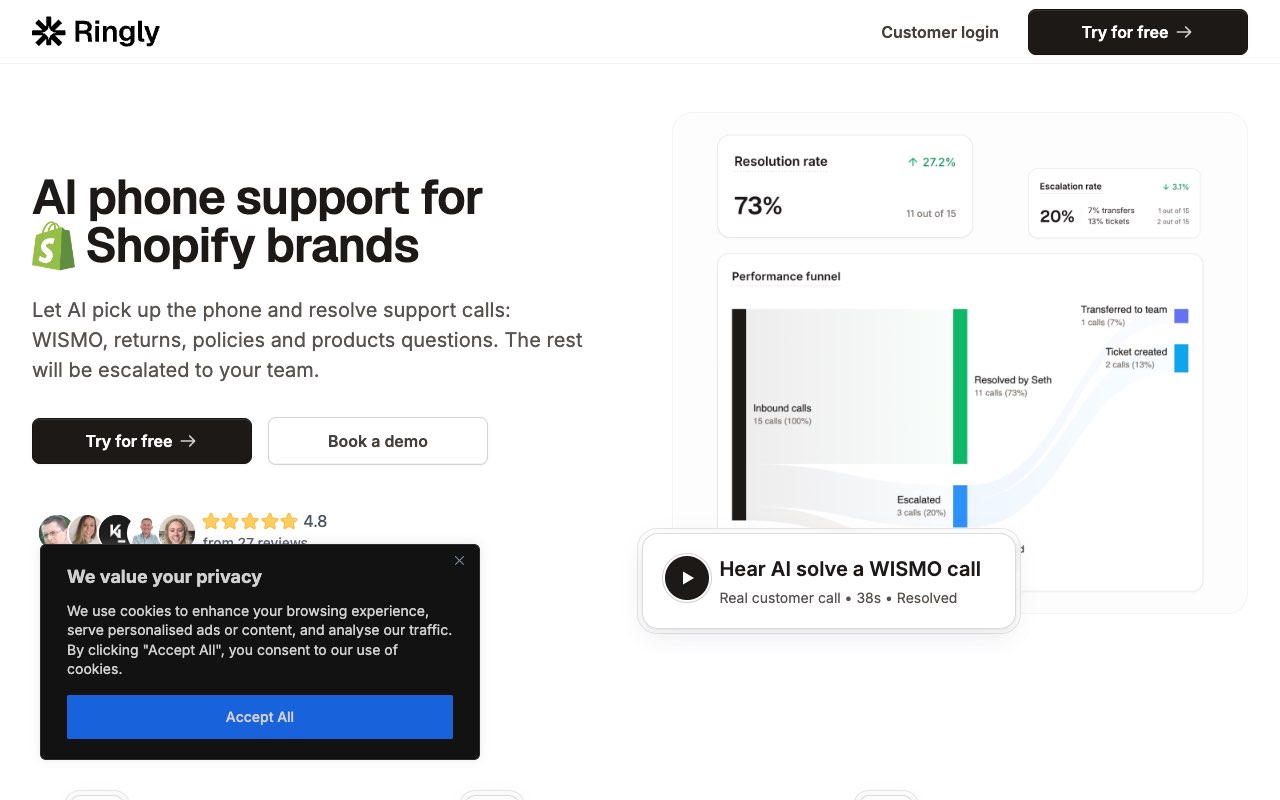
Across 2,100+ Shopify stores using Ringly.io, the most common automated call is a WISMO inquiry: "where is my order?" These calls make up roughly 35-40% of inbound volume for a typical store.
The AI agent looks up the order in Shopify, reads back the tracking status, and resolves the call in under 2 minutes. No hold time. No human needed.
What AI phone agents handle effectively:
- Order status and tracking updates: real-time Shopify lookups via direct Shopify integration
- Return and exchange eligibility: checks policy rules, initiates the process
- Store hours, shipping policies, product availability: informational queries
- Basic troubleshooting: password resets, account questions
- After-hours coverage: 24/7 support in 40 languages without overnight staffing
What still needs a human:
- Angry customers demanding a manager: let AI detect the escalation trigger and transfer
- Complex product consultations: "which supplement should I take for my specific condition?"
- Legal or safety issues: anything with liability implications
- VIP customers with large order histories: sometimes the personal touch matters most
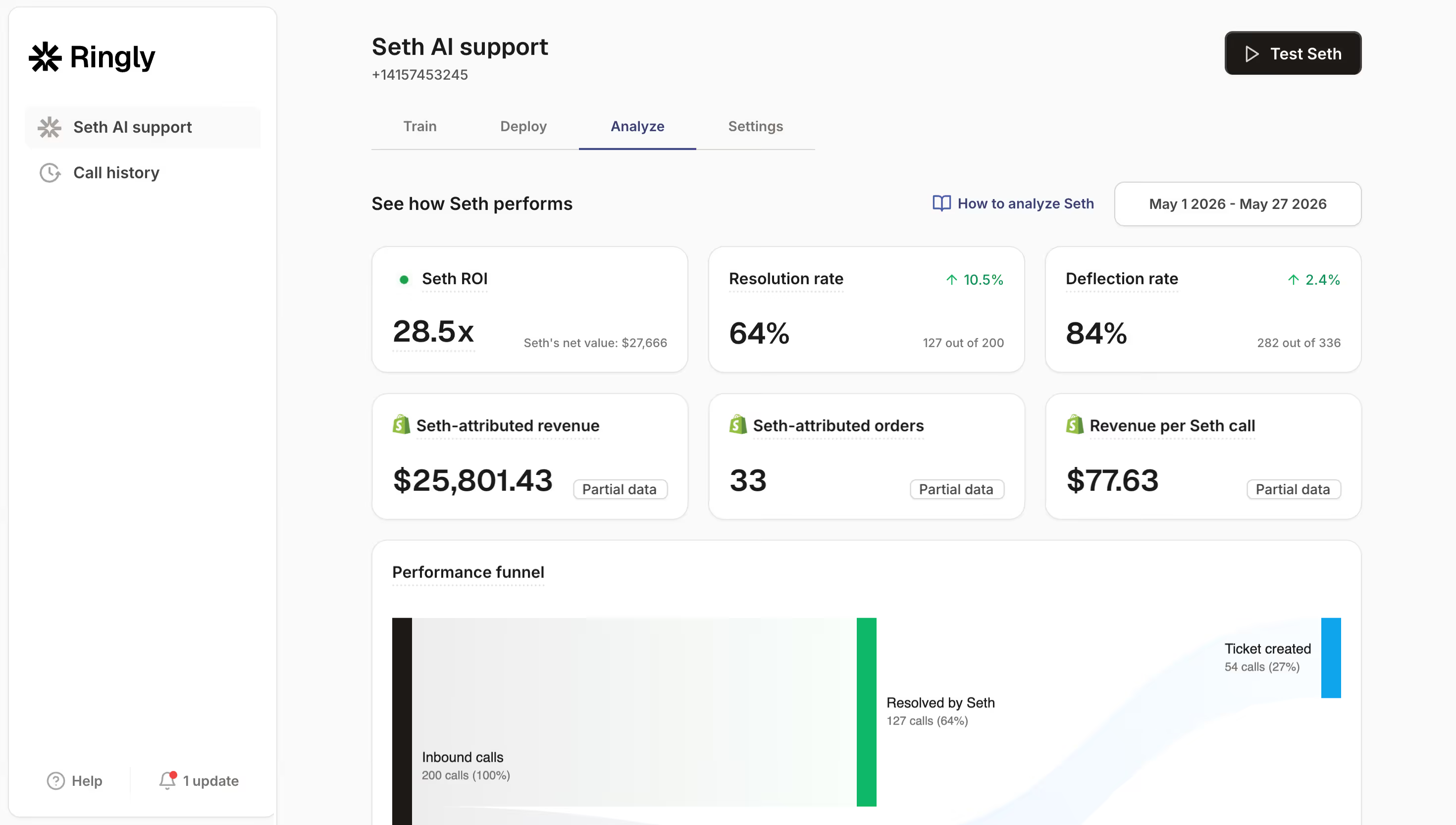
The resolution rate for AI voice agents sits around 70-73% for ecommerce, meaning roughly 3 out of 4 calls never need a human. That's a massive cost reduction on your highest-cost channel.
If those resolution rates sound interesting for your store, see what it looks like with a free trial. Most Shopify stores set up in under 3 minutes.
Self-service portals and knowledge bases
Self-service is the cheapest support channel you can build. Period. When customers find their own answers, the cost per resolution drops to almost nothing, and research from IBM suggests that 40-60% of ecommerce queries can be resolved this way.
The catch is that self-service only works if you build it properly. A bare-bones FAQ page with 10 generic questions won't cut it. You need structured, searchable content that matches how your customers actually phrase their problems.
Essential self-service pages for any ecommerce store:
- Order tracking portal: let customers look up their own shipment status without contacting anyone
- Returns and exchanges center: self-service return initiation with pre-filled order data
- Product-specific FAQs: not generic "how does shipping work?" but "does this supplement interact with blood thinners?"
- Sizing and fit guides: the #1 preventable return reason in fashion and apparel
- Account management: password reset, subscription changes, address updates
The real ROI multiplier is connecting self-service to your other automation tools. When a customer visits your tracking page and doesn't find what they need, the chatbot should pick up where they left off (not ask them to repeat everything). That handoff is where most stores lose people.
Ticket routing and workflow automation
This is the invisible layer that makes everything else work. Even if you don't automate a single customer-facing interaction, automating your internal routing can cut resolution times dramatically.
The logic is straightforward. When a ticket comes in, rules determine: what category does it belong to, what priority level, which team member should handle it, and does it need immediate attention?
Without automation, a human reads every ticket and makes that judgment call. With it, tickets arrive pre-sorted and ready to work.
Workflow automation rules every store needs:
- Priority routing by order value: a $500 order complaint gets escalated faster than a $12 one
- Auto-tagging by keyword: "refund," "broken," "wrong item" all route to the returns team
- SLA timers: tickets older than 2 hours get flagged, older than 4 hours get escalated
- Channel merge: if the same customer emails and calls, both interactions link to one profile
- CSAT triggers: automatically send a satisfaction survey after ticket closure
Shopify Flow handles basic ecommerce triggers. For anything more complex, helpdesk platforms like Gorgias, Zendesk, and Help Scout offer visual workflow builders that don't require code. The investment here is minimal (usually included in your helpdesk plan) and the payoff is immediate.
How much does ecommerce customer service automation actually cost?
Everyone asks this question and nobody answers it clearly. So here's a real breakdown.
| Automation type | Tool examples | Starting price | What it automates | Typical ROI timeline |
|---|---|---|---|---|
| Chat automation | Tidio, Gorgias, Intercom | $0-$29/mo | FAQs, order lookups, product Qs | 1-2 months |
| Email workflows | Gorgias, Zendesk, Help Scout | $10-$40/mo | Routing, templates, auto-responses | 2-4 weeks |
| Phone automation | Ringly.io | $349/mo (1,000 min) | Order status, returns, after-hours | 1-3 months |
| Self-service | Shopify native, Helpcenter | $0-$20/mo | Order tracking, FAQs, returns | 2-4 weeks |
| Workflow routing | Shopify Flow, helpdesk built-in | $0 (included) | Tagging, routing, SLA management | Immediate |
A Forrester Consulting study found that companies implementing customer support automation saw 210% ROI over three years, with payback in under 6 months. And the broader data says companies earn about $3.50 for every $1 invested in AI customer service.
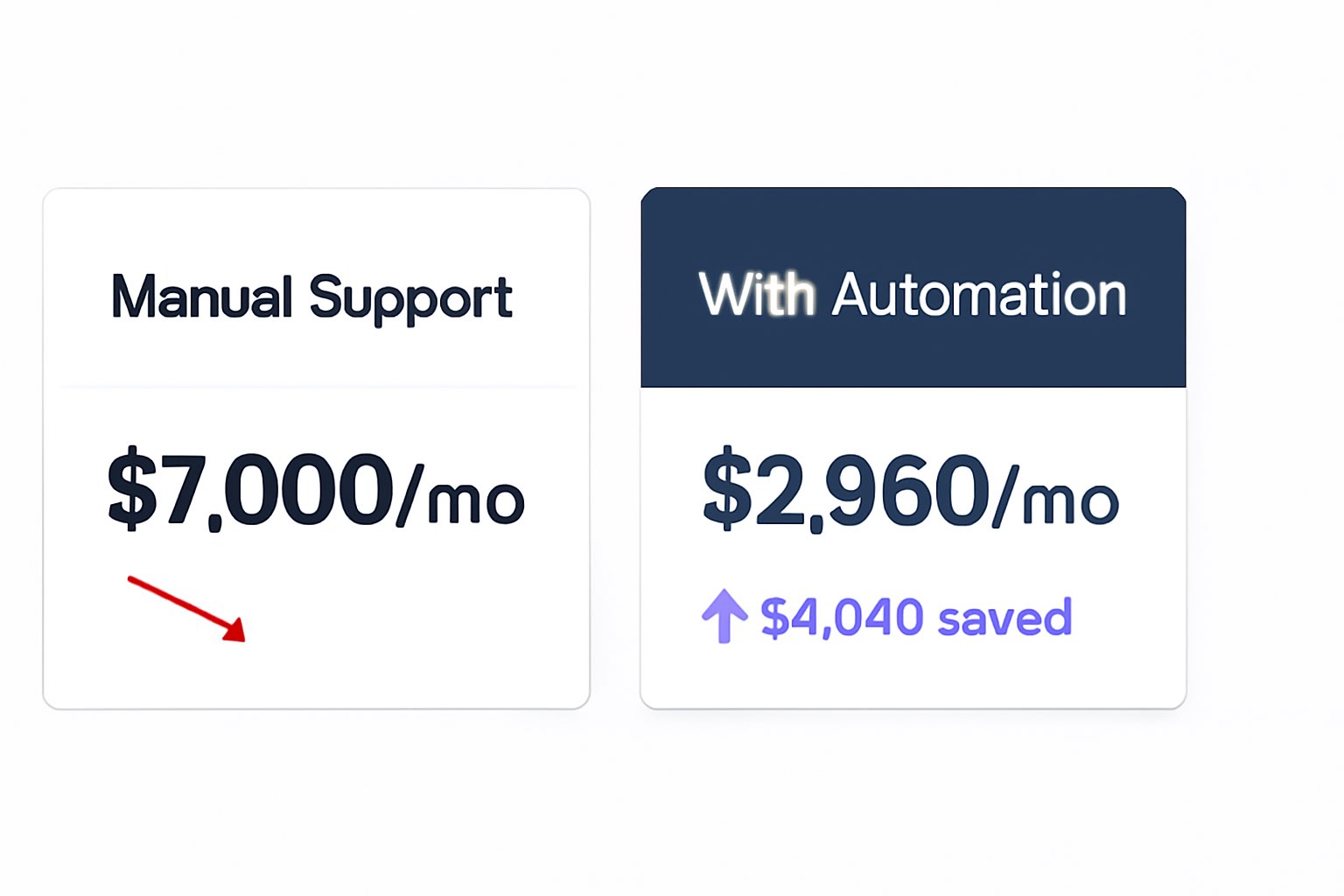
For a mid-size Shopify store doing 1,000 support interactions per month, the math looks something like this. Fully manual support at $7 per interaction: $7,000/month.
With automation handling 60% of volume at $0.60 per interaction: $2,960/month total. That's over $4,000/month in savings, or roughly $48,000 per year.
The stores that get the best ROI don't try to automate everything at once. They start with the highest-volume, lowest-complexity interactions (like WISMO calls and order status chats) and expand from there.
What you should not automate
Automation is powerful, but it's not a universal solution. Some interactions actually get worse when you remove the human. Knowing where to draw the line is what separates stores with 90%+ CSAT scores from ones drowning in 1-star reviews.
Situations where automation will backfire:
- Emotionally charged complaints: a customer whose wedding gift arrived broken doesn't want to talk to a bot. They want empathy, an apology, and a fast replacement.
- High-value customer retention: if your top 10% of customers (by LTV) call with an issue, route them to your best human agent. The math favors retention over efficiency here.
- Product safety or health concerns: supplement stores, skincare brands, anything with potential allergen or health implications needs a trained human.
- Situations where the customer says "let me talk to a person": the single fastest way to destroy trust is trapping someone in an automation loop. Every bot needs an escape hatch.
The Gartner prediction that agentic AI will resolve 80% of common issues by 2029 still leaves 20% for humans. That 20% is where your brand voice lives.
Automate the transactional. Keep the relational human.
From zero to automated in 30 days
If you've read this far and want to actually implement this, here's what a realistic 30-day rollout looks like for a Shopify store.
- Week 1, audit and prioritize: Export your last 90 days of support tickets. Tag them by topic and channel. Find the top 5 repetitive queries. For most stores, it's order status, return requests, shipping timeline, product questions, and account access.
- Week 2, self-service and chat: Build out FAQ content for your top 5 topics. Set up a chatbot (Tidio's free tier works for testing). Connect it to Shopify for order lookups. Measure deflection rate.
- Week 3, email workflows and routing: Set up auto-tagging rules in your helpdesk. Create template responses for top categories. Configure SLA timers. Add post-purchase satisfaction surveys.
- Week 4, phone and advanced automation: Deploy an AI phone agent for after-hours calls first (lowest risk). Monitor call transcripts for the first 50 calls. Expand to full coverage once you're confident in accuracy. Connect all channels so customer context flows between them.
After 30 days, measure three numbers: average resolution time, cost per interaction, and CSAT score. Compare to your baseline. If all three improved (and they almost certainly will), you have your proof to invest further.
So what should you do first?
Don't try to automate everything at once. Start with the channel that costs you the most per interaction. For most ecommerce stores, that's phone and email.
The technology is ready. The data supports it. And the stores that wait will keep losing margin to the ones that don't.
Start your free trial with Ringly.io and see what phone automation looks like for your store. Setup takes under 3 minutes, and you don't pay until it resolves 65% of calls.
Frequently asked questions
What percentage of ecommerce customer service can be automated?
Most ecommerce stores can automate 40-70% of their total support volume, depending on product complexity. Simple product catalogs (like supplements or accessories) see higher automation rates than stores selling highly technical or customizable products. The key is targeting repetitive, data-lookup queries first.
How much does it cost to automate customer service for an online store?
You can start for free with Shopify Flow and a basic chatbot like Tidio's free tier. A full automation stack (chat + email + phone + self-service) typically runs $150-$500/month for a mid-size store. The ROI usually shows up within 2-3 months through reduced agent workload and faster resolution.
Will customers get angry talking to a bot?
They get angry talking to bad bots. Modern AI agents that understand natural language and resolve issues quickly actually score higher in satisfaction surveys than hold-queue phone calls. The critical part is always providing an easy path to a human when the AI can't help.
What's the best customer service automation tool for Shopify?
It depends on the channel. For chat, Gorgias and Tidio integrate natively with Shopify. For phone, Ringly.io was built specifically for Shopify stores with real-time order data, while Gorgias or Zendesk handle email routing and ticketing well.
How long does it take to see ROI from customer service automation?
Most stores see measurable results within 30-60 days. Chat and self-service automation show returns almost immediately (within weeks). Phone and email automation typically need 1-3 months to fully ramp as the AI learns your product catalog and common scenarios.
Can AI handle returns and exchanges automatically?
Yes, for standard returns within policy. AI can check return eligibility based on your rules, generate return labels, and initiate refund processing. Edge cases (damaged items requiring photos, partial refunds, exchanges for out-of-stock items) still benefit from human review.
Do I still need human agents after automating customer service?
Absolutely. Even the most aggressive AI customer service projections (Gartner predicts 80% automation by 2029) still assume 20% of interactions need people. Think of automation as giving your best agents more time for the conversations that actually require skill and judgment.