
Managing a growing store is hard, but your support costs shouldn't eat your entire margin.
You are likely spending hours on the same repetitive questions about shipping or returns.
You feel the pressure of scaling while trying to keep every customer happy without hiring a massive team.
It gets worse.
This guide reveals the 6 tools that will lower your support costs by 70% and automate your inventory.
- First, we compare the top-rated AI agents for 2026.
- Then, we show you how to pick the right one for your Shopify store.
What is AI automation for ecommerce?
AI automation for ecommerce uses technology to handle tasks that typically require human intervention, particularly in marketing, customer service, and operations.
It differs from traditional automation, which follows strict, pre-set rules. Traditional automation can be compared to a simple checklist: if a customer does X, the system does Y. While effective, it lacks adaptability.
AI automation, however, is designed to learn and adapt. It uses machine learning to identify patterns and natural language processing to understand human language. This allows it to make informed predictions, personalize interactions, and adjust its actions based on the situation. It operates beyond a fixed script, understanding context and managing complex scenarios.
Editor’s note: Want to hear some sample AI support calls made for your Shopify store?
- Just paste your store URL
- Get sample calls in under 20 seconds (no email required)
- Listen to demo AI calls for my store

How we selected the best AI automation tools
To create this list, we evaluated each tool based on several key criteria relevant to a growing online store. We considered whether the tool solves a significant problem that can increase revenue or save time.
We also assessed its integration capabilities with existing platforms, particularly e-commerce systems like Shopify. User-friendliness was another important factor, focusing on tools that teams can implement without developer assistance. Scalability was also considered to ensure the tool can support business growth.
Finally, we reviewed the pricing to evaluate its overall value.
Comparison of top AI automation tools
Before we get into the details, here’s a quick look at how the top tools stack up against each other. This table gives you an at-a-glance comparison to help you find the right fit faster.
Top AI Tools for Shopify (2026)
| Tool | Best For | Key AI Feature | Shopify Integration | Starting Price |
|---|---|---|---|---|
| Ringly.io | 24/7 autonomous phone support | Autonomous call resolution | Native App | $349/month |
| Tidio | AI live chat & chatbots | Lyro conversational AI | Native App | 14-day free trial available |
| Klaviyo | Email & SMS marketing | Predictive analytics & segmentation | Native App | 14-day free trial available |
| Inventory Planner | Demand forecasting & purchasing | Predictive analytics for stock levels | Native App | Custom |
| Signifyd | Fraud prevention | Guaranteed chargeback protection | Native App | Custom |
| Shopify Magic | Built-in Shopify AI tools | Content & task generation | Native to Platform | Included with Shopify |
The 6 best tools for ai automation for ecommerce
Now, let's look at each tool in more detail to see what makes it stand out and how it can help your business.
1. Ringly.io

The Ringly.io homepage, an AI phone support tool for Shopify stores.
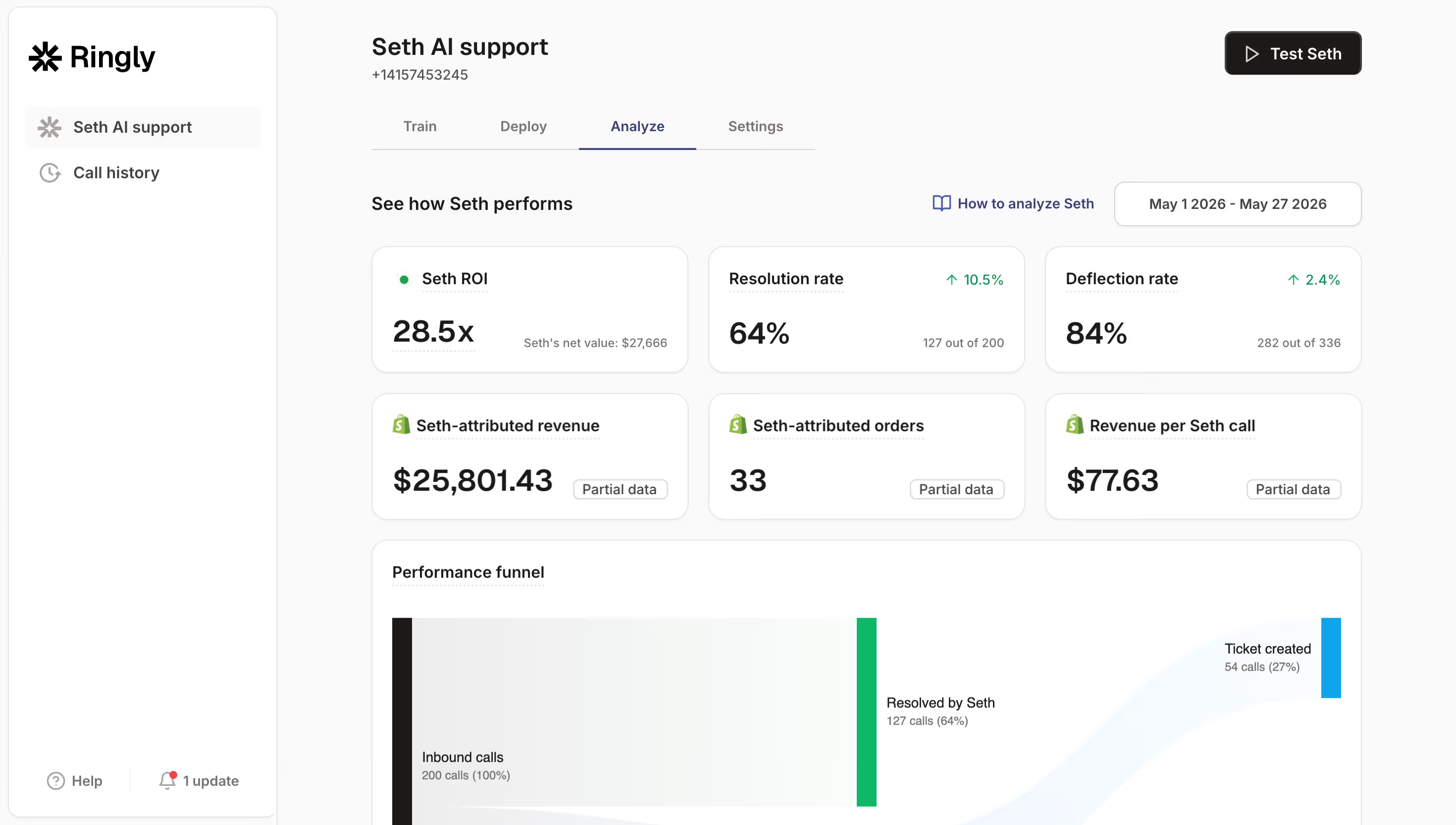
Ringly.io offers a specialized AI phone agent named the AI that’s built for e-commerce stores. the AI is designed to be your front-line support, answering customer calls 24/7. It handles common questions about order status, returns, and product information, freeing your team from repetitive inquiries. The goal is to resolve calls on its own, only escalating to a human agent when a conversation requires it.
- Pros: A key advantage of Ringly.io is its deep, native integration with Shopify. This allows the AI to access real-time order and product data to provide customers with accurate, context-aware answers. The setup process is fast and can be completed in minutes without technical skills. It delivers measurable results, with an average call resolution rate of around 73% across its user base. This can reduce the need for human agents and help lower support costs.
- Cons: Ringly.io is a specialized tool that focuses exclusively on phone support, so it does not handle other channels like email or live chat.
- Pricing:
- Grow plan: $349/month for 250 call minutes.
- Grow Plan: $349/month for 1,000 call minutes and advanced features. This plan comes with a unique guarantee where you pay nothing until The AI resolves at least 65% of your calls.
- Enterprise: custom pricing for stores handling 5,000+ minutes/month, with private Slack channel and custom integrations.
2. Tidio

Tidio is a customer experience platform that combines an AI chatbot named Lyro with live chat and a shared inbox. It’s built to engage your website visitors, acting as an on-site shopping assistant. Lyro can answer questions, recommend products based on visitor behavior, and capture leads, helping convert more browsers into buyers.
- Pros: Tidio is known for its user-friendly interface and quick setup, including a seamless Shopify integration. Its AI, Lyro, can reportedly automate up to 67% of conversations and manages interactions from channels like Instagram and Messenger in a central location. The free plan is a good starting point for small businesses.
- Cons: To access more advanced automation features and higher conversation limits, users need to upgrade to a paid plan.
- Pricing:
- Free: Includes 50 billable conversations per month.
- Starter: Starts at around $24/month for 100 billable conversations.
- Growth: Starts at around $49/month for 250 billable conversations and scales up from there.
- Plus: Starts at $749/month for large-scale businesses needing custom conversation limits.
3. Klaviyo

Klaviyo is a marketing automation tool that uses AI to help e-commerce brands send more personalized email and SMS campaigns. It uses predictive analytics to group your audience based on their past and predicted behavior. This helps you send the right message to the right person at the right time.
- Pros: Klaviyo features data-driven segmentation and robust automation workflows. Its predictive features allow users to forecast metrics like customer lifetime value (CLV), churn risk, and a customer's expected next order date. This can provide a strategic advantage in marketing.
- Cons: The platform may have a learning curve for beginners. Its pricing model scales with the contact list size, which can become a significant expense for growing businesses.
- Pricing:
- Free: Up to 250 profiles and 500 email sends per month.
- Paid plans: Scale based on the number of contacts and the volume of messages you send.
4. Inventory Planner

Inventory Planner is an AI-driven tool designed to improve inventory management. It uses predictive analytics to forecast future demand for your products, helping you optimize your stock levels. By analyzing historical sales data and market trends, it provides data-backed recommendations on what products to order and when, so you can avoid stockouts and prevent capital from being tied up in overstock.
- Pros: A primary feature of Inventory Planner is its demand forecasting, which helps businesses avoid lost sales from stockouts and reduce costs from excess inventory. It offers over 200 different metrics for reporting, providing detailed insights into business performance.
- Cons: This is a tool focused purely on inventory planning and forecasting, not a full inventory management system (IMS). It works best when used alongside an IMS to handle day-to-day logistics.
- Pricing:
- Pricing is custom and based on your business's size and needs. You can request a quote directly from their team.
5. Signifyd

Signifyd is an AI-powered fraud protection platform that helps e-commerce businesses minimize chargebacks and approve more legitimate orders. In online retail, distinguishing a good customer from a fraudster can be difficult. Signifyd's AI analyzes thousands of signals in real-time for every transaction to make that distinction automatically, protecting your revenue.
- Pros: A significant feature of Signifyd is its accuracy in automated fraud detection, which is backed by a 100% financial guarantee against chargebacks on any orders it approves. This provides merchants with financial security and protects their bottom line. It also integrates smoothly with major e-commerce platforms.
- Cons: The platform might feel complex for very small businesses. Like any automated system, there's a small chance it might occasionally flag a legitimate transaction that requires a manual review.
- Pricing:
- Signifyd offers custom pricing based on your transaction volume and specific business requirements.
6. Shopify Magic
Shopify Magic is a suite of AI-powered features built directly into the Shopify platform, rather than a third-party app. These tools are designed to streamline a wide range of day-to-day tasks for merchants. You can use it to write product descriptions, generate email subject lines, or get suggested responses for customer chats.
- Pros: A key benefit of Shopify Magic is its native integration and inclusion in all Shopify plans, with no extra setup required. It's a useful tool for saving time on content creation and other small, repetitive tasks.
- Cons: As a general, built-in feature, it may not have the advanced capabilities of a specialized, third-party AI solution designed for a specific function like phone support or inventory management.
- Pricing:
- Included with all Shopify subscription plans.
How to choose the right AI automation tool
With many options available, selecting the right one can be challenging. Here are a few practical tips to guide your decision.

First, identify your most significant pain point. Are you facing challenges with high call volumes, inventory management, or marketing effectiveness? Focusing on solving one major problem at a time can yield a clearer return on investment.
Next, verify integration capabilities. An AI tool that works well with your existing systems, especially your e-commerce platform like Shopify, will be easier to implement.
Usability is also crucial. A tool's effectiveness depends on your team's ability to use it, so look for simple interfaces and no-code setups that don't require developer resources.
Data security is another important consideration. Since these tools often handle sensitive customer information, ensure any provider you consider complies with data protection regulations like GDPR. This is especially important for businesses with a global customer base. For example, companies based in the Netherlands like Ringly.io adhere to EU data protection standards.
Finally, consider starting with a small-scale implementation. Automate one area of your business, evaluate the results, and then expand your AI strategy based on your findings.
Final thoughts on using ai automation for ecommerce
AI automation is no longer a future concept for e-commerce; it has become a necessary component for staying competitive. Whether the goal is to improve customer support, personalize marketing, streamline operations, or prevent fraud, there is likely an AI tool available to assist.
We've looked at a bunch of different options, from big marketing platforms to very specific tools. The best choice for you really comes down to what your business needs most right now.
For a broader look at how different AI systems are being applied in real-world e-commerce businesses, the following video provides several proven examples that can inspire your own automation strategy.
This video provides several proven examples of how AI systems are giving e-commerce stores a competitive edge.
If high call volumes and repetitive support questions are a challenge, a specialized AI tool could be a solution. Ringly.io, for example, has a dedicated AI phone agent that can handle up to 73% of calls on its own. It gives your customers round-the-clock support and frees up your team to focus on growing the business.
Frequently Asked Questions
What's the first step to implementing ai automation for ecommerce?
The best first step is to identify your biggest pain point. Are you spending too much time on customer phone calls, or is inventory management your main issue? Focusing on one area first, like using an AI phone agent for support, will give you the clearest results before you expand.
Can small businesses benefit from ai automation for ecommerce?
Yes. Many AI tools are designed to be scalable and affordable. Tools with free or low-cost starting plans, like Tidio for chatbots or Ringly.io for phone support, allow small businesses to save time and improve customer service without a huge upfront investment.
How do I measure the success of my ai automation for ecommerce tools?
Success depends on the tool's purpose. For customer support automation, you could track metrics like call resolution rate or reduction in human agent workload. For marketing, you'd look at conversion rates and customer lifetime value. Most tools provide analytics dashboards to help you see their impact.
Is ai automation for ecommerce difficult to set up?
Not necessarily. Many modern AI tools, especially those built for platforms like Shopify, are designed for non-technical users. Tools like Ringly.io or Tidio often have simple, no-code setups that can be completed in just a few minutes.
What are the main benefits of using ai automation for ecommerce in customer support?
The main benefits are providing 24/7 support, instantly answering common customer questions, and reducing the workload on your human team. This leads to lower support costs, improved customer satisfaction, and frees up your staff to handle more complex issues.