

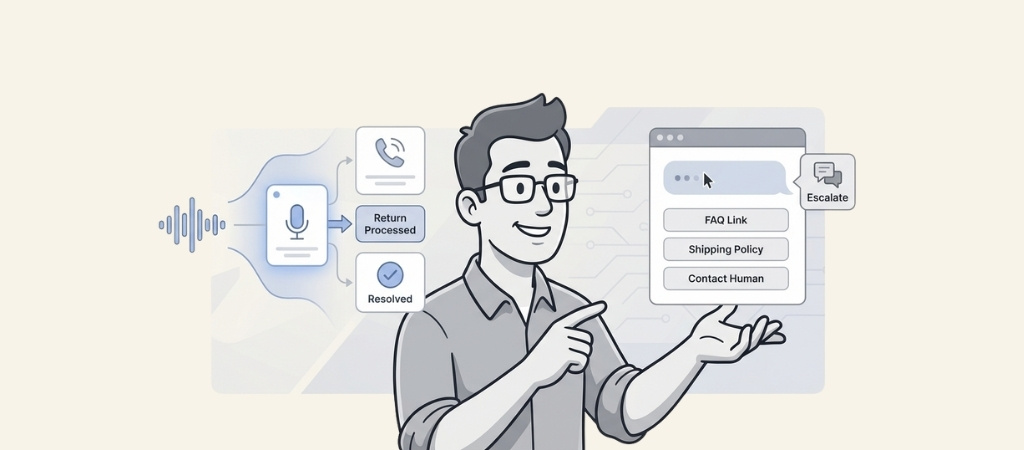
It costs about $15 to $20 for a human to answer a single support call, and yet your team is still drowning in tickets.
You have built a great brand, but as you scale, the "people problem" starts to eat your margins.
You know you need automation, but:
you are stuck choosing between a basic bot that frustrates your customers or a complex system that takes months to build.
Most "solutions" just push the work back onto your customer or your staff.
This guide shows you how to choose between chatbots and voice agents .
First, we compare what each tool actually does.
Then, we look at the real-world ROI for your Shopify store.
Editor’s note: Want to hear some sample AI support calls made for your Shopify store?
- Just paste your store URL
- Get sample calls in under 20 seconds (no email required)
- Listen to demo AI calls for my store
Chatbots vs. AI voice agents: The contenders
What are chatbots?
First up, the basics. A chatbot is a text-based program you’ve seen on countless websites.
It pops up in the corner and follows a script to answer questions. You can think of it as an interactive FAQ.
Its main purpose is to handle simple, repetitive queries. They're good for things like, "What are your hours?" or "Where's your shipping policy?"
They can take some of the load off your team by answering the easy stuff.
However, they have certain limitations. They might struggle if a question is phrased differently, as they often cannot deviate from their script and typically lack memory of past conversations.
Every time you talk to one, it's like starting over. They're built to react, not to solve problems, which is why they often escalate the query to a human agent.
What are AI voice agents?
Now for the AI voice agents. These are a different type of system. An AI voice agent is an autonomous system that talks to customers on the phone using natural, conversational language.
It doesn't just follow a script; it's designed to understand the caller's intent, figure out the problem, and take action on its own to solve it.
This is a key difference. An AI agent can perform multi-step tasks that involve accessing your store’s backend systems.
For example, processing a full return, checking real-time inventory, or changing a shipping address, all during one phone call.
This is the technology behind Ringly.io. Our AI phone rep, the AI, was designed to integrate natively with Shopify from day one.
It can handle calls about orders, returns, and products all by itself because it’s plugged directly into your store's data. It’s not just answering questions; it’s solving problems.

Core capabilities: A head-to-head comparison
A capabilities breakdown
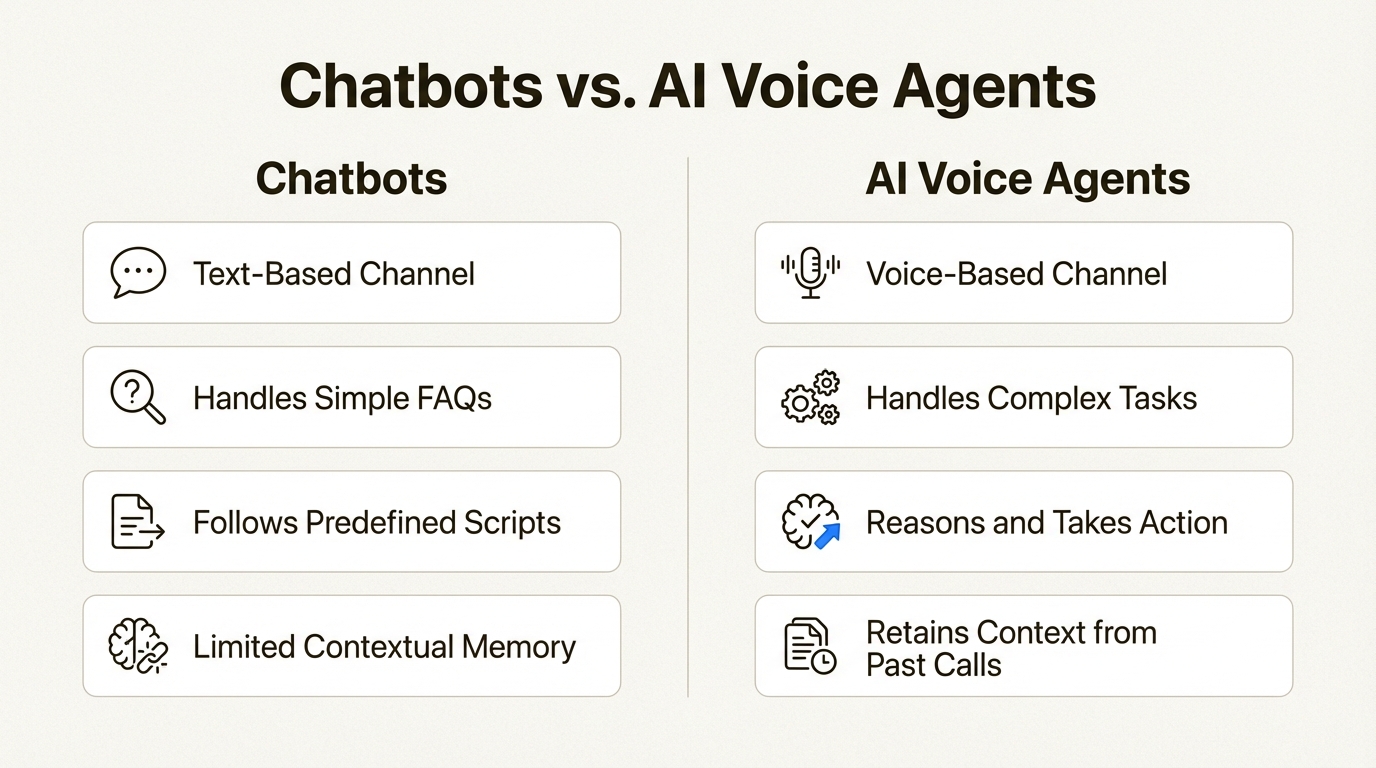
While both tools are meant to automate conversations, their ability to resolve issues can differ significantly. And that difference has a significant effect on your store's efficiency and your customers' happiness.\
Query complexity and problem-solving
Chatbots are effective for handling a high volume of simple questions. Think one-off queries like, "What's your return policy?"
They grab an answer from a knowledge base and show it to the customer. But when a question requires an action, they typically hand it over to a human.
AI voice agents, however, are built for complex, multi-step jobs. Let's say a customer calls because an item arrived damaged.
A voice agent can check their order details, start the return process in your system, and schedule a replacement shipment, all in that one conversation.
This is where a specialized tool like the AI agent from Ringly.io demonstrates its capabilities.
By connecting directly to Shopify, it can manage the whole return or exchange process over the phone, with no human intervention needed.
System integration and taking action
A chatbot's integrations are often focused on information retrieval. They might be able to fetch articles from your help center or create a support ticket.
They can provide information but may not have the ability to perform actions within other systems.
The strength of an AI voice agent lies in its deep integrations. These connections let it do more than just talk; they let it act. An agent can change orders, process refunds, and update customer info in real-time.
This is why Ringly.io's native Shopify integration is a key feature. It’s what allows the AI to take action for your customers, not just read off a static FAQ.
| Feature | Chatbots | AI Voice Agents (like Ringly.io) |
|---|---|---|
| Primary Channel | Text (Website, Messaging Apps) | Voice (Phone Calls) |
| Task Complexity | Best for simple, repetitive FAQs | Handles complex, multi-step workflows |
| Autonomy | Follows predefined scripts; reactive | Reasons and takes independent action |
| Context Awareness | Limited, session-based memory | Retains context from past calls & CRM data |
| Integration Depth | Basic (Knowledge Base, CRM ticket creation) | Deep (E-commerce, Shipping, Payments) |
| Primary Goal | Information retrieval & deflection | End-to-end problem resolution |
The impact on customer experience
How each tool shapes the customer experience
Let's switch gears and look at this from the customer's perspective. How does it feel to use each tool, and does it actually help them when they're in a jam?
Communication channel and accessibility
Chatbots are handy for customers already on your website. But they may not serve customers who prefer to just pick up the phone and talk, especially when a problem feels urgent or complicated.
AI voice agents meet customers on a channel they already use and trust: the phone. They offer an immediate, human-like conversation that can feel more direct and reassuring.
For urgent problems like a missing package or an issue with an order, many customers still prefer to call. Ringly.io aims to provide these customers with an instant, helpful response, day or night.
Speed to resolution vs. self-service fatigue
Using a chatbot is basically a self-service task. The customer has to type out their question, read articles, and click through options. This can work for simple things, but for anything more involved, it can lead to "self-service fatigue."
That's when the customer gets fed up trying to solve the problem themselves and just wants a person.
AI voice agents are designed for resolution. The customer explains their problem once, and the agent does the work to fix it. This results in a much faster and more satisfying outcome.
With an average resolution rate of 73%, Ringly.io's AI agent is built to solve the problem on the first call. This reduces customer frustration and the need for back-and-forth emails and tickets.
The business case for AI voice agents and chatbots
Setup, cost, and ROI
Alright, let's talk numbers. What does it take to get these tools running, and what kind of return can you realistically expect?
Setup and maintenance
Most chatbots based on rules require you to manually build and update conversation scripts, which can be an ongoing task.
While platforms like HubSpot have easy-to-use builders, their chatbots are often flow-based, which may differ from systems with more advanced AI or keyword recognition capabilities.
More advanced features may be part of higher-tier enterprise plans.

On the flip side, some generic voice AI platforms can have a complex setup process, potentially requiring developers and a significant budget.
Purpose-built tools like Ringly.io are designed for a no-code, quick setup. You just connect your Shopify store, and the AI automatically learns your products, policies, and order data.
It simplifies the process of getting started with powerful voice automation.
Pricing and return on investment
Chatbot pricing varies widely. You can find simple tools like Zoho SalesIQ for around $7 per operator per month.
But for more powerful features, you’re looking at platforms like HubSpot, where plans with decent bots can cost you $800 a month or more.

AI voice agent pricing is typically based on usage. For example, Ringly.io's pricing is structured as follows:
- Grow Plan: Starts at $349/month for 1,000 call minutes, including our full Shopify integration and self-learning AI.
- Enterprise: custom pricing for stores handling 5,000+ minutes/month, with private Slack channel and custom integrations.
Ringly.io also offers a trial guarantee: you get your last 3 months refunded if Seth resolves under 65% of calls in 90 days. We want you to see the results before you ever spend a cent.
When you look at ROI, AI voice agents can provide a substantial ROI because they automate phone calls, which are the most time-consuming and expensive support interactions.
By handling these calls from beginning to end, merchants using Ringly.io can save up to 83% per call compared to what it costs for a human agent.
To see how different AI tools can be applied in a real-world e-commerce setting, it's helpful to look at a variety of platforms.
The video below explores several AI-powered chatbot solutions that can help streamline customer interactions and boost conversions for online stores.
This Jotform video explores the top AI chatbots for e-commerce, detailing how they can boost conversions and streamline customer support.
Final thoughts: Chatbots inform, agents resolve
Chatbots are like digital receptionists. They're good at answering simple, text-based questions and pointing people in the right direction.
AI voice agents are autonomous problem-solvers. They take action to fix complex issues over the phone, from start to finish.
When you're deciding, think about your main support channel and the types of questions you get most.
If phone calls are a major part of your support workload and customers often need help with things that require action (like returns or order changes), a voice agent may be a more suitable investment.
For Shopify merchants who are ready to automate phone support, cut costs, and provide 24/7 service, the AI agent from Ringly.io is an agent built specifically for e-commerce stores.
Learn how it can autonomously resolve over 70% of your customer calls.
Start your risk-free trial today.
Frequently Asked Questions
What is the biggest difference when comparing AI voice agents vs chatbots for e-commerce?
The main difference is that chatbots are designed to provide information, usually by following a script or pulling from a knowledge base. AI voice agents are built to resolve problems by taking action. They can integrate with your store's backend systems to process returns, update orders, and handle complex issues from start to finish.
For a Shopify store, which is the better choice in the AI voice agents vs chatbots for e-commerce debate?
For Shopify stores, especially those with significant phone support traffic, an AI voice agent can be a highly effective choice. A specialized agent like the AI agent from Ringly.io integrates directly with Shopify, allowing it to handle order-specific queries, returns, and exchanges autonomously, which is something a standard chatbot can't do.
When it comes to setup and maintenance, what should I expect from AI voice agents vs chatbots for e-commerce?
Traditional chatbots often require you to manually build and maintain conversation scripts. AI voice agents purpose-built for e-commerce, like Ringly.io, offer a much simpler setup. You can connect your Shopify store and have the agent trained on your products and policies in minutes, with no coding required.
How does the ROI compare for AI voice agents vs chatbots for e-commerce?
AI voice agents can deliver a higher ROI because they automate phone calls, which are the most expensive and time-consuming support channel. By resolving complex issues without human help, they can save merchants up to 83% per call compared to the cost of a human agent, directly impacting your bottom line.
Can both options handle complex customer problems in the AI voice agents vs chatbots for e-commerce comparison?
This is a key differentiator. Chatbots are generally designed for simple, FAQ-style questions and often escalate more complex issues. AI voice agents are specifically designed to manage complex, multi-step tasks like processing a damaged item return or updating a shipping address mid-journey.