


How many customers did you lose yesterday because your phone didn’t ring or an email sat unread for six hours?
You are working more hours than ever, but your store's growth has hit a wall because you can't be in ten places at once.
You feel the pressure to provide instant, human-like support while trying to scale.
And it will get worse.
If you don't automate the boring tasks now, you'll keep wasting 20+ hours every week on work that a machine can do better.
This guide goes over the best AI tools to use in eCommerce right now.
First, I'll show you the 6 best tools for 2026. Then, I’ll help you pick the right one for your specific store bottleneck.
What is the best ecommerce AI software in 2026?
Ecommerce AI software is basically any tool that uses artificial intelligence to make running an online business a bit smoother. These aren't just generic chatbots; they're more like specialized assistants built to tackle the specific problems ecommerce stores deal with daily.
They connect to your store's data to get to know your products, orders, and customers, which helps you work smarter.
These tools usually fit into a few main groups:
- Customer service automation: Think of tools that answer common questions like "Where is my order?", track packages, or even handle returns for you. This can be anything from an AI phone agent to automated replies in your helpdesk.
- Personalization and product discovery: AI can look at what a customer has browsed and bought before to suggest products they might like. It can also improve your site's search function and make the shopping experience feel unique to each visitor.
- Marketing and sales automation: This covers software that can help write product descriptions, come up with ad copy, or personalize email and text campaigns to get more people to engage and buy.
- Operations and inventory management: Behind the scenes, AI can help predict what you'll need to restock to avoid running out of popular items. It can also adjust pricing automatically to keep you competitive.
To give you a clearer picture, here’s a visual breakdown of how these AI tools fit into the ecommerce landscape.

Our criteria for choosing the best ecommerce AI software 2026
To put this list together, we thought about what busy store owners actually need: tools that are practical and easy to use. We weren't just looking for software with the longest feature list. We wanted tools that get real results without needing a team of developers to set them up.
Here’s what we looked for:
- Good ecommerce integration: A tool needs access to your store's data to be useful. We focused on software that connects smoothly with platforms like Shopify. This lets them use real-time order, product, and customer info to give accurate answers.
- Solves a specific problem: We looked for tools that are really good at solving one common ecommerce headache. Whether it's answering phone calls or writing product descriptions, every tool here has a clear job.
- Easy to get started: How fast can you get it working? The best tools are made for people who aren't developers, so you can start seeing a return on your investment quickly.
- Clear value and ability to scale: The software had to have a clear way of saving you money, giving you back time, or helping you make more sales. It also needed to be able to grow with your store.
- Simple to use: The interface should be easy to figure out. You shouldn't need a degree in data science to check your stats or make a quick adjustment.
Comparison of the best ecommerce AI software 2026
Here is a quick overview of the top ecommerce AI tools we will cover in this guide, highlighting what each does best.
| Tool | Primary Function | Best For | Shopify Integration | Starting Price |
|---|---|---|---|---|
| Ringly.io | AI Phone Support | Automating voice support & reducing call volume | Native | $349/month |
| Gorgias | Helpdesk Automation | Automating text-based support tickets | Native | Custom (Usage-based) |
| ViSenze | Visual Product Discovery | Fashion and home decor stores | Yes | Custom/Enterprise |
| Klaviyo | Email & SMS Marketing | Predictive marketing automation | Native | $20/month |
| Jasper | AI Content Creation | Writing marketing copy, blogs, and descriptions | N/A | $39/month |
| Describely | Bulk Product Descriptions | Stores with large, frequently updated catalogs | Native | $0.75 per product |
A detailed look at the 6 best ecommerce AI software 2026 tools
Now, let's get into the details of each tool to see what makes it a solid choice. We'll look at why each one is on our list, its main pros and cons, and its pricing to help you find the right match.
1. Ringly.io

- Why it's on the list: While a lot of AI tools are built for text, Ringly.io takes on phone support, which is often overlooked and can take up a lot of time. Its AI phone representative, the AI, offers 24/7 support, so customers can always get a quick answer, even after hours. It's designed from the ground up for ecommerce stores.
- Pros and cons: Its biggest strength is that it specializes in fixing a major customer service bottleneck: phone calls. Its native Shopify integration gives its AI agent, the AI, the ability to handle tricky questions like order lookups, shipping status checks, and even return processing all on its own. In over Shopify stores using it, the AI is able to handle about 73% of calls without needing a human. This frees up teams to work on other things. Another big plus is the setup. You don't need to be a tech expert to get it up and running within an hour for most stores. With support for around 30 languages, it’s also a great option for businesses with customers around the world. The main drawback is that it only handles voice, so you'll need a different tool for email or chat.
- Pricing:
- Start: $349/month for 250 call minutes.
- Grow: $349/month for 1,000 call minutes, self-learning AI, and advanced analytics.
- Enterprise: custom pricing for 5,000+ minutes and custom integrations.
Editor’s note: Want to hear some sample AI support calls made for your Shopify store?
- Just paste your store URL
- Get sample calls in under 20 seconds (no email required)
- Listen to demo AI calls for my store
2. Gorgias
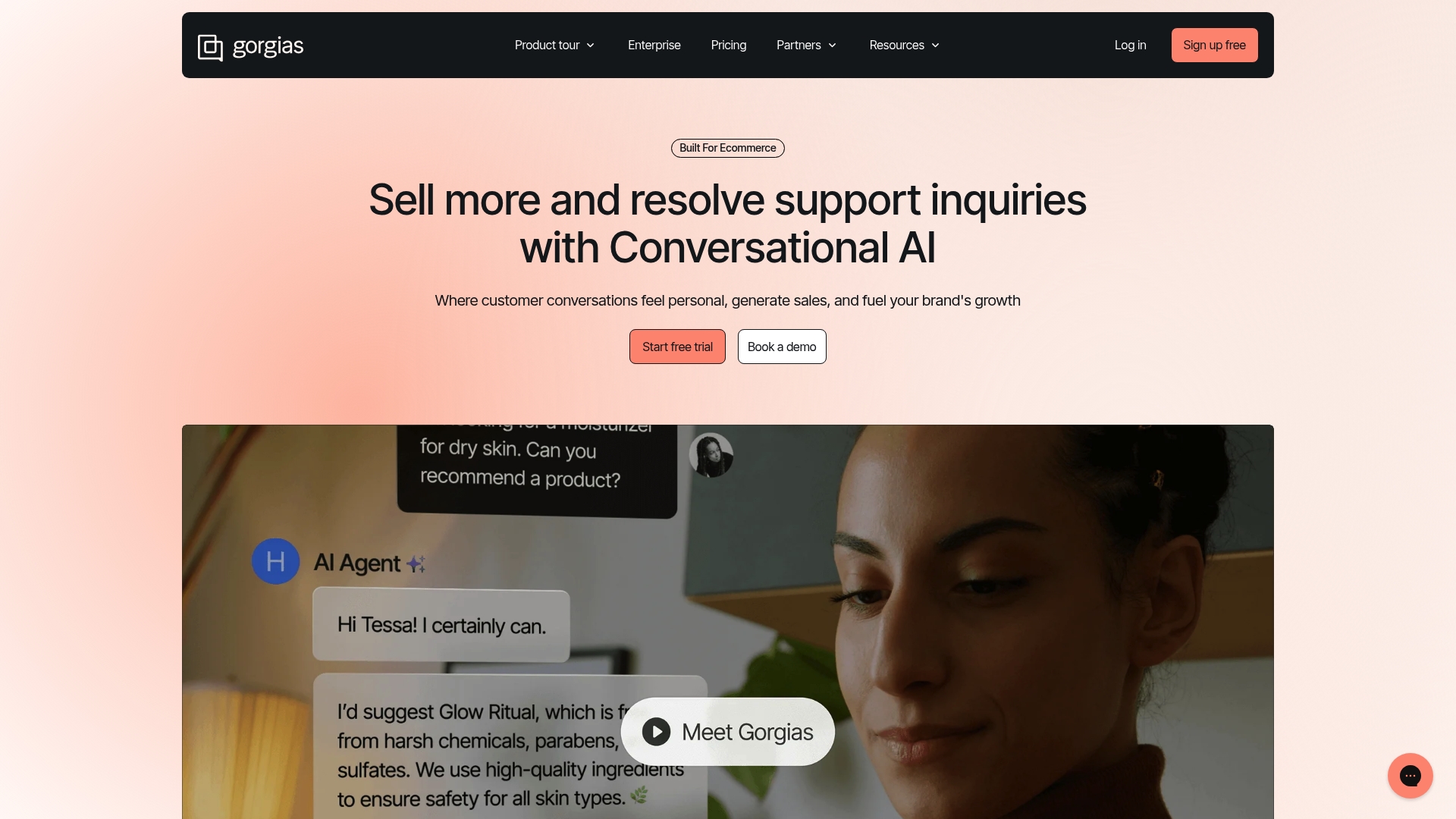
- Why it's on the list: Gorgias is a big name in the ecommerce helpdesk world, and its AI agent is a great add-on for teams that want to automate their text-based support. It’s built to manage the high volume of repetitive emails and chats that can easily swamp a support team.
- Pros and cons: Gorgias is really good at handling common support tickets without any human help. Because it connects directly with Shopify, it can check an order's shipping status, give tracking updates, and even make changes to orders, closing tickets automatically. This lets your human agents spend their time on more complex or sensitive customer problems. The main thing to note is its focus on text-based communication. It doesn't handle phone calls, which means stores needing voice support would require a separate solution.
- Pricing:
- Gorgias has a usage-based model, which costs around $0.90 - $1.00 for each ticket it resolves automatically. This price is on top of your main Gorgias helpdesk subscription.
3. ViSenze

- Why it's on the list: ViSenze offers a different approach to product discovery. It uses AI-powered visual search, which lets customers find products with images instead of words. This really changes the shopping experience in visual industries like fashion, jewelry, and home decor.
- Pros and cons: Using ViSenze can be an intuitive experience for shoppers. Shoppers can upload a photo or click on something in a picture to find similar-looking products. It feels a lot like how you'd naturally discover things you like out in the world. This can lead to more engagement, better conversion rates, and higher average order values. On the other hand, it is designed for larger companies with custom pricing, so it may not be accessible for most small to medium-sized businesses. Its usefulness also really depends on what you sell; it's less valuable for stores selling electronics or car parts where looks aren't the main thing.
- Pricing:
- Custom/Enterprise pricing is available if you get in touch with their sales team.
4. Klaviyo

- Why it's on the list: Klaviyo is a well-known tool for email and SMS marketing, and its AI-driven predictive analytics offer powerful capabilities. It helps you create smarter, more personal campaigns that feel more like helpful conversations than marketing blasts.
- Pros and cons: Klaviyo's machine learning models look at customer data to predict things like when they might buy next, if they're at risk of leaving, or their potential lifetime value. This lets you build very specific customer groups and automated campaigns that send the right message at the perfect time. This kind of personalization can really help with customer retention and revenue. The main thing to know is that its AI is mostly for analysis. It doesn't write content for you or handle customer support chats, so it solves a different kind of problem than a tool like Jasper or Ringly.io.
- Pricing:
- 14-day free trial: Includes up to 500 emails and 150 SMS messages per month.
- Paid plans start at $20/month and go up depending on the number of contacts and how many messages you send.
5. Jasper

- Why it's on the list: Jasper is one of the most well-known and flexible AI writing assistants available. For ecommerce teams, it can be a significant time-saver that can create all sorts of marketing copy, from product descriptions and blog posts to social media ads.
- Pros and cons: Jasper's biggest plus is its flexibility. You can teach it your brand's specific tone of voice, so all the content it creates sounds like it came from you. It is a helpful tool for overcoming writer's block, brainstorming, and knocking out first drafts much faster than you could by hand. But it's good to remember that it's an assistant, not a complete replacement for a human writer. The content it creates will always need a person to fact-check, edit, and add that final bit of polish and strategic thinking.
- Pricing:
- Plans start at $69/month for the Creator mode, which is meant for individuals.
- Business plans with features for teams are available with custom pricing.
6. Describely

- Why it's on the list: If your store has hundreds or thousands of products, writing unique descriptions is a significant task that can be time-consuming. Describely is an AI tool built specifically to solve this problem at a large scale.
- Pros and cons: Describely is made for big product catalogs. It lets you create titles, descriptions, and meta tags for many products at once while keeping your brand voice consistent across the whole store. Its direct connection with platforms like Shopify makes the process smoother, saving a significant amount of time. The main limitation is that it's very focused. Unlike a general writing tool like Jasper, Describely is really just for product page content. It won't help you with blog posts or emails, so it solves one very specific problem.
- Pricing:
- Describely has a pay-as-you-go model that starts at $0.75 per product for up to 500 products.
- Custom quotes are available for businesses with larger needs.
How to choose the best ecommerce AI software 2026 for your store
With all these options, how do you find the right one? It’s less about finding one "best" tool and more about finding the right tool for the job you need to get done.
- First, identify your biggest challenge. Before you even look at software, take a look at your business. Where are things getting stuck? Is your support team spending all day on the phone answering the same three questions? Are your product pages not converting? Is your email marketing not getting results? The most suitable AI tool is one that solves your most significant and time-consuming problem.
- Make sure it integrates with your platform. To be effective, your AI tool has to be able to talk to your ecommerce platform. A native Shopify app, for instance, can use real-time data, which is much more powerful than a tool that needs a complicated custom integration.
- Think about the setup. Some AI tools are complex and need a developer to get them working. For most stores, a no-code solution that you can set up in minutes, like Ringly.io, starts providing value almost right away without needing a technical team.
- Look for clear pricing and a free trial. Look for tools with transparent pricing models. The best options have clear, scalable plans that can grow with you. And always take advantage of a free trial to test the software with your own store's data before you commit.
-

For those looking to explore more options, this video provides a helpful overview of different AI tools that can boost sales and efficiency in an ecommerce setting.
This video reviews five of the best AI tools for e-commerce to help drive sales.
The future of ecommerce with the best ecommerce AI software 2026
The top ecommerce AI software in 2026 isn't one single platform that does everything. It's a mix of specialized tools, each built to be great at solving a specific business problem. Whether you start by automating your phone support, personalizing your marketing, or speeding up your content creation, the goal is to pick a tool that fits in smoothly and removes a real roadblock for you and your team.
For stores where phone support is a significant part of customer service, AI automation can be a practical starting point. Tools like Ringly.io are designed for this purpose, with an AI agent that handles common customer calls, such as order inquiries and returns, to free up team members for other tasks.
Frequently Asked Questions
What's the main benefit of using the best ecommerce AI software 2026?
The biggest benefit is automation. These tools can handle repetitive tasks like answering common customer questions, writing product descriptions, or personalizing marketing emails. This frees up your time to focus on growing your business instead of getting stuck in day-to-day operations.
How do I choose the best ecommerce AI software 2026 for my Shopify store?
Start by identifying your biggest bottleneck. Is it customer support, marketing, or something else? Look for a tool that solves that specific problem and integrates directly with Shopify. A native app is usually the easiest to set up and use.
Is the best ecommerce AI software 2026 difficult to set up?
It varies, but many of the top tools are designed for non-technical users. For example, solutions like Ringly.io can be up and running in just a few minutes. Always look for a tool with a straightforward setup process and a free trial to test it out first.
Can the best ecommerce AI software 2026 handle customer service in multiple languages?
Yes, many AI tools for customer service are built for global businesses. Ringly.io, for instance, can handle phone calls in about 30 languages, which is a great feature if you have an international customer base.
Will the best ecommerce AI software 2026 replace my human support team?
Not at all. The goal is to assist your team, not replace it. AI can handle the simple, repetitive questions, which allows your human agents to focus their expertise on more complex or sensitive customer issues that require a personal touch.
What kind of ROI should I expect from the best ecommerce AI software in 2026?
Your return on investment can come in a few forms: time saved from automating tasks, money saved on support costs, and increased revenue from better marketing or customer experiences. The best tools offer clear value by directly addressing a costly or time-consuming part of your business.