


90% of e-commerce brands fail because they try to do everything by hand.
You are likely burning out while trying to manage ads, write blogs, and fix SEO all at the same time.
You feel like there aren't enough hours in the day to grow.
It seems like you have to choose between scaling your sales or keeping your sanity.
But there is a fix.
This guide will show how to use AI tools to save hundreds of hours.
These tools can turn your store into a self-running machine that handles everything from first click to final support call.
First, we will look at tools that create your content. Then, we will show you how to automate your customer service and SEO.
Editor’s note: Want to hear some sample AI support calls made for your Shopify store?
- Just paste your store URL
- Get sample calls in under 20 seconds (no email required)
- Listen to demo AI calls for my store
Understanding AI marketing tools for e-commerce
An AI marketing tool for e-commerce is software that uses artificial intelligence to handle tasks, analyze data, and create more personalized experiences for shoppers. These tools can be thought of as automated assistants that work 24/7.
Modern AI tools are becoming more "agentic". This means they can operate with more autonomy to achieve set goals. Instead of only answering a question, an agentic AI might manage a customer's return request from start to finish or adjust ad campaigns based on performance data.
These tools generally fall into a few categories:
- Content Generation: Creating blog posts, product descriptions, and ad copy.
- SEO Optimization: Analyzing data to improve a store's ranking in search engines like Google.
- Customer Service Automation: Handling questions and support tickets automatically.
- On-site Personalization: Displaying relevant products to individual shoppers at the right time.
Let's explore some of the available options.
How we selected these marketing AI tools
Our selection process was based on several key criteria relevant to online stores.
First, we prioritized an e-commerce focus. We looked for tools built specifically for e-commerce or that have deep integrations with platforms like Shopify. A generic tool can be useful, but one designed for online stores may offer more specific advantages.
We also looked for a tangible impact on growth. We picked tools that can directly affect metrics such as conversion rates, average order value (AOV), or customer lifetime value (LTV).
Ease of use was another important factor. We focused on platforms with simple setups that a marketing team can implement without requiring developer assistance.
Finally, we considered scalability. The tools on this list are designed to grow with a business, whether it is just starting out or handling thousands of orders a day.
A quick comparison of marketing AI tools
Here is a quick look at the tools we will cover, so you can see how they compare at a glance.
| Tool | Best For | Key AI Feature | Starting Price |
|---|---|---|---|
| Ringly.io | Automating phone support & retention | AI phone agent "Seth" | $349/month |
| Jasper | AI content & copy generation at scale | Brand Voice & AI Agents | $59/month (billed yearly) |
| Surfer SEO | SEO content optimization | Content Editor with real-time scoring | $79/month (billed yearly) |
| Wisepops | On-site conversion & personalization | AI product recommendations for Shopify | $49/month |
| Synthesia | AI video creation | 240+ realistic AI avatars | $29/month |
| Gorgias | Text-based support automation | AI Agent for email, chat & social | $10/month |
6 marketing AI tools for e-commerce
Let's get into the details of each tool and what makes them stand out.
1. Ringly.io

Customer relationships extend beyond the checkout page. The post-purchase experience is important for building loyalty, and Ringly.io can be helpful for this part of the funnel. It addresses a common challenge for growing brands: phone support.
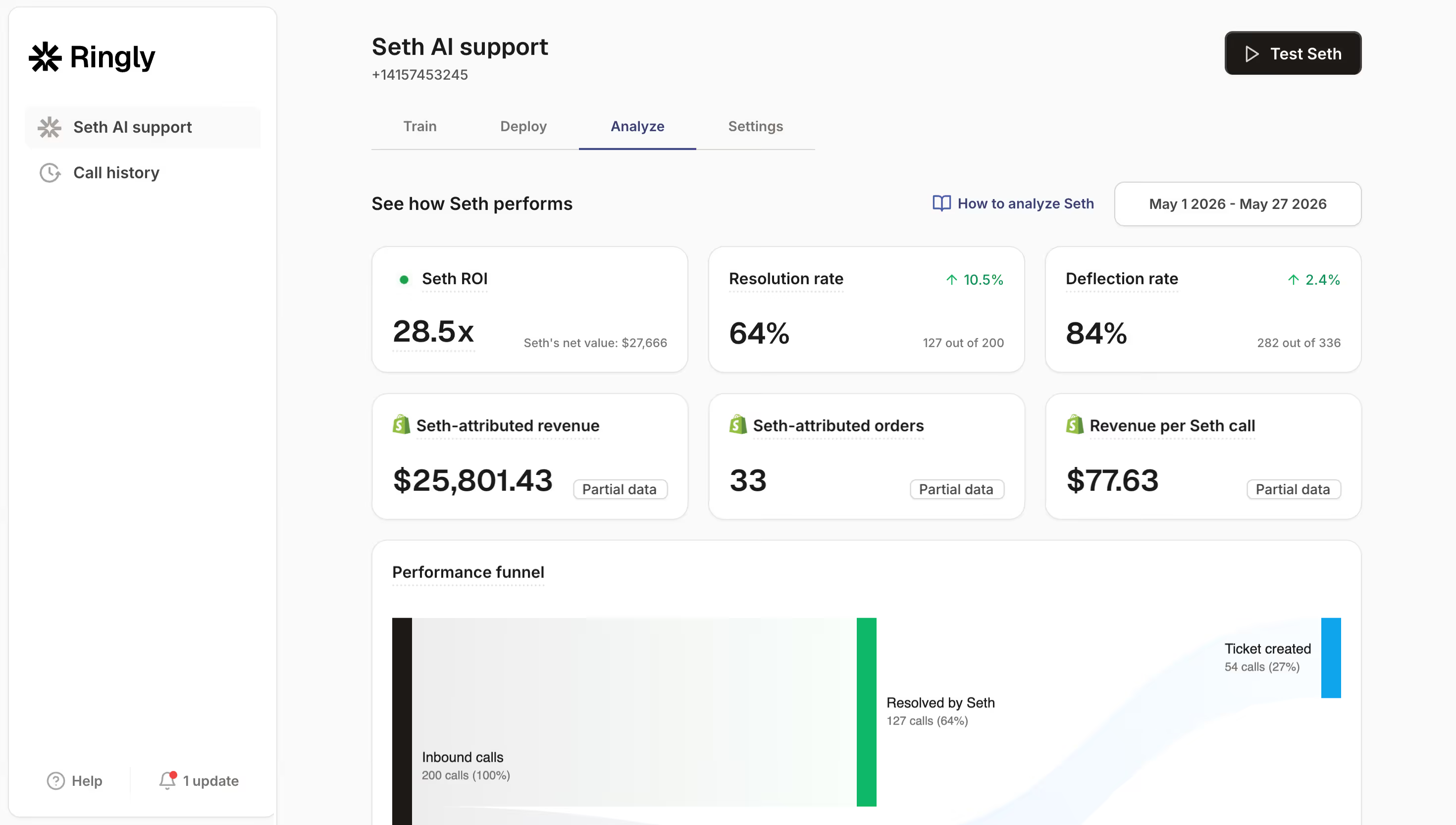
Its core product is the AI, an AI phone agent built specifically for Shopify stores. The AI handles repetitive but important calls, such as inquiries about order status (WISMO), return and exchange requests, and questions about products.
It is available 24/7 to assist customers in over 30 languages. the AI has a 73% resolution rate across thousands of stores, meaning it handles a majority of calls without human intervention.
Pros and cons: A primary advantage is its deep Shopify integration. the AI can pull live order information to give customers accurate, up-to-the-second answers. This reduces the need to place customers on hold to look up tracking numbers.
Additionally, the setup is designed to be straightforward, with a no-code setup in just 3 minutes. One consideration is that it is focused specifically on voice support. Therefore, for managing email and chat, it would likely be used alongside a text-based helpdesk.
Pricing:
Ringly.io has a guarantee that allows businesses to try the service. You get your last 3 months refunded if Seth resolves under 65% of calls in 90 days.
- Grow plan: $349/month for 250 call minutes.
- Grow Plan: $349/month for 1,000 call minutes and self-learning AI.
- Enterprise: custom pricing for 5,000+ minutes and custom integrations.
Editor’s note: Want to hear some sample calls made for your Shopify store?
- Just paste your store URL
- Get sample calls in under 20 seconds (no email required)
- Listen to demo calls for my store
2. Jasper

Jasper is an AI content platform designed to assist marketing teams with writer's block. It helps produce everything from ad copy and social media posts to entire articles.
Two notable features are Brand Voice and AI Agents. With Brand Voice, you can provide Jasper with your website or a style guide, and it learns your specific tone so that its output aligns with your brand. The AI Agents can handle more complex tasks independently, such as running a content campaign based on a simple prompt.
Pros and cons: Jasper's versatility allows for the creation of a large amount of marketing content in less time. This can result in significant time savings. On the other hand, AI-generated content often benefits from human review and editing to ensure strategic alignment and creativity.
Pricing:
- Pro Plan: Starts at $59 per seat/month when billed yearly.
- Business Plan: Custom pricing for larger teams that need more features, including API access.
3. Surfer SEO
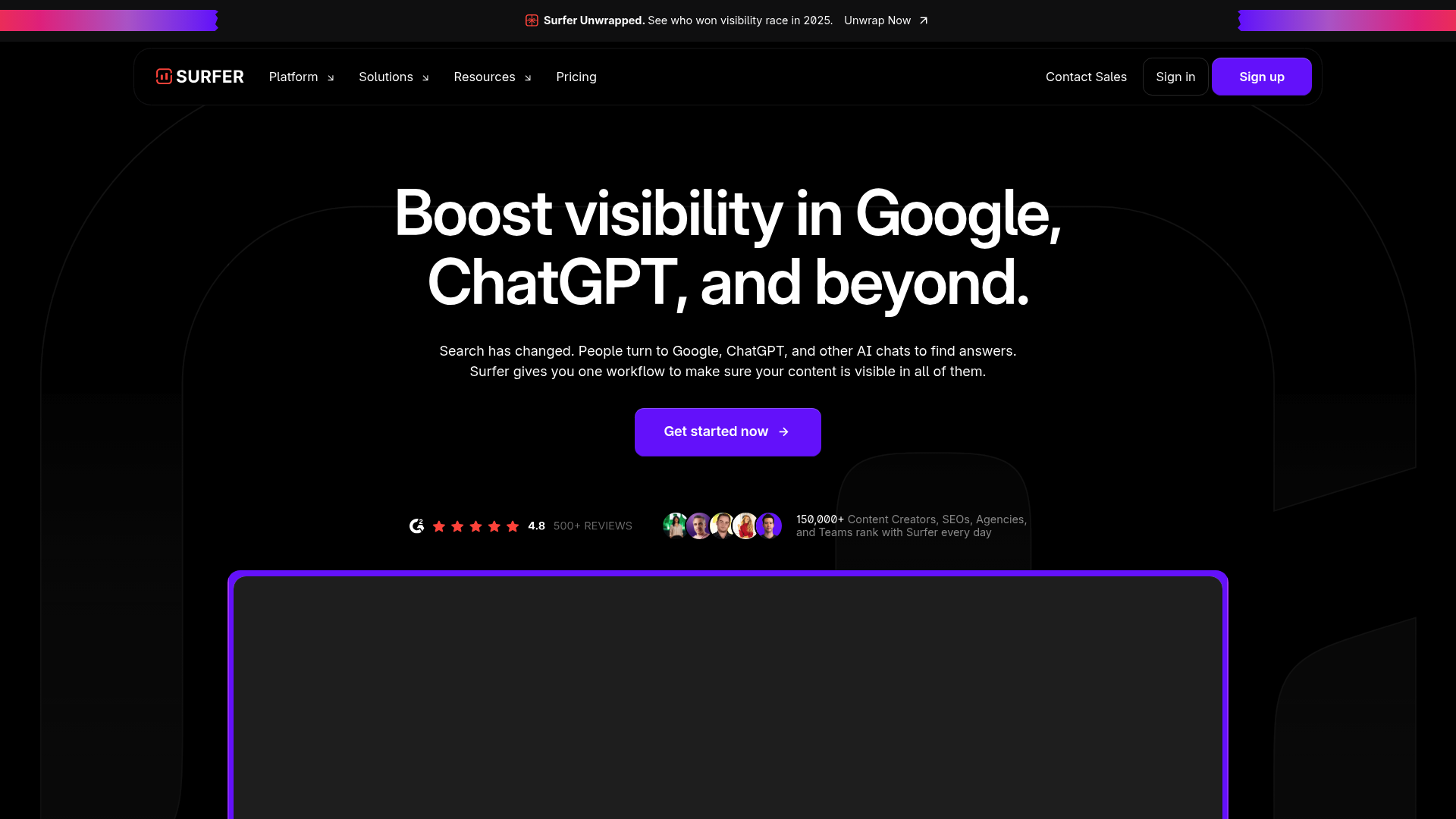
Achieving organic traffic from Google is a common goal for e-commerce brands, and Surfer SEO is a tool that provides a roadmap for content. It uses AI to analyze top-ranking search results and offers a data-backed plan to create competitive content.
Its main features include the Content Editor, which provides a real-time score on your writing and suggests keywords, and the Content Audit tool, which helps improve existing pages. It also has a Topical Map feature to help identify new content ideas.
Pros and cons: A primary benefit of Surfer is that it helps remove guesswork from on-page SEO. It provides a clear, actionable checklist for each piece of content. It also integrates with other tools like Jasper and Google Docs. A potential consideration is the focus on algorithmic factors; it is important to balance optimization with creating content that readers find engaging.
Pricing:
- Essential Plan: Starts at $79/month when you pay annually.
4. Wisepops

Wisepops is an AI tool designed to optimize website visits, using smart popups, forms, and on-site notifications to convert browsers into buyers.
Its standout feature is the AI-powered product recommendation engine for Shopify. It observes user browsing behavior and uses that data to show personalized product suggestions. This can be used for upselling, cross-selling, or recovering abandoned carts. According to Wisepops, this feature can boost sales by up to 10%.
Pros and cons: Wisepops is designed for creating targeted on-site campaigns without developer assistance. The AI recommendations provide a simple way to potentially increase your average order value. One consideration is that its most advanced AI features are currently built for Shopify stores. Users on other platforms may not have access to the full suite of AI features.
Pricing:
- Plans start at $49 per month, and they offer a 14-day free trial.
5. Synthesia

Video production can be time-consuming and expensive. Synthesia addresses this by allowing users to create professional-looking videos by typing a script, without needing cameras, microphones, or actors. It uses over 240+ AI avatars that can speak text in more than 130 languages.
For e-commerce, this can be used to create product demo videos for every item in a catalog, develop video FAQs for a support center, or send personalized marketing videos. It facilitates the creation of engaging video content at scale.
Pros and cons: A primary benefit is the potential for significant savings in time and money. It is also useful for localizing content for a global audience. A consideration is that while the AI avatars are realistic, they may not align with every brand's specific style, especially those that rely on a highly human and authentic video presence.
Pricing:
- Starter Plan: Starts at $29/month, which includes 10 minutes of video generation.
6. Gorgias
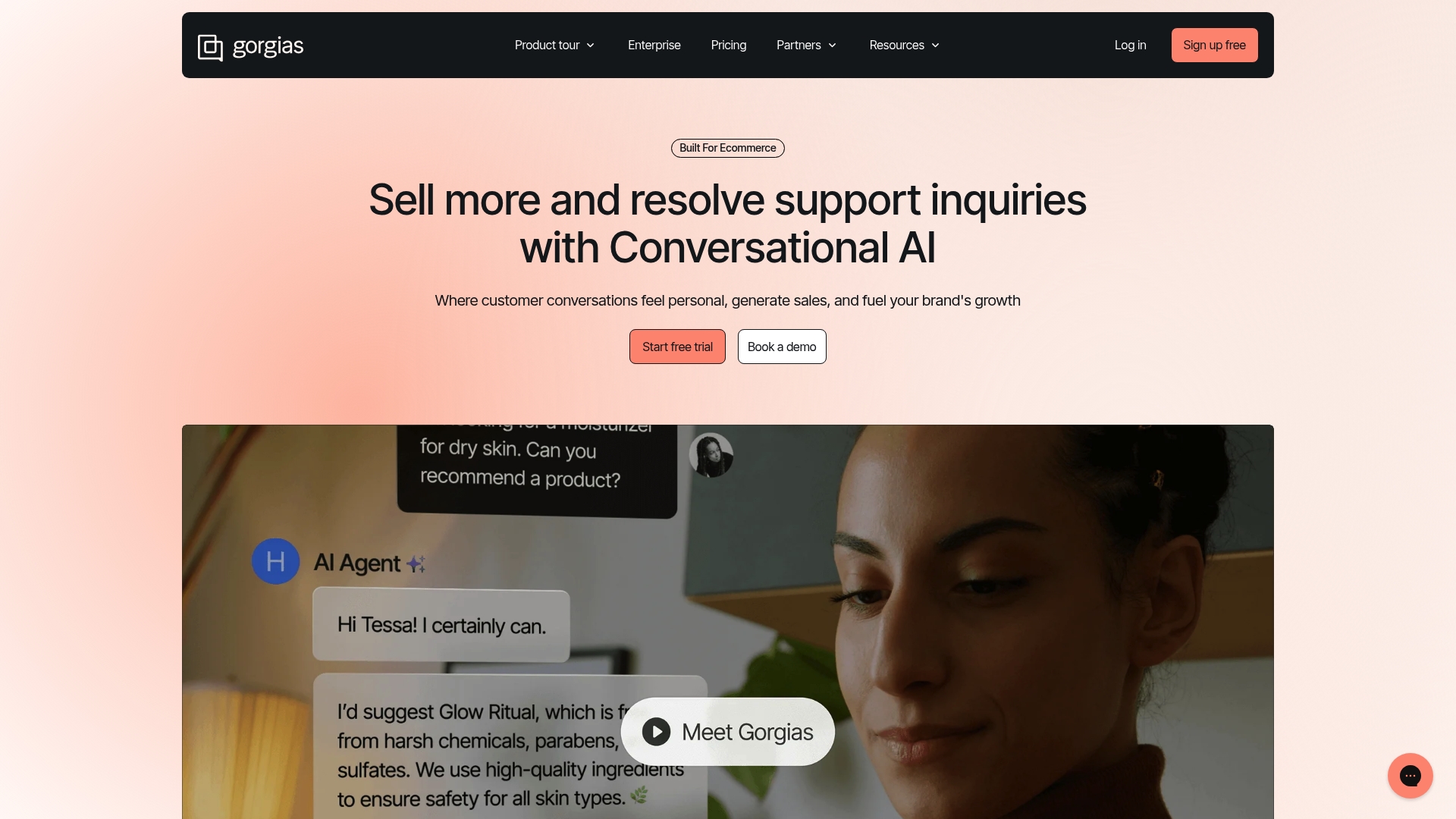
Gorgias is a known name in e-commerce customer service, acting as a central hub for support conversations from email, live chat, and social media. It is built to improve the efficiency of support teams.
Its AI Agent capabilities are a key feature, with Gorgias stating it can resolve up to 65% of common support questions independently. It can handle tasks like tracking orders, initiating returns, and managing subscriptions without human involvement.
Pros and cons: For Shopify stores, Gorgias offers extensive features. Its deep integration allows support teams to view order details and take actions like issuing a refund directly from the helpdesk.
A primary consideration is that its AI is built for text. While it is effective for email and chat, it does not cover phone calls. For brands with significant phone traffic, a specialized voice solution like Ringly.io would be needed to automate those conversations.
Pricing:
- Starter Plan: Begins at $10/month for 50 tickets, with additional costs for automated interactions powered by its AI.
How to choose the right AI marketing tool for your business
With several tools available, how do you choose the right one for your business?
The best way to start is to identify your biggest bottleneck. Where are you losing the most time or money? This flowchart can help guide your decision.

An infographic explaining how to choose the best marketing AI tools for ecommerce by identifying business bottlenecks.
- Are your support agents handling a high volume of repetitive phone calls about order status? You might consider Ringly.io.
- Is your content team struggling to keep up with the demand for new blog posts and product descriptions? Check out Jasper.
- Is your organic traffic flatlining? Surfer SEO may be a suitable option.
It can be effective to start with one tool that solves a significant problem first. Once that is implemented, you can look at adding another. Also, pay close attention to integrations. A tool that integrates directly with your Shopify store will likely provide value faster than one requiring custom work.
Finally, take advantage of free trials and guarantees. A tool like Ringly.io offers a guarantee to pay nothing until its AI agent resolves 65% of your calls. This is a great way to evaluate the impact before committing.
For a visual overview of how different AI tools can be applied in an e-commerce setting, the following video provides some practical examples. It covers a range of tools that can help drive sales and improve efficiency in your online store.
This video from ClickUp covers a range of tools that can help drive sales and improve efficiency in your online store.
Using AI marketing tools to automate e-commerce growth
Marketing AI tools for e-commerce in 2026 are not just about speed. They are about creating a customer journey that is smooth, efficient, and personal from start to finish.
That journey does not stop when the customer clicks "buy." The post-purchase experience is where you can earn their loyalty and encourage repeat business. Automating that part of the relationship, particularly with real-time voice support, can be an important factor for growth.
Ready to provide 24/7, instant phone support and turn customer service into a retention engine? Start your free trial of Ringly.io today and see how the AI can resolve up to 73% of your customer calls automatically.
FAQs
Does Ringly offer a guarantee? Yes. You don’t pay until we resolve at least 65% of your calls autonomously.
Does Ringly work with my current helpdesk? Yes. Ringly can escalate tickets to your existing helpdesk, and you have full control over what gets escalated. Ringly works with platforms like Gorgias, Richpanel, and others.
How does the AI handle order tracking? Our AI pulls data directly from Shopify to answer "where is my order" questions on every live phone call.
Can I forward my existing number? Absolutely. You can use call forwarding to send your business calls to your team.
How do I get started? We offer a free trial so you can start without any risk.
Also read: