

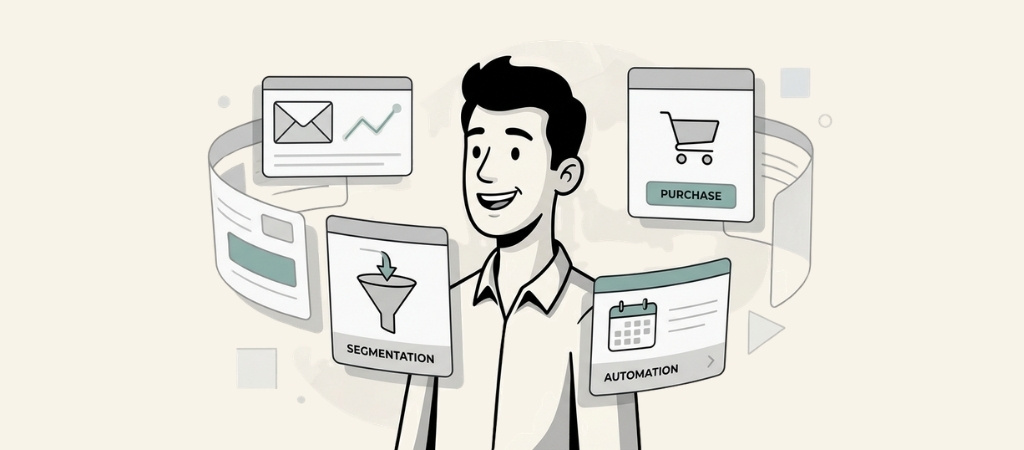
Email marketing consistently outperforms every other digital channel.
For every dollar you spend, you can expect $36 to $45 back. That's not marketing fluff, it's what Litmus research shows year after year.
But here's the catch. Most ecommerce stores treat email like an afterthought.
They send occasional promotional blasts and wonder why their open rates hover around 15%.
The stores that get it right, the ones pulling in serious revenue from their email programs, treat it as a core part of their customer experience.
This guide covers what actually works in ecommerce email marketing.
Not theory, but the specific campaigns, segmentation strategies, and tactics that drive sales and keep customers coming back.
Editor’s note: Want to hear some sample AI support calls made for your Shopify store?
- Just paste your store URL
- Get sample calls in under 20 seconds (no email required)
- Listen to demo calls for my store
What is ecommerce email marketing?
Ecommerce email marketing is the strategic use of email to communicate with customers throughout their entire relationship with your brand.
It starts the moment someone subscribes and continues through every purchase, question, and reorder.
Unlike social media, where algorithms decide who sees your content, email gives you direct access to your audience. You own that relationship.
When someone hands over their email address, they're inviting you into their inbox. That's a level of trust you can't buy with ads.
The channel works across the entire customer lifecycle. You acquire new subscribers through lead magnets and checkout opt-ins.
You nurture them with valuable content until they're ready to buy.
You convert them with targeted offers. You retain them with post-purchase follow-ups.
And when they go quiet, you win them back with re-engagement campaigns.
Over 4.5 billion people use email worldwide. Your customers are already there.
The question is whether you're showing up in their inbox with something worth opening.
Essential ecommerce email campaigns
The difference between stores that struggle with email and stores that thrive comes down to automation.
Manual campaigns have their place, but automated sequences work while you sleep. Here are the campaigns every ecommerce store needs.
Welcome series
Your welcome email is the most important message you'll ever send. It gets 50% open rates and 25% click-through rates, roughly 86% higher engagement than promotional emails.
A solid welcome series includes three emails. The first goes out immediately after signup.
It introduces your brand, sets expectations for what subscribers will receive, and delivers any promised incentive. The second email arrives 24 hours later with your brand story and social proof.
The third comes after 48-72 hours with a time-sensitive offer to drive that first purchase.
Klaviyo's data shows welcome emails generate 320% more revenue per email than other promotional messages.
This is your best opportunity to turn a subscriber into a customer.
Abandoned cart emails
About 70% of online shopping carts get abandoned. That's a lot of potential revenue walking out the door.
Abandoned cart emails recover a meaningful chunk of it.
These emails get 45% open rates and 21% click-through rates. Half the people who click end up completing their purchase.
The math is simple: if you're not sending these, you're leaving money on the table.
The best abandoned cart sequences include three emails. The first sends within an hour of abandonment, a simple reminder of what they left behind.
The second goes out 24 hours later with social proof or a gentle urgency nudge. The third arrives after 72 hours with a discount code if they still haven't purchased.
Some brands hesitate to offer discounts in cart abandonment emails, worried about training customers to abandon carts intentionally.
The data suggests this fear is overblown for most stores. Test both approaches and see what works for your audience.
Post-purchase sequence
The sale isn't the end of the relationship, it's the beginning. Post-purchase emails build loyalty and drive repeat purchases.
Your sequence should include order confirmation immediately after purchase, shipping notification when the order ships, delivery confirmation when it arrives, and a review request 5-7 days after delivery.
Each email is an opportunity to reinforce your brand and set up the next sale.
Review request emails deserve special attention. Reviews are social proof that drives future sales.
Make it easy for customers to leave feedback with a direct link. Consider offering loyalty points or a small discount as a thank you.
Browse abandonment
Cart abandonment gets all the attention, but browse abandonment is just as important.
SaleCycle research shows 43.8% of sessions end on a product page without adding anything to cart. That's a huge pool of interested shoppers.
Browse abandonment emails target people who viewed a product but didn't add it to their cart.
These emails get 80% higher open rates than standard promotional emails. The key is to address possible objections, suggest similar products, or simply remind them what caught their eye.
Re-engagement and win-back
Email lists naturally degrade by about 22.5% every year. People change email addresses, lose interest, or simply stop engaging.
Re-engagement campaigns help you clean your list and potentially win back dormant subscribers.
A typical win-back sequence starts with a "we miss you" email offering an exclusive discount.
If that doesn't work, a second email asks for feedback about why they haven't purchased. The final email gives them a chance to stay subscribed or be removed.
Sunset campaigns, which remove inactive subscribers entirely, improve your deliverability and keep your list healthy.
It's better to have a smaller engaged list than a large dead one.
Building and segmenting your email list
A great email program starts with a quality list. Buying email lists is a shortcut to the spam folder. Build yours organically.
List growth tactics
Pop-up forms are the most effective list building tool for ecommerce stores. According to Klaviyo's benchmarks, full-screen forms convert at 3.54%, standard pop-ups at 2.71%, and fly-out forms at 1.78%. Embedded forms in your footer convert at just 1.04%.
The offer matters as much as the form. Klaviyo's consumer research shows 43% of people sign up for exclusive discounts, 19% for early access to sales, and 13% for personalized recommendations. Test different incentives to see what resonates with your audience.
Checkout opt-ins are another powerful source. Someone making a purchase is already engaged with your brand.
Make sure you're capturing their email for future marketing.
Segmentation strategies
Sending the same email to your entire list is a recipe for mediocre results. Segmentation is how you make emails feel personal.
Demographic segmentation uses data like location, age, or gender. A clothing retailer might send winter coats to subscribers in Chicago and summer dresses to those in Miami.
Behavioral segmentation is where the real power lies. Segment by purchase history to recommend complementary products.
Segment by browsing behavior to follow up on viewed items. Segment by engagement level to send different content to your most active subscribers versus those who rarely open emails.
Segmented emails generate 58% of all email revenue according to Campaign Monitor. The effort pays off.
Writing emails that convert
Great email marketing is part art, part science. The art is in the copy and design. The science is in testing and optimization.
Subject lines that get opened
Your subject line determines whether your email gets opened or deleted. The best ones create curiosity, urgency, or personal relevance.
Curiosity-driven subject lines hint at valuable content inside: "You won't believe what just arrived." Urgency creates FOMO: "24 hours left: 40% off ends tonight." Personalization makes it relevant: "Sarah, your cart is waiting (plus a little surprise)."
Avoid spam trigger words like "FREE," "ACT NOW," or excessive punctuation. These land you in the promotions tab or spam folder.
Email structure and design
Every email should have a clear purpose and a single call-to-action. The structure is simple: compelling header, hero image that reinforces the message, concise copy that gets to the point, and a prominent CTA button.
Design for mobile first. Over 60% of emails are opened on mobile devices.
If your email doesn't look good on a phone, you're losing most of your audience.
Keep paragraphs short. Two to three sentences maximum. Use bullet points for lists. Make it scannable.
A/B testing
Never assume you know what works. Test everything. Subject lines are the easiest place to start.
Test curiosity versus urgency. Test personalization versus generic. Test emoji versus no emoji.
Send times matter too. Test morning versus evening. Test weekdays versus weekends. Your audience might surprise you.
Content variations help you understand what drives clicks. Test different hero images, CTA button colors, or copy length. Small changes can lead to significant improvements.
Measuring ecommerce email success
You can't improve what you don't measure. Track these metrics to understand how your email program is performing.
Key metrics to track
Open rate shows how compelling your subject lines are. Industry averages hover around 20%, though this varies by sector.
Click-through rate measures email engagement. The top 10% of campaigns achieve 4.74% CTR according to Klaviyo's benchmarks.
Conversion rate tracks how many clicks turn into purchases. This is your bottom-line metric.
Revenue per email shows the actual dollar value each message generates. The top performers see $0.97 per recipient.
List growth rate tells you if you're gaining subscribers faster than you're losing them.
Unsubscribe rate should stay below 0.5%. Higher than that suggests you're emailing too frequently or your content isn't relevant.
Calculating true ROI
To calculate email ROI, track all costs including platform fees, design resources, and copywriting time.
Compare that to attributed revenue from email campaigns. Most ecommerce platforms can track this automatically.
The $36-$45 ROI figure you hear quoted includes the full customer lifetime value, not just immediate purchases.
Email builds relationships that lead to repeat purchases over time.
Integrating email with your full support stack
Email doesn't exist in a vacuum. It's one touchpoint in your broader customer experience.
The best ecommerce brands create seamless experiences across every channel.
Email excels at nurturing and retention. It's perfect for building relationships over time, sharing valuable content, and driving repeat purchases.
But it's not the right tool for every situation.
Complex customer issues often need a more personal touch. High-value customers might appreciate a phone call for important updates.
Real-time problems need real-time responses that email can't provide.
This is where channels like phone support come in. While email handles the bulk of your communication, phone support picks up the complex cases that need human attention. The key is making sure these channels work together, not in silos.
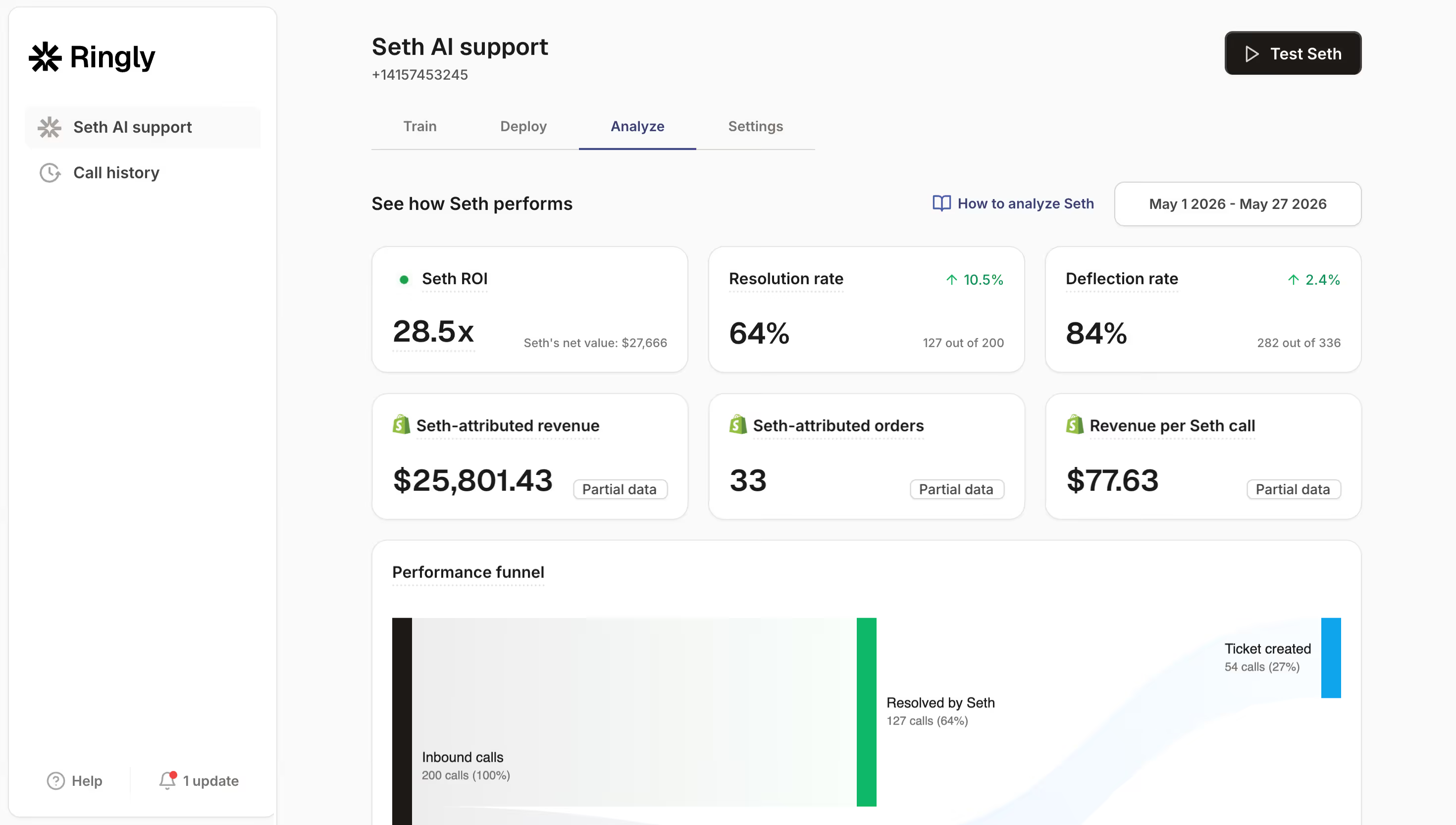
For stores looking to scale phone support without scaling headcount, Ringly.io offers an interesting solution.
Their AI phone agent The AI handles routine calls like order tracking and returns, escalating only the complex issues to your team. It integrates with your existing systems and can resolve around 70% of calls without human intervention.
The goal is consistent brand voice across every channel. Whether a customer emails, calls, or visits your site, they should feel like they're talking to the same brand.
Common ecommerce email mistakes to avoid
Even experienced marketers make these mistakes. Here's what to watch out for.
Buying email lists is the fastest way to destroy your sender reputation. Those people didn't ask to hear from you.
You'll get high spam complaints and low engagement, which hurts your deliverability for everyone.
Neglecting mobile optimization is expensive. Most of your subscribers open emails on their phones.
If your emails require pinching and zooming, you're losing readers.
Sending without segmentation wastes opportunity. Batch-and-blast emails perform worse than targeted messages every time.
The extra effort to segment pays for itself.
Ignoring deliverability best practices lands you in spam folders. Use double opt-in, clean your list regularly, and authenticate your domain with SPF, DKIM, and DMARC records.
Over-mailing subscribers burns them out. There's no universal right frequency. Test to find what works for your audience, and always prioritize quality over quantity.
Getting started with ecommerce email marketing
You don't need to build everything at once. Start with the fundamentals and expand from there.
First, choose an email platform that integrates with your ecommerce store. Klaviyo, Mailchimp, and Omnisend are popular options with strong ecommerce features. Look for pre-built integrations with your store platform.
Next, set up your welcome series. This is your highest-impact campaign and the foundation of your email program.
Get this right before moving on to more complex automation.
Then build your list organically. Add pop-up forms to your site. Enable checkout opt-ins.
Create a lead magnet that delivers real value to your target customer.
Finally, iterate based on data. Watch your metrics. Test different approaches. Double down on what works and cut what doesn't.
Email marketing is a long game. The stores that win are the ones that show up consistently with valuable content.
Start simple, measure everything, and improve over time.
And remember, email is just one piece of your customer communication strategy.
For the moments when customers need immediate help or have complex questions, consider how Ringly.io can handle your phone support. the AI answers calls 24/7, resolves routine issues automatically, and only escalates when necessary.
It's a natural complement to a strong email program.
Frequently Asked Questions
What is ecommerce email marketing?
Ecommerce email marketing is the strategic use of email to communicate with customers throughout their relationship with your brand. It includes promotional campaigns, automated sequences like welcome series and abandoned cart emails, and transactional messages like order confirmations.
How much revenue can ecommerce email marketing generate?
According to Litmus research, email marketing generates $36 to $45 for every $1 spent, making it one of the highest-ROI marketing channels. The exact figure depends on your industry, list quality, and campaign strategy.
What are the most important ecommerce email campaigns?
The essential campaigns are welcome series, abandoned cart emails, post-purchase sequences, browse abandonment emails, and re-engagement campaigns. Start with welcome and abandoned cart, then expand to the others.
How often should I send ecommerce marketing emails?
There's no universal right frequency. It depends on your audience and content quality. Start with 1-2 emails per week, monitor engagement metrics, and adjust based on unsubscribe rates and open rates.
What is a good open rate for ecommerce email marketing?
Industry averages hover around 20%, though this varies by sector. Welcome emails typically see 50% open rates, while promotional emails average 15-25%. Focus on improving your own benchmarks over time rather than comparing to industry averages.
How do I build an ecommerce email list?
Use pop-up forms with incentives (discounts work best), enable checkout opt-ins, create valuable lead magnets, and add embedded signup forms to your footer and about page. Never buy email lists.
What is email segmentation and why does it matter?
Segmentation is dividing your email list into smaller groups based on demographics, behavior, or engagement. Segmented emails generate 58% of all email revenue because they deliver more relevant content to each subscriber.