

Running an online store means juggling a lot of moving parts.
You've got marketing campaigns to launch, customer emails to answer, and inventory that somehow needs to get from your supplier to your customer's doorstep without any drama.
That last part, ecommerce warehouse management, is where things get complicated fast.
What starts as a few boxes in your garage eventually becomes a complex operation involving receiving, storage, picking, packing, shipping, and returns.
Get it right and you have happy customers who get their orders on time.
Get it wrong and you're dealing with stockouts, mis-shipped orders, and a support inbox that never empties.
This guide breaks down what ecommerce warehouse management actually involves, the technology that makes it work, and how to decide whether to keep operations in-house or outsource to a third-party logistics provider (3PL).
Editor’s note: Want to hear some sample AI support calls made for your Shopify store?
- Just paste your store URL
- Get sample calls in under 20 seconds (no email required)
- Listen to demo calls for my store
What is ecommerce warehouse management?
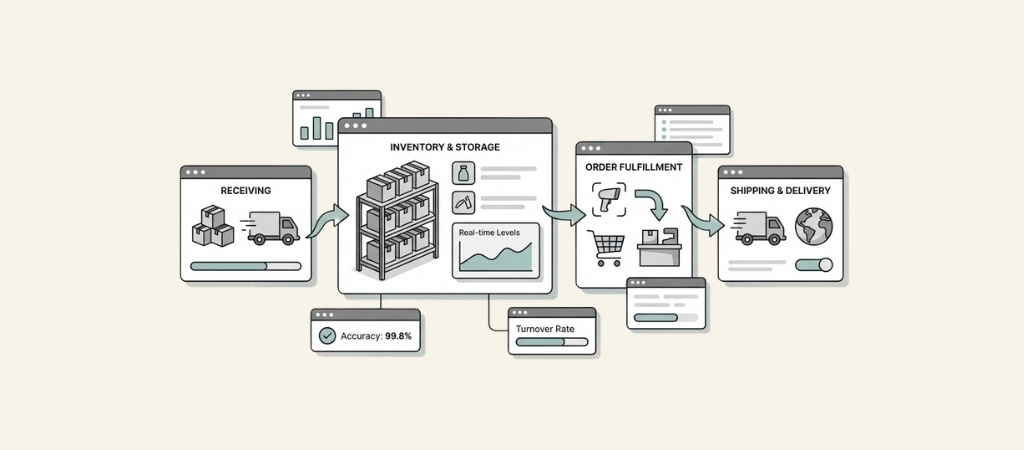
Ecommerce warehouse management is the combination of systems, processes, and people that move products from the moment they arrive at your facility to the moment they reach your customer.
It covers everything from unloading pallets and counting inventory to picking individual items and printing shipping labels.
Unlike traditional warehousing, which often focuses on long-term storage of bulk goods, ecommerce warehousing is built for speed and accuracy.
You're not storing pallets for months.
You're receiving inventory, breaking it down into individual units, and shipping those units to customers who expect two-day delivery.
The scope includes:
- Inventory control — knowing exactly what you have, where it is, and how fast it's moving
- Order fulfillment — picking the right items, packing them properly, and getting them out the door quickly
- Returns processing — receiving items back, inspecting them, and getting them back into sellable condition
- Labor management — scheduling staff, training them on procedures, and keeping them productive
- Technology oversight — running warehouse management systems, barcode scanners, and integration with your ecommerce platform
Here's the short version: ecommerce warehouse management is about getting the right product to the right customer at the right time, without breaking the bank or burning out your team.
The metrics that actually matter are order accuracy (aim for 99%+), fulfillment speed (time from order to carrier handoff), and inventory turnover (how quickly stock moves through your facility).
Track these three and you'll have a clear picture of warehouse health.
One thing that's easy to overlook: warehouse accuracy directly impacts your customer support volume.
When orders ship correctly, you get fewer "where's my order" calls and return requests.
That's worth keeping in mind as you optimize your operations.
Core warehouse operations explained
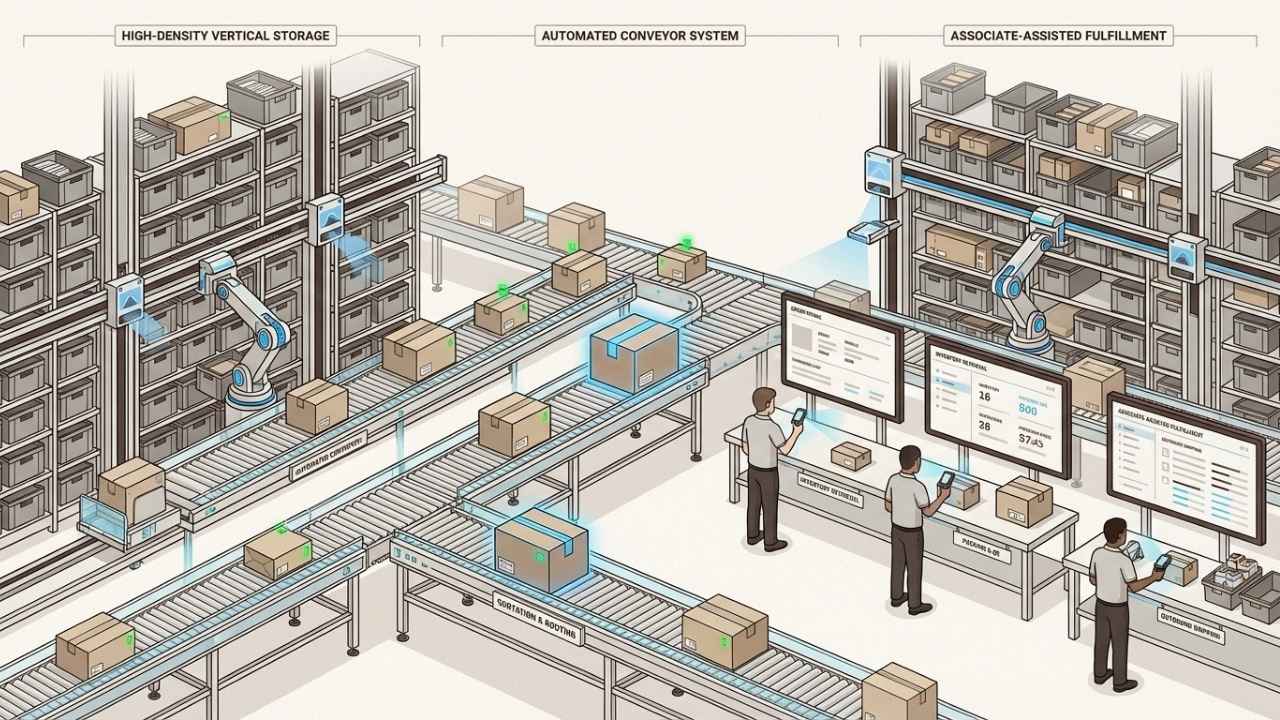
Let's break down what actually happens in an ecommerce warehouse on a typical day.
Understanding these workflows helps you spot bottlenecks and identify where technology can help.
Receiving and put-away
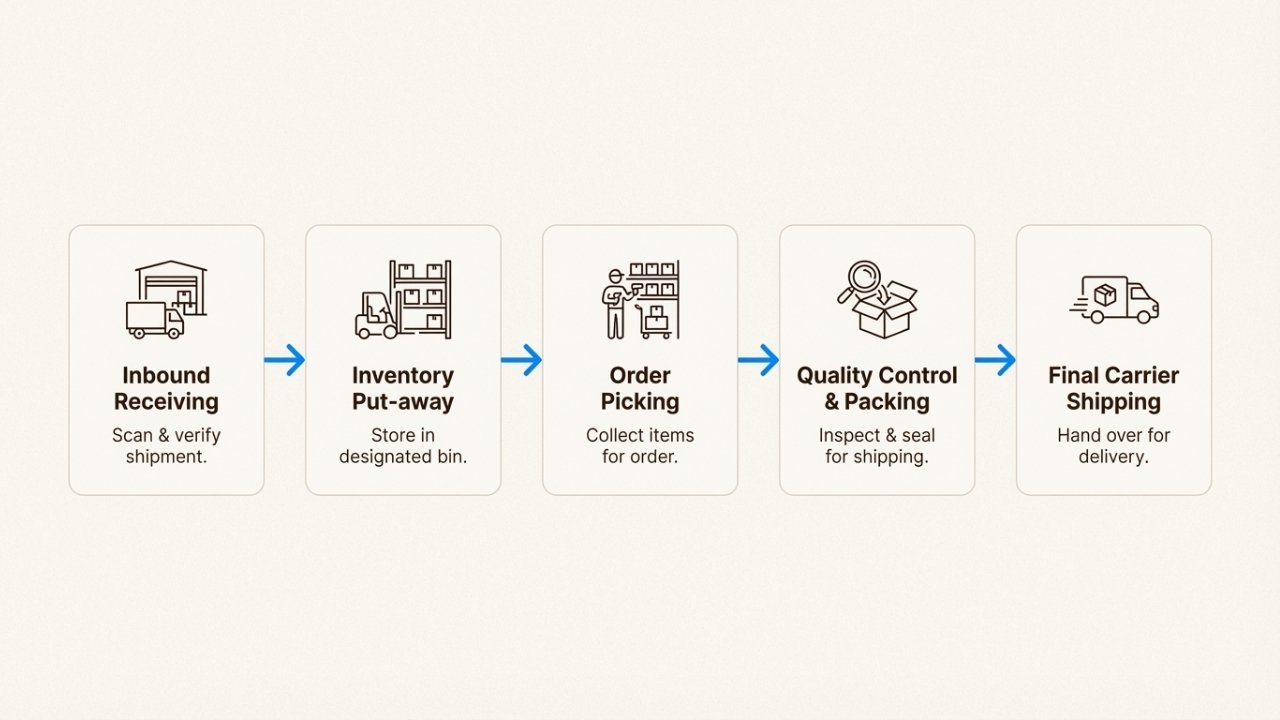
Every warehouse operation starts with receiving. Trucks arrive with pallets of inventory, and your team needs to unload, count, inspect for damage, and get those products into storage locations.
The key here is accuracy. If you miscount during receiving, your inventory records are wrong from day one.
That leads to stockouts, overselling, and angry customers.
Best practices include:
- Counting every carton, not just trusting the packing slip
- Inspecting for visible damage before signing off
- Scanning barcodes immediately to update inventory records
- Putting away inventory the same day it arrives (don't let it sit on the dock)
Inventory storage and slotting
Once inventory is received, it needs a home. How you organize your warehouse directly impacts picking speed and accuracy.
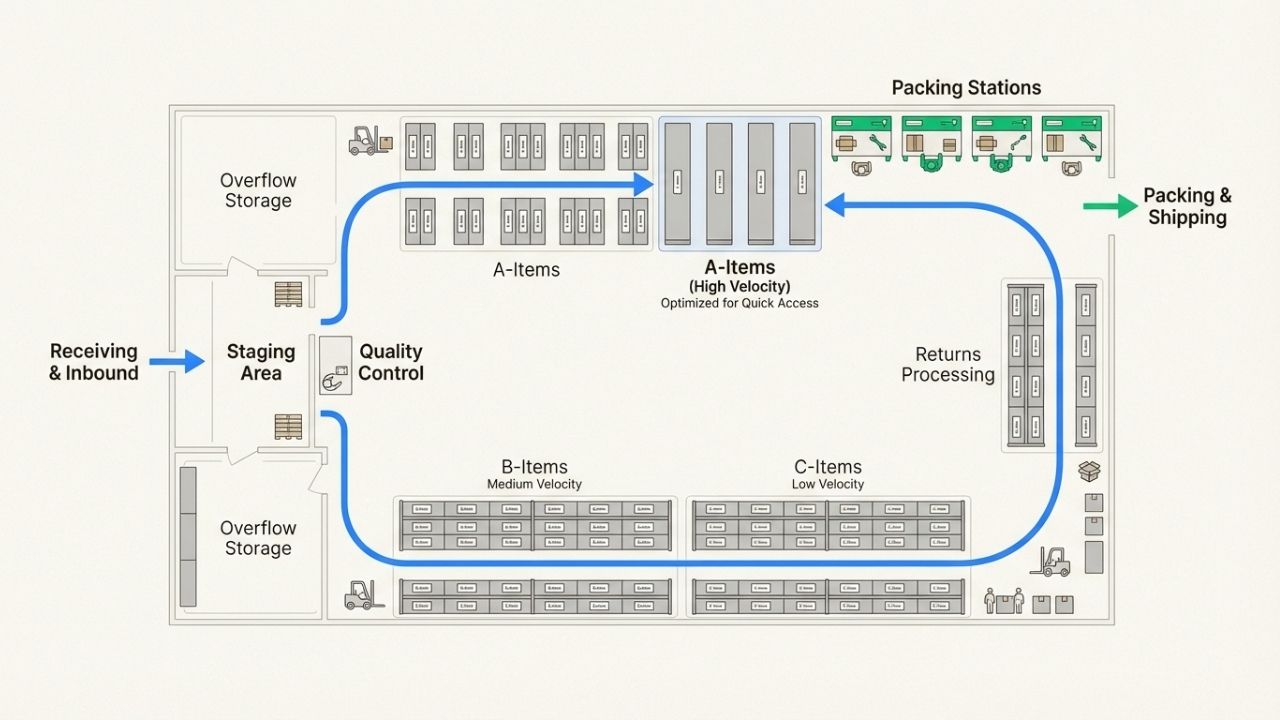
Slotting is the practice of assigning specific locations to specific SKUs based on how frequently they're picked.
High-velocity items should live near your packing stations.
Slow movers can go in the back corners.
Many warehouses use ABC analysis:
- A items — top 20% of SKUs by volume, stored closest to packing
- B items — middle 30%, stored in secondary locations
- C items — bottom 50%, stored wherever there's space
This simple approach can reduce picker travel time by 30% or more.
Order picking and packing
When a customer places an order, the clock starts ticking. Pickers need to locate each item, verify it's the right product, and bring it to the packing station.
There are several picking strategies to consider:
- Single order picking — one picker handles one order from start to finish
- Batch picking — one picker collects items for multiple orders in a single trip
- Zone picking — pickers stay in assigned zones, passing orders between zones
- Wave picking — orders are grouped and picked in scheduled waves throughout the day
The right approach depends on your order volume and warehouse layout.
Small operations often start with single order picking and graduate to batch or zone picking as volume grows.
At the packing station, items get boxed, labeled, and sorted by carrier.
Quality control checks here catch picking errors before they reach customers. This final checkpoint prevents costly mistakes.
Shipping and carrier management
Once packed, orders need to get into the hands of carriers.
This involves generating shipping labels with the correct service level, sorting packages by carrier (USPS, UPS, FedEx, regional carriers), staging them at the correct dock door, and scheduling carrier pickups or drop-offs.
Many warehouses use shipping software that automatically selects the cheapest carrier that meets the delivery promise.
This saves significant money on freight costs.
Returns processing
Returns are a reality of ecommerce. Your warehouse needs a process for receiving returned items, inspecting them, and either restocking them, disposing of them, or sending them back to the manufacturer.
A good returns process includes these steps:
- Scanning the return to update inventory and trigger refunds
- Quality checks to determine if the item is resellable
- Photography/documentation of damaged returns
- Prompt restocking of good inventory
Warehouse management systems: do you need one?
A warehouse management system (WMS) is software that tracks inventory in real-time, optimizes picking routes, and integrates with your ecommerce platform and shipping carriers.
Think of it as the brain of your warehouse operation. Without it, you're relying on memory and spreadsheets.
What a WMS actually does
At its core, a WMS replaces spreadsheets and paper with digital tracking. Here's what that looks like in practice.
Real-time inventory tracking — Every time someone scans a barcode, the system updates. You know exactly how many units you have of every SKU, in every location, at any moment.
Pick path optimization — Instead of wandering the warehouse randomly, pickers get optimized routes that minimize walking distance. The system might direct them to pick A1, then B3, then C2 in the most efficient sequence.
Integration with ecommerce platforms — Orders flow automatically from Shopify, WooCommerce, or Amazon into the WMS. When you ship, tracking numbers flow back to the platform and customers get notified automatically.
Reporting and analytics — See which SKUs are moving fast, which pickers are most productive, and where errors are happening. This data drives continuous improvement.
Types of WMS solutions
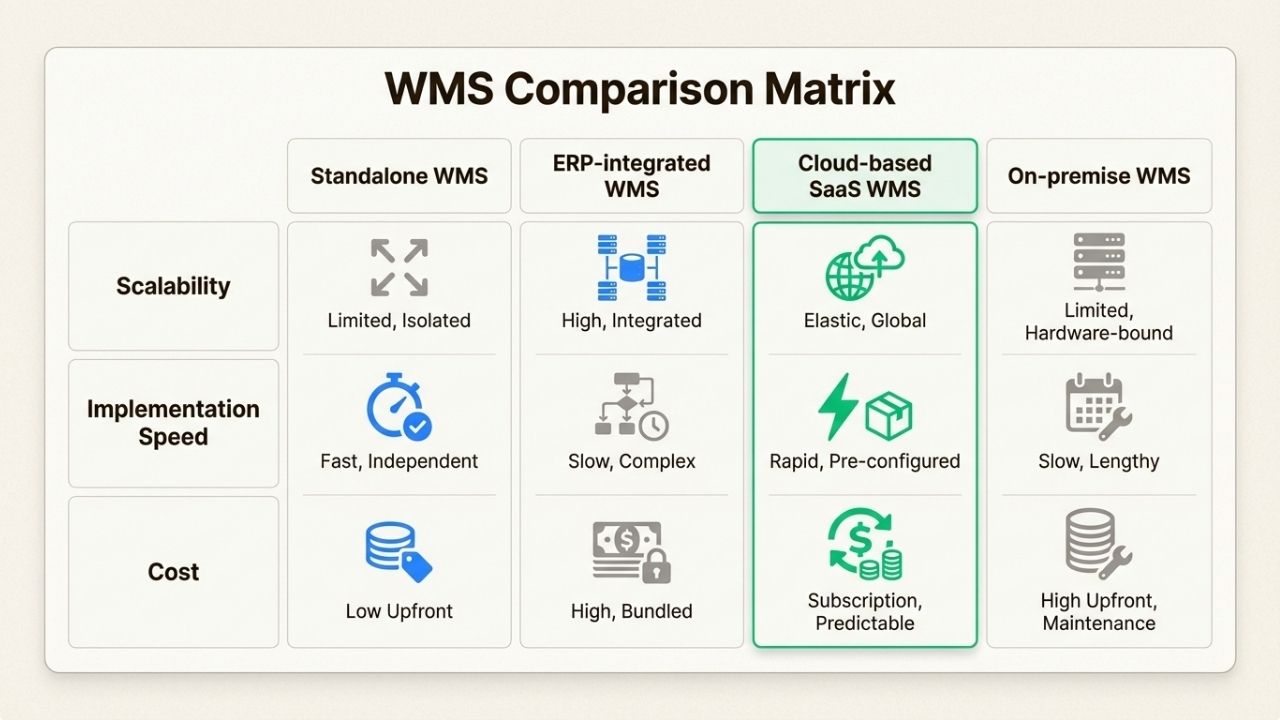
Not all warehouse management systems are the same. The category breaks down into four main types:
| Type | Best For | Key Characteristics |
|---|---|---|
| Standalone WMS | Small operations with basic needs | Focused on core warehouse functions, limited integrations, lower cost |
| Integrated/ERP-connected | Growing businesses | Connects to accounting, purchasing, and sales systems for end-to-end visibility |
| Cloud-based SaaS | Mid-market ecommerce | Fast implementation, monthly pricing, automatic updates, scales with you |
| On-premise enterprise | Large operations | Maximum customization, requires IT staff, higher upfront cost |
Cloud-based solutions have become the default for ecommerce businesses in the $1M-$50M revenue range.
They offer the functionality you need without the IT overhead of on-premise systems.
When to invest in a warehouse management system
There's no magic order number that dictates when you need a WMS, but there are clear signals.
You're shipping more than 50-100 orders per day. You're using spreadsheets to track inventory and they're breaking.
Pickers are spending more time walking than picking. You're running out of stock without realizing it. Or you're discovering you have way more inventory than you thought.
You might also be selling on multiple channels and struggling to keep inventory synced.
The ROI calculation usually centers on labor efficiency and error reduction.
If a WMS saves you one full-time employee's salary through productivity gains and prevents costly mis-ships, it pays for itself quickly.
Key features to evaluate
When comparing WMS options, look for these capabilities.
Multi-channel inventory sync keeps stock levels accurate across Shopify, Amazon, eBay, and wholesale channels.
Barcode/RFID scanning is essential for accuracy and speed.
Mobile device support means pickers need handheld scanners or smartphones that work in the warehouse environment.
Integration ecosystem connects to your ecommerce platform, shipping software, and accounting system.
Reporting and analytics gives you visibility into what's working and what isn't.
Choosing your warehouse model
One of the biggest decisions ecommerce businesses face is whether to run their own warehouse or outsource fulfillment to a third-party logistics provider (3PL).
There's no universal right answer.
It depends on your volume, product characteristics, growth trajectory, and capital situation.
In-house warehousing
Running your own warehouse gives you complete control. You set the processes, hire the staff, and own the customer experience end-to-end.
When it makes sense:
- High order volume (typically 500+ orders per day)
- Products that require specialized handling (refrigeration, fragile items, custom packaging)
- You already have logistics expertise on your team
- You have capital to invest in warehouse space, equipment, and technology
- Your brand experience depends heavily on custom packaging or inserts
The trade-offs:
Fixed costs are high. You're paying rent, utilities, equipment leases, and salaries regardless of order volume.
During slow periods, you're still carrying that overhead.
During peak season, you might struggle to hire and train temporary staff fast enough.
Third-party logistics (3PL)
A 3PL handles warehousing and fulfillment on your behalf. You send them inventory, they store it, and they pick, pack, and ship orders as they come in.
When it makes sense:
- You're growing fast and need to scale quickly
- You want to offer two-day shipping nationwide without operating multiple warehouses
- You lack logistics expertise or don't want to build that capability
- You prefer variable costs (pay per order) to fixed costs
- You're expanding internationally and need local fulfillment
The trade-offs:
You give up some control over the customer experience. You're also dependent on the 3PL's technology and processes.
If they make a mistake, your customers blame you, not the 3PL.
Hybrid approaches
Many successful ecommerce businesses use a hybrid model. They might handle fulfillment in-house for their home region where they have density.
They might use a 3PL for distant regions to reduce shipping times and costs.
Some keep specialty products in-house while outsourcing standard SKUs. Others use 3PL overflow space during peak season (November/December) while handling baseline volume themselves.
Decision framework
Here's a simple framework for thinking through the decision:
| Factor | In-House Favored | 3PL Favored |
|---|---|---|
| Order volume | 500+ per day | Under 500 per day |
| Product complexity | Custom packaging, special handling | Standard boxes, simple products |
| Growth rate | Steady, predictable | Rapid, unpredictable |
| Capital available | Can invest in facilities | Prefer to preserve capital |
| Geographic reach | Single region | National or international |
| Control priority | High (brand experience critical) | Moderate (efficiency matters more) |
One factor that's easy to miss: your support volume. Warehouses that make frequent errors generate more customer service contacts.
If you're considering a 3PL, ask about their accuracy rates and how they handle mis-ships.
A slightly more expensive 3PL with better accuracy might actually cost less when you factor in the support time saved.
Best practices for warehouse efficiency
Whether you run your own warehouse or use a 3PL, these principles will help you get more out of your fulfillment operation.
Layout optimization
Warehouse layout directly impacts labor costs. Every step a picker takes costs money.
The goal is to minimize travel distance while maintaining safety and organization.
Key principles to follow:
- Keep your fastest-moving SKUs closest to packing stations
- Create clear aisles wide enough for safe forklift operation but not so wide that you're wasting space
- Use vertical space with appropriate racking systems
- Design picking paths that flow in one direction (clockwise or counterclockwise) rather than requiring backtracking
The 80/20 rule in practice
In most warehouses, 20% of SKUs generate 80% of orders. Identify your A-list products and give them prime real estate near your packing stations.
This simple adjustment can dramatically reduce picker walking time.
Regular cycle counts vs annual inventory
Don't wait for an annual physical inventory to discover discrepancies.
Cycle counting, where you count a small subset of inventory every day, catches problems early and keeps your records accurate year-round.
A common approach is to count all A items monthly, B items quarterly, and C items annually.
This focuses your counting effort where accuracy matters most.
Staff training and cross-training
Warehouse work is repetitive, but accuracy matters. Invest in training that goes beyond "here's how to use the scanner."
Teach pickers why accuracy matters, how to spot potential errors, and what to do when something looks wrong.
Cross-training is equally important. When your receiving specialist is out sick, someone else needs to step in.
Cross-trained staff give you flexibility and resilience.
Safety and compliance
Warehouse safety isn't just about avoiding injuries (though that's obviously important). Accidents disrupt operations, damage inventory, and create liability.
Basic safety practices include these essentials:
- Clear aisle markings and signage
- Proper lifting techniques training
- Regular equipment maintenance
- Personal protective equipment where required
- Compliance with OSHA regulations
Continuous improvement
The best warehouses treat operations as a process to be improved, not a fixed system. Regularly review your metrics, talk to your floor staff about what's slowing them down, and test small changes.
Even a 5% improvement in picking speed or accuracy compounds over thousands of orders. Small gains add up quickly.
Scaling your warehouse operations
Growth creates warehouse challenges. What worked at 100 orders per day breaks down at 500.
Here's how to think about scaling your operations.
Signs you've outgrown your current setup
Watch for these warning signals. Pickers are constantly bumping into each other or waiting for equipment.
You're running out of storage space and creating temporary piles. Order accuracy is declining because people are rushing.
You're consistently missing carrier pickup deadlines. Your WMS is slowing down or crashing during peak periods.
When you see multiple of these, it's time to make changes.
When to add a second fulfillment location
Single-warehouse operations face a geographic constraint. If your warehouse is in New York, shipping to California takes 5 days and costs more.
Adding a second location in the Midwest or West Coast lets you offer faster, cheaper shipping to those regions.
The math usually works out when:
- You're shipping 1,000+ orders per day
- A significant portion of your customers are 3+ zones away from your current location
- You're losing sales to competitors who offer faster shipping
- You can distribute inventory intelligently (not every SKU needs to be in every warehouse)
Distributed inventory strategy
Running multiple warehouses requires smart inventory allocation. You need to decide which SKUs live where and in what quantities.
Start with your A items. These should be stocked in every location. B items might go to your primary locations.
C items can stay centralized and ship from one warehouse regardless of destination. Inventory management gets more complex with multiple locations.
You need systems that can see inventory across all locations and route orders to the optimal fulfillment point.
Technology upgrades vs operational changes
Not every scaling challenge requires new technology. Sometimes the answer is process improvement: better slotting, batch picking instead of single order picking, or improved training.
But there are inflection points where technology becomes necessary:
- When you're managing inventory across multiple locations
- When your order volume exceeds what manual processes can handle
- When you need real-time visibility into operations
- When you're integrating with multiple sales channels
Plan technology investments ahead of the need. Implementing a new WMS during your busiest season is a recipe for disaster.
Planning for peak season capacity
Ecommerce has predictable seasonality. November and December typically see 2-3x normal volume.
You need a plan for handling that surge. Options include hiring and training seasonal staff in October, using temporary overflow space, partnering with a 3PL for peak volume, and pre-positioning inventory closer to customers before the rush.
The key is planning months ahead, not scrambling in November.
Getting started with better warehouse management
If you're reading this and realizing your warehouse operation needs work, here's a practical roadmap to follow.
Quick wins you can implement now
Start with an honest assessment. Walk your warehouse floor and look for inventory in the wrong locations (A items stored far from packing), cluttered aisles that slow down pickers, processes that rely on memory rather than checklists, and reports that nobody looks at.
Fix the obvious problems first. Reorganize your fast movers, clear the aisles, and create standard operating procedures for common tasks.
Technology roadmap
Don't try to implement everything at once. A typical progression looks like:
- Basic inventory tracking — barcode scanning and location management
- Order management integration — connecting your WMS to your ecommerce platform
- Advanced picking methods — batch or zone picking
- Multi-location support — when you add that second warehouse
- Analytics and optimization — using data to drive continuous improvement
Start simple and add complexity only when you've outgrown the current setup.
When to bring in expertise
There's no shame in asking for help. Consider consultants or 3PL partners when you're making a major transition (first warehouse, first 3PL, multi-location). Or when you've tried to fix problems but metrics aren't improving.
Also consider help when you're entering a new market (international shipping, new product categories) or when you need an outside perspective on what "good" looks like.
Good consultants pay for themselves by helping you avoid expensive mistakes.
The support connection
As you optimize your warehouse operations, keep the bigger picture in mind. Accurate, fast fulfillment reduces the burden on your customer support team.
Every order that ships correctly is one less "where's my order" email you have to answer.
If you're looking for ways to handle the support calls that still come in, consider how AI phone support can help. Ringly.io offers an AI phone agent named an AI agent that handles common support calls automatically.
This includes things like order status lookups, returns, and basic product questions.
It integrates with Shopify and can resolve around 70% of calls without human intervention. This lets your team focus on the complex issues that actually need their attention.
Warehouse efficiency and support efficiency go hand in hand. Both are worth investing in.
Frequently Asked Questions
What is ecommerce warehouse management and why does it matter?
Ecommerce warehouse management is the combination of systems, processes, and people that move products from receiving through to customer delivery. It matters because it directly impacts your ability to fulfill orders accurately and quickly, which affects customer satisfaction, return rates, and your support team's workload.
How is ecommerce warehouse management different from traditional warehousing?
Traditional warehousing focuses on long-term bulk storage. Ecommerce warehousing is built for speed, handling individual orders with fast turnaround times. You're breaking down pallets into single units and shipping them directly to consumers rather than moving full pallets to retailers.
At what order volume should I invest in a warehouse management system?
Most businesses benefit from a WMS once they're handling 50-100 orders per day consistently. Before that, spreadsheets and manual processes often suffice. After that point, the error reduction and labor efficiency gains typically justify the investment.
Should I use a 3PL or run my own warehouse for ecommerce fulfillment?
It depends on your volume, growth rate, and capital situation. Under 500 orders per day, a 3PL usually makes sense. Over 500 with steady growth, in-house operations become cost-effective. Many businesses use hybrid models, handling some volume themselves and using 3PLs for overflow or distant regions.
What are the most important metrics for ecommerce warehouse management?
Focus on order accuracy (aim for 99%+), fulfillment speed (time from order to carrier handoff), and inventory turnover (how quickly stock moves through your facility). These three metrics give you a clear picture of warehouse health.
How can I reduce customer support calls through better warehouse management?
Accurate picking and packing prevents the 'wrong item shipped' contacts. Fast fulfillment with accurate tracking updates prevents 'where's my order' calls. Clear return processes prevent confusion. Every warehouse error generates support contacts, so accuracy pays dividends beyond just the direct costs.
What's the biggest mistake ecommerce businesses make with warehouse management?
Trying to scale manual processes too far. Spreadsheets work for 20 orders a day but break at 200. Businesses often wait too long to implement proper systems, creating a crisis when growth hits. Invest in processes and technology before you're forced to by volume.