
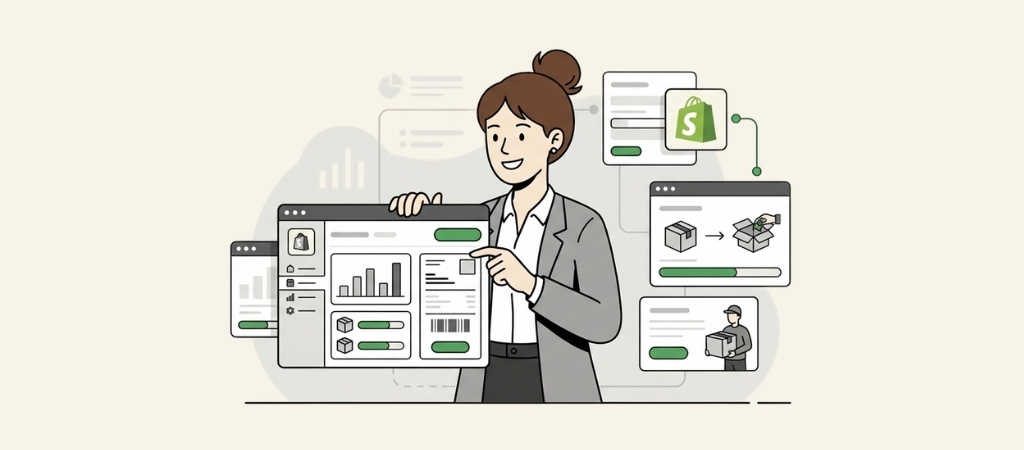
Running a Shopify store means wearing a lot of hats. You're the marketer, the product curator, the customer service rep, and, all too often, the person packing boxes at midnight.
There's a specific moment when store owners realize they've hit a wall: orders are coming in faster than they can be packed, inventory is taking over the living room, and shipping carriers are on a first-name basis.
That is when a third-party logistics provider (3PL) becomes essential.
Editor’s note: Want to hear some sample AI support calls made for your Shopify store?
- Just paste your store URL
- Get sample calls in under 20 seconds (no email required)
- Listen to demo calls for my store
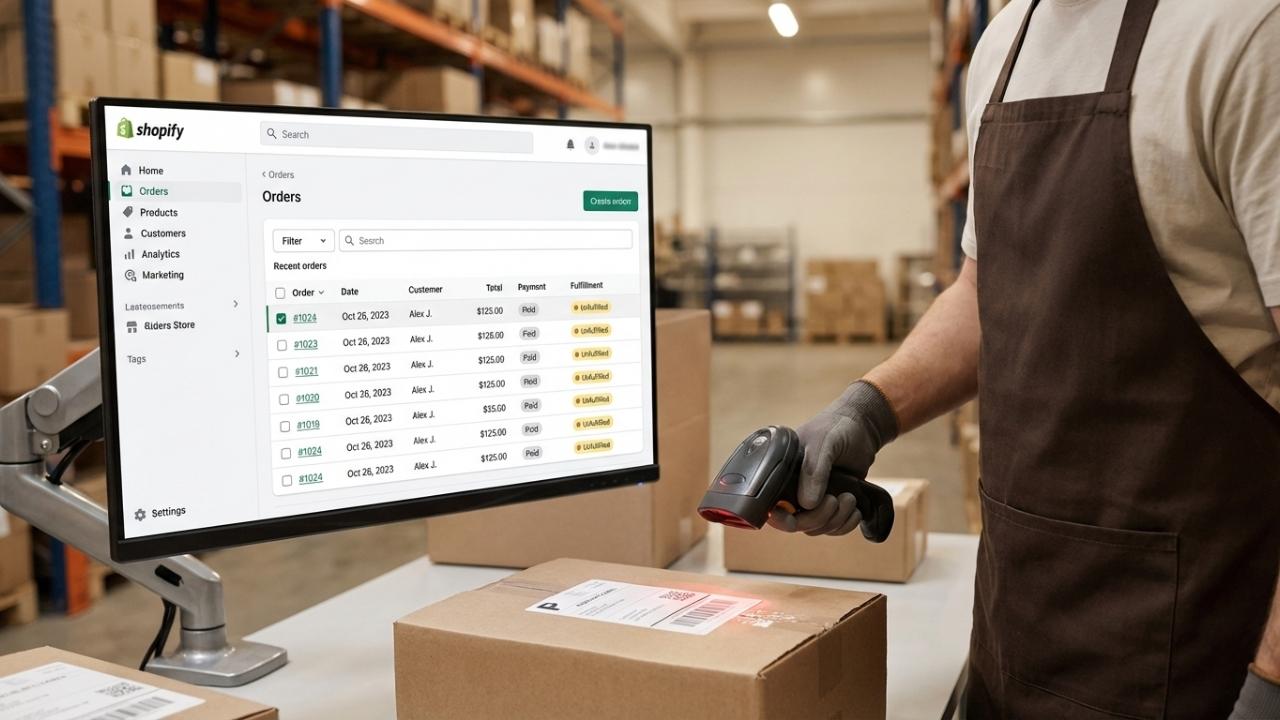
The best 3PL for Shopify does more than just store and ship products.
It integrates directly with your store, syncs inventory in real-time, and helps you offer competitive shipping speeds without building your own warehouse network.
But the Shopify app store lists thousands of "fulfillment" apps, and most are not actual 3PLs.
Many are software connectors or freight brokers, not companies that warehouse, pick, pack, and ship from their own facilities.
This guide cuts through the noise. We have analyzed the top providers based on Shopify integration quality, accuracy guarantees, warehouse networks, and real merchant feedback.
Here are the seven best 3PL options for Shopify stores in 2026.
What is a 3PL and why do Shopify stores need one?
A third-party logistics provider (3PL) is a company that handles the physical side of your ecommerce operation.
They receive your inventory, store it in their warehouses, and when a customer places an order on your Shopify store, they pick the items from shelves, pack them into boxes, and hand them off to shipping carriers like UPS or FedEx.
Think of it this way: Shopify handles your digital storefront, and a 3PL handles your physical supply chain.
The two connect through apps or APIs, so when someone clicks "buy," the order details flow automatically to your 3PL without you lifting a finger.
Most Shopify stores start by handling fulfillment themselves. It works fine for the first dozen orders.
But there is a threshold, usually around 10 to 20 orders per day, where the time spent on packing and shipping starts eating into the time you need for marketing, product development, and actually growing the business.
That is the inflection point where outsourcing makes financial sense.
The benefits go beyond just freeing up your time. 3PLs negotiate bulk shipping rates that individual stores cannot access, often reducing your per-package cost.
They have warehouse networks that let you offer 2-day shipping to customers across the country.
And they have systems designed for accuracy, with barcode scanning and quality checks that reduce the costly mistakes that happen when you are rushing to pack orders at midnight.
How to choose the best 3PL for Shopify
Not every 3PL is a good fit for every store. The provider that works for a furniture brand shipping 50-pound boxes will be different from the one that works for a cosmetics brand shipping small parcels internationally. Here is what to evaluate.
Shopify integration quality. This is non-negotiable. The 3PL must have a deep, seamless integration that automatically syncs orders, inventory levels, and tracking numbers in real-time. Look for certified Shopify Plus partners if you are a high-volume brand.
Warehouse network coverage. Where are your customers? If 80% of your sales are in California, you do not want a 3PL that only has a warehouse in New Jersey. Multiple warehouse locations let you offer 2-day shipping affordably by storing inventory closer to your customers.
Pricing transparency and minimums. Some 3PLs are built for giants and will not work with you unless you ship 1,000 orders a month. Others are built for startups and have no minimums at all. Find one that fits your current size but has room for you to grow.
Accuracy guarantees. Mistakes cost money. A wrong item shipped means a return, a replacement, and a potentially negative review. The best 3PLs publish their accuracy rates and some even offer financial compensation for errors.
Specialization by product type. Heavy, fragile, or high-value items need special handling. Subscription boxes require kitting skills. Make sure your 3PL has experience with your specific product category.
Best 3PL for Shopify: quick comparison
Before diving into each provider, here is how the top options stack up on the metrics that matter most.
| 3PL | Best For | Accuracy Rate | Warehouse Count | Minimum Orders | Pricing Model |
|---|---|---|---|---|---|
| ShipBob | Fast scaling, international | 99.95% | 50+ global | 200+/mo | Custom quote |
| Red Stag Fulfillment | Heavy, bulky, high-value | 100% guaranteed | 2 (TN, UT) | Varies | Premium custom |
| ShipHero | Tech-driven operations | 99.99% claimed | Multiple | Varies | Flat-rate custom |
| Shopify Fulfillment Network | Native Shopify integration | Not published | US network | 84-6,200/mo | Weight-based |
| Amazon MCF | Global reach, FBA users | 99.8% | 110+ US | None | Per-unit fees |
| eFulfillment Service | Small businesses, no minimums | 99.9% | 1 (Michigan) | None | Pay-as-you-go |
| ShipMonk | Subscription boxes, DTC brands | Not published | 12 global | None | Custom quote |
Use this comparison as a starting point, but remember that the best fit depends on your specific product types, customer locations, and growth plans.
The 7 best 3PL providers for Shopify stores
1. ShipBob
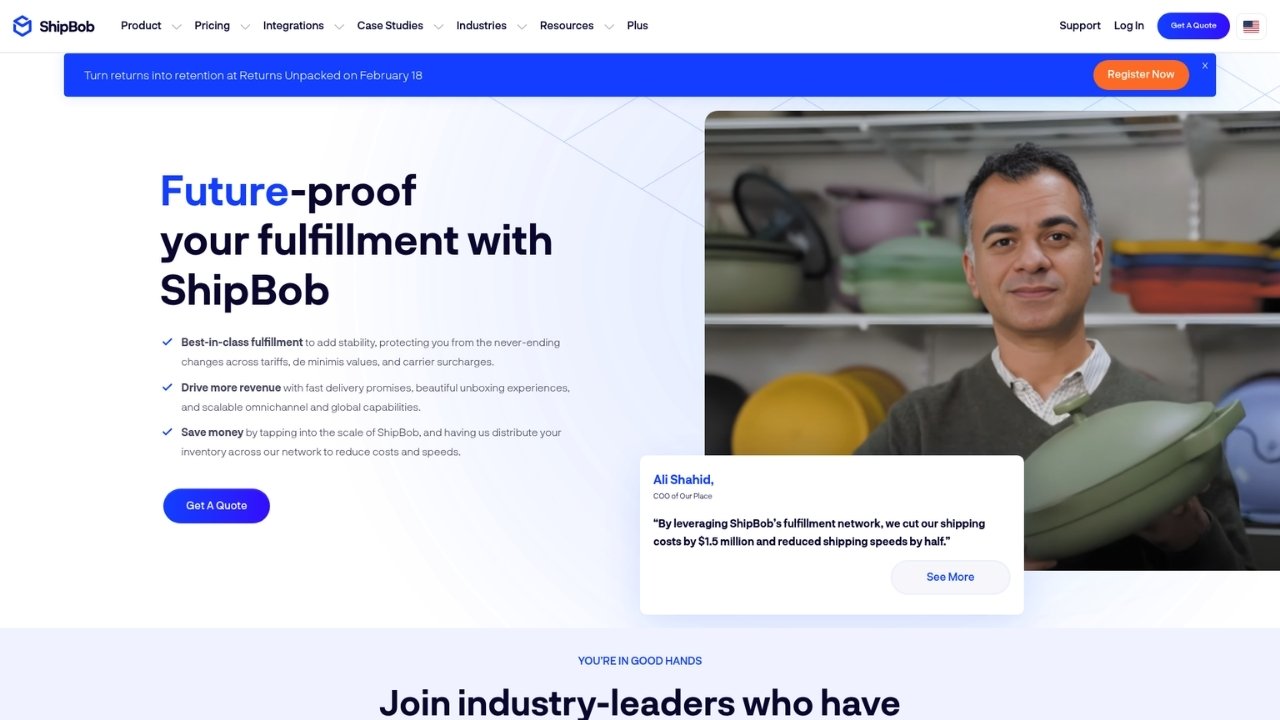
ShipBob has become the default choice for Shopify brands that are growing fast and want to offer Amazon-level shipping speeds.
Founded in 2014, they have built a network of 50+ fulfillment centers across the US, Canada, Europe, the UK, and Australia. That global footprint is their biggest advantage.
The numbers back up their reputation. ShipBob claims a 99.95% order accuracy rate and a 99.96% on-time shipping rate.
Their 2-Day Express program lets you promise fast delivery to customers nationwide, which can directly improve conversion rates at checkout.
Their Shopify integration is robust. Orders sync automatically, inventory updates in real-time across all locations, and you can manage everything from a single dashboard.
They also integrate with other channels like Amazon, TikTok Shop, and wholesale platforms, making them a good choice if you sell across multiple touchpoints.
Pricing: ShipBob uses custom pricing based on your specific needs. They have a $275 monthly minimum, which means they are not the best fit for very small stores just starting out. You will need to contact them for a quote based on your product dimensions, order volume, and shipping destinations.
Pros:
- Massive global warehouse network
- Excellent software and analytics
- Strong Shopify integration
- 2-day shipping capability
Cons:
- $275/month minimum excludes micro-sellers
- Complex pricing requires negotiation
- Can be expensive for low volumes
ShipBob is ideal for Shopify stores that have outgrown their initial fulfillment solution and are ready to scale aggressively, especially if international expansion is on the roadmap.
2. Red Stag Fulfillment

Red Stag carved out a unique position in the 3PL market by specializing in products that other providers either cannot handle or do not want to touch.
If you sell heavy items, bulky products, high-value goods, or anything fragile, Red Stag is often the only serious option.
Their accuracy guarantee is unmatched in the industry. Red Stag promises 100% order accuracy, and if they make a mistake, they pay you $50 for the error.
That is not a typo. They actually compensate you when they get something wrong. This level of accountability is rare in logistics.
They operate two warehouses, one in Knoxville, Tennessee and another in Salt Lake City, Utah.
That bicoastal setup lets them reach 96% of US homes within two days via ground shipping. While they have fewer locations than ShipBob, their strategic positioning works well for most domestic ecommerce.
Pricing: Red Stag is a premium service with custom pricing. They do not publish rates because heavy and high-value products require specialized handling.
Expect to pay more than you would for a standard small-parcel 3PL, but you are paying for expertise that prevents costly damage and errors.
Pros:
- 100% accuracy guarantee with $50 error compensation
- Specialized handling for heavy, bulky, fragile items
- High-security warehouses for expensive goods
- Real phone support with dedicated account managers
Cons:
- Premium pricing
- Only 2 warehouse locations
- US-only (no international fulfillment)
Red Stag is the best 3PL for Shopify stores selling furniture, gym equipment, electronics, artwork, or any product where a single mistake could cost hundreds of dollars to fix.
3. ShipHero
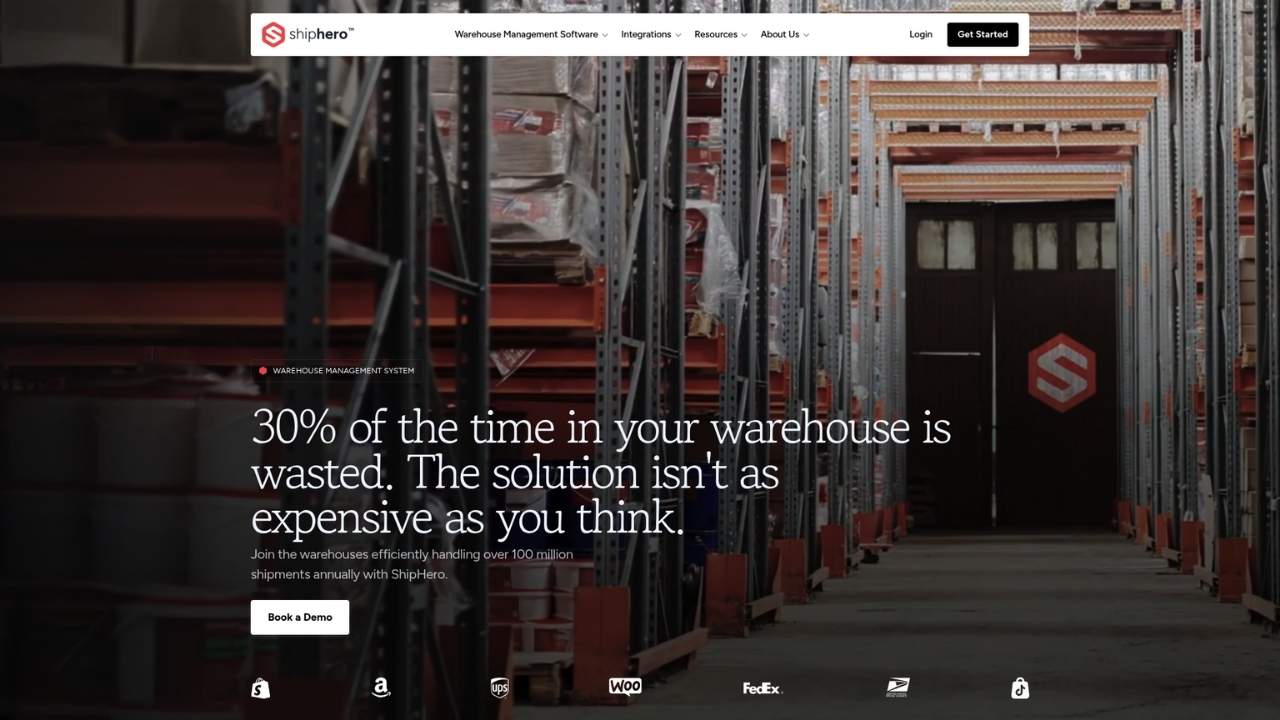
ShipHero, now operating as LVK Logistics after a rebranding, focuses heavily on technology to differentiate itself.
Their core selling point is a proprietary warehouse management system (WMS) that they claim supports a 99.99% accuracy rate across their operations.
Their average fulfillment time is 3.5 days, which is slightly slower than some competitors. But they make up for it with sophisticated software.
Their platform includes real-time analytics, a mobile app for warehouse staff, and detailed reporting that gives merchants visibility into every step of the fulfillment process.
ShipHero uses a flat-rate pricing structure customized to your order volume and requirements.
Additional fees apply for branded packaging, kitting, and other specialty services. Monthly storage fees are based on volume rather than per-unit.
Pros:
- Advanced warehouse management technology
- 99.99% claimed accuracy rate
- Real-time analytics and reporting
- Good for complex operations
Cons:
- Customer support limited to business hours
- 3.5-day average fulfillment is slower than competitors
- Requires scheduling calls for detailed help
ShipHero works best for Shopify brands that value data and operational transparency over pure speed, and for those with complex fulfillment needs that require sophisticated inventory management.
4. Shopify Fulfillment Network
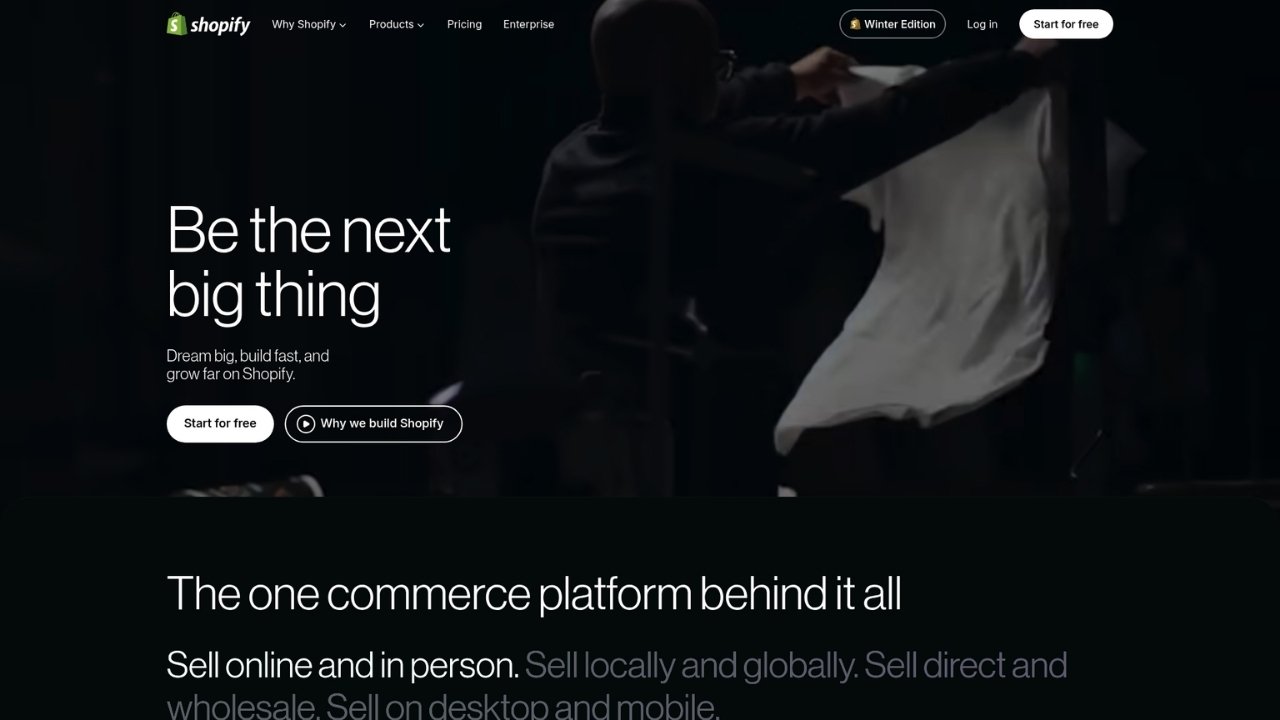
Shopify Fulfillment Network (SFN) is Shopify's own answer to third-party logistics.
Instead of building warehouses from scratch, Shopify partnered with Flexport and a network of existing 3PLs to create a fulfillment solution that is managed entirely within your Shopify admin.
The integration is the main draw. There is no third-party app to configure, no external dashboard to check, and no manual data syncing.
Everything happens automatically inside Shopify. When a customer orders, SFN handles the fulfillment and updates tracking without you doing anything.
SFN promises 2-3 day delivery to most US customers once your inventory is distributed across their network.
They also offer the "Shop Promise" badge, which displays guaranteed delivery dates on your product pages and can increase conversion rates.
However, SFN has strict eligibility requirements. You need to be a US-based business shipping 84 to 6,200 orders per month, with 200 or fewer SKUs, and your products cannot be perishable or hazardous.
If you are below or above those thresholds, you cannot use the service.
Pricing: SFN uses weight-based unit pricing with volume-based storage fees. Multi-item discounts apply per order.
Returns are handled on a flat-fee basis. Pricing is generally competitive due to Shopify's volume leverage, but you have less flexibility than with independent 3PLs.
Pros:
- Perfect native Shopify integration
- Shop Promise badge for higher conversions
- No external apps or dashboards needed
- Simplified pricing structure
Cons:
- Strict eligibility requirements
- Less control over warehouse selection
- US-only coverage
- May outgrow the 6,200 order/month cap
SFN is the best 3PL for Shopify merchants who want the simplest possible setup and do not mind working within Shopify's constraints.
5. Amazon Multi-Channel Fulfillment
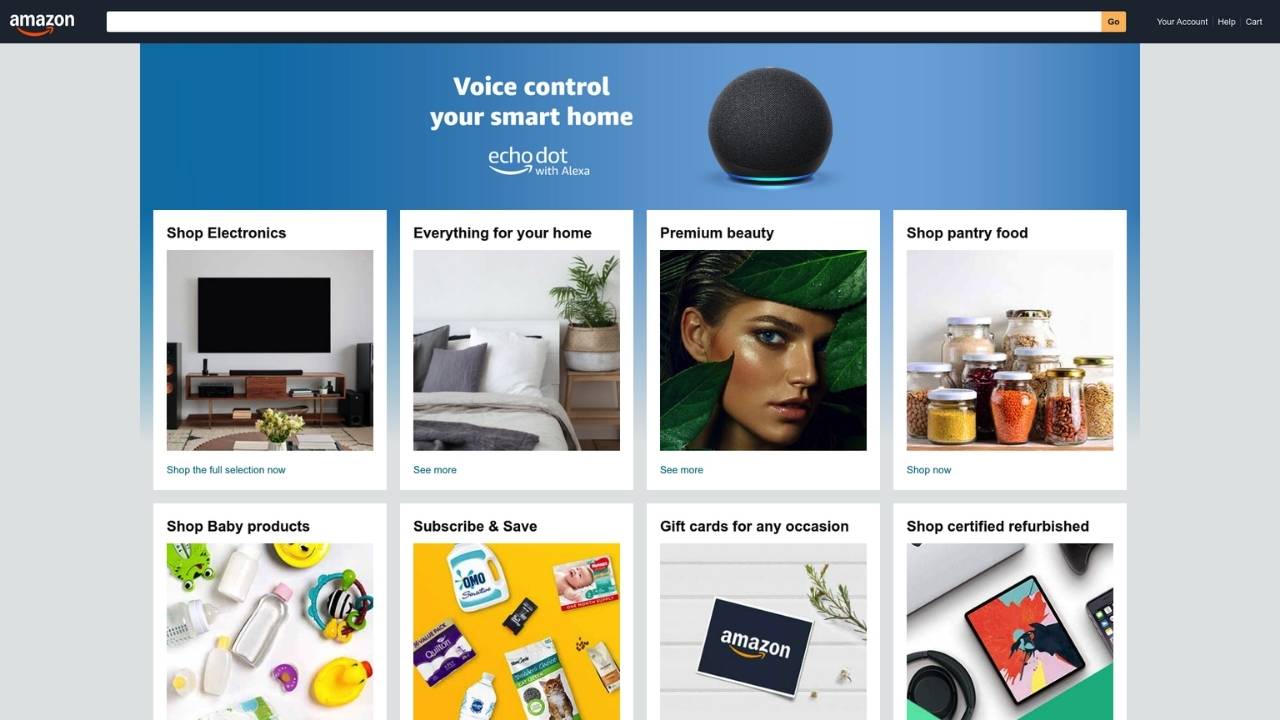
Amazon Multi-Channel Fulfillment (MCF) lets you leverage Amazon's massive fulfillment infrastructure for your Shopify orders.
If you already sell on Amazon using FBA, MCF allows you to use that same inventory pool to fulfill orders from your Shopify store and other channels.
The scale is hard to beat. Amazon operates over 110 fulfillment centers in the US alone, plus extensive international networks.
They claim a 99.8% undamaged package delivery rate and a 97%+ on-time delivery rate. You can offer Prime-level shipping speeds, often 1-2 days, which can be a significant competitive advantage.
The catch is the packaging. Orders fulfilled through MCF arrive in Amazon-branded boxes.
Your customers will know Amazon handled the shipping, which can dilute your brand identity. Some merchants worry it trains customers to buy directly from Amazon next time.
Pricing: Amazon MCF has a complex fee structure with separate charges for storage and fulfillment.
Storage fees range from roughly $0.75 to $2 per cubic foot per month depending on season. Fulfillment fees vary by product size and weight, typically $3 to $8 for small to medium items. You also need a $39.99/month Amazon seller account.
Pros:
- Massive global fulfillment network
- Prime-level shipping speeds
- Reliable during peak seasons
- Good for international expansion
Cons:
- Amazon-branded packaging
- Complex fee structure with potential surprises
- Limited customization options
- Requires managing Amazon Seller Central
Amazon MCF is the best 3PL for Shopify stores that already use FBA or need the absolute fastest shipping speeds and are willing to sacrifice some brand control to get it.
6. eFulfillment Service
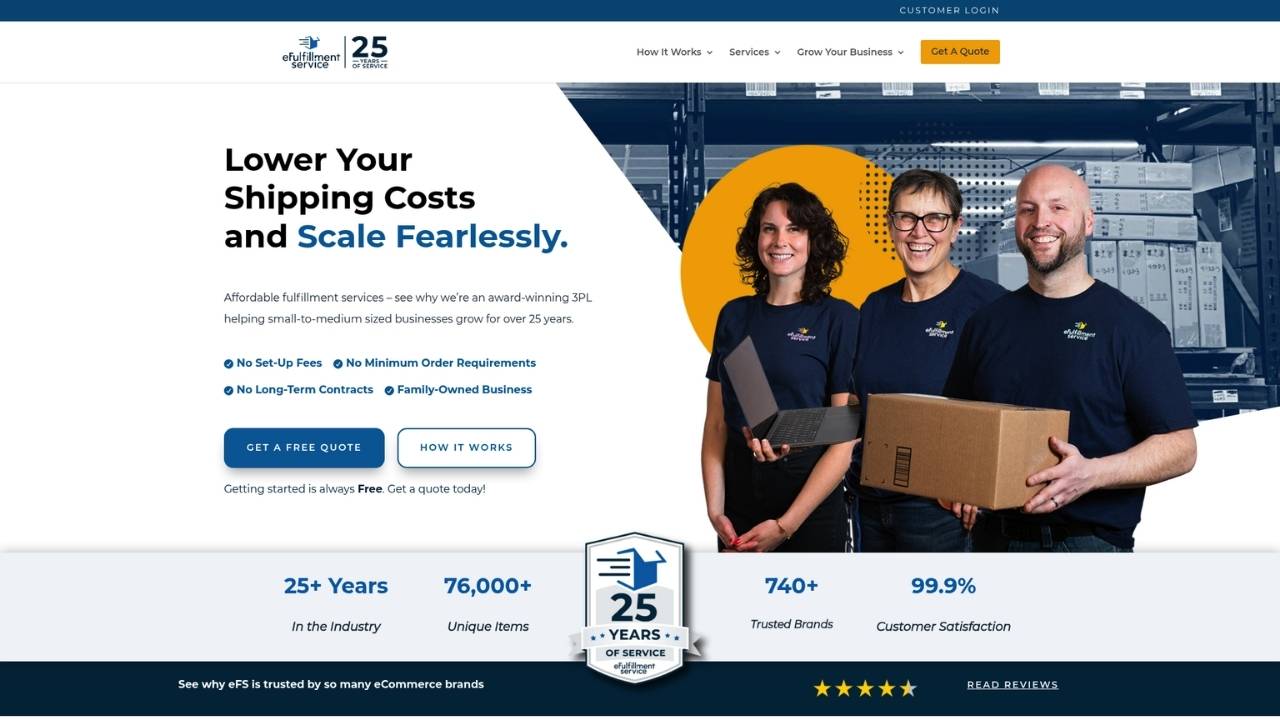
eFulfillment Service has been around for over 20 years and has built a reputation as one of the most small-business-friendly 3PLs in the industry.
They are family-owned and focus on providing high-touch service without the high-volume requirements that lock out smaller merchants.
Their biggest differentiator is the complete absence of minimums. No setup fees, no long-term contracts, no monthly order requirements.
You can send them 10 orders a month or 10,000, and they will handle both with the same level of service.
That makes them an ideal first 3PL for stores just starting to outsource fulfillment.
eFulfillment Service maintains a 99.9% order accuracy rate and operates a single warehouse in Michigan.
That central location provides reasonable shipping times to most of the US, though West Coast deliveries may take an extra day compared to bicoastal providers.
They also have strong expertise in subscription box fulfillment and crowdfunding campaigns, making them a popular choice for Kickstarter and Indiegogo creators who need to fulfill backer rewards.
Pricing: eFulfillment Service uses transparent, pay-as-you-go pricing. You pay for storage space and per-order fulfillment fees without any monthly minimums.
This makes costs predictable and low-risk for businesses testing the 3PL waters.
Pros:
- No setup fees, minimums, or long-term contracts
- 20+ years of experience
- Excellent for subscription boxes and crowdfunding
- High-touch customer service
Cons:
- Single warehouse location
- Limited international options
- Slightly longer shipping to West Coast
eFulfillment Service is the best 3PL for Shopify stores that are just starting to outsource fulfillment and want a low-risk, flexible partner to grow with.
7. ShipMonk
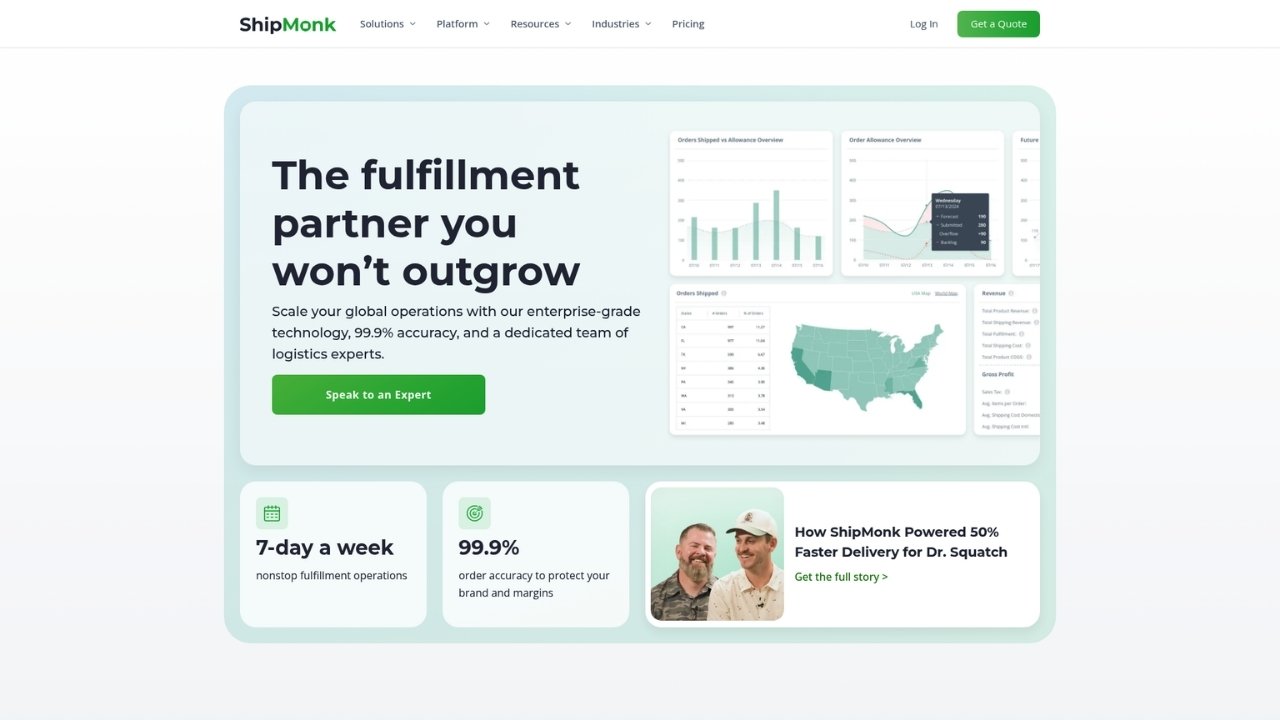
ShipMonk has built its reputation on being user-friendly and flexible, with a particular strength in handling subscription box businesses and direct-to-consumer brands with complex needs.
Their tagline is "Stress less and grow more," and they back it up with a platform designed for entrepreneurs.
Like eFulfillment Service, ShipMonk has no order minimums, which makes them accessible to smaller stores.
They operate 12 warehouses across the US, Canada, Mexico, and Europe, giving them solid international coverage for a mid-sized 3PL.
Their "Stress-Less" software platform gets consistent praise for being clean and intuitive.
You get real-time inventory visibility, order tracking, and reporting without the learning curve that comes with some enterprise-focused 3PL dashboards.
ShipMonk processes over 100,000 orders per day across their client base, so they can clearly handle volume.
Their expertise in kitting, assembly, and subscription box curation sets them apart for brands with complex product bundles.
Pricing: ShipMonk uses custom pricing based on your specific services.
Expect moderate rates that can increase if you have complex SKUs or require special handling during peak seasons.
Pros:
- No order minimums
- User-friendly software platform
- Strong subscription box expertise
- 12 global warehouse locations
Cons:
- Costs can increase with complex products
- Newer company (founded 2015) with less track record
- Many options can feel overwhelming at first
ShipMonk is the best 3PL for Shopify stores running subscription services or those that prioritize software usability over having the largest possible warehouse network.
Which 3PL should you choose?
The right choice depends on where you are in your business journey and what you are selling. Here is a simple framework.
If you are just starting out (under 100 orders per month), look at eFulfillment Service or ShipMonk.
Both have no minimums and will let you test 3PL fulfillment without committing to high monthly volumes.
If you are growing fast (100 to 1,000 orders per month), ShipBob or Shopify Fulfillment Network are solid choices. ShipBob gives you more flexibility and international options. SFN gives you the simplest integration if you meet their eligibility requirements.
If you sell heavy, bulky, or high-value products, Red Stag Fulfillment is the clear winner.
Their specialization and accuracy guarantee are worth the premium pricing for products where mistakes are expensive.
If you are expanding internationally, ShipBob or Amazon MCF have the global warehouse networks you need.
Amazon MCF is particularly compelling if you already sell on Amazon and want to unify inventory.
If you already use Amazon FBA, Amazon MCF lets you use that same inventory for Shopify orders.
It is the simplest multi-channel solution, even with the branding trade-offs.
One final piece of advice: before committing to any 3PL, test them with a small batch of inventory. See how their onboarding process feels, how quickly they actually ship orders, and how responsive their support team is when something goes wrong.
Switching 3PLs is expensive and time-consuming, so it is worth doing your due diligence upfront.
What comes after you have solved fulfillment?
Once you have outsourced your warehousing and shipping, the next bottleneck for growing Shopify stores is usually customer support.
When order volume increases, so do the "where is my order" calls, return requests, and product questions.
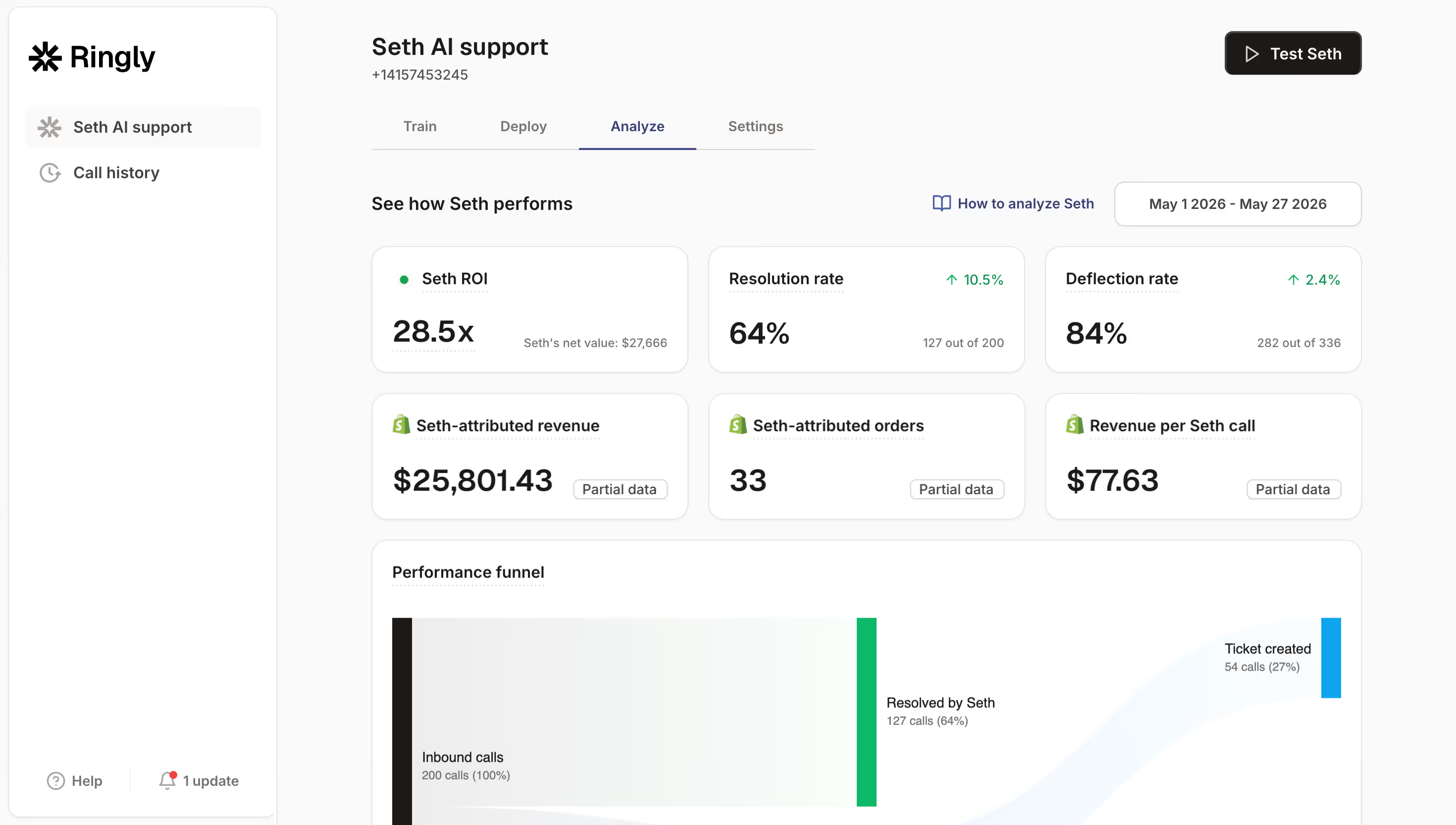
This is where Ringly.io can help. the AI, Ringly's AI phone support agent, handles inbound calls 24/7. It looks up orders, processes returns and exchanges, answers FAQs, and only escalates to your team when necessary.
The AI resolves roughly 70-73% of calls without human intervention.
the AI integrates directly with Shopify, so it has real-time access to order status and customer data. It supports 30 languages, which means you can offer phone support to international customers without hiring multilingual staff.
And unlike human agents, the AI never sleeps, never gets sick, and never has a bad day.
Ringly offers a 14-day free trial with full features. After that, the Grow plan is $349 per month for 1,000 call minutes.
That is often less than the cost of a single full-time support rep, and the AI can handle far more volume.
If you have already solved your fulfillment problem and are ready to tackle phone support next, start your free trial with Ringly.
Frequently Asked Questions
Does Shopify work with 3PL providers?
Yes, Shopify integrates with hundreds of 3PL providers through the Shopify App Store and direct API connections. The best 3PL for Shopify offers native integrations that automatically sync orders, inventory, and tracking information in real-time.
What is the best 3PL for Shopify stores just starting out?
For stores shipping under 100 orders per month, eFulfillment Service and ShipMonk are the best options because they have no minimum order requirements and no long-term contracts.
How much does the best 3PL for Shopify typically cost?
Pricing varies widely. Budget-friendly options like eFulfillment Service start with pay-as-you-go pricing and no monthly minimums. Mid-tier providers like ShipBob typically require $200-300 monthly minimums. Premium services like Red Stag Fulfillment use custom pricing based on product complexity.
Can I use Amazon to fulfill Shopify orders?
Yes, through Amazon Multi-Channel Fulfillment (MCF), you can use Amazon's fulfillment network to ship Shopify orders. However, packages will arrive in Amazon-branded boxes, which may dilute your brand identity.
What accuracy rate should I expect from the best 3PL for Shopify?
Top-tier 3PLs publish accuracy rates of 99.9% or higher. Red Stag Fulfillment offers a 100% accuracy guarantee with $50 compensation for errors. ShipBob claims 99.95% accuracy, and ShipHero claims 99.99%.
How do I know when it is time to switch to a 3PL?
Most Shopify stores should consider a 3PL when they reach 10-20 orders per day, are running out of storage space, cannot offer competitive shipping speeds, or find that fulfillment is taking time away from growing the business.