
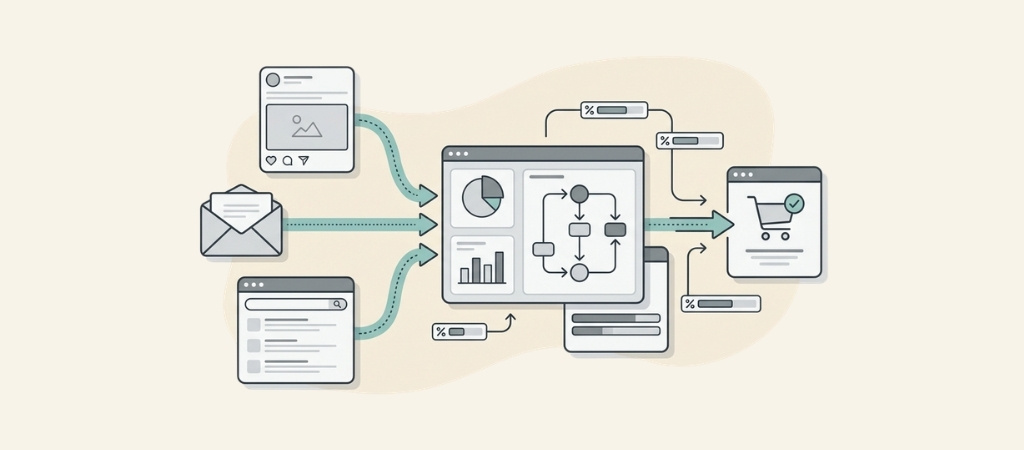
Most ecommerce stores make million-dollar marketing decisions based on incomplete data.
They look at where customers clicked last and call it a day. But over 90% of shoppers interact with multiple marketing channels before making a purchase.
When you only credit the final touchpoint, you miss the full story.
Ecommerce attribution is how you track which marketing efforts actually drive sales.
It helps you see beyond the last click to understand the complete customer journey.
This guide covers the essential attribution models, how to choose the right one for your business, and practical steps to get started.
Editor’s note: Want to hear some sample AI support calls made for your Shopify store?
- Just paste your store URL
- Get sample calls in under 20 seconds (no email required)
- Listen to demo calls for my store
What is ecommerce attribution?
Ecommerce attribution is the process of assigning credit to marketing touchpoints that contribute to a sale.
Every time a customer sees your Instagram ad, clicks a Google search result, opens your email newsletter, or types your URL directly, that's a touchpoint.
Attribution models determine how much credit each touchpoint gets for the final conversion.
Here's why this matters for your budget. If you only look at last-click data, you might cut spending on top-of-funnel campaigns that bring in new customers.
You could over-invest in retargeting ads that simply "finish the job" while undervaluing the awareness campaigns that started the conversation.
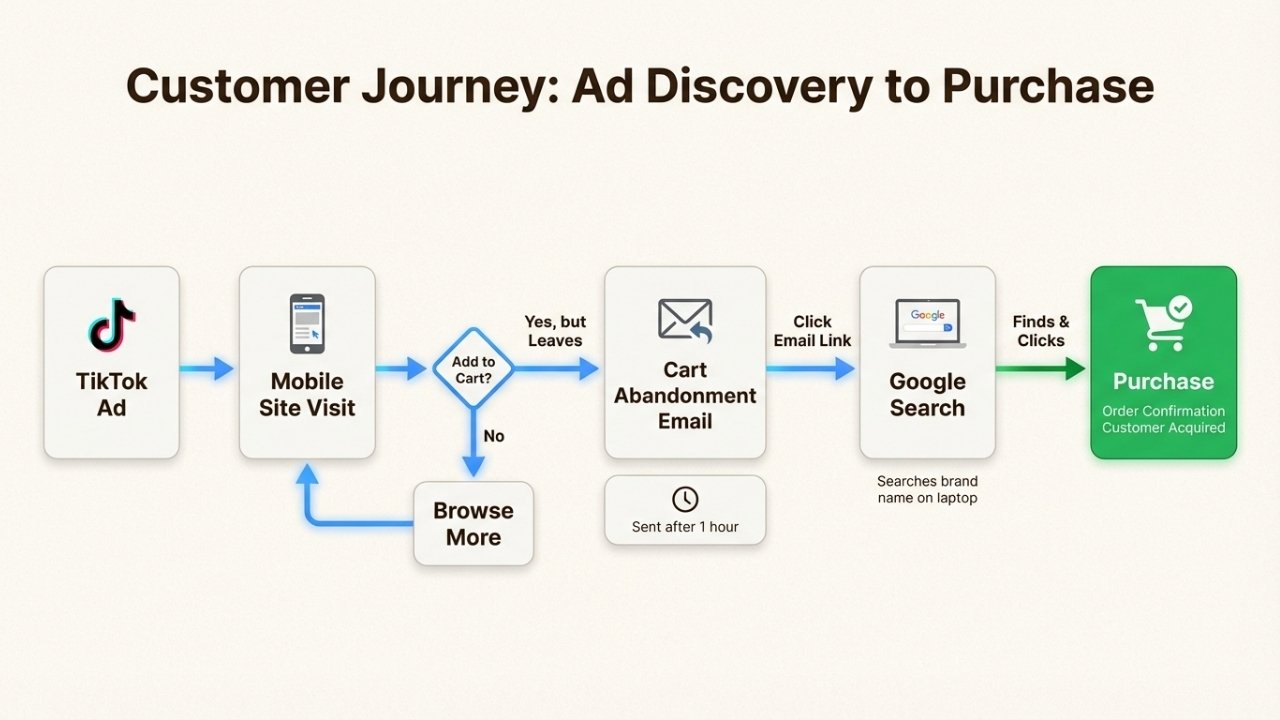
The reality of modern shopping makes attribution complex. A customer might discover your brand on TikTok during their lunch break, browse on mobile later that evening, get a cart abandonment email the next day, and finally purchase on their laptop after a Google search.
That's one sale across three devices, multiple sessions, and several channels. Without proper attribution, you're flying blind.
Attribution also connects to customer support touchpoints that many merchants overlook. When customers call your store with questions about products or orders, those conversations influence purchase decisions.
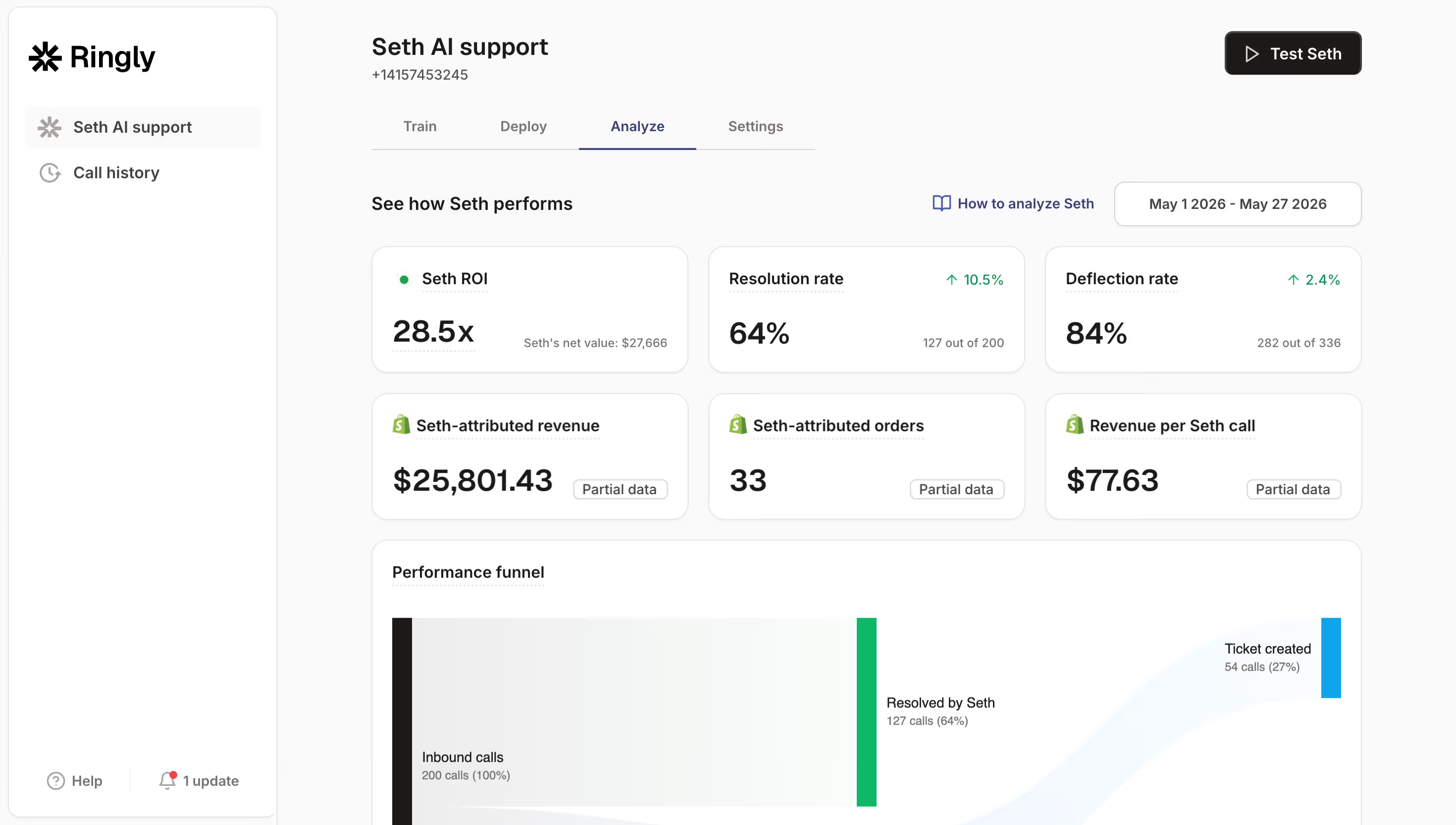
Ringly.io captures these voice interactions, giving you visibility into phone support as a marketing channel that traditional analytics miss entirely.
The 6 essential ecommerce attribution models
Attribution models fall into two categories: single-touch and multi-touch. Single-touch models credit one interaction.
Multi-touch models distribute credit across the entire journey. Here's how each model works.
First-touch attribution
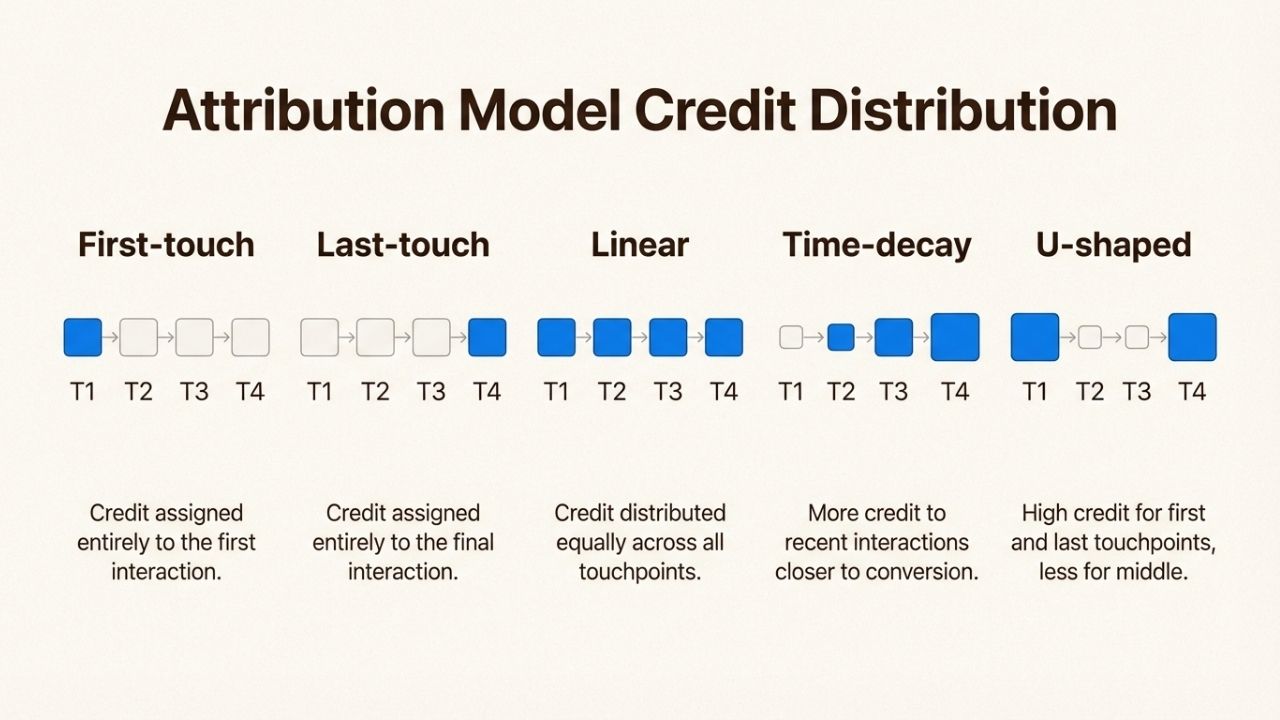
First-touch attribution gives 100% of the credit to the first marketing interaction.
If a customer first discovers you through a Facebook ad, then reads your blog, gets an email, and finally purchases through Google search, the Facebook ad gets all the credit.
This model works well when you want to understand which channels drive brand awareness and new customer acquisition.
It's useful for evaluating content marketing, influencer partnerships, and display advertising campaigns.
The limitation is obvious: it completely ignores the nurturing and conversion activities that happen later in the journey.
Last-touch attribution
Last-touch attribution is the default in Google Analytics and most ecommerce platforms. It credits the final interaction before purchase.
In the same customer journey example, the Google search would get all the credit.
This approach makes sense for conversion-focused campaigns. It helps you identify which channels and campaigns drive immediate purchases.
But it has a significant blind spot. Last-touch attribution overvalues bottom-funnel activities while undervaluing the awareness and consideration efforts that made the customer ready to buy in the first place.
Linear attribution
Linear attribution distributes credit equally across all touchpoints. If a customer has four interactions before purchasing, each gets 25% of the credit.
This model provides a balanced view of your entire marketing strategy.
The strength of linear attribution is that no channel gets overlooked. You can see how your social ads, email campaigns, and search efforts work together.
The weakness is that it assumes every touchpoint is equally valuable, which rarely reflects reality.
A brand discovery ad and a cart abandonment email probably don't deserve the same weight.
Time-decay attribution
Time-decay attribution gives more credit to touchpoints closer to the conversion.
The logic is simple: recent interactions typically have stronger influence on purchase decisions. A touchpoint right before buying might get 50% credit, while the first interaction gets significantly less.
This model suits businesses with short sales cycles or time-sensitive promotions.
It works well for flash sales, abandoned cart recovery campaigns, and retargeting efforts. The downside is that it may undervalue early-stage brand building activities that happen weeks before the purchase.
Position-based (U-shaped) attribution
Position-based attribution, also called U-shaped, assigns 40% credit to the first touchpoint, 40% to the last touchpoint, and distributes the remaining 20% across everything in between.
This model recognizes that acquisition and conversion are both critical moments.
U-shaped attribution is popular with B2B ecommerce and high-consideration purchases where the journey has clear beginning and end points.
It balances investment between top-of-funnel and bottom-of-funnel activities. The limitation is that the fixed percentages may not match your actual customer behavior patterns.
Data-driven attribution
Data-driven attribution uses machine learning to analyze your historical conversion data and assign credit based on each touchpoint's actual impact.
Instead of following predetermined rules, it identifies which channels truly influence purchases for your specific business.
This approach requires significant data volume, typically 3,000 or more conversions per month, to produce statistically reliable results.
It's available in Google Analytics 4, Google Ads, and advanced attribution platforms. When you have enough data, this is the gold standard for understanding marketing performance.
How to choose the right ecommerce attribution model
There's no universal best attribution model. The right choice depends on your business type, sales cycle, and data volume.
Here's a practical framework to guide your decision.
New stores with short sales cycles should start simple. Last-touch or first-touch attribution is easier to implement and understand.
You can always graduate to more complex models as your marketing matures. Don't let perfect be the enemy of good when you're just starting out.
Established stores with multiple active channels benefit from linear or position-based models.
These give you visibility into how channels work together rather than just which one closed the sale. If you run social ads, email campaigns, and search ads simultaneously, you need a multi-touch approach.
High-volume stores with 3,000 or more monthly conversions can leverage data-driven attribution.
The machine learning models require substantial data to produce reliable insights. If you meet the volume threshold, this approach will give you the most accurate picture of marketing performance.
Businesses with long consideration cycles should consider time-decay or position-based models.
If your customers typically research for weeks or months before purchasing, you need a model that accounts for the extended journey.
Time-decay works well for impulse-driven purchases, while position-based suits considered purchases.
One critical warning: don't switch models frequently. Attribution data isn't comparable across different models.
If you change from last-touch to linear attribution, your historical data becomes meaningless for trend analysis. Pick one model and stick with it for at least a quarter, preferably longer.
Platform discrepancies and why your numbers never match
If you've ever compared conversion data between Google Ads, Facebook Ads, and Shopify, you've noticed they never match.
Each platform tells a different story because each uses different attribution logic and windows.
Google Ads tracks interactions within its own ecosystem. It uses a 30-day click window and 1-day view window by default.
This means it credits conversions to ad clicks that happened up to 30 days ago, or ad views from the past day. Google Ads will claim credit for conversions even when other marketing channels played significant roles.
Facebook and Meta Ads have been heavily impacted by iOS 14.5 privacy changes.
Their default window is 7-day click and 1-day view, significantly shorter than Google's. When users opt out of tracking on iOS devices, Facebook loses visibility into those conversions entirely. This has made Facebook attribution data less reliable and created larger discrepancies with other platforms.
Shopify's native attribution often provides the most reliable data for ecommerce merchants.
Because Shopify controls both the store platform and the tracking, it can provide more accurate conversion data than platforms relying on third-party cookies. Shopify allows you to toggle between different attribution models and integrates seamlessly with UTM parameters for detailed campaign tracking.
The key insight here is that platform-specific data is best used for platform-specific optimization. Use Google Ads data to optimize your Google campaigns.
Use Facebook data to optimize Facebook campaigns. Don't try to reconcile the numbers perfectly or use one platform's data to judge another's performance. They're measuring different things with different methodologies.
Implementing ecommerce attribution: practical first steps
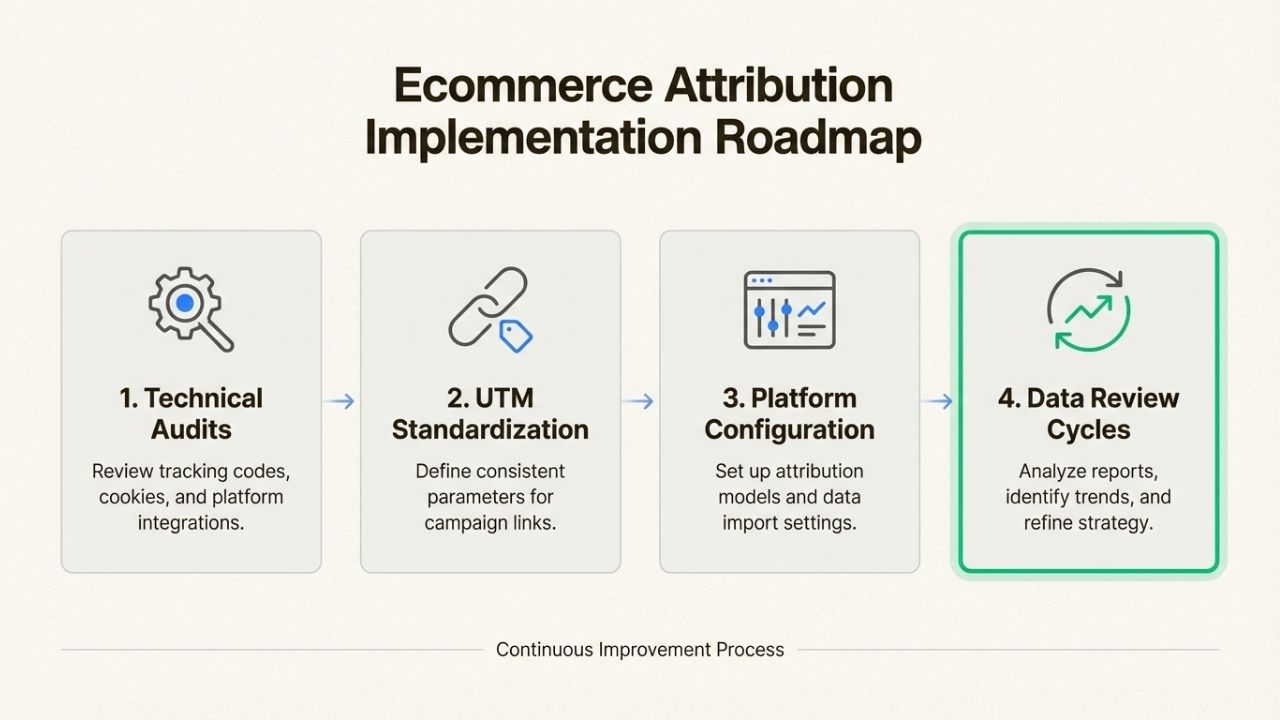
Getting started with attribution doesn't require a PhD in data science. Here's a simple four-step process to implement attribution in your store.
Step 1: Audit your current tracking. Check that your Google Analytics pixel is properly installed on every page.
Verify that conversion events fire correctly at checkout. Make sure UTM parameters are being captured consistently. Most attribution problems stem from broken tracking, not model selection.
Step 2: Standardize your UTM naming conventions. Create a clear, consistent system for labeling campaigns.
Decide on standardized values for source, medium, and campaign name. Document this system and share it with everyone who creates marketing content.
Inconsistent UTM usage is one of the biggest sources of attribution confusion.
Step 3: Configure your chosen model in your primary analytics tool. If you use Google Analytics 4, navigate to the attribution settings and select your preferred model. If you use Shopify, check the marketing attribution settings in your admin panel. Set this once and resist the urge to change it frequently.
Step 4: Establish a review cadence. Attribution insights require time to become meaningful. Review your data monthly or quarterly, not daily.
Look for trends and patterns rather than obsessing over individual conversions. Marketing attribution is about strategic budget allocation, not tactical day-to-day optimization.
Common mistakes to avoid include using inconsistent UTM parameters across campaigns, comparing data from different attribution models month-over-month, and ignoring view-through conversions entirely.
While view-through data is less precise than click data, it provides valuable signal about awareness campaign performance.
Privacy changes and the future of attribution
The attribution landscape is shifting rapidly due to privacy regulations and technology changes.
Third-party cookies are being deprecated. iOS privacy features limit tracking. These changes force merchants to adapt their attribution strategies.
First-party data collection is becoming essential. Instead of relying on cookies that track users across the web, you need to build direct relationships with your customers.
Email lists, loyalty programs, and account registrations give you owned data that isn't subject to platform changes.
Server-side tracking offers an alternative to browser-based pixels. Instead of loading tracking scripts in the customer's browser, you send conversion data directly from your server to analytics platforms.
This approach is more reliable and privacy-compliant than traditional pixel tracking.
Zero-party data represents another path forward. Post-purchase surveys ask customers directly how they heard about you.
While this relies on customer memory rather than precise tracking, it captures touchpoints that digital attribution misses entirely. Phone calls, word-of-mouth recommendations, and offline advertising all show up in survey data.
AI and machine learning are improving attribution accuracy even with limited data.
Advanced models can identify patterns in customer behavior that rule-based models miss. As privacy restrictions tighten, these algorithmic approaches become more valuable.
Voice channels represent an attribution blind spot for most merchants. When customers call your store with questions, those conversations influence purchase decisions but rarely appear in digital analytics.
Ringly.io captures these interactions through AI phone support, giving you visibility into voice as a marketing channel that traditional attribution completely misses.
Making ecommerce attribution work for your store
Attribution isn't about achieving perfect data. It's about making better decisions with the data you have.
Start by identifying your primary business goal, then choose a model that aligns with that objective.
If you're focused on new customer acquisition, first-touch attribution helps you identify your best discovery channels.
If you're optimizing for immediate conversions, last-touch shows you what closes the deal. If you want a balanced view of your entire marketing strategy, linear or position-based models provide that perspective.
The key is consistency. Pick a model, implement it properly, and review the data regularly. Don't chase perfect attribution at the expense of taking action.
Even imperfect data beats gut feelings when it comes to budget allocation.
Remember that attribution tracks digital touchpoints, but customer journeys include offline and voice interactions too.
While your analytics platform captures clicks and views, it misses phone conversations that often seal the deal.
Ringly.io handles those voice interactions, capturing insights from customer calls that analytics platforms never see.
The AI phone agent resolves around 70% of calls without human intervention while giving you data on what customers actually ask about.
Ready to improve your customer experience across all channels? Start your free trial and see how voice support fits into your attribution picture.
Frequently Asked Questions
What is ecommerce attribution and why does it matter?
Ecommerce attribution is the process of assigning credit to marketing touchpoints that lead to sales. It matters because over 90% of customers interact with multiple channels before purchasing, and without proper attribution, you might cut spending on awareness campaigns that actually drive new customers while over-investing in channels that simply close existing interest.
Which ecommerce attribution model should I start with?
New stores should start with last-touch or first-touch attribution because they're simpler to implement and understand. Established stores with multiple active channels should consider linear or position-based models. If you have 3,000 or more monthly conversions, data-driven attribution provides the most accurate insights.
Why don't my Google Ads and Facebook Ads conversion numbers match?
Each platform uses different attribution windows and logic. Google Ads uses a 30-day click window, while Facebook uses 7-day click after iOS 14.5 privacy changes. Additionally, each platform credits itself for conversions even when other channels contributed. Use platform data to optimize that specific platform, not for cross-platform comparison.
How often should I review my ecommerce attribution data?
Review attribution data monthly or quarterly, not daily. Attribution insights require time to reveal meaningful patterns. Focus on trends and strategic budget allocation rather than obsessing over individual conversions. Avoid switching models frequently, as this makes historical data incomparable.
How do privacy changes like cookie deprecation affect ecommerce attribution?
Privacy changes limit traditional cookie-based tracking, making first-party data collection essential. Server-side tracking and zero-party data (like post-purchase surveys) are becoming more important. AI-powered attribution models can identify patterns even with limited tracking data, helping maintain visibility as third-party cookies phase out.
Can ecommerce attribution track offline and voice interactions?
Traditional digital attribution misses phone calls and offline touchpoints. Server-side tracking and post-purchase surveys can capture some of this data. For phone support specifically, AI solutions like Ringly.io capture voice interactions and provide analytics on customer questions and outcomes, filling a gap that standard attribution platforms miss.