

Most ecommerce stores treat customer service as a cost center. Something you have to do, not something that makes you money. But here's what the best-performing stores figured out: your support team talks to your most engaged customers every single day, and that's a revenue channel hiding in plain sight.
According to Accenture, upselling alone increases ecommerce revenue by 10-30% on average. And phone calls convert 10-15x higher than web leads. Yet most Shopify stores pour money into checkout popups and post-purchase funnels while completely ignoring the upsell opportunities sitting in their support queue.
This article breaks down nine strategies to turn your customer service interactions into real revenue, without making your customers feel like they're getting a sales pitch instead of help.
Hear what AI support calls sound like for your store. Just paste your Shopify URL and get sample calls in under 20 seconds, no email required. Listen to demo calls for my store.
Why customer service is your best upselling channel
When a customer calls or chats in, they're already engaged. They chose to reach out. That's a completely different level of intent compared to someone scrolling past a popup on your product page.
Think about it. A customer who contacts support has already bought from you (or is about to). They trust you enough to pick up the phone or open a chat. That's the highest-intent interaction your store gets, and most brands waste it by only solving the immediate problem.
The numbers back this up. Research from Bain & Company shows returning customers spend 67% more than first-time buyers. And selling to existing customers has a 60-70% success rate, compared to just 5-20% for new prospects. Your support team is already talking to the people most likely to buy more.
But there's a catch. A survey from AchieveGlobal found that 40% of customers get annoyed when agents upsell during support interactions. At the same time, 50% say they actually find agent recommendations helpful and make additional purchases because of them.
So the difference between annoying and helpful comes down to execution. Get it right, and you're adding value. Get it wrong, and you're damaging trust. The nine strategies below are designed to keep you firmly on the helpful side.
Compare that to the alternatives. Checkout popups have notoriously low conversion rates. Banner ads get ignored. Even well-targeted email campaigns rarely break single-digit click rates. Meanwhile, a customer already on the phone with you is paying attention, trusting you, and open to suggestions. That's a fundamentally different dynamic.
And the economics are hard to argue with. Upselling to existing customers is 68% more cost-effective than acquiring new ones. HubSpot data shows that targeted upsells drive 21% of total company revenue. The opportunity is massive, and most ecommerce stores are barely scratching the surface.
The "help first, sell second" rule
Before we get into specific tactics, there's one rule that applies to every single one of them: solve the customer's problem first. Always.
If someone calls about a delayed shipment, fix the shipping issue. If they're confused about a product, answer their question. If they're frustrated about a return, handle it smoothly. The upsell comes after, never before or during the resolution.
Here's why this works. Right after you solve someone's problem, there's a brief window (maybe 30-60 seconds) where the customer feels genuinely grateful. Trust is at its peak. That's when a well-timed recommendation feels like a favor, not a pitch.
The moment you try to sell before resolving the issue, you signal that revenue matters more than their experience. And that's a customer you'll lose for good. If the issue isn't resolved, skip the upsell entirely. There's always the next interaction.
This applies to every channel: phone, live chat, email, and social DMs. Whether you're running a small Shopify support team or a full-scale ecommerce call center, the principle doesn't change. Solve first. Recommend second. No exceptions.
Upselling vs. cross-selling in customer service (quick primer)
Before we get into the strategies, let's clarify the two types of revenue-generating recommendations your support team can make:
- Upselling: Recommending a higher-tier, larger-quantity, or premium version of what the customer already has or is considering. Example: suggesting the 32oz bottle instead of the 16oz, or the pro version instead of the basic.
- Cross-selling: Recommending complementary products that go alongside the original purchase. Example: suggesting a phone case after someone buys a phone, or a serum to pair with a moisturizer.
Both work in customer service conversations, and the best agents use whichever fits the moment. In our experience, cross-selling tends to convert slightly better in support calls because it's easier to frame as problem-solving ("this goes great with what you already have") rather than an upgrade pitch.
The strategies below cover both. Some lean more toward cross-selling, others toward upselling. The common thread: they all start with genuine customer value and only then lead to additional revenue.
9 strategies for ecommerce upselling through customer service
1. Use real-time order data to personalize recommendations
Generic product suggestions don't work. "You might also like..." with random items feels automated and impersonal. What works is pulling up the customer's actual order history and making a recommendation based on what they already bought.
Here's a practical example. A customer calls about their recent skincare order (a cleanser and toner). Your agent sees they don't have a moisturizer in their purchase history. Recommending the matching moisturizer from the same product line is a natural, helpful suggestion.
According to data from Opensend, personalized recommendation engines improve average order value by 25-30%. And AI-powered systems increase take rates by up to 30% compared to generic offers.
The key is access to data. Your support agents (or AI phone agents) need real-time access to order history, browsing behavior, and product catalog information. Without that, you're guessing. With it, you're helping.
This is where having a Shopify-native system pays off. When your support tool integrates directly with your store, agents can see exactly what the customer ordered, when they ordered it, and what products pair well together. Ecommerce personalization isn't just for product pages. It's arguably more powerful in a live conversation.
2. Train your team with specific upsell scripts
"Just recommend stuff" isn't a training program. Your agents need actual conversation frameworks they can adapt to different situations. Here are three that work well for ecommerce:
The complementary product script: "By the way, I noticed you ordered [product]. A lot of our customers pair that with [complementary product] and love the results. Want me to add it to your order?"
The replenishment script: "I can see you last ordered [consumable product] about three months ago. Would you like me to set up auto-delivery so you never run out?"
The upgrade script: "Since you're already using [basic version], you might want to check out [premium version]. It has [specific benefit] that a lot of customers in your situation switch to."
The scripts should sound natural, not robotic. Role-play training helps your team internalize these so they come across as genuine recommendations, not sales pitches. For more on training frameworks, check out our guide on ecommerce customer service training.
3. Time your upsell for the post-resolution moment
Timing makes or breaks an upsell. The research is clear on this: the best moment is right after you've resolved the customer's issue. Not before, not during, and definitely not when they're still frustrated.
A simple transition phrase does the trick: "Before I let you go, I wanted to mention something that might be useful..." or "One more thing, since you're already on the line..."
These phrases signal that the main business is done and this is bonus information. The customer doesn't feel trapped. If they're in a hurry, they'll say so, and you move on. No harm done.
This approach lines up with what we know about customer service response time benchmarks. Customers value efficiency. A quick resolution followed by a brief, relevant recommendation respects their time.
4. Cap upsells at 25% of original order value
This is a concrete rule that prevents the most common upselling mistake: suggesting something too expensive. If a customer just placed a $60 order, don't recommend a $150 add-on. That's sticker shock, not upselling.
The 25% rule is a solid benchmark. For a $60 order, keep the upsell under $15. For a $200 order, stay under $50. This feels reasonable to the customer and avoids the perception that you're trying to squeeze them.
| Original Order Value | Max Upsell Suggestion | Example |
|---|---|---|
| $50 | $12-13 | Sample pack, travel size |
| $100 | $20-25 | Complementary accessory |
| $200 | $40-50 | Premium add-on, bundle upgrade |
| $500+ | $100-125 | Extended warranty, VIP membership |
Small, high-margin complementary products tend to convert best. Think sample packs, accessories, or subscription upgrades. These are easy yes/no decisions for the customer. For more on boosting your ecommerce AOV, we have a dedicated guide.
5. Use subscription and replenishment nudges
If your store sells consumable products (supplements, skincare, pet food, coffee), every support call about a past order is a subscription upsell opportunity.
The conversation is simple: "I see you ordered [product] back in January. A lot of our customers switch to a monthly subscription and save 15%. Want me to set that up for you?"
This works because it's genuinely useful. The customer was going to reorder anyway. You're just making it easier and saving them money in the process. That's not a sales pitch. That's good service.
Subscription upsells also dramatically increase customer lifetime value. According to industry data, businesses see a 20-40% increase in LTV from effective upselling strategies. Subscriptions are the highest-LTV version of that. Check out our guide on subscription customer service for more on this.
Try Ringly.io free for 14 days and see how AI phone support handles upselling for your Shopify store. Setup takes three minutes.
6. Offer exclusive phone-only deals
Here's a tactic most stores overlook completely. Give your support agents access to exclusive offers that aren't available on your website. When a customer calls in, the agent can say: "Since you called in today, I can offer you 15% off [product] if you'd like to add it."
This does two things. First, it creates an incentive for the customer to say yes right now (urgency without being pushy). Second, it makes the phone channel feel premium and special.
You're essentially rewarding customers for engaging with your support team directly. That builds loyalty and makes customers more likely to call in the future, which means more upsell opportunities over time. Stores that invest in phone support see this flywheel effect consistently.
How much of a discount should you offer? Keep it modest (10-15%). The goal isn't to erode your margins. It's to provide just enough incentive that the customer says "sure, add it." Since they're already on the line and you've already resolved their issue, the barrier to saying yes is low. A small nudge is all it takes.
7. Cross-sell through problem solving
This is the most natural upsell in customer service because it's literally just solving a problem. The customer has an issue, and the solution happens to be another product you sell.
Example: a customer calls because their face cream isn't absorbing well. Your agent explains that applying it after a hydrating serum makes a big difference, and you happen to sell exactly that serum. The recommendation isn't a pitch. It's product knowledge.
Another example: a customer's supplement isn't giving them the energy boost they expected. Your agent recommends pairing it with the B-vitamin complex that most customers use alongside it. Again, this is expertise, not selling.
This approach works especially well for skincare brands, supplement stores, and any store where products work as part of a routine or system. The upsell and the support are the same thing.
It also builds incredible trust. When a customer feels like the agent genuinely understands their problem and offers a real solution (even if it costs money), they see the brand as an expert, not a salesperson. That's the kind of experience that turns one-time buyers into loyal repeat customers.
8. Use post-call follow-ups for missed opportunities
Not every call is the right moment for an upsell. Maybe the customer was in a hurry. Maybe they were upset and the agent (correctly) skipped the recommendation. That's fine. The opportunity isn't gone.
Send a follow-up email within 24 hours: "Thanks for calling today! Based on our conversation, here are a few products that might interest you." Include a small incentive (free shipping, 10% off) to sweeten the deal.
You can automate these follow-up sequences based on call outcomes. If the call was tagged as a return or exchange, skip the follow-up. If it was a product question or order inquiry, trigger the recommendation email. For tips on building this out, see our guide on customer service email templates.
This approach pairs well with abandoned cart recovery workflows. If the customer asked about a product but didn't add it during the call, a follow-up email with that exact product (plus a small incentive) closes the loop. It's low-pressure, highly relevant, and converts well.
9. Let AI handle upselling at scale
Here's the honest truth about everything above: it's hard to do consistently with a human team. Training takes time. Agents forget scripts. Quality varies from person to person. And you can't have agents on the phone 24/7.
AI phone agents solve all of these problems. They access order data instantly, never forget to make a recommendation, and deliver consistent quality on every single call. At 2am on a Sunday or noon on a Tuesday, the experience is the same.
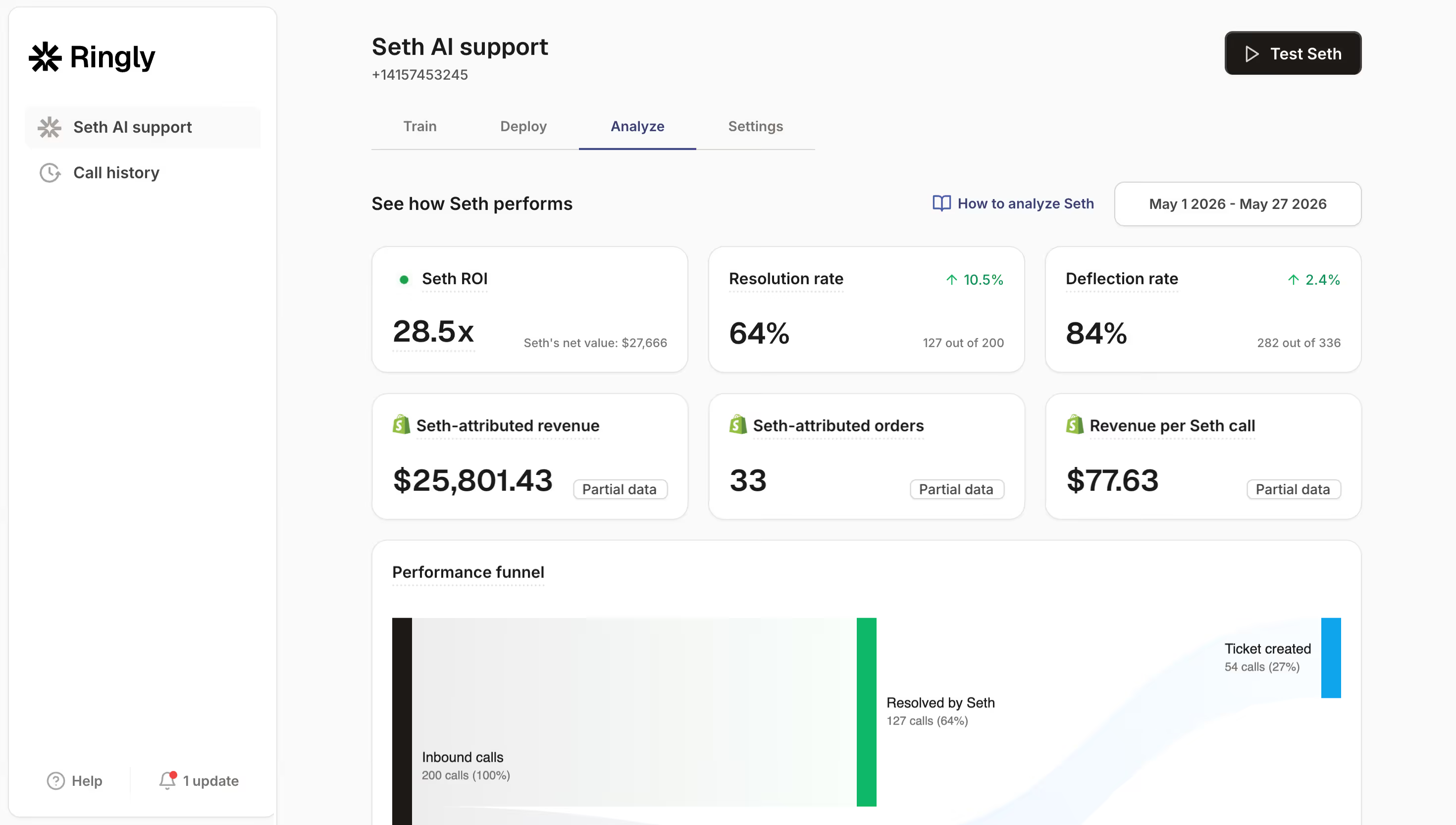
Ringly.io's AI agent Seth handles inbound support calls for Shopify stores, and upselling is built into the experience. Seth looks up order history in real-time, suggests complementary products based on what the customer already bought, and can even process additions to existing orders.
With a 73% resolution rate and 24/7 availability across 40 languages, it's the kind of consistency that's impossible with a human-only team. And setup takes about three minutes. See what it sounds like for your store.
The cost comparison makes this even more compelling. A human agent handling upsells needs training, quality monitoring, and ongoing coaching. An AI agent needs setup once and improves automatically. For stores that want to capture every upsell opportunity without building a dedicated sales-support hybrid team, this is the path that makes the most sense.
How to measure customer service upselling success
You can't improve what you don't track. Here are the five metrics that matter for ecommerce customer service KPIs around upselling:
- Revenue per support interaction: Total upsell revenue divided by total support contacts. This is your north star metric. Track it weekly.
- Upsell conversion rate: What percentage of support interactions result in an additional purchase. A healthy range is 10-25% for ecommerce, according to industry benchmarks.
- Average order value lift: Compare AOV for customers who interacted with support vs. those who didn't. The delta tells you if your upselling is actually moving the needle.
- CSAT post-upsell: Track customer satisfaction scores specifically for interactions where an upsell was attempted. If satisfaction drops, your approach needs adjustment.
- Repeat purchase rate: Customers who received good recommendations should come back more often. If they don't, your recommendations aren't landing.
Set a baseline, measure weekly, and iterate. Even a small improvement (going from 5% to 10% upsell conversion) can mean thousands in monthly revenue for a mid-size Shopify store.
One more thing: track which specific products convert best as upsells and which agents (or AI interactions) generate the most upsell revenue. This data becomes your playbook. Double down on what's working. Cut what isn't. If you're looking for a deeper framework on support metrics, check out our guide on first call resolution and how it impacts revenue.
Common mistakes that kill customer service upsells
Knowing what to do matters. Knowing what NOT to do matters more. Here are the most common ways stores sabotage their own upselling efforts:
- Upselling before resolving the issue: This is the number one trust killer. Fix the problem first. Every time.
- Being too aggressive or scripted: Customers can tell when an agent is reading from a card. Natural conversation beats perfect scripts.
- Recommending irrelevant products: Suggesting winter coats to someone buying swimwear (yes, this happens with poorly configured recommendation systems). Relevance is everything.
- Upselling every single interaction: Pick your moments. Not every call needs a pitch. Oversaturating your customers leads to the 40% annoyance problem.
- Ignoring customer signals: If they sound frustrated, rushed, or uninterested, skip it. Reading the room is a skill your team needs to develop.
- Not tracking results: If you don't measure upsell conversion rates and revenue per interaction, you have no idea what's working. Use your call center analytics to track performance.
- Using the same recommendation for everyone: A customer who buys skincare weekly has different needs than a first-time buyer. Segment your recommendations. Customer service for small teams doesn't mean one-size-fits-all upsells.
Ready to turn your support calls into a revenue channel? Start your free trial with Ringly.io. Setup takes three minutes and Seth starts answering calls the same day.
Frequently asked questions
Does upselling during customer service calls actually work?
Yes. According to research, 50% of customers say they find agent recommendations helpful and make additional purchases because of them. Phone calls also convert 10-15x higher than web interactions, making support calls one of the highest-converting upsell channels available.
How do I train my support team to upsell without being pushy?
Start with specific conversation scripts for common scenarios, then use role-playing exercises so agents internalize the language. The most important rule: always solve the customer's problem first. Upselling should feel like an afterthought, not the reason for the call.
What's the difference between upselling and cross-selling in customer service?
Upselling means recommending a higher-tier or larger-quantity version of what the customer already has. Cross-selling means suggesting complementary products. Both work well in support conversations, and the best agents use whichever fits the situation.
Can AI handle upselling during support calls?
Absolutely. AI agents like Ringly.io's Seth access order data in real-time, recommend products based on purchase history, and process additions to orders without any training cost. They also handle calls 24/7, capturing opportunities that human teams miss outside business hours.
What percentage of ecommerce revenue should come from upselling?
Industry benchmarks show upselling contributes 10-30% of total ecommerce revenue. Amazon generates roughly 35% of its revenue from upselling and cross-selling. Most small and mid-size stores are well below these numbers, which means there's a lot of room to grow.
What are the best products to upsell during customer service calls?
Consumable replenishments, complementary accessories, and subscription upgrades tend to convert best. The key is relevance: the product should directly relate to what the customer already bought or is asking about. A $15 add-on to an $80 order is an easy yes. A $200 premium upgrade is a harder sell during a support call.
When should I NOT upsell during a customer service interaction?
Skip the upsell during active complaints, when the customer is visibly frustrated, when the issue hasn't been resolved yet, or when the customer is clearly in a hurry. Forcing a recommendation in these moments damages trust and increases churn. There's always the next interaction.
Your support team is a revenue engine
Your customer service team (or AI agent) talks to your most engaged, most loyal customers every day. Treating those interactions as pure cost is leaving real money on the table.
The stores that get ecommerce upselling through customer service right see 10-30% revenue lifts. They turn a cost center into a profit center. And they do it without annoying their customers, because they follow the "help first, sell second" rule.
Start with one or two strategies from this list. Measure the results. Scale what works. And if you want to see what AI-powered upselling looks like in practice, try Ringly.io free for 14 days. Seth can be answering your calls and making smart product recommendations by this afternoon.