

Your customers are putting your product on their face. Think about that for a second.
Skincare isn't like buying a phone case or a pair of socks. It's personal. It's tied to how people feel about themselves. And when something goes wrong (a reaction, the wrong shade, a formula that doesn't work), the stakes feel much higher than a bad t-shirt purchase.
That's why skincare brand customer experience matters more than in almost any other ecommerce category. According to Mage Loyalty's 2026 benchmarks, the average DTC brand retains just 28.2% of customers for a second purchase. That means nearly three out of four first-time buyers never come back. For skincare, where products are consumable and customers should reorder every 60-90 days, that number is brutal.
Most skincare brands pour their energy into the pre-purchase experience. Beautiful packaging, influencer content, skin quizzes, AR try-ons. But then they completely drop the ball on what happens after someone clicks "Buy." This article covers nine practical strategies to fix that, from product discovery all the way through post-purchase support.
Hear what AI support calls sound like for your store. Just paste your Shopify URL and get sample calls in under 20 seconds, no email required. Listen to demo calls for my store.
Why skincare brand customer experience is different from other ecommerce
Skincare is one of the most anxiety-driven purchase categories online. Customers worry about reactions, allergies, ingredient interactions, and whether a product will actually work for their skin type. That level of uncertainty doesn't exist when you're buying a candle or a coffee maker.
And customers are getting smarter. Ingredient literacy has exploded over the past few years. People know what retinol is. They know to check for parabens. They ask specific questions about concentrations and formulations that would've been unheard of five years ago.
Here's the thing: only 4% of dermatology-related Instagram accounts are actually run by board-certified dermatologists. That means most of the skincare "advice" your customers find online is unreliable. Your brand has an opportunity to fill that trust gap with genuine, knowledgeable support.
The subscription model adds another layer. Skincare products run out. Customers need to reorder, adjust formulas, skip shipments, or swap products. That creates ongoing support needs that most one-time-purchase categories don't have.
On the bright side, consumers are increasingly loyal to skincare brands they trust. According to recent industry data, 42% of consumers now say they're loyal to their beauty and skincare brands, up 10% from 2023. When you get the experience right, people stick around.
The pre-purchase experience: helping customers find the right products
Before a customer ever adds something to their cart, they need to feel confident they're picking the right product. In skincare, that confidence is harder to build than in most categories.
Skin quizzes and personalized recommendations
Product quizzes are one of the highest-converting tools in skincare ecommerce. According to industry research, 58% of shoppers are more likely to buy from brands that offer online recommendation quizzes. One skincare brand reported an 8% quiz conversion rate, which was double their overall store conversion rate.
Keep your quiz short (5-7 questions max) and tie every answer to a real product recommendation. Don't just collect data and dump someone on a generic product page. The quiz should feel like talking to a knowledgeable friend who actually understands skin.
Dermatica does this well with their skin assessment. You answer a few questions about your skin concerns, history, and goals, and they recommend a specific treatment formula. It's not a gimmick. It's personalization that drives real conversions.
Ingredient transparency that builds trust
Your customers want to know what's in the bottle. Not just the INCI list buried on the back label, but plain-language explanations of what each ingredient does and why it's there.
Proactively flag common allergens and sensitivities. If a product contains fragrance, essential oils, or known irritants, say so clearly. Don't make customers dig through reviews to find out if your moisturizer will break them out.
HydroPeptide is a good example here. They provide detailed ingredient breakdowns alongside their product listings, explaining what each active does in accessible language. This kind of transparency reduces returns and builds the trust that drives repeat purchases.
Social proof and user-generated content
According to Justuno's DTC beauty report, about 64% of shoppers actively look for user-generated content before buying skincare products. Before-and-after photos are especially powerful in this category because they show real results on real skin.
Layer your review system so customers can filter by skin type, concern, and age. Fenty Beauty does this with their review filtering, letting shoppers find reviews from people with similar skin. This is way more useful than a wall of 5-star reviews with no context.
Encourage customers to share their results. A simple follow-up email 30 days after purchase asking "How's your skin looking?" with a review link can generate the kind of social proof that drives customer retention.
The post-purchase experience most skincare brands ignore
Here's where most skincare brands drop the ball. They spend all their budget on acquisition and discovery, then go silent after the order ships.
Proactive post-purchase communication
Don't ghost your customers after checkout. The period between purchase and first use is when anxiety is highest. "Did I buy the right thing? Will this work for me? What if I react badly?"
Send usage guides and application tips. "Your product has shipped" is not enough. Follow up with "Here's how to get the best results from your new serum" or "What to expect in the first two weeks." These messages reduce returns and increase satisfaction.
Set up 90-day replenishment reminders. Skincare is consumable. If your customer bought a moisturizer that lasts about three months, remind them before it runs out. This is basic, but most brands still don't do it.
Making returns painless (not punishing)
Skincare returns are emotional. When someone says "this product broke me out," they're not just returning a product. They might be dealing with visible skin irritation, anxiety about ingredients, and disappointment. Treating that return like a logistics problem misses the point entirely.
Make your return policy clear, easy to find, and generous. Complicated return processes don't save you money. They destroy trust and prevent customers from trying new products in the future.
The best skincare brands treat returns as a trust-building moment. Ask why the product didn't work, recommend an alternative, and make the process friction-free. That's how you turn a return into a second purchase.
If you're running a Shopify store and want to make sure every customer interaction (including returns) is handled well, Ringly.io can help your AI phone agent handle returns and exchanges automatically. See how it works for your store.
Phone support is the skincare CX channel nobody talks about
Read any article about skincare brand customer experience and you'll find the same playbook: quizzes, personalization, AR try-ons, loyalty programs. What you won't find is a single mention of phone support.
That's a massive blind spot.
Skincare customers call about urgent, personal things. A customer having a reaction to your product doesn't want to submit a ticket and wait 48 hours for an email. They want to talk to someone who can help right now.
According to ecommerce customer support data, 76% of consumers still prefer phone calls for customer support. And this isn't just older demographics. Even among Gen Z, 71% prefer live phone calls when they need help.
Phone availability also signals trust. Even if most of your customers never call, knowing they could call if something went wrong makes them more comfortable buying. It's the "just knowing I can reach someone" effect.
Small skincare brands often skip phone support because they think it's too expensive or complicated. But that's changed dramatically in the past year. AI voice agents can now handle skincare customer calls 24/7, answering ingredient questions, looking up orders, and processing returns without needing a single human agent on the clock.
According to eDesk's ecommerce research, companies with strong omnichannel support retain 89% of customers compared to just 33% for brands with weak omnichannel presence. Phone is a major piece of that puzzle.
How AI phone agents handle skincare brand customer experience
So what does AI phone support actually look like for a skincare brand?
An AI phone agent connects to your Shopify store and your product knowledge base. When a customer calls, it can pull up their order, check shipping status, answer product questions, and process returns or exchanges. All without a human picking up the phone.
Here are the kinds of calls skincare brands get every day:
- "Does this product contain parabens?" The AI checks your product data and gives a direct answer.
- "I'm having a reaction. What should I do?" The AI provides your safety guidance and escalates to a human if needed.
- "When will my subscription box ship?" It pulls the order tracking data and gives a specific date.
- "Can I exchange this for a different formula?" It walks the customer through your exchange process.
- "Which moisturizer is best for dry, sensitive skin?" It references your product catalog and recommends based on the customer's concern.
The 24/7 availability matters more for skincare than most categories. Reactions don't happen during business hours. If someone notices redness or irritation at 10 PM, they want answers now, not tomorrow morning.
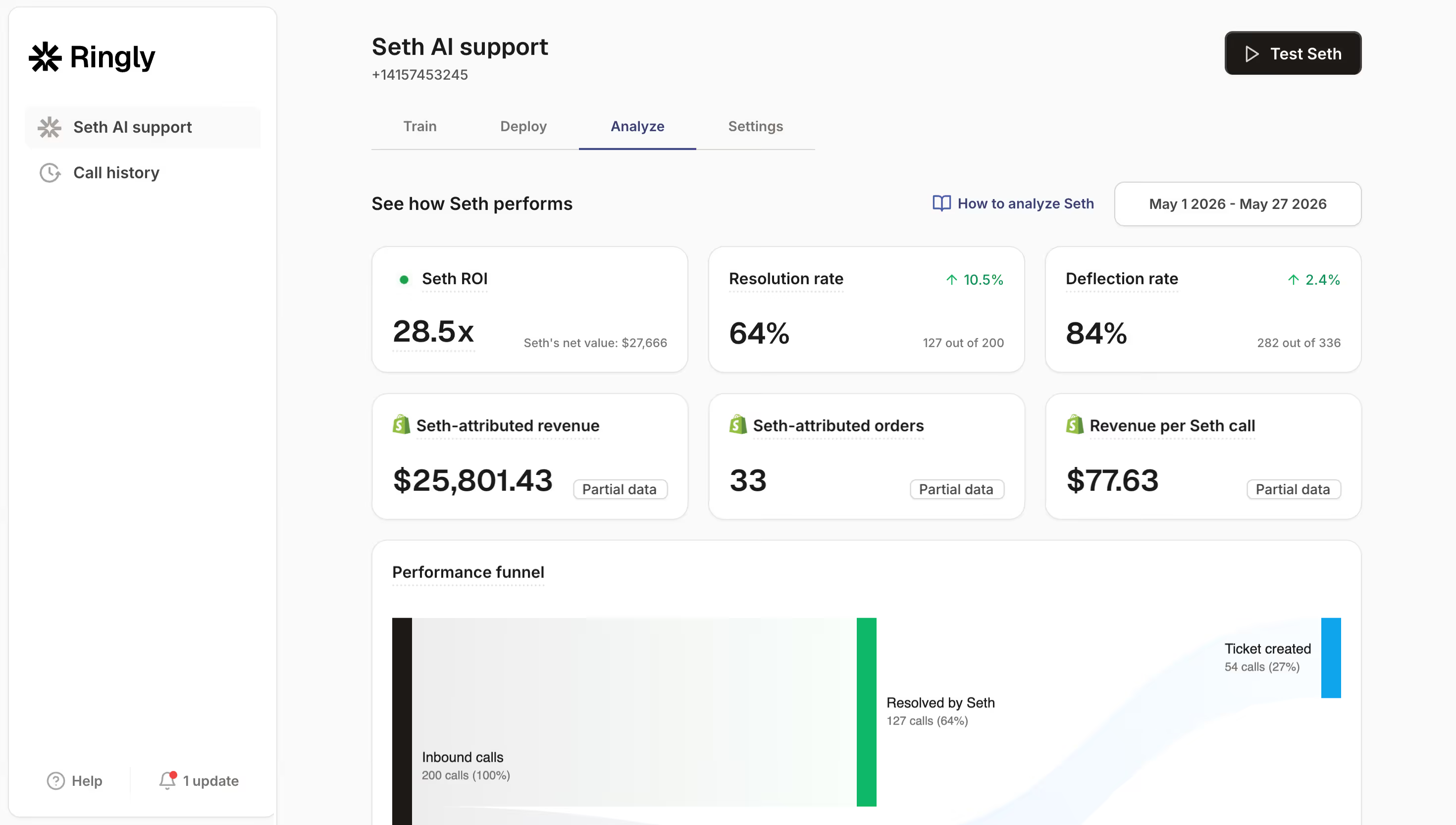
Ringly.io handles about 73% of calls without needing a human agent. Setup takes about three minutes on Shopify, with no code or technical work required. Pricing starts at $349/month for 1,000 minutes, which is a fraction of what even one part-time support agent would cost.
Compare that to outsourced call centers ($15-25/hour per agent, limited hours, constant training needed) or in-house staff ($35,000-50,000/year per agent plus benefits). For most skincare brands doing under $5M in revenue, an AI phone agent is the most practical way to offer phone support.
Try Ringly.io free for 14 days and see what AI phone support looks like for your skincare store. Setup takes three minutes.
Building a loyalty program that works for skincare
Skincare is a natural fit for loyalty programs. Products run out. Customers need to reorder. That recurring purchase cycle is exactly what loyalty programs are designed to capture.
The data backs this up. According to industry benchmarks, beauty brands with well-designed loyalty programs see 20-40% higher repeat purchase rates. And 83% of consumers say loyalty programs directly impact their decision to repurchase.
Sephora's Beauty Insider program is the gold standard here. According to LoyaltyLion's case study, the program has over 45 million members responsible for 80% of the company's total sales, proving that tiered loyalty works in beauty. Their retention rate sits at 81%, dramatically above the industry average.
You don't need Sephora's budget to build something effective. Here's what works for indie skincare brands:
- Points for reviews and referrals: Reward customers for leaving reviews (especially with photos) and referring friends. Glossier built an empire on this. 80% of their customers come from friend referrals.
- Early access to new products: Give loyal customers first dibs on new launches. This makes them feel valued and creates excitement.
- Subscription discounts: Offer a 10-15% discount for subscribing to auto-replenishment. It locks in recurring revenue and reduces churn.
- Tiered rewards: Start simple (free shipping after X points) and build up to exclusive rewards. The tiers keep customers motivated to keep buying.
Personalizing the skincare customer experience at every touchpoint
Personalization in skincare goes way beyond "Hi [first_name]" in your emails. Your customers gave you their skin type, concerns, and product preferences (through quizzes, purchase history, and support interactions). Use that data.
Customers who receive personalized experiences are 60% more likely to become repeat buyers. And 58% say they'd pay 10% more for a personalized beauty shopping experience. That's not a small number.
Here's what practical skincare personalization looks like:
- Product recommendations by skin profile: If someone bought an oily-skin cleanser, recommend the matching toner and moisturizer from your oily-skin line. Don't show them dry-skin products.
- Seasonal adjustments: Email your customers when the weather changes. "Winter's coming, here's how to adjust your routine" with product suggestions feels helpful, not salesy.
- Replenishment timing: Track average product usage cycles and send reminders at the right time. Not too early (annoying), not too late (they've already bought from someone else).
- Post-purchase routines: Send a "your complete routine" email showing how their products work together. This drives additional purchases and reduces confusion.
The brands winning in DTC skincare are the ones that make customers feel like the brand actually knows their skin.
Measuring your skincare brand customer experience
Most skincare brands track revenue and maybe NPS. But if you want to actually improve your customer experience, you need more specific metrics.
Here are the KPIs that matter for skincare CX:
| Metric | Benchmark | Why it matters |
|---|---|---|
| First response time | Under 1 hour | Sub-one-hour responses drive 71% retention vs. 48% for slower |
| First contact resolution | 70%+ | Resolving issues in one interaction prevents frustration |
| Repeat purchase rate | 28% average, 40%+ for top brands | The core metric for skincare. If customers aren't reordering, something is broken |
| Customer lifetime value | Growing quarter over quarter | Repeat customers spend 30% more after 6 months, 45% more after 3 years |
| Return rate + reasons | Track by product and reason | Identifies product issues vs. expectation gaps |
| Support CSAT | 80%+ | Measures how customers feel about their support interactions |
Track these monthly. Set benchmarks based on your current numbers and aim to improve incrementally. Even small improvements in repeat purchase rate compound into significant revenue over time.
The customer retention statistics are clear: keeping existing customers is far cheaper and more profitable than acquiring new ones.
Common skincare CX mistakes to avoid
Before you start building out your CX strategy, make sure you're not making these common mistakes:
- Outsourcing support to agents who don't know your products: If your support team can't explain the difference between niacinamide and hyaluronic acid, customers will notice. Product knowledge is non-negotiable in skincare.
- Hiding your contact information: If customers can't find a way to reach you, they'll assume you're hiding from complaints. Put your phone number, email, and chat on every page.
- Using generic chatbot responses for skincare questions: "I'm sorry you're having trouble! Let me connect you with a team member" isn't helpful when someone is asking whether your serum is safe for rosacea. Your support tools need skincare-specific knowledge.
- Ignoring post-purchase support: The sale isn't the finish line. It's the starting line. Everything after checkout determines whether that customer ever comes back.
- Treating returns as a cost center: Returns in skincare are trust-building opportunities. Handle them well and you'll earn a customer for life. Handle them poorly and you'll earn a negative review.
- Over-relying on email for urgent issues: A customer having a skin reaction doesn't want to wait 24-48 hours for an email. Offer real-time support channels like phone or AI-powered call handling.
Ready to add phone support to your skincare brand without hiring a call center? Start your free Ringly.io trial. It takes three minutes to set up.
Frequently asked questions
What makes skincare brand customer experience different from other ecommerce?
Skincare is uniquely personal and anxiety-driven. Customers worry about reactions, ingredient interactions, and whether products will work for their specific skin type. That emotional weight means support interactions carry more significance than in categories like electronics or apparel. The same principle applies to hair care brands on Shopify, where ingredient sensitivity and texture matching create similarly complex support needs.
How can a small skincare brand afford phone support?
AI phone agents like Ringly.io start at $349/month and handle most calls without human intervention. That's a fraction of the cost of hiring even a part-time support agent, and it provides 24/7 coverage in 40 languages.
What are the most common reasons skincare customers contact support?
The top reasons are ingredient and allergy questions, order tracking inquiries, subscription management (skipping, swapping, canceling), returns and exchanges, and product recommendation requests. Shade matching questions alone account for roughly 18% of all inbound calls at skincare brands.
How does AI phone support work for skincare brands?
An AI phone agent connects to your Shopify store and product database. When customers call, it can look up orders, answer product questions, process returns, and provide personalized recommendations. It escalates to a human agent when the situation requires it. Learn more about AI voice agents for customer support.
What's a good repeat purchase rate for a skincare brand?
The average DTC brand sees about 28% second-purchase retention. Top-performing skincare brands with strong CX and loyalty programs hit 40% or higher. Given that skincare products are consumable and need regular repurchasing, anything below 30% suggests a customer experience problem worth investigating.
How do I improve customer retention for my skincare brand?
Focus on three things: post-purchase communication (usage tips, check-ins, replenishment reminders), responsive multi-channel support (including phone), and a loyalty program that rewards repeat purchases. Brands that get these right see retention rates 20-40% above industry average.
Your skincare CX is only as strong as its weakest moment
The brands dominating skincare right now aren't necessarily the ones with the best formulas. They're the ones that make customers feel supported at every step, from first visit to fifth reorder.
Phone support is the most underrated piece of that puzzle. It's the channel your competitors are ignoring, the one customers actually prefer, and the one that builds the deepest trust.
You don't need a team of support agents to offer it. AI phone agents handle the heavy lifting, and setup is measured in minutes, not months.
See what AI phone support looks like for your skincare brand. Free trial, three-minute setup, no credit card required.