

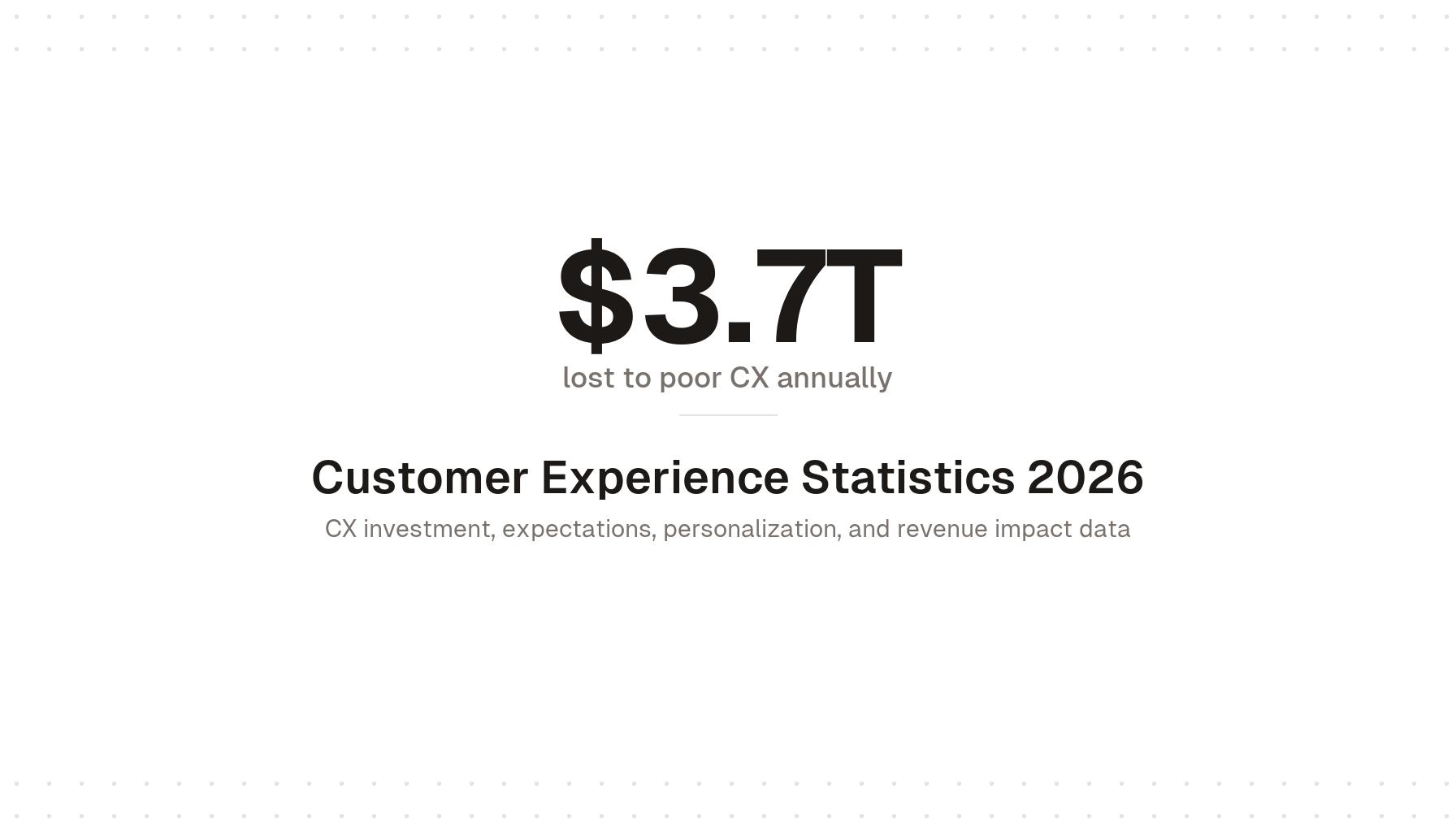
Customer experience is the single biggest factor separating brands that grow from brands that bleed customers. The numbers prove it: $3.7 trillion is lost globally each year because companies fail to meet basic CX expectations (Qualtrics XM Institute).
We collected 50 of the most important customer experience statistics for 2026. The data comes from Zendesk, Salesforce, PwC, McKinsey, Forrester, Gartner, Bain & Company, and other major research firms. Whether you sell on Shopify or run a large ecommerce operation, these numbers will help you benchmark your CX, spot gaps, and decide where to invest next.
Hear what AI support calls sound like for your store. Just paste your Shopify URL and get sample calls in under 20 seconds, no email required. Listen to demo calls for my store.
Key highlights
- $3.7 trillion is lost globally each year due to poor customer experiences (Qualtrics XM Institute)
- 72% of customers switch brands after a single negative experience (Renascence)
- The CX management market is projected to hit $26.11 billion in 2026, up from $15.55 billion in 2025 (Fortune Business Insights)
- 86% of buyers will pay more for a better customer experience (PwC)
- 50% of service cases are expected to be resolved by AI by 2027, up from 30% in 2025 (Salesforce)
- Companies with strong omnichannel strategies retain 89% of their customers vs. 33% for weak ones (Aberdeen Group)
CX market size and investment
The customer experience industry is growing fast. Here's how much companies are spending, and the returns they're seeing.
1. The global CX management market was valued at $15.55 billion in 2025 and is projected to reach $47.72 billion by 2033, growing at a CAGR of 15.2%. (Grand View Research)
2. The CX management market is projected to hit $26.11 billion in 2026. (Fortune Business Insights)
3. 80% of business leaders plan to increase their customer service budgets over the next year. (Zendesk CX Trends 2026)
4. 94% of organizations saw CX investments deliver ROI within the last five years. (Nextiva State of CX)
5. Companies see an average return of $3.50 for every $1 invested in AI customer service. (Crescendo AI)
6. 84% of businesses already using AI in CX plan to invest even more. (Zoom)
The ROI data speaks for itself. Nearly all companies that invested in CX saw returns, and the AI investment multiplier ($3.50 for every $1) makes AI-powered customer service one of the highest-return investments you can make.
Customer expectations and preferences
What customers actually want has shifted dramatically. Speed, availability, and personalization are now baseline expectations, not bonuses.
7. 83% of consumers say experiences should be better than they are today. (Zendesk CX Trends 2026)
8. 74% of consumers expect customer service to be available 24/7. (Zendesk CX Trends 2026)
9. 88% of customers expect faster responses than they did just one year ago. (Zendesk)
10. 99% of consumers say customer service influences their buying decisions. (Salesforce)
11. 52% would pay more for greater speed and efficiency. (PwC 2025 CX Survey)
12. 74% find it frustrating to repeat their story to different agents. (Zendesk CX Trends 2026)
13. 73% of people expect companies to understand their unique needs and expectations. (Salesforce)
The takeaway? Customers expect instant, personalized, always-on support. And they're increasingly willing to pay for it.
That's why tools like AI answering services and AI voice agents are growing so quickly. They deliver the speed and availability customers demand without the cost of 24/7 human staffing.
Impact on revenue and loyalty
Great CX isn't just a feel-good metric. It directly drives revenue, loyalty, and profitability. The gap between CX leaders and laggards is massive.
14. Companies that focus on CX see an 80% increase in revenue. (Fullview)
15. CX leaders achieve 17% compound average revenue growth, compared to just 3% for CX laggards. (InMoment)
16. 86% of buyers are willing to pay more for a better customer experience. (PwC)
17. A 5% increase in customer retention can boost profits by 25 to 95%. (Bain & Company)
18. 65% of a company's revenue comes from existing customers. The top 5% of customers generate 35% of total ecommerce revenue. (Envive)
19. Customer-obsessed organizations report 41% faster revenue growth than their peers. (Forrester via Shopify)
20. Excellent CX drives a 4-8% revenue increase above the market average. (Bain & Company)
21. Customer acquisition costs in ecommerce rose from $24-28 in 2015 to $78-82 in 2025, a 233% increase. (Envive)
The math here is simple. Acquiring new customers is getting more expensive every year. Keeping existing ones through better CX is one of the highest-ROI moves available.
For a deeper look at the numbers, check out our guide on ecommerce customer retention.
The cost of poor customer experience
Bad CX doesn't just disappoint customers. It destroys revenue.
And most of the damage is invisible. Unhappy customers don't complain. They just leave.
22. Poor customer experiences cost businesses $3.7 trillion globally per year. (Qualtrics XM Institute)
23. 72% of customers switch brands after a single negative experience. (Renascence)
24. 52% of consumers stopped buying from a brand because of a bad experience with products or services. (PwC 2025 CX Survey)
25. 85% of CX leaders say customers will drop brands over unresolved issues, even on the first contact. (Zendesk CX Trends 2026)
26. 56% of consumers rarely or never complain about bad service. They just leave and never come back. (Coveo via Shopify)
27. About 9 out of 10 executives say customer loyalty has grown in recent years, but only 4 out of 10 consumers agree. (PwC 2025)
28. 59% of consumers feel companies have lost touch with the human element of customer experience. (PwC 2025)
Stat #27 is the most alarming one on this list. There's a massive gap between what executives think customers feel and what customers actually feel. If you're not actively measuring CX with tools like call analytics and customer feedback loops, you're probably in that gap.

Personalization statistics
Personalization has shifted from "nice to have" to "expected." Customers want brands to know them, and they get frustrated when that doesn't happen.
29. 76% of customers expect personalized experiences from the brands they buy from. (McKinsey)
30. 76% feel frustrated when experiences aren't personalized. (McKinsey)
31. Brands with mature personalization strategies are 71% more likely to report high customer loyalty. (Emarsys)
32. Businesses excelling in personalization see 40% higher revenue from those efforts compared to competitors. (McKinsey)
33. 61% of customers say they're often treated like "numbers" rather than individuals. (Salesforce)
34. 50% of consumers spend more with brands that offer personalized experiences. (Envive)
35. 92% of businesses already use AI to drive personalization. (FastSimon)
Personalization isn't just about using someone's first name in an email. It's about understanding their order history, preferences, and context. For Shopify stores, this is where tools like AI shopping assistants and ecommerce personalization strategies make a real difference.
Ringly.io's AI phone agent pulls up caller order data from your Shopify store in real time, so every interaction is personalized without any extra work from your team. See how it works for your store.
AI and automation in customer experience
AI is no longer a future trend in CX. It's already here, and adoption is accelerating. But there's a gap between buying AI tools and actually using them well.
36. 30% of service cases were resolved by AI in 2025. That number is expected to reach 50% by 2027. (Salesforce State of Service)
37. 80% of businesses plan to adopt AI-driven voice technology for customer service by 2026. (KaiCalls)
38. AI reps spend 20% less time on routine cases, freeing up roughly 4 hours per week for complex work. (Salesforce)
39. 89% of service professionals say conversational AI increases self-service resolution rates. (Salesforce)
40. A chatbot interaction costs about $0.50, compared to $6.00 for a human agent. That's a 12x cost difference. (Tidio)
41. AI is forecast to reduce call center agent labor costs by $80 billion globally. (Gartner)
42. Only 25% of call centers have successfully integrated AI automation into their daily workflows. The other 75% own AI tools but aren't fully using them. (TELUS Digital)
43. 95% of consumers want to know why AI makes the decisions it does. But only 37% of companies currently explain AI reasoning to customers. (Zendesk CX Trends 2026)
The cost savings are obvious: $0.50 vs. $6.00 per interaction. But stat #42 is the real story.
Most companies bought AI tools but haven't figured out how to actually use them. The ones that do, like stores using AI phone agents for Shopify, are seeing massive advantages in speed, cost, and customer satisfaction.
Want to learn more? We've covered how AI is changing call centers and the latest AI customer service statistics in depth.
Omnichannel customer experience
Customers use multiple channels. They expect the experience to be consistent everywhere. Most companies are failing at this.
44. Companies with strong omnichannel engagement retain 89% of customers, compared to 33% for companies with weak strategies. (Aberdeen Group)
45. Omnichannel customers spend 13-16% more per order than single-channel shoppers. (CapitalOne Shopping)
46. The purchase rate on omnichannel platforms is 250% higher than single-channel ones. (WiserReview)
47. Only 22% of companies have fully unified customer data across all service touchpoints. (CCW Digital via Shopify)
48. 76% of customers would choose a company that lets them share text, images, and video in the same support thread. (Zendesk CX Trends 2026)
49. Companies with integrated omnichannel support see a 31% reduction in first-resolution times and a 39% decrease in customer wait times. (Trengo)
50. 76% of consumers still prefer phone calls to get customer support, including 71% of Gen Z. (Nextiva, McKinsey via Shopify)
The phone stat (stat #50) surprises a lot of people. Even with live chat, social media, and email growing, most customers still prefer picking up the phone. And Gen Z? Same thing.
The challenge is answering those calls consistently. That's where AI voice agents and ecommerce phone support tools come in. If you can't staff a call center 24/7, AI fills the gap without the cost.
What this means for ecommerce brands
The data points in several directions at once. Customers want instant, 24/7 support. They want personalization.
They prefer the phone. And they'll leave without telling you why if anything falls short.
Here's what actually matters if you're running an ecommerce store:
CX is the biggest competitive advantage you have. CX leaders grow revenue at 17% annually. Laggards grow at 3%. That gap is enormous, and it's widening.
Speed is non-negotiable. 88% of customers expect faster service than last year. The stores that respond in minutes, not hours, win. Sub-one-hour responses drive 71% retention vs. 48% for slower ones.
AI adoption is still early. 80% of businesses plan to use AI voice tech by the end of 2026, but only 25% of call centers have actually integrated AI into daily workflows. There's a first-mover advantage right now.
Personalization pays. Companies that get personalization right see 40% more revenue from those efforts. But 61% of customers still feel like numbers. The gap between expectation and reality is your opportunity.
Phone support isn't dead. 76% of consumers prefer phone calls. Even Gen Z. If your store skips phone support because staffing is too expensive, AI voice agents solve that problem.
If your store runs on Shopify, Ringly.io is built specifically for this. Seth, our AI phone agent, picks up every call 24/7 in 40 languages, looks up orders directly in Shopify, and handles returns automatically.
Over 2,100 Shopify stores already use it, with a 73% resolution rate without human help.
Try Ringly.io free for 14 days and get Seth answering calls in under three minutes.
Frequently asked questions
How much does poor customer experience cost businesses?
Poor CX costs businesses $3.7 trillion globally each year, according to the Qualtrics XM Institute. On an individual brand level, 72% of customers switch after a single negative experience, and 52% stop buying from a brand entirely after a bad encounter.
What percentage of customers switch brands after a bad experience?
72% of customers switch brands after just one negative experience. Even more concerning, 56% of unhappy customers never complain. They just leave silently, which means you often don't know there's a problem until revenue drops.
How big is the customer experience management market?
The global CX management market was $15.55 billion in 2025 and is projected to hit $26.11 billion in 2026. By 2033, it's expected to reach $47.72 billion, growing at a CAGR of 15.2%.
What ROI do companies see from CX investments?
94% of organizations saw CX investments deliver ROI within five years. For AI specifically, companies see an average return of $3.50 for every $1 invested. CX leaders also grow revenue at 17% annually, compared to 3% for laggards.
How does personalization affect customer experience?
76% of customers expect personalized experiences, and 76% feel frustrated when they don't get them. Brands with mature personalization are 71% more likely to report high loyalty, and they see 40% higher revenue from personalization efforts.
What role does AI play in customer experience?
30% of service cases were resolved by AI in 2025, expected to hit 50% by 2027. AI interactions cost about $0.50 vs. $6.00 for a human agent, but only 25% of call centers have fully integrated AI into workflows.
Do customers still prefer phone support over chat?
Yes. 76% of consumers prefer phone calls for support, and 71% of Gen Z agree. Companies with strong omnichannel support (including phone) retain 89% of customers vs. 33% for those without it.
How does omnichannel CX affect revenue?
Companies with strong omnichannel strategies retain 89% of customers and see 250% higher purchase rates. Omnichannel shoppers spend 13-16% more per order. But only 22% of companies have fully unified their customer data across touchpoints.