
Most ecommerce stores launch a loyalty program the same way. They install a points widget, set up some basic earning rules, and wait for retention to magically improve.
It doesn't work that way. The widget collects dust. Customers forget they have points. And your repeat purchase rate stays flat.
Here's what actually moves the needle: a loyalty program that's simple enough to use, valuable enough to care about, and backed by a customer service experience that makes people want to come back. That last part is the one most brands miss entirely.
This guide breaks down the four main types of ecommerce customer loyalty programs, walks through how to build one that works on Shopify, and covers the loyalty driver that almost nobody talks about.
Hear what AI support calls sound like for your store. Just paste your Shopify URL and get sample calls in under 20 seconds, no email required. Listen to demo calls for my store.
Why ecommerce customer loyalty programs matter more than ever
Customer acquisition costs keep climbing. Facebook and Google ads are more expensive than they were two years ago, and the trend isn't reversing. That makes customer retention the most reliable growth lever you have.
The numbers back this up. According to Bain & Company research, a 5% increase in customer retention can boost profits by 25% to 95%. Loyalty program members spend 12-18% more per transaction than non-members. And 84% of consumers say they're more likely to stick with a brand that offers a loyalty program.
But here's the thing. Acquiring a new customer costs roughly five times more than keeping an existing one. If you're spending $50 to acquire a customer who buys once and never returns, you're burning money. A well-built loyalty program flips that math.
The US loyalty program market is projected to hit $44.73 billion by 2029, up from $27.26 billion in 2025. Ecommerce brands are investing heavily because the ROI is real: 90% of loyalty program owners report positive ROI, with average returns of 4.8x.
And yet, most ecommerce stores either don't have a loyalty program or have one that nobody uses. They launch a generic points widget and expect retention to fix itself. It won't.
The question isn't whether your store needs a loyalty program. It's which type fits your business and how to build one that customers actually use. Getting this right can be the difference between a customer who buys once and one who buys ten times.
Four types of ecommerce customer loyalty programs (and when to use each)
Not every program type works for every store. Your product cycle, margins, and average order value all determine which structure makes sense.

Points-based programs
This is the most common type. Customers earn points for purchases and redeem them for discounts, free products, or perks.
Sephora's Beauty Insider program is the gold standard here. It drives 80% of the company's North American sales, and members can choose between discounts, exclusive products, and experiences like free makeovers.
Points programs work best for stores with consumable products and frequent repeat purchases. Think supplements, beauty, pet food, and health products. If your customers buy every 30-60 days, points give them a reason to buy from you instead of a competitor.
- Earning: typically 1-10 points per dollar spent
- Redeeming: set a clear threshold (e.g., 500 points = $5 off)
- Bonus actions: award points for reviews, referrals, social follows, birthdays
Tiered (VIP) programs
Tiered programs add a progression element. Customers unlock better perks as they spend more or accumulate points. The psychology is simple: once someone reaches Gold status, they don't want to drop back to Silver.
Flipkart Plus members transact 5x more and spend 7x higher than regular customers. ALDO Crew uses three tiers to push customers toward higher spending levels.
These work well for fashion and apparel brands, jewelry stores, and any business with a range of price points. The tiers create aspirational value.
- Structure: 2-4 tiers (e.g., Bronze, Silver, Gold, Platinum)
- Unlock criteria: based on annual spend or lifetime points
- Perks escalation: free shipping at Silver, early access at Gold, exclusive products at Platinum
Paid membership programs
Customers pay an upfront fee for benefits. Amazon Prime is the obvious example. Walmart+ is another.
The upfront commitment creates a psychological anchor. Once someone pays $99/year, they're motivated to shop more to "get their money's worth." That drives frequency and customer lifetime value.
Paid programs work best for stores where customers buy frequently and shipping costs are significant. If your typical customer orders monthly, offering free shipping through a paid membership can be very compelling (nine out of ten shoppers say free shipping is their top incentive).
- Price: typically $49-$99/year or $9.99/month
- Core benefit: free or expedited shipping
- Extras: early access to sales, exclusive products, member-only pricing
Referral and hybrid programs
Referral programs turn your best customers into your sales team. You reward them for bringing in new buyers, and referred customers spend 2x more with 16% higher lifetime value than customers acquired through other channels.
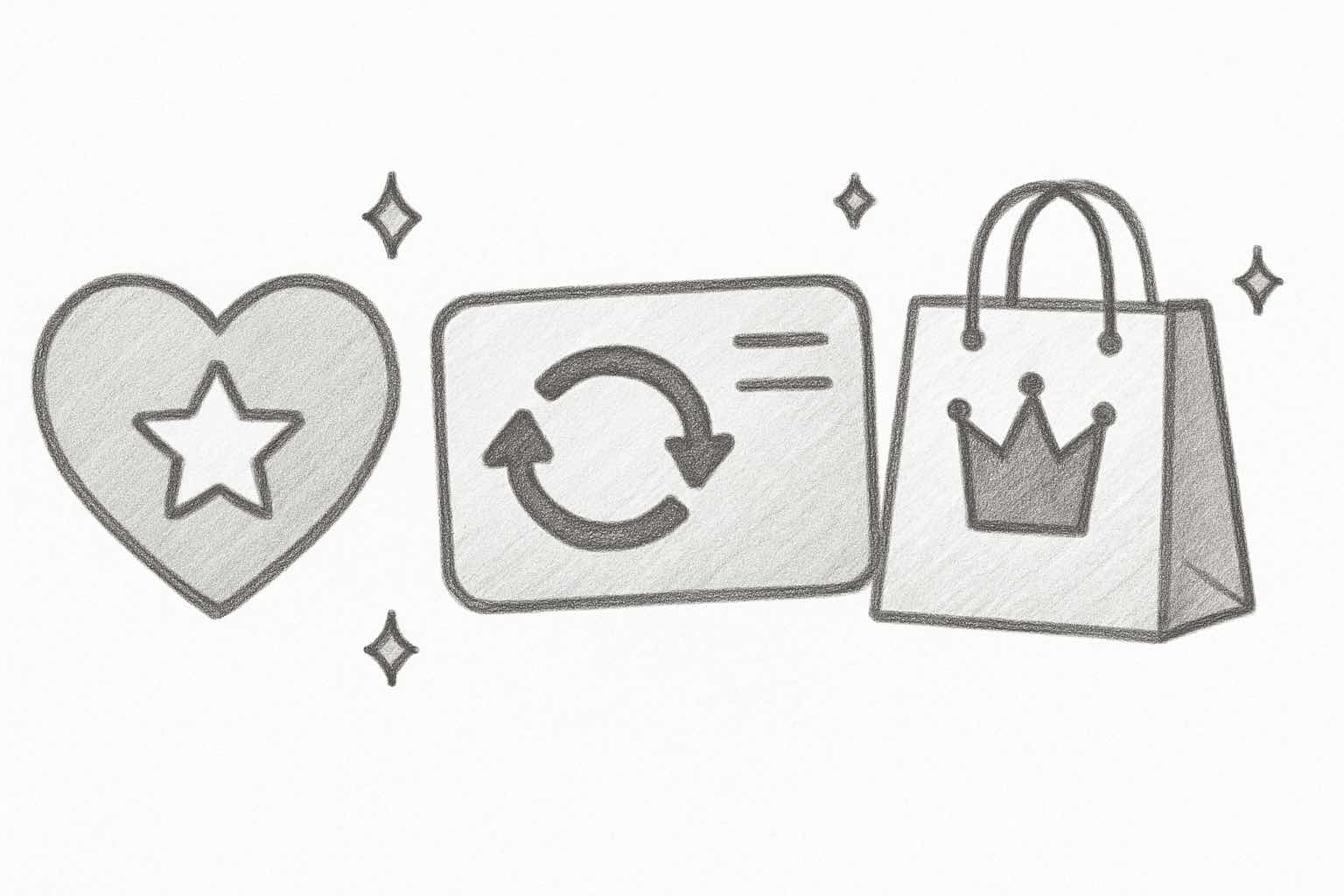
Most successful loyalty programs combine elements. A points system with a referral bonus and VIP tiers gives customers multiple reasons to engage.
These work for virtually any DTC brand. They're especially effective when your product has a natural word-of-mouth component, like skincare, wellness, or pet products.
- Reward structure: give $10, get $10 (or points equivalent)
- Double-sided: reward both the referrer and the new customer
- Tracking: use unique referral links or codes
How to build an ecommerce customer loyalty program that works
Knowing the types is step one. Actually building a program that drives retention is where most stores get stuck. Here's the step-by-step process.
Define your goal and pick the right program type
Start with one question: what behavior do you want to encourage?
- More frequent purchases? Points-based program
- Higher spend per order? Tiered/VIP program
- More word-of-mouth? Referral program
- All of the above? Hybrid (but start simple)
Look at your current repeat purchase rate and AOV. If your repeat rate is under 20%, a basic points program with a referral bonus is usually the best starting point. Don't overcomplicate it.
Choose a platform
Four platforms dominate the Shopify loyalty space. Here's how they compare.
| Platform | Starting Price | Best For | Key Differentiator |
|---|---|---|---|
| Smile.io | Free (200 orders/mo) | First-time loyalty programs | Easiest setup, 100K+ stores |
| Rivo | $49/mo | Modern Shopify-native loyalty | 150+ features, affordable |
| Yotpo | Free (basic) | All-in-one retention suite | Reviews + loyalty + SMS combined |
| LoyaltyLion | $399/mo | Data-driven mid-market brands | Predictive analytics, deep segmentation |
If you're just getting started, Smile.io's free plan or Rivo's $49/mo plan are your best bets. Smile.io has a 4.8/5 rating on G2 across 800+ reviews, and it powers 100,000+ stores. You can always upgrade later.
If you want everything in one tool, Yotpo combines loyalty with reviews, SMS, and email. It's rated 4.3/5 on G2 with 300+ reviews and has 65+ integrations. But the full feature set gets expensive fast.
If analytics matter most, LoyaltyLion gives you predictive insights and customer segmentation. It scores 4.6/5 on G2 and is particularly strong for beauty and fashion verticals. But at $399/mo minimum, it's better suited for stores doing $500K+ annually.
If you're Shopify-only and want something modern, Rivo has quickly built a reputation for packing 150+ features into an affordable $49/mo package. It's Shopify-exclusive, so the integration is tight.
See our full breakdown of Shopify customer service apps for more options. You can also check our guides on Shopify customer retention apps to see how loyalty fits into a broader retention stack.
Set up earning and redemption rules
Keep it simple. If a customer can't explain how your program works in one sentence, you've made it too complicated.
A solid starting point:
- Earning: 1 point per $1 spent
- Redemption: 100 points = $5 off
- Bonus: 200 points for writing a review, 500 points for a successful referral
- Birthday bonus: 100 free points on their birthday
The key is making the first reward achievable. If it takes 10 purchases to earn a $5 discount, most customers will never bother. Set the threshold so a typical customer earns their first reward after 2-3 purchases.
Promote your program everywhere
A loyalty program won't work if nobody knows about it. Most ecommerce marketing strategies overlook loyalty program promotion.
- Checkout page: remind customers they'll earn points on this purchase
- Post-purchase emails: show them their points balance and what's next
- Homepage banner: make the program visible to first-time visitors
- Packaging inserts: physical card explaining the program
- Social media: highlight member-only perks and rewards on your social channels
Measure and optimize
Track these four metrics monthly:
- Repeat purchase rate: percentage of customers who buy again within 90 days
- Program enrollment rate: what percentage of customers join
- Redemption rate: how often members actually use their rewards (healthy = 20-40%)
- Customer lifetime value: are loyalty members worth more over time? Track this with your CLV metrics
If enrollment is low, your program isn't visible enough. If redemption is low, your rewards aren't compelling enough. Let the data guide your adjustments.
You can track customer service KPIs alongside loyalty metrics to see how support quality affects repeat purchases. They're more connected than you'd think.
Want to see how AI phone support fits into your retention strategy? Try Ringly.io free for 14 days. Setup takes three minutes.
The loyalty driver most ecommerce brands overlook: customer support
Here's something the loyalty program industry doesn't want to talk about: no amount of points or tiers will save you if your customer service is bad.
According to PwC research, 73% of consumers say customer experience is a key factor in their purchasing decisions. And 32% will walk away from a brand they love after just one bad experience.
Think about it from your customer's perspective. They have 500 loyalty points with your store. But the last time they called about a missing order, nobody picked up. They sent an email and waited three days for a response. Are those 500 points enough to keep them? Probably not.
Phone support creates emotional loyalty that discounts can't match. When a customer calls and gets their issue resolved in two minutes, that experience sticks. It builds trust. And trust drives repeat purchases more reliably than any points program.
The problem is that most small ecommerce teams can't offer 24/7 phone support. They don't have the headcount. So calls go to voicemail, customers get frustrated, and they buy from someone else next time.
This is where AI phone agents change the equation. Tools like Ringly.io put an AI agent on your phone line that handles order lookups, return requests, and product questions around the clock. It resolves about 73% of calls without human intervention, in 40 languages.
The result: your loyalty program members get the support experience they expect, even at 2 AM on a Sunday. And that consistent support quality is what turns one-time buyers into repeat customers.
If you're building a loyalty program but haven't solved your support experience, you're building on a shaky foundation. Fix the support first. Then let the program amplify it.
See what AI phone support looks like for your store. No credit card required.
Real examples of ecommerce customer loyalty programs that work
Theory is nice. Here's what actually works in practice.
Sephora Beauty Insider
Sephora's three-tier program (Insider, VIB, Rouge) is the most referenced loyalty program in ecommerce for good reason. It drives 80% of the company's North American sales and generated a 22% increase in cross-sell revenue plus a 51% boost in upsell revenue.
What makes it work: the rewards aren't just discounts. Members get early access to products, birthday gifts, free beauty classes, and exclusive events. The experiential rewards create emotional connection, not just transactional loyalty.
The program also collects rich first-party data on purchase preferences, which fuels personalized product recommendations. For skincare and cosmetics brands, this is the model to study.
SHEIN Bonus Points
SHEIN's system is built on gamification. You earn points not just for buying, but for daily check-ins, writing reviews, sharing on social media, and even just browsing the app.
What makes it work: the barrier to entry is extremely low. You start earning before you ever make a purchase. That early engagement creates a habit loop that drives first purchases and repeats.
For smaller stores, the lesson is clear: don't limit earning to purchases only. Let customers earn points for actions that build engagement.
Zappos VIP
Zappos takes a different approach. Their VIP program centers on shipping and service, not points. Members get free expedited shipping, surprise upgrades, and access to a dedicated support line.
What makes it work: Zappos built its brand on customer service. The loyalty program is an extension of that identity. It works because the core experience is already excellent.
This is the model most relevant for smaller ecommerce brands. If you can't compete with Sephora's scale or SHEIN's gamification budget, you can compete on service quality. And that's a loyalty strategy that doesn't require a $599/mo platform.
The lesson from all three examples: loyalty isn't just about rewards. It's about the experience customers have every time they interact with your brand, from browsing to buying to needing help after the sale. The brands that get customer experience optimization right don't need to bribe customers into coming back. They come back because they want to.
Common mistakes that kill ecommerce loyalty programs
Even well-intentioned programs fail when stores make these errors.
- Making it too complicated: if your earning rules need a flowchart to explain, simplify them. One point per dollar, clear redemption thresholds, done.
- Offering rewards nobody wants: "10% off your next order" isn't exciting if your products already go on sale regularly. Ask your customers what they actually want. Free shipping usually wins.
- Ignoring the support experience: a customer with 1,000 loyalty points who can't get their order status checked on the phone will still churn. Points don't fix bad service.
- Not promoting the program: launching a loyalty program without promoting it is like opening a store without a sign. Put it in your emails, your checkout flow, and your packaging.
- Setting the bar too high: if it takes 50 purchases to earn a meaningful reward, nobody will engage. Make the first reward achievable within 2-3 purchases.
- Treating it as set-and-forget: loyalty programs need ongoing optimization. Track your metrics, test different reward structures, and iterate based on what the data tells you.
- Copying enterprise programs without the budget: Sephora can afford experiential rewards because they process millions of transactions. A store doing 500 orders per month should start with a simple points-and-referral combo, not a four-tier VIP system with exclusive events.
- Forgetting about post-purchase communication: your loyalty program is only as strong as your follow-up. If members don't hear from you between purchases, they'll forget you have a program at all.
Ready to pair your loyalty program with support that actually keeps customers happy? Start your free Ringly.io trial and get AI phone support running in three minutes.
Frequently asked questions
What is an ecommerce customer loyalty program?
It's a system that rewards customers for repeat purchases and engagement with your store. Programs typically use points, tiers, referral bonuses, or paid memberships to incentivize customers to keep buying from you instead of a competitor.
How much does a loyalty program cost for Shopify?
You can start for free with Smile.io (up to 200 orders/month) or pay $49/mo for Rivo or Smile's Starter plan. Mid-range options like Yotpo run $199/mo, while enterprise tools like LoyaltyLion start at $399/mo.
Do loyalty programs actually increase retention?
Yes. 79% of consumers say they purchase more frequently after joining a loyalty program. Brands typically see an 8.5x ROI within the first 90 days, and loyalty members spend 12-18% more per transaction than non-members.
What's the best loyalty app for Shopify?
For most stores just starting out, Smile.io or Rivo offer the best balance of features and price. If you want an all-in-one retention platform (reviews + loyalty + SMS), look at Yotpo. For deep analytics, LoyaltyLion is strong but expensive.
How long does it take to see ROI from a loyalty program?
Most brands report measurable results within 90 days. The initial lift comes from increased repeat purchase rates among enrolled members. Full ROI, including referral revenue and reduced churn, typically materializes over 6-12 months.
Can small ecommerce stores benefit from loyalty programs?
Absolutely. Small stores often see the biggest percentage lift because their baseline retention is lower. Start with a simple points program and a referral bonus. You don't need enterprise software. A free Smile.io plan or Rivo's $49/mo plan is plenty for stores doing under 1,000 orders per month.
How does customer service affect loyalty program success?
It's the foundation everything else sits on. Customer retention statistics show that 32% of customers leave after one bad service experience, regardless of loyalty points. Investing in responsive customer support, including AI phone agents for 24/7 coverage, protects the retention gains your loyalty program creates.
Build loyalty that lasts
The best ecommerce customer loyalty program isn't the one with the fanciest features or the most tiers. It's the one your customers actually use.
Start simple. Pick a program type that matches how your customers buy. Choose a platform you can afford. Set earning rules a five-year-old could understand. Then promote it like your retention depends on it, because it does.
And don't forget the piece that holds it all together: great customer support. A loyalty program amplifies whatever experience you're already delivering. Make sure that experience is worth amplifying.
Try Ringly.io free for 14 days and see what consistent, AI-powered phone support does for your repeat purchase rate. Setup takes about three minutes.