

Average order value is one of those metrics that sounds simple but can make or break your ecommerce profitability.
It's the difference between a store that barely covers its ad costs and one that scales comfortably.
Editor’s note: Want to hear some sample AI support calls made for your Shopify store?
- Just paste your store URL
- Hear sample calls for your store (no email required)
- Listen to demo calls for my store
Let's break down what ecommerce AOV actually means, where your store stands against industry benchmarks, and the proven tactics that drive real results.
Understanding ecommerce AOV
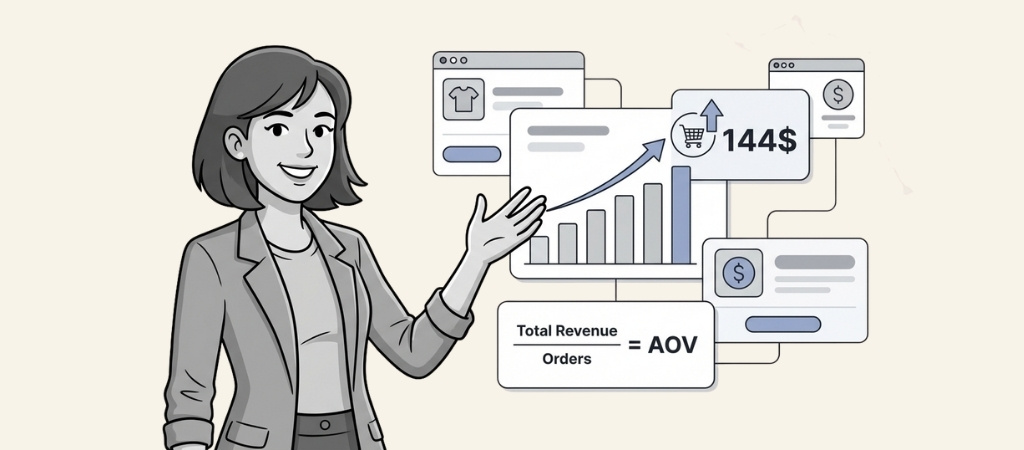
Average order value (AOV) tracks the average dollar amount spent each time a customer places an order. The math is straightforward: divide your total revenue by the number of orders.
For example, if your store generated $31,000 in revenue from 1,000 orders last month, your AOV is $31. That's it. No complex formulas or advanced analytics required.
Here's why this metric deserves your attention. Acquiring new customers keeps getting more expensive. Digital ad costs have jumped 60% across platforms in just two years. When you focus on increasing AOV instead of just chasing more traffic, you're extracting more value from visitors you've already paid to acquire.
AOV also helps you evaluate pricing strategy and marketing effectiveness. If your AOV stays flat while traffic increases, something in your merchandising or offer structure isn't clicking. The metric serves as a health check for your overall revenue engine.
One common point of confusion: AOV is not the same as conversion rate or lifetime value. Conversion rate measures how many visitors buy. AOV measures how much they spend when they do. Lifetime value tracks total revenue per customer over time. Smart merchants watch all three, but AOV is often the quickest lever to pull for immediate revenue gains.
Ecommerce AOV benchmarks by industry
Before you panic about your numbers, let's look at what "normal" actually looks like.
Global AOV currently sits around $144-166 depending on which data source you check. This represents roughly 8.7% year-over-year growth, driven partly by inflation and partly by merchants getting smarter about upselling.
But these averages hide massive variation by platform:
| Platform | Average AOV | Notes |
|---|---|---|
| Shopify | $92 | Top 20% of stores exceed $209 |
| WooCommerce | $122 | Higher B2B mix pushes numbers up |
| BigCommerce | $120-150+ | Enterprise-focused with strong holiday growth |
| Amazon | $35 | Single-item purchases dominate |
| Walmart | $41-42 | Grocery and household goods boost basket size |
Industry matters even more than platform. Here's how different categories stack up:
| Industry | AOV Range | What Drives It |
|---|---|---|
| Luxury & Jewelry | $380-436 | Premium pricing, multi-item sets |
| Electronics | $348 | High-ticket single purchases |
| Home & Furniture | $250-253 | Room furnishing orders |
| Fashion & Apparel | $129-200 | Multiple items per order |
| Consumer Goods | $189 | Mixed pricing across categories |
| Food & Beverage | $114-147 | Frequent moderate purchases |
| Beauty & Personal Care | $70-137 | Low-cost individual items |
| Pet Care | $71-110 | Lowest-priced category |
Device type creates another significant gap. Desktop AOV ranges from $146-219 while mobile sits at $85-142. Tablet falls in between at around $140-149. Desktop users browse more, research thoroughly, and build larger carts. Mobile shoppers tend to be mission-focused, buying single items quickly.
Use these benchmarks as directional guidance, not rigid targets. A beauty store averaging $80 AOV is performing well. A furniture store at the same level has serious problems. Compare yourself against your specific industry and platform, not the overall average.
Proven tactics to increase your ecommerce AOV
Now for the actionable part. These are the tactics that consistently move the needle across thousands of stores.
Free shipping thresholds
This is the classic AOV tactic for good reason. Approximately 52% of shoppers add extra items to their cart specifically to qualify for free shipping. The key is setting your threshold strategically.
Aim for 15-30% above your current average order value. If your AOV is $50, set free shipping at $60 or $65. Go too high and you'll frustrate customers. Go too low and you leave money on the table while eating into margins with shipping costs.
Product bundling and cross-sells
Bundles simplify decision-making while increasing perceived value. When executed well, bundling delivers a 55% lift in AOV and an 86% increase in revenue per user.
Cross-selling (suggesting complementary products) deserves special attention. Studies show it's 20 times more effective than upselling (pushing premium versions). The "complete the look" and "frequently bought together" approaches work because they feel helpful rather than pushy.
Case in point: Avera, a home and kitchen brand, increased AOV by 12% using dynamic bundles. Office supplies company Paperstone saw an 18.94% AOV boost by offering bulk discount deals.
Volume discounts and bulk pricing
Show customers exactly how much they're saving per item when they buy more. This reduces purchase guilt and encourages larger quantities. The psychology is simple: people feel smart when they get a deal, even if they're spending more overall.
Loyalty programs and incentives
Forty-three percent of customers spend more on brands they're loyal to. Effective programs boost AOV by an average of 13.71%, with top performers seeing increases up to 75%.
The trick is tiered rewards that motivate higher spending. Offer points, perks, or exclusive products as customers cross spending thresholds. Make the next reward feel achievable but just out of reach.
Personalized recommendations
Amazon's recommendation engine drives 35% of their revenue. While you probably don't have Amazon's AI budget, modern ecommerce platforms offer solid personalization tools that analyze purchase history and browsing behavior.
Personalization leaders see 40% higher revenue from targeted suggestions. The key is relevance: suggesting a laptop bag to someone buying a laptop works. Suggesting a random unrelated product feels like spam.
The hidden ecommerce AOV driver: customer support
Here's something most AOV guides miss: your customer service team directly impacts order values.
Eighty-eight percent of customers say good service makes them more likely to purchase again. But the impact goes beyond retention. Real-time support removes friction that kills larger orders. When a shopper hesitates about sizing, compatibility, or features, a quick conversation can close the sale and often upsell them to a better option.
Live chat specifically shows measurable impact. Brands using it effectively see AOV rise by 10%, with chat-assisted customers spending 60% more per purchase than those who don't engage.
Phone support takes this even further. Complex purchases often need human conversation. A customer considering a $500 order wants reassurance before committing. If they can't get answers quickly, they either abandon the purchase or downgrade to a cheaper, "safer" option.
This is where we come in. At Ringly.io, Ringly.io offers an AI phone support agent specifically for Shopify stores. The AI handles inbound calls 24/7, answers product questions, looks up orders, and processes returns. When appropriate, he can suggest complementary products or premium alternatives during the conversation.
The result? Stores using the AI resolve up to 90% of calls without human intervention while maintaining the personal touch that drives higher order values. Your customers get instant answers. You capture revenue that would otherwise walk away.
Measuring and testing AOV improvements
Implementing tactics is only half the battle. You need proper measurement to know what's actually working.
Start by setting up AOV tracking in your analytics platform. Most ecommerce platforms calculate this automatically, but verify the numbers match your internal records. Track AOV by traffic source, device type, and customer segment to spot patterns.
A/B testing is essential for optimization. Test one variable at a time: free shipping thresholds, bundle configurations, cross-sell placement. Give each test enough traffic to reach statistical significance before declaring winners.
Watch these metrics alongside AOV:
- Conversion rate: Higher AOV means nothing if conversion drops proportionally
- Revenue per visitor (RPV): Combines conversion and AOV for the complete picture
- Profit margins: A higher AOV with lower margins might hurt overall profitability
One common mistake: chasing AOV increases that actually hurt your business. A 20% AOV boost means little if it requires 30% more discounting that destroys margins. Always track profitability alongside revenue.
Also watch for unintended consequences. Aggressive upselling can annoy customers and hurt long-term loyalty. Free shipping thresholds set too high increase cart abandonment. Measure the full customer journey, not just the immediate transaction.
Start improving your ecommerce AOV today
You don't need to implement everything at once. Here's a practical priority list for this week:
- Calculate your current AOV by platform, device, and traffic source
- Set a free shipping threshold 15-20% above your current average
- Identify 2-3 product bundles that make logical sense for your catalog
- Add cross-sell recommendations to your product and cart pages
- Audit your customer support response times and availability
Pick the tactics that fit your current resources. A small store with limited inventory should focus on cross-sells and free shipping thresholds before attempting complex loyalty programs.
Remember that customer support plays a bigger role in AOV than most merchants realize. When shoppers have questions about premium products or need help understanding options, fast helpful responses convert hesitation into higher-value orders.
If phone support is a gap in your current setup, try Ringly.io for free. The AI handles the routine calls so you can focus on strategy while capturing revenue that would otherwise go unanswered.
Higher AOV isn't about tricking customers into spending more. It's about removing friction, offering genuine value, and being available when shoppers need help making decisions. Get those pieces right and the revenue follows.
Personalized experiences lift average order value significantly. See the benchmarks in our ecommerce personalization statistics for 2026.
Shoppers who call before buying often need just one answer. Seth, the AI phone agent from Ringly.io, answers product and stock questions 24/7 and can text a checkout link during the call.
Frequently Asked Questions
What is ecommerce AOV and why does it matter?
Ecommerce AOV (average order value) measures the average dollar amount spent per transaction in your online store. It matters because increasing AOV is often more cost-effective than acquiring new customers. When you raise AOV, you generate more revenue from existing traffic without increasing ad spend.
How do I calculate ecommerce AOV for my store?
Divide your total revenue by the number of orders over a specific time period. For example, $10,000 in revenue divided by 100 orders equals a $100 AOV. Most ecommerce platforms like Shopify calculate this automatically in their analytics dashboards.
What is a good ecommerce AOV benchmark for my industry?
Good AOV varies dramatically by industry. Luxury and jewelry stores average $380-436, electronics around $348, fashion $129-200, and beauty $70-137. Compare yourself against your specific category rather than overall averages. Platform also matters: Shopify stores average $92 while WooCommerce hits $122.
How can customer support increase ecommerce AOV?
Customer support increases AOV by removing purchase friction and enabling real-time upselling. Eighty-eight percent of customers buy again after good service experiences. Live chat users see 10% higher AOV, and phone support helps close larger orders that need human reassurance. Support teams can suggest complementary products and premium alternatives during conversations.
What are the fastest ways to increase ecommerce AOV?
The fastest tactics are free shipping thresholds (set 15-30% above current AOV), strategic product bundling, and cross-selling complementary items. These require minimal technical setup and show results within weeks. Personalized recommendations and loyalty programs take longer to implement but deliver sustained gains.
Can increasing ecommerce AOV hurt my business?
Yes, if done poorly. Aggressive upselling can annoy customers and hurt loyalty. Free shipping thresholds set too high increase cart abandonment. Discounting to boost AOV can destroy profit margins. Always measure profitability and customer satisfaction alongside AOV to ensure you're building sustainable growth.
Looking for data to back up your strategy? Check out our latest research: 50 ecommerce cart abandonment statistics for 2026 and 45 customer retention statistics for 2026.