

Shopify already has an order management system built in. That's the thing nobody tells you when they're pitching you a new one.
So the real question isn't "do I need an OMS." It's "have I outgrown the one Shopify gives me, and if so, which one do I move to without burning down everything that already works?"
Most posts on this topic do one of two things. They pitch a single vendor as the answer. Or they write a 4,500-word generic explainer that never tells you what to actually buy or how much it costs. This one is different.
We're going to walk through what a Shopify OMS integration actually does, the real signals that mean you've outgrown native, seven real vendors with real pricing, the three ways the integration can be built, and the customer-service piece (WISMO calls, returns, order-status) that almost nobody covers but absolutely matters.
Hear what AI support calls sound like for your store. Just paste your Shopify URL and get sample calls in under 20 seconds, no email required. Listen to demo calls for my store.
What is a Shopify OMS integration?
A Shopify OMS integration connects a dedicated order management system to your Shopify store so orders, inventory, products, and customer data stay synced across every channel and warehouse you sell from.
Shopify gives you basic order management for free. You get an order list, basic fulfillment, support for up to three fulfillment locations, marketplace connectors, and order analytics. For a single-warehouse brand selling on Shopify alone, that's often enough.
But the moment you add a second sales channel, a second warehouse, B2B with custom pricing, or an ERP behind the scenes, the native tools start to creak. That's where a dedicated OMS comes in.
Here's what gets synced in a proper OMS integration:
- Orders flow down: every order, every status change, every refund pushed into the OMS
- Inventory flows up: stock updates from the OMS back to Shopify in near-real time
- Products sync both ways: depends on whether your PIM or OMS owns the catalog
- Fulfillment status flows back: tracking numbers, carriers, and delivery updates back to Shopify
According to Shopify's own enterprise guide, adopting a dedicated OMS can speed up order processing by roughly 40% while cutting errors by more than half. That's the upside. The downside is cost, implementation time, and the risk of breaking something that already works.
Signs you've outgrown native Shopify order management
Most articles get vague here. They say "when your business grows" or "when complexity increases." Useless.
Here are the actual seven signals. If you hit two or more, it's time to look at a dedicated OMS.
- You're past 500 orders a month and manual fulfillment is eating real hours: native fulfillment works, but at scale you need rules-based routing, not click-by-click handling
- You sell on more than three channels: Shopify plus Amazon plus eBay plus retail plus wholesale starts to break native sync
- You ship from more than three fulfillment locations: Shopify caps out at three. Past that, you need real distributed order management
- You're overselling regularly: this is the inventory sync problem. Native sync is fine for one channel. Add channels and the lag becomes a refund-and-apology problem
- You do B2B with custom pricing, net terms, or quotes: native Shopify B2B works for simple cases. Complex pricing rules need an OMS or ERP
- WISMO calls are eating your support team: where-is-my-order questions can account for 20-50% of total ecommerce support tickets according to WISMOlabs, and during peaks that jumps even higher. If your phone agents are spending half their day looking up tracking numbers, your OMS data isn't reaching the place customers actually call
- Returns and exchanges are manual chaos: cross-channel returns where someone bought on Amazon and wants to return in your retail store need an OMS to handle the routing
That sixth sign is the one most posts ignore. We'll come back to it in the phone support section because it's the cheapest fix on this list.
If you're under 500 orders per month, on one channel, with one warehouse, you don't need a dedicated OMS. You need a better workflow inside Shopify and maybe a Shopify helpdesk app that talks to it.
The 3 ways to integrate an OMS with Shopify
There's no single right path. The right path depends on your size, your engineering resources, and how much custom logic you need.
Pattern 1: Native Shopify app (point and click)
You install an OMS straight from the Shopify App Store, authorize it, and you're synced.
This is the right pattern when you're a mid-sized brand running a few channels, one or two warehouses, and you want the install to take a day, not a quarter. Cost is usually $0 to $1,000 a month for the app itself. Apps like Extensiv Order Management or OMSGuru live here.
Pattern 2: iPaaS / middleware (Zapier, Make, Celigo, Mulesoft)
You use a connector platform to wire Shopify to your existing systems: ERP, accounting, 3PL, WMS. The middleware does the translating.
This is the right pattern when you already have a stack of tools, you want flexibility without a six-month rebuild, and you don't have an engineering team to write GraphQL queries. Cost is roughly $200 to $2,000 a month depending on volume. Celigo and Mulesoft live here.
Pattern 3: Custom GraphQL integration (engineering build)
You build directly against Shopify's Admin API, ideally with GraphQL bulk operations, and you wire it to your OMS or ERP.
This is the right pattern when you're $10M+ GMV, you have a real engineering team, and you have custom workflows that no off-the-shelf tool will support. Cost is $10K to $200K to build plus ongoing maintenance.
One thing to watch: Shopify's REST API is rate-limited and chatty. According to Shopify's developer docs, the GraphQL Admin API caps at 100 points per second on standard plans, 200 on Advanced, 1,000 on Shopify Plus, and 2,000 on Enterprise. Single queries can't exceed 1,000 points. If you're syncing tens of thousands of orders, only bulk operations bypass these limits.
HotWax Commerce documented a real example where they handled 50,000 orders in a single day for an enterprise Shopify client by pacing requests with the leaky bucket algorithm and batching downloads in 100-order chunks. That's the kind of detail middleware vendors gloss over.
7 OMS platforms that integrate with Shopify
We looked at the dedicated OMS market in 2026 and picked seven options that span the size and budget range. Prices change. Always check the vendor's pricing page before you sign anything.
| OMS | Best for | Starting price |
|---|---|---|
| Native Shopify | Single channel, under 500 orders/mo | Included in plan |
| Extensiv Order Management | Multi-channel marketplace sellers | $400/mo |
| Brightpearl by Sage | OMS + ERP + accounting in one | $375-$500+/mo |
| Linnworks | Marketplace-heavy operators | Contact sales |
| fabric OMS | Enterprise omnichannel retail | Enterprise |
| Deck Commerce | ERP-anchored enterprise brands | Enterprise |
| HotWax Commerce | Shopify Plus at high volume | Enterprise |
1. Native Shopify order management
Best for: stores under 500 orders per month, single warehouse, one or two channels
Shopify's built-in order management gets dismissed too quickly. For most brands under a couple million in GMV, it's enough. You get an order list, basic fulfillment, multi-location inventory across up to three locations, and built-in order analytics.
Pricing
Included in your Shopify plan. Basic at $39/mo, Shopify at $105/mo, Advanced at $399/mo, Shopify Plus starting at $2,300/mo.
What works
- Zero setup: it's already there, you don't install anything
- Free with your plan: no separate OMS bill
- Mobile fulfillment app: pack and ship from your phone
- Basic shipping integrations: USPS, UPS, DHL, FedEx out of the box
- Sales channels included: Amazon, eBay, TikTok Shop, Facebook all connect natively
What doesn't
- Caps at 3 fulfillment locations: beyond that you need a real OMS
- No advanced order routing rules: can't auto-route by zone, weight, SKU, or stock level
- Weak B2B: simple net terms and custom pricing exist on Plus, but anything complex needs more
- No ERP sync: if you run SAP, NetSuite, D365, you'll need middleware or a real OMS
Why it ranks first: don't pay for what Shopify already gives you. If you're not hitting the limits, stay here. Add a Shopify returns app and a helpdesk and you're set.
2. Extensiv Order Management (formerly Skubana)
Best for: $5M-$50M GMV multi-channel sellers, heavy on marketplaces
Extensiv is the rebranded version of Skubana, the OMS that built its reputation in the Amazon FBA + Shopify world. It's an automation-heavy platform with orderbots, marketplace routing, and 3PL integration baked in.
Pricing
Listed at $400 per month on the Shopify App Store. Higher tiers reportedly go to $1,000+ per month per Capterra reports. Contact sales for an actual quote.
What works
- Automation rules (orderbots): route orders by SKU, weight, zone, or any combination automatically
- Strong marketplace breadth: Amazon, eBay, Walmart, plus the usual ecom platforms
- 3PL integrations: ShipBob, ShipMonk, and dozens of others
- Demand forecasting: built-in replenishment recommendations
- Real-time dashboards: aggregated data across every channel and warehouse
What doesn't
- Expensive at scale: most-cited complaint on G2 and Capterra
- Slow backend reported: some users mention sluggish UI on big order volumes
- Steep learning curve: 6-12 week onboarding is normal
Why it ranks second: rated 4.7/5 on Capterra across 112 reviews and 4.6/5 on the Shopify App Store. For multi-channel brands that already sell on Amazon plus eBay plus Shopify, it earns the spend.
3. Brightpearl by Sage
Best for: multi-channel retail brands wanting OMS plus accounting under one roof
Brightpearl calls itself a Retail Operating System, which is marketing speak for "we do more than OMS." You get order management, inventory, warehouse, accounting, and CRM in one platform. That breadth is the pitch and the curse.
Pricing
Not public. Industry benchmarks put it at $375 to $500+ per month, plus implementation fees. You'll need to talk to sales.
What works
- Automation Engine: rules-based workflows for fulfillment, shipping, accounting
- Built-in accounting: cuts the QuickBooks or Xero connector step entirely
- Inventory forecasting: demand planning with purchasing recommendations
- Plug-and-play with Shopify, Amazon, eBay: real native connectors
- Strong claimed outcomes: 65% error reduction and 50% labor cost reduction per Brightpearl's own customer data
What doesn't
- Opaque pricing: can't budget without a sales call
- Steep learning curve: implementation typically 8-16 weeks
- Weak on complex manufacturing: it's a retail tool, not a manufacturing one
Why it ranks third: rated 4.5/5 on Capterra across 150+ reviews and 4.4/5 on G2 with 86% saying they'd recommend. Strong fit if you want one tool instead of three or four.
4. Linnworks
Best for: marketplace-heavy operators (Amazon + eBay + Etsy + Shopify + Walmart)
Linnworks is the marketplace-first OMS. The pitch is 100+ native marketplace integrations and bulk listing management across all of them. If your business lives on Amazon and you've got Shopify as one of many channels, Linnworks is built for you.
Pricing
Not publicly listed. Reportedly starts around $200 per month per third-party benchmarks. Contact sales.
What works
- 100+ marketplace integrations: probably more than anyone else
- Rules Engine with Spotlight AI: rule-based workflow automation
- Multichannel listing tools: bulk create and manage listings across platforms
- Stock forecasting: SKU-level demand planning
- Real customer logos: Spreetail, Ford, Turtle Wax, Rave Coffee
What doesn't
- Customer support reputation is mixed: at least one public alternatives review mentions partnerships "turning problematic"
- UI feels dated in places: the platform has 15 years of legacy
- Pricing not transparent: contact-sales-only
Why it ranks fourth: rated 4.3/5 on G2. Pick it for marketplace breadth, not for Shopify-first depth.
5. fabric OMS
Best for: enterprise brands with retail plus ecom unified, BOPIS, curbside, and ship-from-store
fabric is the modern, distributed OMS pitch. Built for omnichannel retailers who need a single view of inventory across stores plus warehouses plus 3PLs, with AI-driven order routing on top.
Pricing
Enterprise. Contact sales.
What works
- Distributed order management: single view of inventory across every location
- AI order routing: routes based on stock, distance, cost, and fulfillment SLA
- BOPIS, curbside, ship-from-store: built for the retail-plus-ecom blend
- Modern API-first architecture: easier to integrate than legacy enterprise OMS
What doesn't
- Priced for $50M+ brands: not for everyone
- Implementation is multi-month: enterprise pace
Why it ranks fifth: narrow fit but strong inside its niche. If you're omnichannel retail at real scale, look at it.
6. Deck Commerce
Best for: enterprise brands integrating SAP, Oracle, D365, Manhattan, or other big ERPs
Deck Commerce sits on the ERP-heavy side of the market. The selling point is depth of integration with enterprise backbones like SAP and Oracle, plus payment provider connectors for Cybersource, Braintree, Adyen, and Klarna.
Pricing
Enterprise. Contact sales.
What works
- Deep ERP integrations: SAP, Oracle, D365, Manhattan, Infor, JDE
- Payment provider connectors: Cybersource, Braintree, Adyen, Klarna, Afterpay
- Distributed order management: multi-warehouse routing
- Fraud detection tools: built in
What doesn't
- Heavy implementation: month-long minimum, often longer
- Niche fit: built for $50M+ ERP-anchored brands
Why it ranks sixth: specialist tool. If you don't have SAP or Oracle, this isn't for you.
7. HotWax Commerce
Best for: Shopify Plus brands at high volume with engineering resources
HotWax is the most Shopify-Plus-native of the enterprise OMS options. They've published case studies handling 50,000 orders per day for clients, with real technical depth on API rate limit handling.
Pricing
Enterprise. Contact sales.
What works
- Real technical depth: leaky-bucket pacing, GraphQL bulk operations, delta inventory syncs documented publicly
- Shopify Plus specialist: not a generic OMS retrofitted for Shopify
- Proven at high volume: 50K orders/day case study
What doesn't
- Services-heavy: you're paying for implementation, not just software
- Not for small brands: built for enterprise Shopify Plus
Why it ranks seventh: narrow but technically strong. If you're a high-volume Shopify Plus brand with a CTO, this belongs on your OMS shortlist.
If you've narrowed your options and now you're thinking about the support side, Ringly.io is AI phone support for Shopify brands. The AI reads your Shopify order data live, so WISMO calls and order-status calls get answered in seconds instead of escalating to a human. Try it free for 14 days.
What actually gets synced (and where it breaks)
Every OMS pitch deck shows a clean diagram with arrows going every direction. The reality has more failure modes.
Here's what actually moves between Shopify and a typical OMS, and where things tend to break in practice.
- Orders, Shopify to OMS: every new order, every status change, every refund. Usually webhook-driven. Breaks when webhooks fail silently and nobody notices for a day
- Inventory, OMS to Shopify: ideally near-real-time deltas (only what changed). Breaks when sync is set to full inventory dumps every hour because it burns API budget and lags during sales
- Products: bidirectional, depends on which system owns your PIM. Breaks when both sides claim ownership and overwrite each other
- Customers: usually Shopify is the source of truth, OMS reads. Breaks when OMS tries to write back with different formatting
- Fulfillment status, OMS to Shopify: tracking numbers and carriers pushed back so customers see them in their account. Breaks when the OMS uses carrier names Shopify doesn't recognize
The three most common, expensive break points:
- Inventory lag causing overselling: someone buys an out-of-stock SKU because Shopify hadn't received the latest count yet. Refund plus apology plus angry tweet
- Returns syncing back as new orders instead of refunds: messes up your accounting and your customer's experience
- Custom field mappings: every brand has at least one custom Shopify field that doesn't auto-map. Always allocate dev hours for this
This is why ecommerce returns management and ecommerce order tracking need their own attention during any OMS migration, not just the order flow itself.
How phone support fits into your OMS stack
This is the section nobody else writes. WISMO calls are the single biggest support cost most ecom brands carry, and your OMS is the system that knows the answer. The problem is the data almost never reaches the place customers actually call.
WISMO (where-is-my-order) inquiries can account for 20 to 50% of ecommerce support volume according to WISMOlabs benchmarks, and during peak periods that climbs further. Salesforce's own data puts WISMO at a similar share. Industry cost-per-call is roughly $5 to $8 per call when a human handles it.
Without OMS-aware phone support, here's what happens. Customer calls, agent answers, agent puts customer on hold, agent opens Shopify in one tab and the OMS in another, finds the order, reads the tracking, reads it back to the customer, hangs up. Two to four minutes per call. Multiply by hundreds per week.
With OMS-aware AI phone support, the AI answers the call, pulls the order from Shopify, reads the tracking from the OMS or the carrier API directly, and gives the customer the answer in 30 seconds. Returns work the same way. The AI processes the return on the call, the OMS updates inventory, the refund queues up.
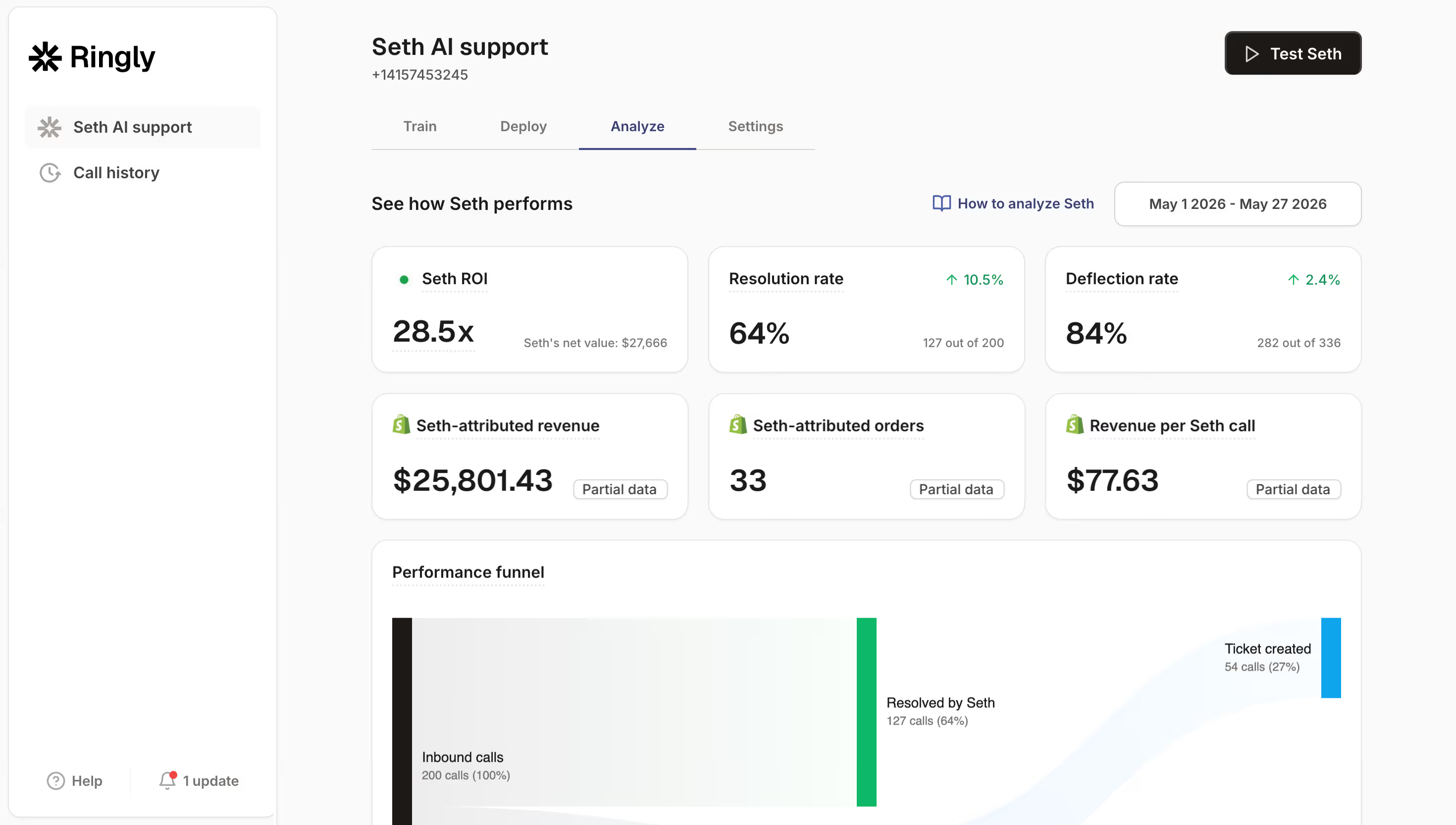
Ringly.io is AI phone support for Shopify brands. The AI handles inbound calls 24/7, finds orders in your Shopify store, processes returns, answers product questions from your knowledge base, and rescues abandoned carts via outbound follow-up. Across 50+ brands, the AI resolves 73% of inbound calls autonomously at roughly $0.42 per resolved call. Calls that need a human escalate cleanly to Gorgias, Richpanel, Reamaze, or whatever helpdesk you already run.
If you're looking at Shopify voice agents or 24/7 ecommerce phone support, this is the layer that sits on top of whichever OMS you pick.
Try Ringly free for 14 days. Live in under an hour. 65% resolution guarantee.
Integration timeline: what to actually expect
Vendors love to say "live in days." In practice, here's the real range.
- App-store install (native Shopify pattern): same day to one week. Install, authorize, configure rules, go live.
- iPaaS / middleware (Celigo, Mulesoft, Zapier): 1 to 4 weeks. Most of the time is mapping fields and testing edge cases.
- Mid-tier OMS (Extensiv, Brightpearl, Linnworks): 6 to 12 weeks. Data migration, custom field mapping, training, and go-live testing.
- Enterprise custom build (fabric, Deck, HotWax): 3 to 9 months. ERP integration, distributed warehouse setup, custom workflows, change management.
What eats the time:
- Data migration: cleaning up SKU mismatches, location mappings, customer dedupes
- Custom field mappings: every brand has at least three Shopify fields the OMS doesn't know what to do with
- Edge-case workflows: returns, exchanges, B2B quotes, partial fulfillments
- Training: the OMS only works if your team uses it correctly
- Testing: parallel-running old and new for two to four weeks before fully cutting over
Plan for scope creep. The vendor's "8-week implementation" is usually 12.
How to choose the right Shopify OMS
Pick by complexity and budget, not by feature checklist.
- Choose native Shopify if: under 500 orders/mo, 1-2 channels, 1-2 warehouses, no B2B complexity
- Choose iPaaS/middleware (Celigo, Zapier) if: 500-2,000 orders/mo, you need ERP or accounting sync without ripping anything out, you don't have eng resources for a custom build
- Choose Extensiv Order Management if: $5M-$50M GMV, marketplace-heavy (Amazon plus eBay plus Walmart), want automation rules and orderbots
- Choose Brightpearl if: you want OMS plus accounting plus inventory plus CRM in one tool, and you can stomach the learning curve
- Choose Linnworks if: marketplace listings across 50+ marketplaces are your bread and butter
- Choose fabric OMS if: you're enterprise omnichannel with retail plus ecom, BOPIS, and curbside
- Choose Deck Commerce if: you're enterprise with SAP, Oracle, or D365 in the backend
- Choose HotWax Commerce if: you're Shopify Plus at high volume with engineering resources
And whichever OMS you pick, layer Ringly.io on top to take the WISMO calls off your team. See pricing here.
Frequently asked questions
Does Shopify already have an order management system? Yes. Shopify includes basic order management in every plan: order processing, fulfillment tracking, up to three fulfillment locations, and connectors to Amazon, eBay, and TikTok Shop. For most stores under 500 orders per month, that's enough. Beyond that, you'll want a dedicated OMS.
What's the difference between an OMS and an ERP? An OMS owns the order lifecycle: orders, inventory, fulfillment status. An ERP owns the back office: accounting, finance, HR, procurement. They overlap on inventory, which is why brands sometimes integrate both. Brightpearl is one tool that tries to be both.
How much does a Shopify OMS integration cost? Native Shopify is included in your plan ($39 to $2,300/mo). Mid-tier dedicated OMS solutions like Extensiv start around $400/mo. Enterprise platforms like fabric or Deck Commerce are typically $10K to $50K+/mo plus implementation. Always ask for a real quote, not a brochure number.
How long does it take to integrate an OMS with Shopify? App-store installs take days. iPaaS middleware setups take 1-4 weeks. Mid-tier OMS implementations run 6-12 weeks. Enterprise custom builds run 3-9 months. Add 30% buffer for scope creep.
Will an OMS prevent overselling? A well-configured OMS reduces overselling dramatically because it syncs inventory across channels in near-real time. But "well-configured" is doing a lot of work in that sentence. Bad sync intervals, full-inventory dumps instead of deltas, or API rate-limit issues during peak sales can still cause overselling.
Do I need an OMS if I use a 3PL? Often the 3PL has its own OMS-light functionality. If you only sell on Shopify and ship from one 3PL, that's usually enough. If you run multiple 3PLs, multiple warehouses, plus your own inventory, you'll want a dedicated OMS to coordinate them.
How do I avoid Shopify API rate limits during big sales? Use GraphQL bulk operations, not REST polling. Send inventory deltas only, not full dumps. Batch order downloads in 100-order chunks. And if you're on Shopify Plus, you get 1,000 points per second of GraphQL capacity versus 100 on Standard, which gives serious headroom.
Can my phone support team use OMS data to answer calls faster? Yes, and that's the cheapest support upgrade most brands miss. With AI phone support like Ringly.io, the AI reads your Shopify and OMS data live, so WISMO and order-status calls get answered in 30 seconds without a human ever picking up. Across 50+ Shopify brands, the AI resolves 73% of inbound calls autonomously at roughly $0.42 per resolved call.
Wrapping up
The OMS upgrade decision is a complexity threshold, not a size threshold. Native Shopify is fine until it isn't, and the moment it isn't is usually when you cross 500 orders per month with 3+ channels or 3+ fulfillment locations, or when WISMO calls become your largest support category.
When you're ready to upgrade, pick by use case, not by marketing copy. Extensiv for marketplace-heavy. Brightpearl for one-tool-everything. Linnworks for marketplace breadth. fabric, Deck, or HotWax for enterprise.
And whichever OMS you pick, the support layer matters as much as the order layer. Ringly.io handles 73% of inbound calls autonomously across 50+ Shopify brands. Start your free 14-day trial. Live in under an hour, 65% resolution guarantee.
Article by Ruben Boonzaaijer. Co-founder of Ringly.io. We build AI phone support for Shopify brands so they can scale support without hiring a phone team.