

Refunding the order is only half the job.
- In Shopify, a refund returns the money but does not stop the recurring contract. The customer gets charged again next cycle unless you cancel the subscription separately in your app.
- You get the exact admin steps for full, partial, prepaid, and store-credit refunds, plus a per-app table for Recharge, Shopify Subscriptions, Bold, and Recurly.
- Built for founders and CX leads at $10M-$100M Shopify brands running auto-ship, where cancel-and-refund calls are the second-biggest pile after WISMO.
A customer calls in after their monthly auto-ship hits. They want their money back and they want it to stop. You go into Shopify, find the order, click Refund, send the cash back. Done, right?
Not done. The refund returned the payment, but the recurring contract is a separate thing that lives in your subscription app. It is still active. Next cycle, your customer gets charged again, calls back angrier, and now you are one bad review or one chargeback away from a real mess.
Quick note before we go on: this guide is about refunding a customer's subscription order in your store. If you landed here trying to get a refund on your own Shopify plan fee, that is a billing-review request you open with Shopify support, and this isn't the page for it. Everyone else, you run customer experience or you own the brand at a $10M-$100M Shopify supplement or DTC business, and the refund-and-cancel queue is quietly costing you more than the refunds themselves.
Most supplement and wellness brands we work with run a 5 to 6 person CS team and a phone line that goes quiet after 6 p.m., right when the older auto-ship buyer calls to cancel. We've set up AI phone agents for Shopify brands trying to fix exactly that. Book a 30-min call and we'll show you what your auto-ship cancel queue is actually costing.
The mistake that gets you re-billed and then disputed
Here is the trap. In Shopify, a refund is a payment action. The recurring contract that keeps charging your customer every month is a different object, and it lives in your subscription app, not on the Orders page.
So when you refund the order and walk away, the money goes back but the contract keeps running. Refund the order without touching the contract and the customer gets charged again on schedule, which is how a polite refund turns into an angry chargeback. Recharge says this plainly in their own docs: refunding the order in Shopify cancels the Recharge order, but it does not cancel the subscription.
This is not a small edge case. Chargebacks in B2C services jumped 83% recently, and the analysts tie a chunk of that directly to recurring-billing confusion and "I cancelled but they kept charging me" disputes, per Chargeflow's 2025 chargeback data. A chargeback costs you the goods, the original processing fee (which you do not get back on a refund either), a dispute fee, and a ding on your dispute ratio with the card networks. A clean refund plus a clean cancel costs you the refund. That gap is the whole game.
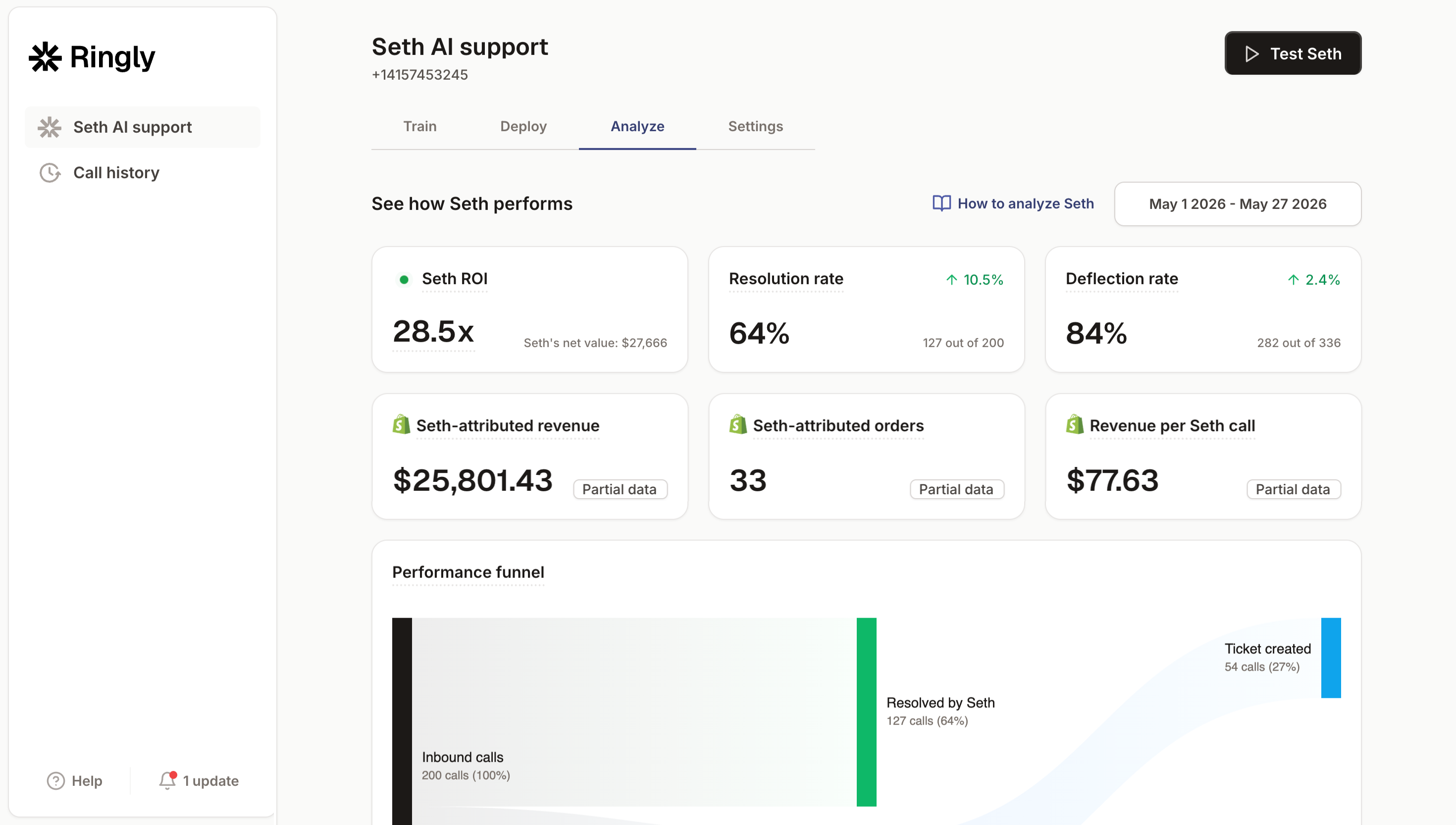
BioLongevity Labs, a supplement brand on Ringly, resolves 79% of its calls autonomously, including the routine cancel-and-skip requests that used to land on a rep at 9 a.m. Monday. More on the volume problem later. First, the actual steps.
How to refund a subscription order in Shopify, step by step
The native flow is the same one you use for any order. The difference is the second half nobody tells you about. Part one returns the money in Shopify:
- Go to Orders in your Shopify admin and open the subscription order you want to refund.
- Click Refund near the top of the order.
- For a full refund, enter the full item quantities. For a partial refund, enter fewer items or type a specific number into the Refund Amount field.
- To return shipping too, use the Refund shipping section and enter an amount up to the original shipping charge. (You can't refund this on orders that used an order-level free-shipping discount.)
- Leave Restock items on if you want the stock back, or turn it off if you restock by hand.
- Pick the refund destination: original payment method or store credit.
- Click Refund.
The order status flips to Refunded or Partially refunded, and you can keep issuing partial refunds until you hit the original order total (Shopify's refunding-orders docs have the full reference).
Part two: stop the recurring contract in your subscription app. This is the step that prevents the re-charge. Open Recharge, Shopify Subscriptions, Bold, or whatever you run, find the customer's contract, and cancel, pause, or skip it depending on what they actually asked for. Do not skip this because Shopify will not do it for you.
A few timing facts worth knowing so you set the right expectation on the call:
- The refund shows as Pending for up to 2 business days on your side.
- The customer can wait up to 10 business days for the money to land, depending on their bank.
- Your original credit-card processing fee is not returned, so a refund is never fully free.
- You can refund up to 120 days after the transaction, and once a refund is issued you cannot reverse it. If you fire one off by mistake, your only move is a draft order to recollect (Shopify Payments refund timing).
Tell the customer the 10-day window on the call. Half the "where's my refund" follow-up calls come from people who expected the money back instantly and panicked on day three.
What a Shopify refund does in each subscription app
The order-versus-contract split plays out a little differently per app, but the headline is identical everywhere: the Shopify refund returns money, it does not stop future charges. Here's the at-a-glance version.
| Subscription app | Shopify "Refund" returns the money? | Does it stop future charges? | What you also have to do |
|---|---|---|---|
| Recharge | Yes, and it cancels the matching Recharge order | No | Cancel or pause the subscription inside Recharge |
| Shopify Subscriptions | Yes, full or partial | No | Cancel or skip the contract in Apps > Subscriptions > Contracts |
| Bold Subscriptions | Yes | No | Cancel or pause the subscription in Bold |
| Recurly | Yes | No | Cancel the subscription in Recurly |
For the native Shopify Subscriptions app specifically, the contract controls live in Apps > Subscriptions > Contracts. Open the contract and you can cancel, pause, skip an upcoming order, change frequency, or edit the address. A cancel can't be undone, so the customer would have to re-subscribe from your storefront to start fresh.
Prepaid plans have one more wrinkle. You can cancel a prepaid subscription order that hasn't been fulfilled yet. Once any scheduled items have shipped, you can no longer cancel that order, but you can still issue full or partial refunds against the fulfilled and scheduled items (Shopify's subscription-order docs). Shopify itself flags it: when you refund from the Orders page, you might need to cancel the order in your subscription app as well.
Full refund, partial refund, prorate, or store credit: which one to use
Not every "I want my money back" deserves a full refund to the card. Picking the right response keeps revenue in the brand and keeps refund-hunters from training your team to give it all away. Here's how we'd route it.
- Full refund to original payment. Use it when the product was defective, the charge was a genuine mistake, or the customer is clearly within a posted guarantee. Fast and clean beats fighting and losing the chargeback.
- Partial refund. Use it when one item in a multi-item box was wrong, or when a goodwill gesture saves the relationship without writing off the whole order. Refund the items, keep the rest.
- Store credit instead of cash. Use it for "I changed my mind" returns where your policy allows it. The revenue stays with you and the customer often spends more than the credit.
- Prorate a prepaid plan. Use it when someone cancels a 3 or 6-month prepaid subscription partway through. Refund the unshipped portion, keep the value of what already went out.
- Cancel-and-refund. Use it for the "stop charging me" calls. Refund the last charge if it's fair, then immediately cancel the contract in the app so there is no next cycle.
The point is to have a rule before the call comes in, not to improvise per customer. A documented refund ladder is what stops one generous rep from becoming the reason your refund rate creeps up every quarter. TechCraft Studio handles 88% of its calls without a human partly because the routine cancel-and-skip requests follow a fixed rule and never need a person at all.
"My customers also feel like it's a normal person. They feel like they can communicate if they have questions."
— Claudia Droge, TechCraft Studio
If you want to give the customer a self-serve path before they ever call, pair this with a clear returns and refund flow and a written policy. Our return policy generator and refund email generator are free if you need a starting point.
The real cost is the call volume, not the refund
Here's the part that doesn't show up on the refund line of your P&L. To write this guide I documented the refund flow on a live Shopify store and read through 40+ real Shopify-brand support call logs. Subscription cancel-and-refund is the second-biggest pile after WISMO, and it spikes hard in the 72 hours right after the auto-ship charge hits.
That timing matters. WISMO already runs 30-40% of support tickets in a normal week and over 50% at peak, per Salesforce. Stack the cancel-and-refund wave on top, right when the monthly charge posts, and you get a predictable Monday-morning queue. It gets worse with subscriptions specifically: 44% of subscription-box cancellations happen in the first 90 days, so a chunk of your refund calls are brand-new customers you just paid to acquire.
Now put a number on the team handling all that. Take a $50M supplement brand with a 6-rep CS team.
| Line item | Today | With Ringly |
|---|---|---|
| 6 reps × $4K loaded per rep | $24,000/mo | — |
| Ringly (about $5K/mo) | — | $5,000/mo |
| Net monthly CS spend | $24,000/mo | $5,000/mo |
| Monthly savings | — | $19,000/mo |
| Annual savings | — | $228,000/yr |
That's roughly 70% of the repeatable calls, the WISMO and the routine skip-pause-cancel requests, handled without a person. The genuinely hard calls, the ones that need a judgment refund or a real apology, still go to your team, who now have the time to actually solve them.
If auto-ship cancel and refund calls are eating your team's morning, book a 30-min call and we'll do the math live on your store.
How to cut subscription refund and cancel calls with proactive support
Refunds you can process in your sleep. The expensive part is fielding the calls that lead to them, so the real win is cutting the inbound. A few moves that work:
- Send a pre-charge heads-up. A reminder SMS or email two or three days before the auto-ship charge gives the "I forgot I had this" customer a chance to skip instead of refund-and-rage after the fact.
- Make skip and pause stupid easy. A lot of cancel requests are really "I have too much product right now." A one-tap skip in the customer portal saves the subscription and the call.
- Put the cancel path in writing. Hiding the cancel button is what creates chargebacks. A clear path actually lowers disputes.
- Answer the phone when they call to cancel. This is the one most brands miss. Your older auto-ship buyer doesn't open the portal, they call. If the line rings out after hours, 85% of callers who can't reach a person never call back and 62% switch to a competitor, per PCN's missed-call study.
That last one is where an AI phone agent earns its keep. Ringly.io is AI phone support for Shopify brands. When a customer calls to cancel or ask for a refund, the AI looks up their order, offers a skip or pause first, handles the routine cancel cleanly, and escalates the real refund decisions to your team with the full context already attached. It answers 24/7, finds orders in your Shopify store, and escalates into Gorgias, Re:amaze, or whatever helpdesk you already run. It resolves up to 90% of calls on its own.
WashCo, a Shopify brand we launched recently, generated $22,664 in attributed revenue in its first 7 days on Ringly, with 271 calls handled at 85% deflection and $0.91 per call versus $2.70 for a human-handled one. The phone stopped being a cost center and started catching saves the team would have missed.
You keep control of the refund rules. The AI doesn't invent refunds. It triages, retains where it can with a skip or pause, and routes the rest to a human with the order context ready, which is the whole point of pairing it with a real subscription workflow. If you want to see how this maps onto a supplement or wellness catalog specifically, the AI phone support for supplement stores breakdown goes deeper, and the WISMO automation and order-status lookup pages cover the calls that sit right next to refunds in your queue. Keeping subscribers happy here is one of the cheapest customer retention levers you have, and it sits inside your broader ecommerce customer service and Shopify call center setup. For the supplement vertical we keep a dedicated customer service for supplement stores guide too.
Frequently asked questions
Does refunding a subscription order in Shopify cancel the subscription?
No. Refunding the order returns the payment, but the recurring contract keeps running. In Recharge the refund even cancels the matching order while leaving the subscription active, so you have to cancel or pause the contract separately in your subscription app or the customer gets charged again.
How do I issue a partial refund on a recurring order?
Open the order in Shopify admin, click Refund, then either reduce the item quantities or type a specific amount into the Refund Amount field. The order status changes to Partially refunded, and you can keep issuing partial refunds until you reach the original order total.
Can I refund a prepaid subscription that hasn't shipped yet?
Yes. You can cancel a prepaid subscription order that hasn't been fulfilled. If some scheduled items have already shipped, you can no longer cancel that order, but you can still issue full or partial refunds on the fulfilled and scheduled items.
How long does a Shopify subscription refund take to reach the customer?
The refund shows as Pending for up to 2 business days on your side, and the customer's bank can take up to 10 business days to post the money. Tell the customer the 10-day window upfront, because most "where's my refund" follow-ups come from people who expected it instantly.
Do I get my payment processing fee back on a refund?
No. The original credit-card processing fee is not returned when you issue a refund, so every refund carries a small fixed cost. That's one more reason a clean refund beats a chargeback, which adds a dispute fee on top.
Should I refund, give store credit, or just cancel the subscription?
Match the response to the reason. Full refund for defects or genuine billing mistakes, store credit for "changed my mind" returns to keep the revenue, prorate for partway-through prepaid cancels, and cancel-and-refund for the "stop charging me" calls. Decide the rule before the calls come in, not per customer.
How do I stop getting so many subscription cancel and refund calls?
Send a pre-charge reminder, make skip and pause one tap in the customer portal, put the cancel path in writing, and actually answer the phone when older auto-ship buyers call to cancel. An AI phone agent can handle the routine skip-pause-cancel calls 24/7 and escalate only the real refund decisions to your team.
Talk to us

If you run a $10M-$100M Shopify brand on auto-ship and the cancel-and-refund queue is eating your team's mornings, a 30-min call is the fastest way to see what that queue is actually costing you and how much of it can run without a person.
Our 3 promises.
- Live in under 1 hour. Setup and test calls are free.
- 30-day money back on the $99 plan fee.
- 65% resolution guarantee: if Seth resolves under 65% of your support calls in a month, that month comes back as credit (after 90 days on Pay per call).
Ruben (Ringly co-founder) takes these calls personally.