
This post in 30 seconds.
- The honest list: Measured, Northbeam, Triple Whale, Polar Analytics, Cometly, Prescient AI, and SegmentStream, sorted by what a store your size actually needs and what each one costs once you get a real quote.
- Why people leave: not quality. Rockerbox earns its support reputation on G2. Brands leave because it starts around $2,000/mo, climbs into the high five figures on annual deals, and bundles three measurement methods most $10-50M stores only half use.
- Built for: founders, COOs, and growth leads at $10M-$100M Shopify brands deciding where the measurement budget should actually go.
Run a search for "Rockerbox alternatives" and most of what comes back was published by an attribution company that conveniently lands itself at the top of its own list. Helpful for them. Not for you, because the only thing you need to know is which tool fits a brand your size, and what the bill looks like after the quote call.
This list goes the other way. Every tool below got priced against one real $30M Shopify store, the sales-gated ones got their quote pages opened and read, and the whole thing is sorted by what a brand that size actually uses, not by what the feature grid claims. Nobody here paid for a placement.
Here's the part the vendor lists skip: Rockerbox is enterprise measurement. It stacks multi-touch attribution, marketing mix modeling, and incrementality testing into one platform. Half the "alternatives" you'll see recommended are the same class of tool, priced the same opaque way. Four of the seven below still make you book a call before they'll tell you a price.
If you run growth, ops, or CX at a $10M-$100M Shopify brand, you already know the Rockerbox tension. A measurement engine you respect, an invoice you wince at, and a quiet sense that you bought a Formula 1 car to drive to the grocery store. That's the real reason this list exists, and it sits next to the fundamentals in our guide to ecommerce analytics. If you'd rather talk through your specific stack than read, book a 30-min call and we'll do the math live.
In this post:
The alternatives at a glance
Quick version before the deep dives. Starting prices are floors, not ceilings. Everything past Polar scales with your ad spend or data volume, and four of these gate their real number behind a sales call, so treat the "custom" rows as a meeting, not a price.
| Tool | Starting price | Pricing model | Best for | Verdict |
|---|---|---|---|---|
| Measured | Custom (sales-gated) | Enterprise, by quote | True incrementality at scale | Closest real peer to Rockerbox |
| Northbeam | ~$1,500/mo | Tiered, scales with media | Paid-media attribution | Best down-market step for ad-heavy DTC |
| Triple Whale | Free / ~$129-$279/mo | Scales with GMV | Shopify command center | Best if you want one dashboard, not three methods |
| Polar Analytics | ~$300-$450/mo | Scales with GMV | One transparent dashboard | Best mid-market all-rounder |
| Cometly | Custom (sales-gated) | Scales with ad spend | Server-side tracking plus AI prompts | Best "tell me what to do next" pick |
| Prescient AI | Custom (sales-gated) | Tiered by channel count | Daily MMM for DTC | Best lighter-weight MMM |
| SegmentStream | Custom (sales-gated) | Modular add-on licenses | Model-based attribution | Best automation-over-dashboard pick |
How I evaluated these Rockerbox alternatives
I'm Ruben, co-founder of Ringly. We run AI phone support for Shopify brands, which means I sit in a lot of operator stacks and watch which measurement tools earn their line item and which ones get cancelled after the annual renewal lands. I evaluate this category as a buyer, not a critic.
For this list I ran every tool against the same yardstick: a real $30M Shopify brand spending in the low hundreds of thousands a month across Meta, Google, and TikTok, with a visible phone number and a paid helpdesk. Here's what I scored against.
- Real price at $30M. I priced each tool against that store's spend and GMV, and for the four that hide pricing, I opened the quote pages and noted that you can't budget without a call.
- What it actually measures. I separated true MMM and incrementality (causal) from multi-touch dashboards (correlational), because most brands pay for the first and use the second.
- Shopify fit. I checked how cleanly each one ties back to Shopify revenue rather than ad-platform-reported conversions.
- Time to a usable answer. I noted setup weight, because a model you can't read for six weeks isn't measurement, it's a project.
- The blind spot test. I checked whether any of them could attribute revenue to an inbound phone call that never got answered. None can. More on that below, because it's the whole reason this post ends where it does.
I don't take affiliate commissions on anything here. Ringly sells phone support, not attribution, so it isn't a row in the comparison table. It shows up once, honestly, in the one place these tools all share a gap.
Why Shopify brands look past Rockerbox
The reason brands shop Rockerbox alternatives is almost never accuracy, it's price and fit. Rockerbox is a genuinely strong measurement platform, and its G2 reviews back that up, especially on cross-channel visibility and support quality. The friction shows up somewhere else.
It starts around $2,000/mo and climbs into the high five figures on enterprise annual contracts, custom-quoted on your data volume, channel count, and which methods you turn on. Reviewers on G2 and Capterra call it out plainly as expensive for mid-market and better suited to larger organizations. The setup is also a real lift, not a weekend.
And then there's the overkill problem. Rockerbox bundles multi-touch attribution, marketing mix modeling, and incrementality testing. A $10-50M brand usually lives in the attribution dashboard and barely touches the MMM and incrementality muscle it's paying for. You're buying three methods and using one.
If your renewal is coming up and you can't justify the line item to finance, you have a cheaper-and-simpler path or a same-price-different-shape path. Before you sign either, book a 30-min call and we'll help you figure out which one your store actually needs.
The 7 best Rockerbox alternatives
1. Measured
Best for: brands that genuinely need causal incrementality at real scale. Measured is the closest true peer to Rockerbox on this list, built around marketing mix modeling plus geo-based incrementality testing rather than click-path dashboards.
Measured moves past correlation to causality, using geo holdout tests to isolate what each channel actually drives. Its customer roster runs to names like Paramount, Unilever, and Intuit, which tells you exactly where it's aimed.
Pricing
Custom enterprise pricing. There's no public number, and no self-serve tier. You're booking a call and getting a quote shaped to your media budget.
What works
- Real causal measurement. Geo incrementality is the rigorous version of "did this channel actually do anything," not a modeled guess.
- Enterprise trust. G2 reviewers rate it 4.9/5, praising the strategic-partnership style of support, though the review count is still small.
- Strategic depth. It's a measurement partner, not just a dashboard you log into.
What doesn't
- Built for big spend. If you're not spending serious media dollars, the rigor is more than your decisions need.
- No transparent pricing. Same budgeting friction that pushes people off Rockerbox.
Why it ranks 1st
If the reason you're leaving Rockerbox is anything other than price, Measured is the most direct swap. If price is the reason, keep reading, because it solves the wrong problem for you.
2. Northbeam
Best for: ad-heavy DTC brands that mostly need paid-media attribution. Northbeam pulls Meta, TikTok, Pinterest, Snap, Google, and Microsoft into one blended view and layers an MMM add-on on top.
It's the down-market step from Rockerbox that still feels serious. Strong on paid-media performance, less of an everything-platform, and priced where a growing brand can actually start.
Pricing
Starter begins at $1,500/mo for brands under $250K/mo in media, with Professional from around $2,500/mo and Enterprise custom-quoted (pricing breakdown).
What works
- Paid-media depth. Cross-platform blended attribution is the core, and it's good at it.
- Transparent floor. You at least know where the entry price sits.
- MMM when you grow into it. The modeling add-on is there when paid attribution stops being enough.
What doesn't
- Still a real spend. $1,500/mo is a meaningful line for a sub-$25M brand.
- Built for $50K+/mo media. Under that, you're not using what you're paying for.
Why it ranks 2nd
The most natural step down from Rockerbox if your pain is "I just need my paid channels measured well." If you want the full reasoning, our Northbeam alternatives breakdown goes deeper on where it fits.
3. Triple Whale
Best for: Shopify brands that want one command center, not three measurement methods. Triple Whale ties attribution to CAC, LTV, margin by channel, and unit economics, all pinned to your Shopify data.
This is the popular pick for a reason. It's Shopify-native, the dashboard is dense in a good way, and it answers the "how's the business doing right now" question better than the heavyweight measurement tools.
Pricing
A free tier exists, with paid plans starting roughly $129-$279/mo and scaling with your GMV as you grow.
What works
- Shopify-native. Ties cleanly to your store data instead of ad-platform-reported numbers.
- Operator dashboard. CAC, LTV, and margin in one place your whole team can read.
- Accessible entry. You can start without an enterprise budget conversation.
What doesn't
- Attribution disputes. Its 4.4/5 across 350+ reviews on G2 comes with consistent complaints about attribution accuracy and 2024 price increases.
- Not true MMM. If you came to Rockerbox for incrementality, this is a different category of answer.
Why it ranks 3rd
The right swap if Rockerbox was overkill and you mostly wanted a Shopify dashboard. If you're weighing it specifically, our Triple Whale alternatives post lines it up against the same field.
4. Polar Analytics
Best for: mid-market teams that want one clean, transparent dashboard across channels. Polar pulls first-party pixel data, multi-touch attribution, and cohort analysis into a single reporting layer.
It's the calm all-rounder. Less ad-media-obsessed than Northbeam, less feature-dense than Triple Whale, and easy to put in front of a founder who just wants the numbers in one place.
Pricing
Roughly $300/mo for the Analyze plan and $450/mo for Analyze & Enrich, scaling with GMV. Pricing is published openly, which on this list is a small mercy.
What works
- Transparent pricing. You know the number before you talk to anyone.
- Clean reporting. One dashboard, low setup drama, fast to a usable view.
- First-party foundation. Built on your own pixel data rather than borrowed signal.
What doesn't
- Dashboard, not deep model. It reports well, but it isn't incrementality testing.
- Scales with GMV. The bill grows as you do, like most of this category.
Why it ranks 4th
The best pick if Rockerbox felt heavy and you just want trustworthy reporting your team will actually open every morning.
5. Cometly
Best for: brands that want server-side tracking plus a tool that tells them what to do next. Cometly leans on server-side data capture, AI optimization recommendations, and conversion sync back to the ad platforms.
Where most tools hand you a chart, Cometly tries to hand you a next action. That's the pitch, and for teams that want prompts over dashboards, it lands.
Pricing
Sales-gated and tied to ad spend. Professional is positioned for brands spending under $500K/mo on ads, and Enterprise for over $5M/yr, but you'll need a call to get a real number.
What works
- Server-side accuracy. Better signal capture in a post-cookie world.
- Action, not just data. AI recommendations aimed at the next move, not the last click.
- Conversion sync. Feeds cleaner data back to the ad platforms to improve targeting.
What doesn't
- No public pricing. Same budgeting friction as Rockerbox.
- Recommendation trust. AI prompts are only as good as the data and the model behind them.
Why it ranks 5th
A solid choice if your gap is "I have dashboards, I just don't know what to do with them." Less so if you wanted transparent pricing.
6. Prescient AI
Best for: DTC brands that want marketing mix modeling without Rockerbox's setup weight. Prescient runs a daily-updating MMM across DTC, Amazon, retail, and wholesale, with each channel getting its own model.
It's MMM rigor in a lighter wrapper. The model refreshes daily with your latest spend and performance, so saturation curves and recommendations track current conditions instead of last quarter's.
Pricing
SMB, Growth, and Enterprise tiers set a base platform fee, sized by your sales channels. It's sales-gated, so the real number comes on a call.
What works
- Daily-updating MMM. Recommendations reflect now, not a stale historical pull.
- Halo visibility. It measures cross-channel halo effects that click-path tools miss.
- DTC-shaped. Built for the brand profile reading this post.
What doesn't
- Sales-gated pricing. No self-serve number to budget against.
- MMM is a mindset. If your team wants per-click certainty, modeling will frustrate them.
Why it ranks 6th
The pick if you wanted Rockerbox's modeling brain without its implementation tax. It's a real alternative, just not a transparent-pricing one.
7. SegmentStream
Best for: teams that want model-based attribution plus incrementality, sold as modular add-ons. SegmentStream combines conversion modeling, geo-holdout incrementality, and signal-loss recovery for a post-cookie world.
It's the automation-first option. Less "log in and read a dashboard," more "let the models recover the signal you lost when tracking fell apart after iOS 14."
Pricing
Custom and sales-gated, suited to $50K+/mo in ad spend. The platform is modular, so incrementality, predictive scoring, and LTV analytics are separate add-on licenses rather than one bundled price.
What works
- Signal recovery. Built to model around cookie loss and consent gaps.
- Incrementality included. Geo-holdout testing is core, not an afterthought.
- Modular. You license the pieces you actually use.
What doesn't
- Add-on math. Modular licensing means the real cost depends on how many modules you turn on.
- High-spend fit. Aimed at $50K+/mo media, so smaller brands overpay for the rigor.
Why it ranks 7th
The most automation-leaning Rockerbox alternative. Strong for high-spend teams that want models doing the work, weaker as a transparent-pricing pick.
The revenue channel none of these tools can measure
Here's what I noticed pricing all seven against that $30M store. Every one of these tools is brilliant at measuring something that left a digital trace. A click. An impression. A pixel fire. A modeled conversion.
None of them can attribute a single dollar to the customer who called your store, hit voicemail, hung up, and bought from a competitor instead. There's no pixel on a phone that rang out. So the revenue you lose on the phone never shows up in Rockerbox, or in any of its alternatives, because the channel is invisible to all of them by design.
That gap is not small. According to PCN, 85% of callers who can't reach a person never call back, and 62% of them switch to a competitor. Eden found 80% of voicemail-routed callers hang up without leaving a message. Your attribution stack will never report a cent of that, because the order never happened in a channel it can see, and the customer retention hit of a frustrated caller never shows up either.
This is where Ringly fits, and it's the only place it does. Ringly.io is AI phone support for Shopify brands. Instead of growing your support headcount every time call volume climbs, the AI answers inbound calls 24/7: order status, returns, the same questions over and over, and the after-hours backlog nobody picks up. It resolves up to 90% of calls autonomously, and calls that need a human escalate cleanly to whatever helpdesk your CS team already runs.
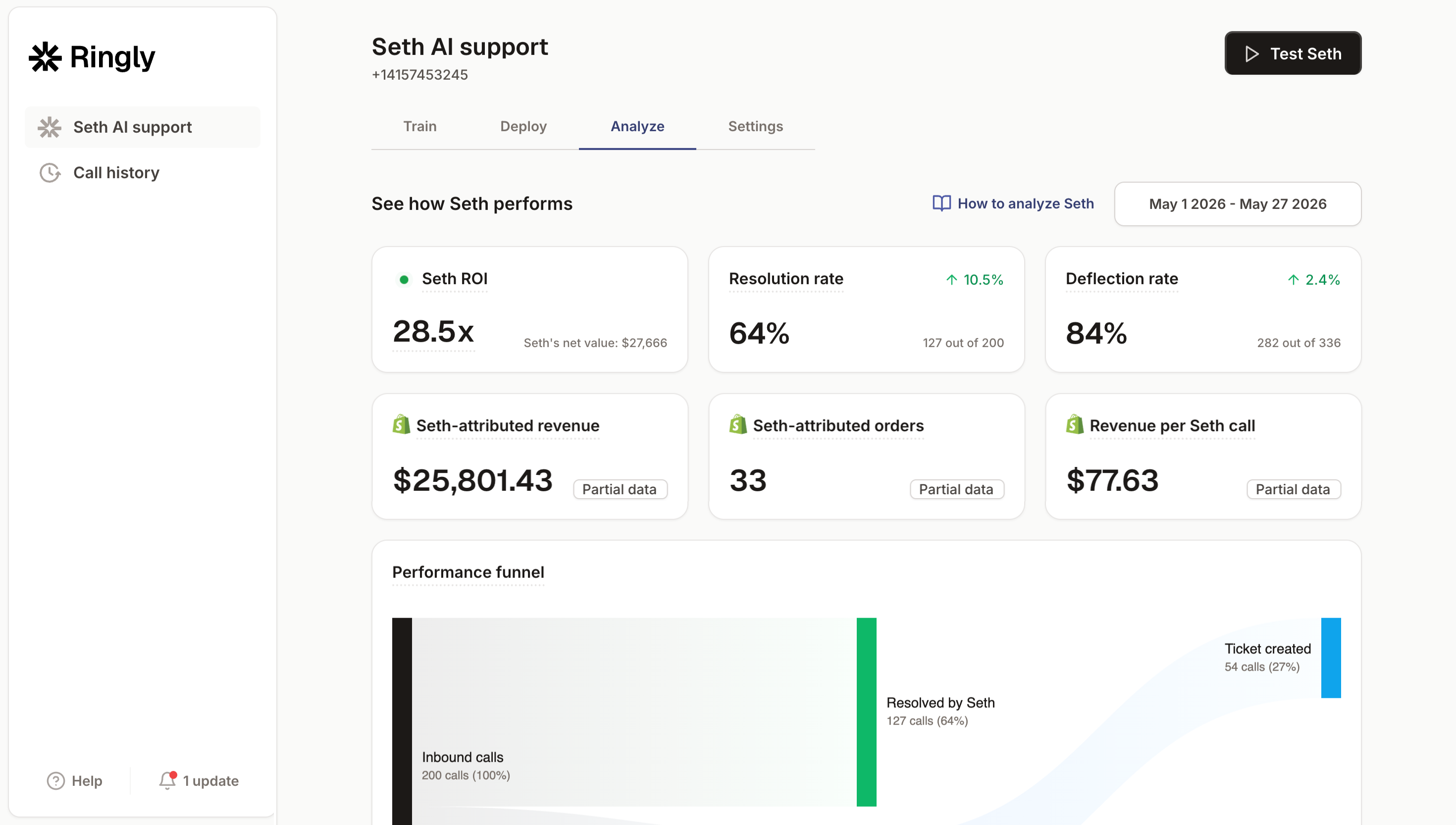
The point isn't that Ringly replaces your attribution tool. It doesn't. The point is that the most measurement-obsessed brands on Shopify are running expensive models on every channel except the one quietly leaking orders after 6 p.m. WashCo, a Shopify brand we launched, recovered $22,664 in its first 7 days on the phone, revenue that no dashboard would have ever attributed because the channel was dark before the AI picked up.
"My customers also feel like it's a normal person. They feel like they can communicate if they have questions."
Claudia Droge, TechCraft Studio
What the phone channel costs you today
The math is the same shape as your CS payroll, just pointed at a channel you weren't measuring. Take a $30M Shopify brand running a 6-rep support team to cover the phones.
| Line item | Today | With Ringly |
|---|---|---|
| 6 reps × $4K loaded per rep | $24,000/mo | n/a |
| Ringly (illustrative) | n/a | ~$5,000/mo |
| Net monthly spend | $24,000/mo | $5,000/mo |
| Monthly difference | n/a | $19,000/mo |
| Annual difference | n/a | $228,000/yr |
That's roughly 70% of repeatable calls (order status, returns, the after-hours backlog, the same five questions all day) handled by the AI. The genuinely complex 30% still go to your CS team, who now have the time to actually solve them. For the deeper version of this math, our DTC customer service pricing breakdown walks through it line by line.
Once your attribution stack is sorted, book a 30-min call and we'll show you what the phone channel is actually leaking for a store your size.
How to choose the right Rockerbox alternative
The right pick depends on why you're leaving and how big you are, not on which tool has the longest feature list.
Choose Measured if:
- You're leaving Rockerbox for reasons other than price.
- You genuinely use incrementality testing to make spend decisions.
- You have the media budget to justify enterprise measurement.
Choose Northbeam or Triple Whale if:
- Rockerbox was overkill and you want a step down that still feels serious.
- Northbeam for paid-media depth, Triple Whale for a Shopify command center.
Choose Polar Analytics if:
- You want one transparent, low-drama dashboard your whole team will read.
- Predictable pricing matters more than causal modeling.
Choose Prescient AI or SegmentStream if:
- You want MMM or model-based attribution without Rockerbox's setup weight.
- You're comfortable with a sales-gated quote and a $50K+/mo media profile.
Look at your phone channel if:
- You run a visible phone number and a paid helpdesk.
- You suspect after-hours calls and the voicemails you never return are costing real orders.
- You want to measure and recover the one channel none of the tools above can see. Our guide to AI voice agents for ecommerce is the place to start, and automated phone support for Shopify Plus brands covers the larger-store version.
Frequently asked questions
How much does Rockerbox cost?
Rockerbox starts around $2,000/mo, with enterprise annual contracts running into the high five figures. Pricing is custom-quoted based on your data volume, channel count, and which methods you turn on, so there's no public number. G2 reviewers consistently flag it as expensive for mid-market brands.
What's the cheapest Rockerbox alternative?
Triple Whale has the lowest entry point with a free tier and paid plans starting around $129-$279/mo, and Polar Analytics is transparent at roughly $300-$450/mo. Both scale with your GMV, so the entry price is a floor. The four sales-gated options (Measured, Cometly, Prescient AI, SegmentStream) require a call before you can budget at all.
Is Measured better than Rockerbox?
Measured is the closest peer, built around the same causal-measurement philosophy with strong geo-incrementality testing. Whether it's better depends on your reason for switching. If price is the problem, Measured won't fix it, since it's also enterprise-priced and sales-gated.
Can Triple Whale replace Rockerbox?
For most $10-50M Shopify brands, yes, if your real need is a Shopify-native dashboard rather than full marketing mix modeling and incrementality. Triple Whale ties attribution to CAC, LTV, and margin in one place. If you specifically came to Rockerbox for causal incrementality, Triple Whale is a different category of answer.
What's the difference between multi-touch attribution and marketing mix modeling?
Multi-touch attribution follows individual customer journeys across touchpoints, which is dashboard-friendly but vulnerable to signal loss. Marketing mix modeling uses statistical models to estimate each channel's true incremental impact, including effects no pixel can see. Rockerbox bundles both, which is part of why it costs what it does.
Do I actually need incrementality testing at my size?
Most brands under $25M in revenue rarely use incrementality to make real decisions, even when they pay for it. If you're spending under $50K/mo on media, a transparent dashboard like Polar or Triple Whale usually answers your questions for a fraction of the price. Incrementality earns its keep once your media spend is large enough that being wrong about a channel costs more than the tool.
None of these measure my phone revenue. What does?
That's the honest gap in the whole category. Attribution platforms track digital touchpoints, so an inbound call that rolled to voicemail leaves no trace and never gets attributed. Ringly is AI phone support for Shopify brands that answers those calls 24/7 and resolves up to 90% of them autonomously, which is how you recover and measure revenue on a channel your attribution stack can't see. Our primer on the AI receptionist for ecommerce covers how that works.
Talk to us

If you run a $10M-$100M Shopify brand, you've already invested in measuring every digital channel. The phone is the one you probably haven't. A 30-min call is the fastest way to see what your store is leaking on the calls nobody answered.
Our 3 promises.
- Live in under 1 hour. Setup and test calls are free.
- 30-day money back on the $99 plan fee.
- 65% resolution guarantee: if Seth resolves under 65% of your support calls in a month, that month comes back as credit (after 90 days on Pay per call).
Ruben (Ringly co-founder) takes these calls personally.