
This post in 30 seconds.
- The honest list: Triple Whale, Rockerbox, Polar Analytics, Cometly, SegmentStream, ThoughtMetric, and Hyros, sorted by who each one actually fits and what it costs once your spend scales.
- Why people leave: not accuracy. Northbeam earns its 4.5/5 on G2. Brands leave because it starts at $1,500/mo, scales on data volume, and is built for $50K+/mo in ad spend most stores never hit.
- Built for: founders, COOs, and Heads of CX at $10M-$100M Shopify brands deciding where the analytics budget should actually go.
Type "Northbeam alternatives" into Google and almost every result was written by a tool that ranks itself first. Useful for the tool. Useless for you, because the only question that matters is which one fits a brand your size, and what the real bill looks like once your ad spend climbs.
So I did the boring version. I priced all seven against a real $30M Shopify store, sat through the sales-gated quote calls for the ones that hide their numbers, and matched what each tool promised against what a brand that size actually needs. No tool here is paying me to rank it.
If you run growth, ops, or CX at a $25M-$100M Shopify brand, you know the Northbeam tension: a powerful media-mix engine you're paying enterprise money for, and a nagging sense you use about a third of it. That's the real reason this list exists, and it sits next to the basics in our guide to ecommerce analytics. If you'd rather talk through your stack than read, book a 30-min call and we'll do the math live.
The alternatives at a glance
Here's the short version before the deep dives. Prices are starting points. Everything past ThoughtMetric scales with your ad spend or data volume, so treat these as floors, not ceilings.
| Tool | Starting price | Best for | Verdict |
|---|---|---|---|
| Triple Whale | ~$300/mo | The popular Shopify command center | Best down-market swap from Northbeam |
| Rockerbox | Custom (sales-gated) | MMM plus offline channels | Best if you still need media-mix modeling |
| Polar Analytics | ~$400/mo | One transparent dashboard | Best mid-market all-rounder |
| Cometly | Custom (sales-gated) | AI attribution with recommendations | Best for "tell me what to do next" |
| SegmentStream | ~$1,000-$2,000/mo | Model-based attribution at high spend | Best automation-over-dashboard pick |
| ThoughtMetric | $99/mo | Cost-sensitive attribution | Best budget pick |
| Hyros | ~$369/mo | Long or high-ticket funnels | Best for non-Shopify-shaped funnels |
There's one thing this table can't show you, and it's the biggest revenue source most $10M-$100M brands never put on any dashboard. More on that after the tools.
How I tested these Northbeam alternatives
I'm Ruben, co-founder of Ringly.io. We run AI phone support for Shopify brands, which means I sit next to operators all day while they argue about attribution, so I look at these tools as a buyer, not a critic.
Over two weeks I scored every tool against the same five criteria, using a real $30M Shopify brand's numbers as the test case:
- Does it tie out to Shopify. I lined each tool's reported revenue up against Shopify's own order data and noted the gap. The bigger the modeling layer, the more often the two numbers drift, so I checked how far.
- What it really costs at $30M GMV. Not the headline number on the homepage. The real monthly bill once data-volume tiers and a la carte channels kick in.
- Whether you actually need MMM. Northbeam's whole pitch is media-mix modeling and incrementality. For a lot of brands that's horsepower they never touch, so I scored each alternative on whether it matches the job or oversells it.
- Onboarding and whether a human shows up. I checked setup time and whether you get a person or a help doc when the numbers look wrong.
- The sales-gated quote test. For Northbeam, Rockerbox, and Cometly I went through the actual quote conversation, so I can tell you what revenue band each one really expects before you waste a call.
I don't take affiliate commissions on anything below. The only product I sell is Ringly, and it shows up in its own section near the end for one honest reason: it isn't an attribution tool, and I'm not going to pretend it competes with one.
Why Shopify brands look past Northbeam
Let's be fair to Northbeam first. It was built in 2020 to solve the post-iOS 14.5 attribution mess, and it does that well. Reviewers on G2 give it 4.5/5 and keep using words like "attribution you can finally trust." If you're spending real money across many channels and you've operationalized the media-mix side, it's one of the best tools in the category. This isn't a hit piece.
The reason brands shop around almost never has to do with accuracy. It has to do with price and fit. Northbeam starts around $1,500/mo and scales with the volume of data it processes, and it's purpose-built for DTC brands spending $50,000 or more a month on paid acquisition, per its pricing breakdown. If you're not in that spend bracket, you're buying an econometric engine to answer a question a $400 dashboard could handle.
The second reason is complexity. The same reviews that praise the accuracy flag the learning curve, and plenty of teams never fully turn on the MMM and incrementality features they're paying for. A tool you use a third of is an expensive tool, no matter how good the other two thirds are.
Here's the honest part most of these lists skip: if Northbeam's numbers are driving real spend decisions and your ad budget justifies the price, you might not need to switch at all. Re-platforming your attribution means re-installing tracking and losing some historical continuity. Do it because a tool below fits your size better, not because a vendor blog told you to. Brands that obsess over ecommerce conversion rate optimization know the cost of churning a working tool for a marginal one.
The 7 best Northbeam alternatives
1. Triple Whale
Best for: brands that want the popular Shopify command center, with attribution, profit, and post-purchase surveys in one place, at a fraction of Northbeam's price.
Triple Whale is the default DTC analytics tool for a reason. The Triple Pixel, the unified dashboard, and post-purchase surveys made it the standard for a generation of Shopify brands, and roughly 45,000 stores still run it. If Northbeam felt like overkill, Triple Whale is the obvious step down in price and up in everyday usability.
Pricing
| Plan | Price | Included |
|---|---|---|
| Starter | ~$300/mo | Dashboard, Triple Pixel, blended attribution |
| Higher tiers | scales up | Adds surveys, advanced attribution, AI features |
Note that tiers climbed 30-50% across the board in 2024, and add-ons stack on top, so price the real configuration you need.
What works
- Shopify-native depth. The Triple Pixel and Shopify integration are best in the category for a DTC store.
- One pane of glass. Attribution, profit, and survey data live together instead of across three subscriptions.
- Big community. ~45,000 stores means real benchmarks and a lot of shared playbooks.
What doesn't
- Attribution that doesn't always tie out. Reviewers on G2 (4.4/5 across 350-plus reviews) flag gaps against Shopify Analytics on the same orders.
- Price creep. The 2024 increases plus add-ons mean the bill grows faster than you'd expect.
Why it ranks 1st For most brands leaving Northbeam because it got expensive or heavy, Triple Whale is the swap that loses the least and costs far less. It's the default recommendation.
2. Rockerbox
Best for: brands that genuinely need media-mix modeling and have real spend outside Meta and Google, including offline channels like TV, podcast, and direct mail.
Rockerbox is the closest like-for-like to Northbeam on capability. It pairs multi-touch attribution with marketing-mix modeling, which means it can see the channels that don't offer click-level tracking. If you're leaving Northbeam for a cleaner tool but you still need the MMM layer, Rockerbox is the one alternative on this list built for that.
Pricing
Custom and modular. You pay for a base platform plus add-ons per channel you want to track, and you book a demo to get real numbers. Expect it to land in the same enterprise neighborhood as Northbeam.
What works
- MTA plus MMM in one tool. The dual methodology survives the post-iOS tracking mess better than pixel-only tools.
- Offline attribution. TV, podcast, and direct mail tracking that most DTC tools can't touch.
- Measurement-first. It leans toward clean measurement rather than a busy command center.
What doesn't
- Still enterprise-priced. If you came here to spend less, Rockerbox may not be the answer.
- Sales-gated pricing. You're booking a call to find out what it costs.
Why it ranks 2nd It's the right call only if you actually use MMM. If you're leaving Northbeam because the modeling was overkill, buying another modeling tool misses the point.
3. Polar Analytics
Best for: mid-market Shopify brands that want one transparent dashboard, with attribution, BI, LTV, and creative analytics, without enterprise modeling or enterprise pricing.
Polar is the all-rounder. It pulls Shopify, ad platforms, email, and more into a single dashboard, layers on blended attribution, LTV, and creative analytics, and publishes its starting price instead of hiding it behind a rep. For a brand that liked Northbeam's clarity but not its weight, Polar is the easiest landing spot.
Pricing
Starts around $400/mo, with no per-seat licensing or feature gating, per Polar's own pricing. It scales with your data, but the entry point is transparent and predictable.
What works
- Transparent pricing. A published starting number, which is rare in this category.
- One dashboard, no modeling tax. You get attribution, LTV, and creative analytics without paying for an econometric engine.
- Strong Shopify App Store standing. Real reviews, real adoption.
What doesn't
- Not a causal tool. If you need incrementality testing or media-mix modeling, this isn't it.
- Scales with GMV. The friendly entry price climbs as you grow.
Why it ranks 3rd For the largest slice of brands leaving Northbeam, the real need was a clean, trustworthy dashboard, not modeling. Polar answers that at a price finance won't argue with.
4. Cometly
Best for: paid teams that want attribution to recommend the next move, not just chart the last one.
Cometly's pitch is AI attribution with real-time optimization recommendations across the full customer journey. Where most tools tell you where revenue came from, Cometly tries to tell you what to do about it. For teams that live in the ad accounts, that bias toward action is the draw.
Pricing
Custom and demo-gated. The pricing page collects your monthly ad spend and points you toward a call, so it scales with spend rather than publishing a flat number.
What works
- Action over reporting. The optimization recommendations are the differentiator.
- Full-journey tracking. Server-side data that survives iOS tracking gaps.
- AI-led workflow. Aimed at acting on the data, not just reading it.
What doesn't
- Opaque pricing. You're booking a call to learn the number.
- Recommendation trust. Acting on a model's advice takes a few cycles of validation before you lean on it.
Why it ranks 4th Strong for a team that wants a co-pilot, not a dashboard. If you just want clean numbers you trust, the tools above it are simpler.
5. SegmentStream
Best for: high-spend brands that want model-based attribution and automated optimization instead of a reporting tool.
SegmentStream argues that a dashboard showing you the past doesn't improve the future. It uses machine-learning attribution plus incrementality and leans into automated budget optimization, positioning itself for brands spending $100K+ a month on ads. It's the most "do something with the data" tool on the list after Cometly.
Pricing
Generally in the $1,000-$2,000+/month band depending on spend. Closer to Northbeam's price than the dashboards above, which is the point: it's an alternative for the high-spend brand, not the cost-cutter.
What works
- Automation over reporting. Built to act on the data, not just chart it.
- Model-based attribution. Less reliant on the pixel iOS14 broke.
- Incrementality built in. Causal signal without bolting on a second tool.
What doesn't
- High-spend assumption. Below $100K/mo in ad spend, the value gets thin.
- Heavier lift. This is a platform, not a plug-and-play app.
Why it ranks 5th A real Northbeam alternative for the brand that wants the modeling and the automation. For everyone spending less, it's more machine than the job needs.
6. ThoughtMetric
Best for: cost-sensitive brands whose only real complaint about Northbeam is the bill.
ThoughtMetric is the budget answer. It does server-side tracking, multi-touch attribution across five models, and Shopify and WooCommerce integration, with setup measured in days. It won't model your media mix, but for a brand that just wants clean attribution it doesn't need to.
Pricing
Starts at $99/mo and scales with volume from there. It's the cheapest serious attribution tool on this list by a wide margin.
What works
- $99 entry point. A fraction of Northbeam's floor.
- Five attribution models. You're not locked into one opinionated view of the journey.
- Fast setup. Days, not weeks.
What doesn't
- No MMM or incrementality. It's attribution, full stop.
- Thinner on profit and LTV. The financial side is lighter than Polar.
Why it ranks 6th If your beef with Northbeam is purely the price and attribution is the feature you actually use, ThoughtMetric gets you most of the value for a tiny fraction of the cost.
7. Hyros
Best for: brands with long or high-ticket sales funnels where standard pixel tracking falls short, including info products and call-driven sales.
Hyros is the outlier on this list. It's built for funnels that don't look like a normal Shopify checkout: long consideration windows, high-ticket offers, and sales that close on a call or over weeks. If your customer journey is more complicated than "click ad, buy product," Hyros tracks the parts pixels miss.
Pricing
Starts around $369/mo on the Paid Traffic plan, on a model that's roughly 1-2% of your ad spend with minimum fees. So it scales directly with how much you spend.
What works
- Long-funnel tracking. Built for journeys pixels can't follow.
- Call and high-ticket attribution. Strong where the sale doesn't happen in-cart.
- Spend-based pricing. Predictable as a percentage, if you spend steadily.
What doesn't
- Not Shopify-shaped. For a standard DTC checkout, it's solving a problem you may not have.
- Percentage pricing climbs. As spend grows, so does the bill, linearly.
Why it ranks 7th A specialist. For most Shopify brands it's the wrong tool, but for high-ticket or long-cycle sellers it's the one that finally sees the whole path.
The revenue your attribution stack can't model
Every tool above shares one blind spot, and it's a big one. They all measure revenue that already landed. Not one of them measures the buyer who tried to give you money and couldn't get through.
Northbeam can model your entire media mix and still miss the customer who called your store at 7 p.m. and got voicemail. That call is the highest-intent signal you get all day. Someone dialing your number is ready to buy or about to churn, and according to a missed-call revenue study, 85% of callers who can't reach a person never call back, and 62% of them switch to a competitor. A lot of those calls are WISMO, the "where's my order" calls that pile up after hours. None of it ever shows up in an attribution report, because the revenue never landed at all.
This is the honest seventh option, and it isn't an attribution tool. Once your analytics stack is set, the next thing a lot of operators add is the one that recovers the calls the rest of the team can't get to.
That's where Ringly.io fits. Ringly is AI phone support for Shopify brands. Instead of growing your support headcount every time call volume spikes, the AI answers inbound calls 24/7: order status, returns, product questions, and canceling orders when a caller asks. It resolves up to 90% of calls autonomously for $1.99 a call after the first 50, against $7-$16 per call for a human BPO. Calls that need a person escalate cleanly to your existing ecommerce customer service stack, whether that's Gorgias, Richpanel, or Re:amaze. You also get your own call analytics dashboard, so the phone finally shows up in your reporting the way ad spend already does.
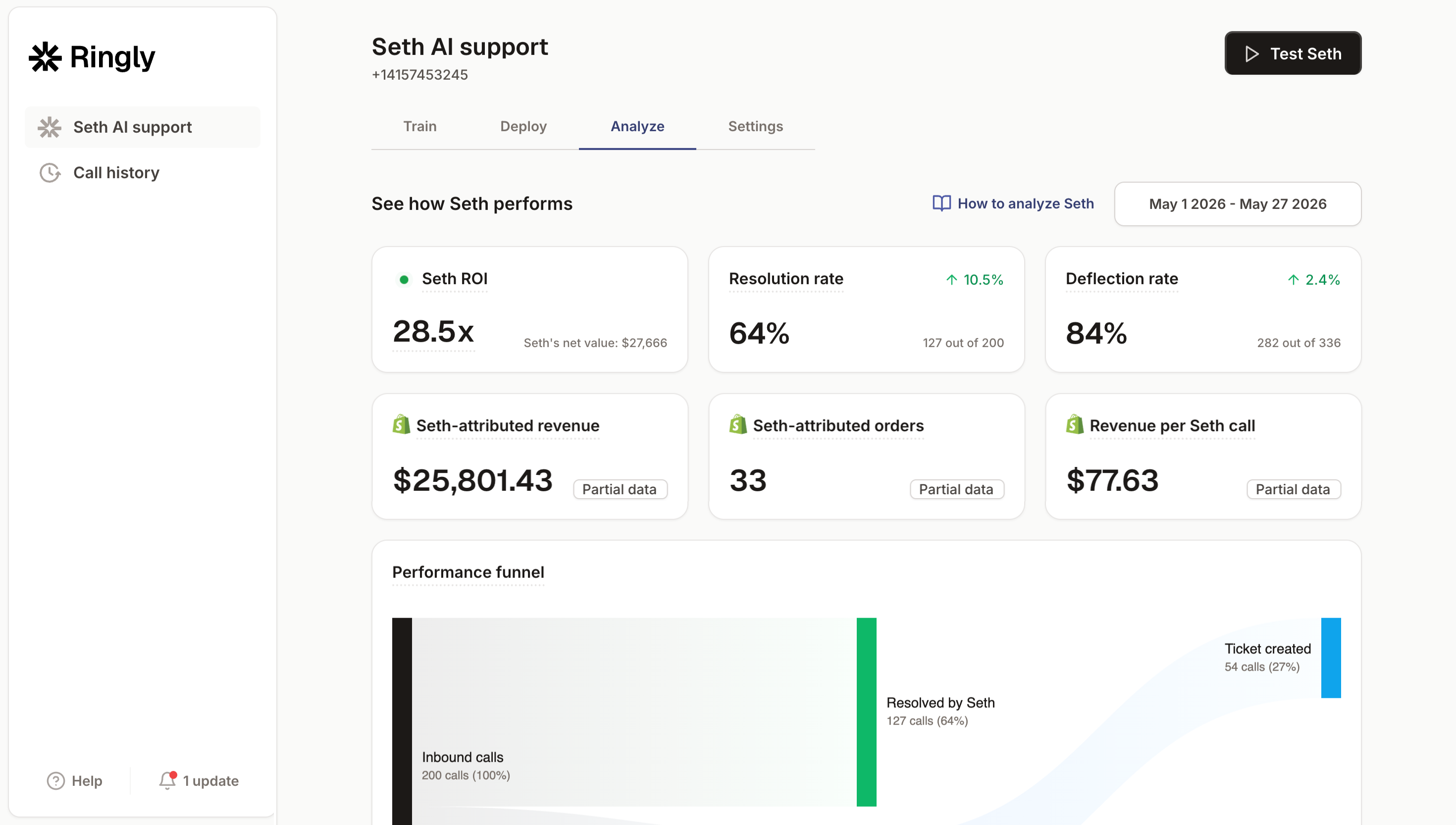
The reason this matters next to an attribution post: a dashboard can finally tell you a lost customer was worth $480 in lifetime value, right after they're gone. The phone line is where you keep them before they leave. WashCo, a Shopify brand we launched, recovered $22,664 in its first 7 days on the phone.
"My customers also feel like it's a normal person. They feel like they can communicate if they have questions."
Claudia Droge, TechCraft Studio
What the dropped-call leak costs
Your media-mix model can put a number on every ad channel. It can't put a number on the calls your team never picks up. Here's what that leak looks like for a typical $50M Shopify brand running a 6-rep CS team:
| Line item | Today | With Ringly |
|---|---|---|
| 6 reps × $4K loaded per rep | $24,000/mo | n/a |
| Ringly Enterprise (~$5K/mo) | n/a | $5,000/mo |
| Net monthly CS spend | $24,000/mo | $5,000/mo |
| Monthly savings | n/a | $19,000/mo |
| Annual savings | n/a | $228,000/yr |
That's roughly 70% of repeatable calls (order status, returns, the same five questions over and over) routed to the AI. The genuinely complex 30% still go to your team, who finally have time to solve them. If you're weighing whether an AI receptionist for ecommerce makes sense at your volume, that's the math to run, and you can sanity-check it against Ringly's pricing.
You've already spent weeks comparing attribution tools. Spend 30 minutes on the leak none of them cover. Book a 30-min call and we'll pull your last 7 days of missed calls live.
How to choose the right Northbeam alternative
Match the tool to the question you're actually trying to answer.
- Choose Triple Whale if you want the popular Shopify command center and Northbeam felt like more engine than you use.
- Choose Rockerbox if you genuinely need media-mix modeling and you spend real money on offline channels.
- Choose Polar Analytics if you want one transparent dashboard and a price finance won't fight you on.
- Choose Cometly if you want attribution that recommends the next move, not just charts the last one.
- Choose SegmentStream if you're spending $100K+/month and want automation, not a reporting tool.
- Choose ThoughtMetric if your only real problem is the Northbeam bill and attribution is the feature you use.
- Choose Hyros if your funnel is long or high-ticket and pixel tracking keeps missing the path.
- Add Ringly if your phone goes to voicemail after hours and you'd rather recover those high-intent buyers than read about them once they're gone. A full ecommerce call center build is the other path, but it costs more than it saves for most brands this size.
Frequently asked questions
What is the best Northbeam alternative? For most Shopify brands, Triple Whale is the closest down-market swap, with the command-center feel at a fraction of the price. If your only issue is cost, ThoughtMetric at $99/mo is the budget pick, and if you still need media-mix modeling, Rockerbox is the like-for-like.
Why are brands leaving Northbeam? Almost never for accuracy, which is its strength. They leave because it starts around $1,500/mo, scales on data volume, and is built for $50K+/mo in ad spend, plus a learning curve that means many teams never use the MMM features they pay for.
Is Northbeam worth it in 2026? For brands spending real money across many channels who have operationalized the media-mix and incrementality side, often yes. For mid-market stores that mainly want a trustworthy dashboard, it's more tool and more cost than the job needs.
What is a cheaper Northbeam alternative? ThoughtMetric starts at $99/mo and Polar Analytics starts around $400/mo. Both cost a fraction of Northbeam while covering the attribution and dashboard work most brands actually use.
Do I need $50K/mo in ad spend to justify Northbeam? Roughly, yes. Northbeam is purpose-built for DTC brands spending $50,000+ a month on paid acquisition, with its Starter tier aimed below $250K/mo and Professional above $500K/mo. Below that bracket you're paying for modeling you won't use.
Northbeam vs Triple Whale for a Shopify brand? Triple Whale is the everyday Shopify command center, cheaper and more usable for most stores. Northbeam is the heavier media-intelligence engine for high-spend brands that need media-mix modeling and incrementality.
Does an attribution tool replace phone support? No, they solve different problems. Attribution tools tell you where past revenue came from, while an AI phone agent like Ringly recovers high-intent buyers who call in real time. Brands often run both because they never overlap.
Talk to us

You came here to pick an analytics tool, and you should. But once it's set, the fastest revenue you'll find isn't on any of these dashboards. It's the calls your team can't get to. If you run a $10M-$100M Shopify brand, a 30-min call is the quickest way to see what those missed calls are costing you.
Our 3 promises.
- Live in under 1 hour. Setup and test calls are free.
- 30-day money back on the $99 plan fee.
- 65% resolution guarantee: if Seth resolves under 65% of your support calls in a month, that month comes back as credit (after 90 days on Pay per call).
Ruben (Ringly co-founder) takes these calls personally.