

For every 10 shoppers who add something to their cart, roughly 7 leave without paying. That's not a rounding error. That's the majority of your potential revenue walking out the door.
We pulled together 50 of the most current cart abandonment statistics for 2026, covering everything from abandonment rates by device and industry to recovery benchmarks across email, SMS, and phone. Whether you're running a Shopify store or managing a larger ecommerce operation, these numbers will help you figure out where you're losing customers and what actually works to get them back.
Hear what AI support calls sound like for your store. Just paste your Shopify URL and get sample calls in under 20 seconds, no email required. Listen to demo calls for my store.
Key highlights
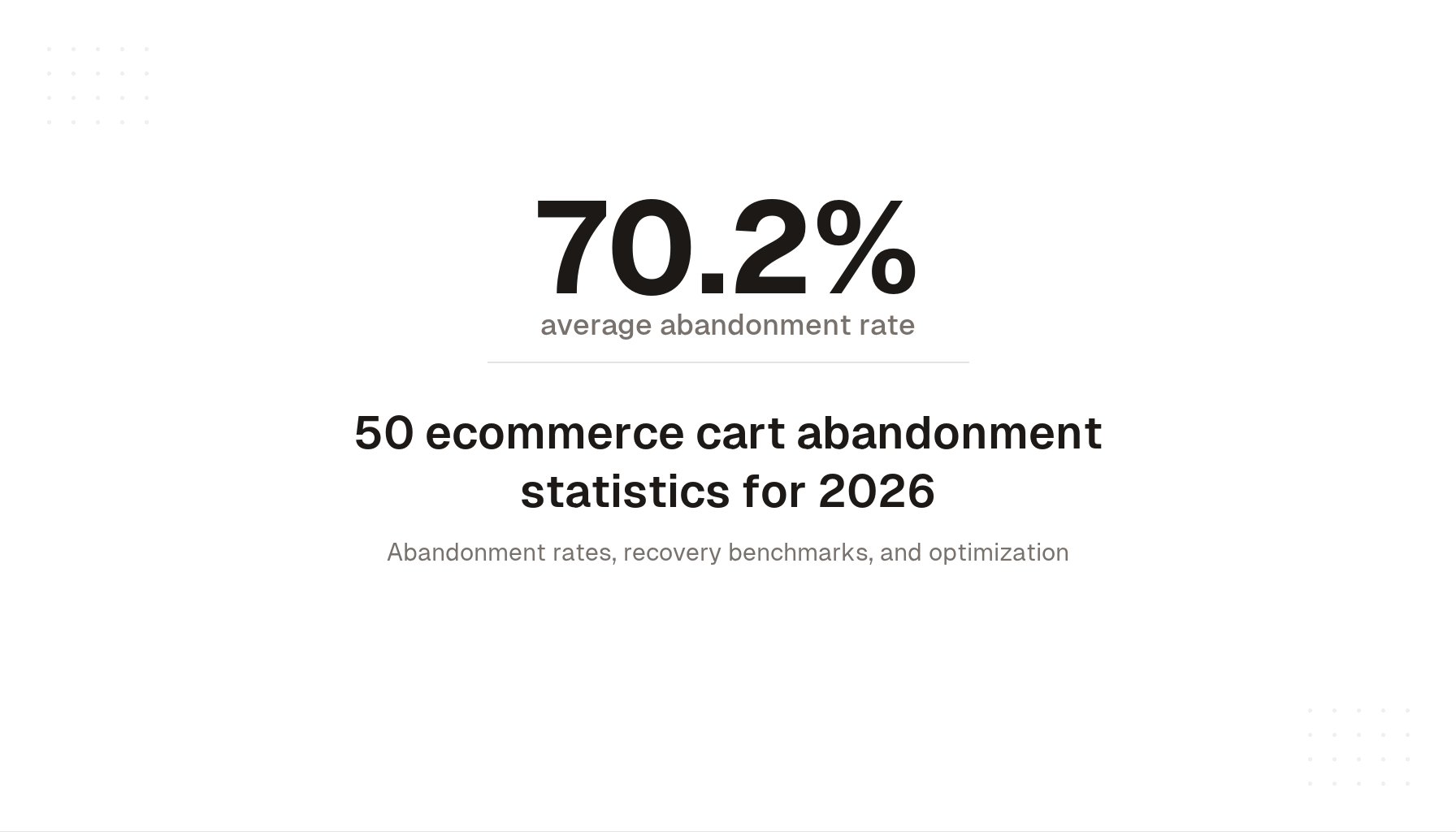
- 70.22% is the average cart abandonment rate across 50 studies (Baymard Institute)
- $260 billion in lost orders are recoverable in the US and EU through better checkout design (Baymard Institute)
- 48% of shoppers abandon because of unexpected extra costs at checkout (Baymard Institute)
- 80.02% of mobile carts get abandoned, compared to 66.41% on desktop (Dynamic Yield)
- 50.5% open rate on abandoned cart emails, 5x higher than typical marketing emails (Klaviyo)
- Phone calls achieve 70-85% connection rates for cart recovery, nearly double email open rates (Ringly.io)
Overall ecommerce cart abandonment rates
These are the big-picture numbers that define the problem.
1. The average cart abandonment rate is 70.22%, calculated across 50 different studies. (Baymard Institute)
2. Global cart abandonment hit 78.77% in August 2025, the highest month of the year. (Statista)
3. Dynamic Yield tracked a 76.8% abandonment rate based on 200 million unique monthly users throughout 2025. (Dynamic Yield)
4. Ecommerce retailers lose approximately $18 billion annually due to abandoned carts. (Dynamic Yield)
5. An estimated $260 billion in lost orders are recoverable in the US and EU alone, just through better checkout flow and design. (Baymard Institute)
6. The average large ecommerce site can gain a 35.26% increase in conversion rate through checkout improvements. (Baymard Institute)
7. December has the lowest abandonment rate of the year at 71.36%, likely due to higher purchase intent during the holidays. (Statista)
The gap between the best and worst months (71.36% vs 78.77%) tells you something important: intent matters. When shoppers are serious about buying (holiday season), abandonment drops.
The rest of the year, a huge chunk of "abandoned carts" are just window shopping. Still, even the best month means 7 out of 10 carts get left behind. That's a structural problem worth solving.
Why shoppers abandon their carts
Understanding the reasons is the first step to fixing the problem. Baymard Institute surveyed US online shoppers to find out why they leave without completing their purchase.
8. 48% of shoppers abandon because extra costs (shipping, taxes, fees) were too high. (Baymard Institute)
9. 43% said they were "just browsing / not ready to buy." (Baymard Institute)
10. 26% abandoned because the site required them to create an account. (Baymard Institute)
11. 21% left due to a checkout process that was too long or complicated. (Baymard Institute)
12. 18% didn't trust the site with their credit card information. (Baymard Institute)
13. 22% didn't complete their purchase because their preferred payment method wasn't available. (ConvertCart)
14. 60% of shoppers say they won't complete a purchase without free shipping. (Shopify)
Here's the thing: "just browsing" accounts for 43% of abandonment. You can't recover those shoppers with a better checkout.
But the other 57%? Those are real buyers hitting real friction. Extra costs, forced account creation, complicated forms. All fixable.
If you're an ecommerce store spending money on ads to drive traffic, losing nearly half your serious shoppers to checkout friction is like pouring water into a bucket with holes. Fix the bucket first.
Cart abandonment by device
Mobile shopping keeps growing, but mobile checkout still has a conversion problem.
15. Mobile carts are abandoned at a rate of 80.02%, compared to 68.84% on tablets and 66.41% on desktops. (Dynamic Yield)
16. Mobile devices now account for over 60% of all ecommerce traffic. See our mobile commerce statistics for a full breakdown of that shift. (Shopify)
17. During Black Friday 2024, mobile abandonment reached 80%, vs. 74% on desktop. (Statista)
18. Mobile traffic makes up the majority of visits but converts at roughly half the rate of desktop (3.5% vs 7% during holiday peaks). (Statista)
The math here is brutal. Most of your visitors are on phones. Those visitors abandon at significantly higher rates.
And when they do convert, the conversion rate is roughly half of desktop. This means optimizing your mobile checkout isn't optional.
Smaller screens, slower typing, and harder-to-navigate forms all push mobile abandonment up. Any friction you can remove from the mobile experience pays for itself quickly.

Cart abandonment by industry
Not all industries deal with the same abandonment problem. Higher-priced items and more complex purchases see dramatically higher rates.
19. Cruise and ferry has the highest abandonment rate at nearly 98%. (Statista)
20. Beauty and personal care: 82.32%. (Dynamic Yield)
21. Luxury and jewelry: 81.68%. (SellersCommerce)
22. Telecommunications: 79.16%. (SellersCommerce)
23. Home and furniture: 78.65%. (SellersCommerce)
24. Pet care and veterinary services has the lowest rate at 52.49%. (Dynamic Yield)
25. Grocery comes in even lower at 50.03%. (Dynamic Yield)
The pattern is clear. Products that require more deliberation (big-ticket items, luxury goods, travel) get abandoned more. Products people need regularly (pet food, groceries) get bought on autopilot.
If you sell health and wellness products, supplements, or cosmetics and skincare, your industry's abandonment rate is above 80%. That means only 1 in 5 shoppers who add your product to their cart actually buys it.
Even small improvements to your checkout or follow-up can make a noticeable difference in revenue.
Cart abandonment by region
Geography plays a bigger role than most people expect.
26. The Middle East and Africa have the highest regional abandonment rate at 93%. (SellersCommerce)
27. Asia Pacific: 87% (SaleCycle) / 80.05% (Dynamic Yield). (SellersCommerce, Dynamic Yield)
28. EMEA: 79.21%. (Dynamic Yield)
29. North America: 76%. (SellersCommerce)
30. Americas overall: 73.4%. (Dynamic Yield)
Regional differences often come down to payment infrastructure and trust. Markets with fewer digital payment options and less established ecommerce habits see higher abandonment.
If you're selling internationally, localized checkout experiences with region-specific payment methods can close some of this gap.
Checkout optimization statistics
Your checkout page is where revenue is won or lost. Here's what the data says about fixing it.
31. The average checkout flow is 5.1 steps long and contains 11.3 form elements. (Baymard Institute)
32. The average site has 39 potential areas for checkout improvement. (Baymard Institute)
33. Reducing checkout steps from 5 to 3 can decrease abandonment by 27%. (VWO)
34. Offering guest checkout can increase checkout conversions by 45%. (PayPal/Krepling)
35. Adding trust badges to checkout forms increases conversions by 42%. (Oberlo)
36. 79% of people are more likely to shop online when free shipping is offered. (Shopify)
If you're running a Shopify store, a lot of this is already handled for you. Shopify's optimized checkout brings the average abandonment rate down to 67-70%, about 2-3 points better than the industry average. (Red Stag Fulfillment)
But there's still room to improve. Guest checkout, fewer form fields, transparent pricing, and visible trust badges can each move the needle. Stacked together, these changes can make a significant dent.
Ringly.io can help recover the carts you still lose. Our AI phone agent calls shoppers who abandon their carts and actually has a conversation with them. Try it free for 14 days.
Email recovery statistics
Abandoned cart emails remain the most widely used recovery method. Here's how they perform.
37. The average open rate for cart abandonment emails is 50.5%, more than double the average marketing email. (Klaviyo)
38. Abandoned cart emails generate $3.65 revenue per recipient on average. (Klaviyo)
39. Average click-through rate: 8.38%. (Barilliance)
40. Average conversion rate: 10.7%. (Barilliance)
41. Emails sent within 1 hour of abandonment convert at 20.3%, compared to 12.2% when sent after 24 hours. (Barilliance)
42. The best-performing campaigns use a 3-email sequence: within 1 hour, at 24 hours, and at 72 hours. (Barilliance)
Email works. But it's not perfect. A 50% open rate means half your recovery emails never get seen.
And the 10.7% conversion rate, while good for email marketing, still means roughly 9 out of 10 people who abandoned their cart don't come back through email alone. That's why smart stores combine email with other channels.
SMS recovery statistics
SMS is faster and harder to ignore than email. The numbers show it.
43. SMS messages have a 98% open rate. (CartBoss)
44. Click-through rates for SMS recovery campaigns range from 19-30%. (CartBoss)
45. SMS recovery campaigns convert at 15-20%, often outperforming email. (CartBoss)
46. SMS abandonment messages get opened within 90 seconds on average, compared to 90 minutes for email. (SaleCycle)
SMS closes the speed gap. When someone abandons a cart, you have a window before they forget about it or buy elsewhere.
A text that arrives in 15 minutes feels timely. An email that arrives 90 minutes later? They might already be on to something else.
The catch is that SMS requires opt-in, and not every shopper will give you their phone number. That's where combining multiple recovery channels makes sense. Stores that use AI to reduce abandoned checkouts are seeing meaningful recovery improvements.
Phone call recovery statistics
Phone calls are the least used recovery channel, but the data suggests they might be the most effective.
47. Phone calls achieve 70-85% connection rates for cart recovery, nearly double email open rates. (Ringly.io)
48. 45% of cart recoveries happen within the first 2 hours after abandonment. (Ringly.io)
49. Combining phone calls with email and SMS increases recovery rates by up to 45%. (Various industry sources)
50. The average Shopify store recovery rate is 8-15% with email alone. Multi-channel recovery (email + SMS + phone) pushes this significantly higher. (Closer Apps)
Here's why phone calls work so well: they're personal. An email is easy to delete. A text is easy to swipe away.
But when someone answers a call and has an actual conversation about the product they were interested in, the chance of converting goes up dramatically.
The reason most stores don't use phone calls for cart recovery is simple: it's expensive and time-consuming to have humans make those calls.
But AI phone agents have changed that equation completely. An AI can call a shopper within minutes of cart abandonment, answer their questions about the product, address their concerns, and guide them back to checkout.
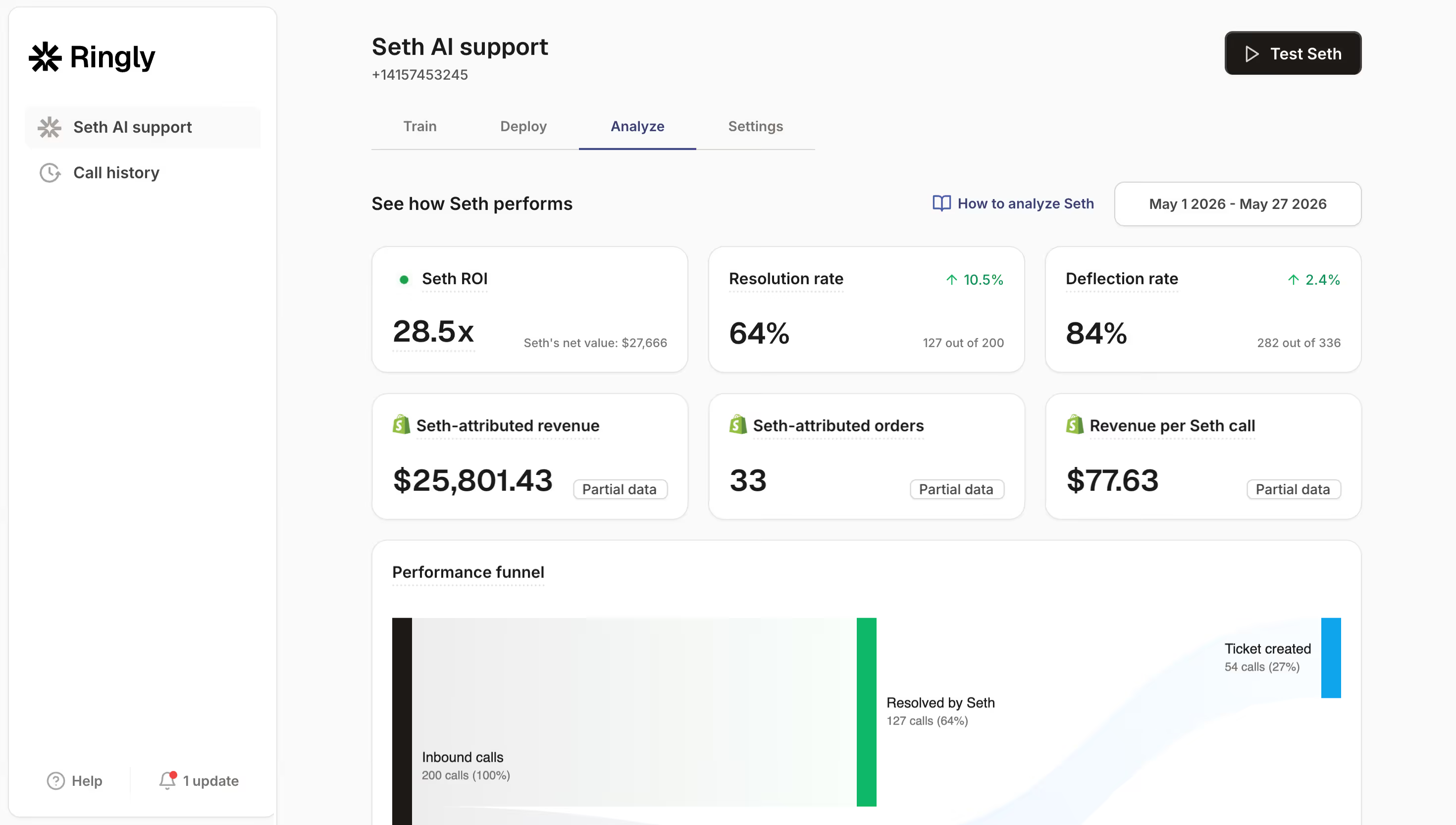
Ringly.io does exactly this for Shopify stores. Seth, our AI phone agent, can automatically call shoppers who abandon carts, have a natural conversation in 40 languages, and help them complete their purchase.
See how it works with a free trial.
Retargeting and exit-intent statistics
Beyond direct recovery outreach, retargeting ads and on-site interventions can pull shoppers back.
- Exit-intent popups reduce cart abandonment by at least 17% and can recover up to 21% of leaving visitors. (OptiMonk, Convertful)
- 26% of customers return to a site through retargeting ads. (DemandSage)
- Retargeting ads are 76% more likely to get clicks than regular display ads. (DemandSage)
- Retargeted visitors are 70% more likely to convert than cold visitors. (DemandSage)
Retargeting works because it catches people who already showed interest. They've seen your product, maybe even added it to their cart.
A well-timed ad reminding them about that product has a much higher chance of converting than showing the product to a stranger. For Shopify store owners, combining retargeting ads with email and phone follow-up creates multiple touchpoints. Each additional channel improves your odds of recovering that sale.
What this means for ecommerce brands
The big takeaway from these 50 statistics? Cart abandonment isn't a bug. It's a fundamental feature of online shopping. People browse, compare, and leave. That's normal.
What isn't normal is doing nothing about it.
The most fixable causes of abandonment are structural:
- Surprise fees at checkout
- Forced account creation
- Slow or complicated forms
- Missing payment options
These are problems you can solve this week.
Optimizing your checkout with guest checkout, transparent pricing, and fewer form fields can recover a significant chunk of lost sales.
But even with a perfect checkout, you'll still lose 60-70% of carts. That's where recovery strategies come in:
- Email is the baseline (50% open rate, 10.7% conversion rate)
- SMS is faster and converts better (98% open rate, 15-20% conversion)
- Phone calls are the most engaging channel of all (70-85% connection rate)
The stores that are winning at cart recovery in 2026 aren't picking one channel. They're using all three: an email at 1 hour, an SMS at 15 minutes, and a phone call for high-value carts.
With AI making phone outreach affordable at scale, there's no reason to leave this channel on the table. If you're a Shopify store losing 7 out of 10 carts, even recovering an extra 5-10% of those abandoned carts can meaningfully impact your bottom line.
That's the kind of math that makes investing in AI customer support and recovery tools worth it.
Ready to recover more abandoned carts? Ringly.io lets you set up AI phone recovery for your Shopify store in about three minutes. Start your free 14-day trial and see what automated phone follow-up can do for your conversion rate.
Frequently asked questions
What is the average cart abandonment rate in 2026?
The average cart abandonment rate in 2026 is 70.22%, according to Baymard Institute's analysis of 50 different studies. That means roughly 7 out of every 10 shoppers who add items to their cart leave without buying.
What is the number one reason for cart abandonment?
Extra costs revealed at checkout. 48% of shoppers abandon their cart when shipping fees, taxes, or other charges make the final total higher than expected. The fix: show all costs upfront and avoid surprise fees.
How much revenue is lost to cart abandonment?
Ecommerce retailers lose approximately $18 billion per year to cart abandonment. Baymard Institute estimates that $260 billion in the US and EU alone is recoverable through better checkout design and prevention strategies.
Is cart abandonment worse on mobile?
Yes, significantly. Mobile cart abandonment rates sit at 80.02% compared to 66.41% on desktop, according to Dynamic Yield's 2025 data. Since over 60% of ecommerce traffic now comes from mobile, improving your mobile checkout experience is one of the highest-impact changes you can make.
What is a good abandoned cart email open rate?
The average abandoned cart email open rate is 50.5%, which is already 2-3x better than typical marketing emails. The key is speed: emails sent within 1 hour convert at 20.3%, while those sent after 24 hours drop to 12.2%.
Do abandoned cart SMS messages work better than email?
In many cases, yes. SMS messages have a 98% open rate and get read within 90 seconds on average, compared to 90 minutes for email. SMS recovery campaigns convert at 15-20%, often outperforming email's 10.7% average.
Can phone calls recover abandoned carts?
Phone calls achieve 70-85% connection rates for abandoned cart recovery, making them the most engaging recovery channel. AI phone agents now make this scalable, calling shoppers within minutes of abandonment and guiding them back to checkout.
Which industries have the highest cart abandonment rates?
The cruise and ferry industry leads at nearly 98%, followed by beauty and personal care at 82.32% and luxury/jewelry at 81.68%. Industries with routine, lower-priced purchases have the lowest rates: pet care at 52.49% and grocery at 50.03%.