
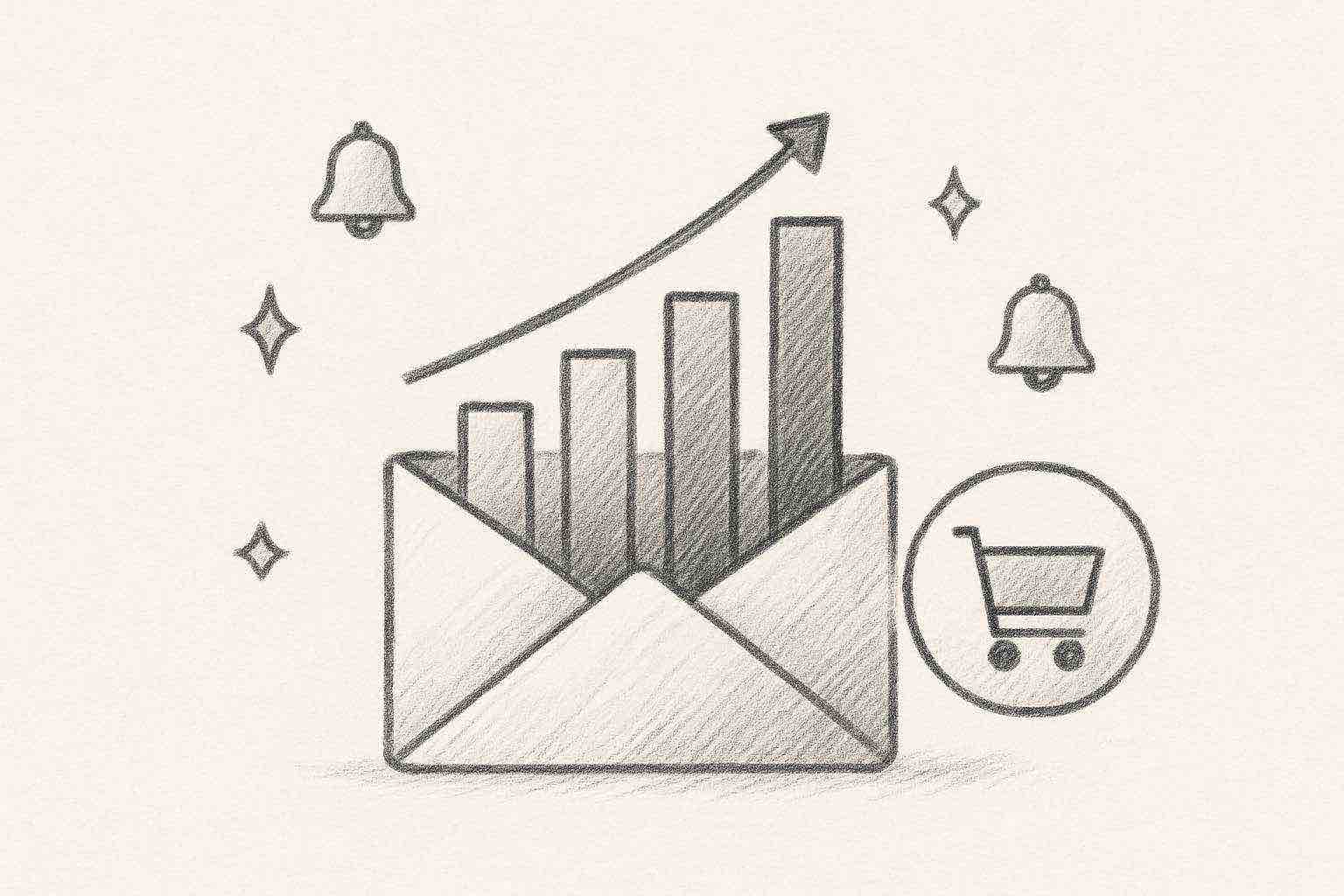
Email marketing still prints money for online stores. With an average return of $36 for every dollar spent (and up to $72 in the US), it's the highest-ROI channel most ecommerce brands have access to. But the numbers have shifted a lot since last year.
We pulled together 42 ecommerce email marketing statistics from Omnisend, Klaviyo, Litmus, and other major platforms. Whether you're building your first welcome flow or fine-tuning a multi-step abandoned cart sequence, these benchmarks will show you where you stand.
Hear what AI support calls sound like for your store. Just paste your Shopify URL and get sample calls in under 20 seconds, no email required. Listen to demo calls for my store.
Key highlights
- Email marketing returns $36-$72 per dollar spent for ecommerce brands, depending on region and platform.
- Automated emails drive 30% of revenue from just 2% of total sends.
- Welcome emails hit 83.6% open rates, the highest of any automated email type.
- Abandoned cart emails convert at 3.33% on average, with top performers reaching 7.69%.
- Segmented campaigns generate 760% more revenue than non-segmented sends.
- The email marketing market is worth $13.72 billion in 2026, growing at 10.82% annually.
Email marketing ROI and revenue statistics
These numbers explain why email keeps getting budget increases while other channels fight for scraps.
1. The average email marketing ROI is $36 for every $1 spent globally. This makes email one of the most cost-effective marketing channels available. For context, paid social typically returns $2-$5 per dollar. (Omnisend)
2. US ecommerce brands see $72 in return for every $1 spent on email. The US market outperforms the global average by 2x, partly due to higher average order values and more mature email programs. (Omnisend)
3. Retail, ecommerce, and consumer goods earn the highest email ROI of any sector at $45 per $1. No other industry vertical comes close. Financial services and agencies trail behind. (Litmus)
4. Omnisend merchants on paid plans averaged $79 per $1 spent in 2025. That's almost double the general industry benchmark. It shows what's possible when you actually invest in the channel. (Omnisend)
5. Email can account for up to 40% of total ecommerce revenue. If your email program isn't driving at least 30-40% of total revenue, you're underperforming. (ConvertCart)
6. Consumers spend 128% more when purchasing through email compared to other channels. Email shoppers don't just convert more often. They spend significantly more per order. (Shopify)
7. 52% of marketers said their email marketing ROI doubled in 2023 compared to the previous year. The channel isn't just stable. It's actively growing in effectiveness for most teams. (EmailMonday)
Email open rates and engagement benchmarks
Open rates matter less than they used to (thanks, Apple), but they're still the first signal that your subject lines and timing are working.
8. Ecommerce email open rates rose for the fifth consecutive year, reaching 30.7% in 2025 (up from 26.6% in 2024). This steady climb suggests better list hygiene and more relevant sends across the industry. (Omnisend)
9. Click-to-conversion rates jumped 53% year-over-year, from 5.9% to 9%. Fewer people clicked, but those who did were far more likely to buy. Quality is winning over quantity. (Omnisend)
10. The average ecommerce email campaign open rate is 37.93%. This includes all ecommerce verticals, from fashion to supplements to electronics. (MailerLite)
11. Klaviyo's portfolio-weighted average open rate sits at 42.89%. That's across both campaigns (43.02%) and flows (39.40%) for brands using their platform. (BS&Co)
12. Apple Mail Privacy Protection inflates reported open rates by 10-15%. If a big chunk of your list uses Apple Mail, your real open rates are lower than what your dashboard shows. Factor this in when benchmarking. (BS&Co)
13. ActiveCampaign users see an average open rate of 39.26% and a click rate of 6.21%. Different platforms produce different benchmarks, so always compare against your own ESP's data. (ActiveCampaign)
Automation and flow performance statistics
This is where the real money lives. Automations do the heavy lifting while you sleep.
14. Automated emails account for just 2% of sends but drive 30% of email revenue. This single stat should convince any ecommerce brand to invest in automation before sending another promotional blast. (Omnisend)
15. Automated emails earn 16x more revenue per send than scheduled campaigns. Per-send efficiency isn't even close. Flows crush campaigns on every metric. (Omnisend)
16. Automated emails generate $2.87 per email compared to $0.18 for campaigns. That's a 15.9x difference in revenue per recipient. (Omnisend)
17. Klaviyo flows generate $1.58 per recipient vs $0.06 for campaigns, a 28x gap. March 2026 data from Klaviyo-powered stores confirms the automation advantage is even wider on that platform. (BS&Co)
18. Flow revenue should represent 50-60% of total email revenue. That's the benchmark for well-optimized Klaviyo stores. If your flows are below 40%, there's money sitting on the table. (Klaviyo)
19. Automated emails see 42.1% open rates vs 25.2% for campaigns. Click rates follow the same pattern: 5.4% for automations vs 1.5% for campaigns. People engage more with timely, triggered messages. (Omnisend)
20. 87% of B2C marketers say automation is a crucial part of their email strategy. The other 13% are leaving money on the table. Automation is table stakes for ecommerce customer retention. (InboxAlly)
If you're spending time on repetitive support calls instead of building email flows, consider automating your phone support too. Ringly.io handles 73% of ecommerce support calls automatically, freeing your team to focus on revenue-driving work like email marketing.
Welcome email statistics
Your welcome flow is probably your highest-performing automation. These numbers show why.
21. Welcome emails achieve an average open rate of 83.6%. No other email type comes close. Your first impression matters more than any campaign you'll ever send. (Omnisend)
22. The target conversion rate for welcome flows is 8-12%. If you're below 8%, your offer or messaging likely needs work. Above 12% means you're in elite territory. (Klaviyo)
23. Welcome emails generate up to 320% more revenue per email than promotional messages. This makes your welcome series the single most valuable email automation you can build for your Shopify store. (InboxAlly)
Abandoned cart email statistics
Cart abandonment happens on roughly 70% of online orders. These emails are your best shot at winning that revenue back.
24. Abandoned cart emails achieve a 50.5% average open rate. That's well above standard campaign benchmarks, and the top 10% of brands reach 65.34%. (Klaviyo)
25. The average click rate for cart recovery emails is 6.25%, with elite brands hitting 13.33%. More than double the average. The gap between average and top performers is enormous. (Klaviyo)
26. Abandoned cart emails convert at 3.33% on average, with high performers reaching 7.69%. Even the average is strong. At 7.69%, top brands are recovering significantly more abandoned carts. (Klaviyo)
27. Revenue per recipient averages $3.65 for abandoned cart flows, but elite performers generate $28.89. That's nearly 8x the average. The difference comes down to sequence design, timing, and offer strategy. (Klaviyo)
28. Three-email abandoned cart sequences generated $24.9 million compared to $3.8 million from single emails. If you're only sending one cart reminder, you're recovering a fraction of what you could. (Klaviyo)
29. Sending the first cart email within 60 minutes yields approximately a 15% recovery rate. Timing matters. Waiting 24 hours causes a sharp drop in recovery. (Mailmend)
30. Most ecommerce stores recover 3-5% of abandoned carts, while top performers recover 10-14%. That gap represents thousands (or millions) in annual revenue depending on your store size. (Mailmend)
Phone support can also help recover abandoned carts. Customers who call with questions during checkout are far more likely to complete their purchase when they get immediate answers. See how AI phone agents handle these calls.
Email segmentation statistics
Sending the same email to your entire list is like shouting into a crowd. Segmentation turns that shout into a conversation.
31. Segmented email campaigns generate 30% more opens and 50% more click-throughs than non-segmented campaigns. The lift is consistent across industries and ecommerce verticals. (Mailmodo)
32. Marketers using advanced segmentation see a 760% increase in revenue. This isn't a typo. The brands that segment by behavior, purchase history, and lifecycle stage see dramatically different results. (Campaign Monitor via OptinMonster)
33. Highly segmented lists return $0.19 per recipient vs $0.06 for unsegmented, a 3x difference. Even basic segmentation (active vs inactive, buyers vs browsers) makes a measurable impact on your conversion rates. (Klaviyo)
34. Personalized subject lines increase open rates by 26%. Something as simple as adding the recipient's name or referencing their last purchase can significantly boost engagement. (Campaign Monitor via OptinMonster)
35. Personalized emails deliver 6x higher transaction rates. Beyond opens and clicks, personalization directly drives purchases. It's the biggest customer experience lever you have in email. (Experian via ConvertCart)
Mobile email statistics
More than half your subscribers are reading on their phone. If your emails don't work on mobile, they don't work.
36. 55% of all emails are now opened on mobile devices. Responsive design isn't optional anymore. It's the baseline. (Litmus)
37. Mobile email opens have grown to represent over 70% of all opens in some ecommerce segments. For brands targeting younger demographics or selling fashion and beauty products, mobile dominance is even higher. (MailerLite)
38. During the holiday season, mobile email opens increase to 44.2%. Peak shopping periods see even more mobile activity. Your Black Friday and holiday customer service emails need to be mobile-first. (Litmus)
Email marketing market size and growth
The industry is growing fast, and ecommerce is the biggest driver.
39. The global email marketing market is worth $13.72 billion in 2026, growing at a 10.82% CAGR to reach $22.93 billion by 2031. This isn't a channel in decline. It's accelerating. (Mordor Intelligence)
40. Retail and ecommerce hold 29.17% of the total email marketing market share. No other vertical invests more in email. It's the backbone of ecommerce marketing. (Verified Market Research)
41. There are 4.73 billion email users worldwide in 2026, projected to reach 4.89 billion by 2027. The addressable audience keeps growing. Email isn't going anywhere. (Statista)
42. Generative AI usage for email image creation jumped 340% year-over-year. AI is transforming how ecommerce brands create email content, from copy to visuals to personalization. (Litmus)
What this means for ecommerce brands
The data tells a clear story. Email marketing isn't just surviving in 2026, it's delivering stronger returns than ever. The gap between average performers and top performers keeps widening, and the difference almost always comes down to automation, segmentation, and timing.
If you're still relying primarily on batch-and-blast promotional campaigns, you're competing with one hand tied behind your back. The brands pulling $79 per dollar spent aren't sending more emails. They're sending smarter ones, with automated flows that trigger at exactly the right moment.
The abandoned cart data is particularly telling. A well-timed three-email sequence generates 6.5x more revenue than a single reminder. And stores that send that first email within 60 minutes recover 3x more carts than those who wait a day. Small operational changes create massive revenue differences.
For Shopify store owners, the playbook is straightforward: build your core flows (welcome, abandoned cart, post-purchase), segment your list beyond basic demographics, and make every email mobile-first. These aren't advanced tactics. They're the minimum standard for competitive ecommerce customer service in 2026.
And while you're optimizing email, don't forget about phone support. Customers who prefer calling still need great experiences. If you run a Shopify store, Ringly.io handles 73% of support calls automatically with AI. Try free for 14 days.
Frequently asked questions
What is the average ROI for ecommerce email marketing?
The global average is $36 for every $1 spent, but US ecommerce brands see returns as high as $72 per dollar. Retail and ecommerce consistently have the highest email ROI of any industry sector.
How much revenue should email drive for an ecommerce store?
A well-performing email program should drive 30-40% of total store revenue. If your email channel is contributing less than that, your automation flows likely need optimization.
What is a good open rate for ecommerce emails?
The average ecommerce email open rate is around 30.7-37.9%, depending on the platform. Keep in mind that Apple Mail Privacy Protection inflates open rates by 10-15%, so actual engagement may be lower than reported.
How effective are abandoned cart emails?
Very effective. They achieve 50.5% open rates and 3.33% average conversion rates. Top-performing brands convert at 7.69%. A three-email sequence significantly outperforms sending a single cart reminder.
Do email automations really outperform campaigns?
Yes, by a wide margin. Automated emails drive 30% of revenue from just 2% of sends. Per-send revenue is 16-28x higher for automations compared to standard campaigns. Every ecommerce brand should prioritize building core automation flows.
How important is email segmentation for ecommerce?
Critical. Segmented campaigns generate 30% more opens, 50% more clicks, and up to 760% more revenue than unsegmented sends. Even basic segmentation by purchase history or engagement level makes a measurable difference.
What percentage of emails are opened on mobile?
At least 55% of all emails are opened on mobile devices, with some ecommerce segments seeing over 70% mobile opens. Mobile-responsive email design is a necessity, not an option.
Is email marketing still growing in 2026?
Absolutely. The global email marketing market is worth $13.72 billion in 2026 and growing at nearly 11% annually. Email users will reach 4.89 billion by 2027. The channel continues to outperform newer marketing channels on ROI.