
Your Shopify store's abandoned cart emails are probably recovering 3-5% of lost checkouts. That's the industry average, according to Klaviyo's own benchmarks. Phone calls? They recover 15-35%. That's not a typo.
Here's the thing: 7 out of 10 shoppers who start checkout on your store won't finish it. That's the Baymard Institute's number, averaged across 50 studies. Most stores throw an email at those people and call it a day. A few add SMS. Almost nobody picks up the phone.
This guide covers exactly how to set up abandoned cart phone calls on your Shopify store. You'll learn when to call, what to say, which apps handle it automatically, and the ROI math behind it all. And no, this isn't cold calling. You're reaching out to people who were seconds away from buying.
Hear what AI support calls sound like for your store. Just paste your Shopify URL and get sample calls in under 20 seconds, no email required. Listen to demo calls for my store.
Why phone calls recover more abandoned carts than email
Let's start with the obvious question. Why would a phone call work better than the abandoned cart email sequence you already have running?
The answer comes down to attention. An abandoned cart email has about a 45-50% open rate (which is good, by email standards). SMS hits around 98% open rates. But a phone call that gets answered? That's 100% attention. No subject line to ignore. No notification to swipe away. It's a real conversation.
And that conversation is where the magic happens. When someone abandons your checkout, you don't actually know why. Maybe shipping costs surprised them. Maybe they had a sizing question. Maybe their kid started crying and they put their phone down. An email can't ask "hey, what happened?" A phone call can.
One Shopify store owner tested phone outreach against their existing email flows and reported a 55% recovery rate from calls versus 10% from emails. That's an extreme example, but even the more conservative data tells the same story.
Here's how the channels compare:
| Channel | Recovery rate | Attention rate | Can solve objections? |
|---|---|---|---|
| 3-5% | 45-50% open | No (one-way) | |
| SMS | 2-4% | 98% open | Limited |
| Phone call (AI) | 10-18% | 70-85% answer | Yes (real-time) |
| Phone call (human) | 15-25% | 70-85% answer | Yes (real-time) |
The real advantage isn't just the higher recovery rate. It's that phone calls let you fix the actual problem. If someone's confused about your return policy, the agent explains it. If they want to know whether the medium fits like a true medium, the agent answers. You can't do that with an email template.
And here's the framing that matters: these aren't cold calls. Calling someone about their abandoned cart is "hot calling." They had items in their cart. They entered their payment info. They were ready to buy. Reaching out within a few hours is closer to customer service than it is to telemarketing.
How to collect phone numbers on your Shopify checkout
Before you can call anyone, you need their phone number. And this is where most Shopify stores hit the first roadblock.
By default, Shopify doesn't require a phone number at checkout. Many stores don't even show the phone field. So the first step is making sure you're actually collecting this data.
Here's how to enable it:
- Step 1: Go to your Shopify admin, then Settings > Checkout
- Step 2: Under "Customer contact method," you can choose email only, or email and phone number
- Step 3: Make the phone field either optional or required
- Step 4: Add a line near the phone field about how you may follow up regarding their order (this covers your consent basis)
Making the phone number required will get you the most data, but it can slightly reduce checkout conversion rates. The tradeoff is usually worth it. If requiring a phone number drops your completion rate by 1-2%, but phone recovery brings back 10-18% of abandoners, the math works out heavily in your favor.
A middle-ground approach: make the phone field "optional but encouraged." Add helper text like "So we can help with your order" below the field. Most customers will fill it in.
What if you don't have the phone number?
Not every abandoned checkout will include a phone number. That's okay.
For checkouts without a phone number, stick to your existing email and SMS recovery flows. Use phone calls as an additional channel for the carts where you DO have the number.
You can also collect phone numbers earlier in the journey. An SMS opt-in popup offering a discount code is one approach. Post-purchase, asking for a phone number for order updates is another. The more phone numbers you have on file, the more abandoned carts you can recover by phone.
When to call: the timing framework for Shopify abandoned cart phone calls
Timing is everything with cart recovery. According to Dotdigital's research, 45% of all abandoned cart recoveries happen within the first two hours. Wait a full day and you've lost almost half your potential wins before you even start.
But calling too fast feels invasive. Nobody wants their phone ringing 30 seconds after they close a browser tab. The sweet spot is somewhere in between.
Here's the multi-channel timing sequence that works:
- 1 hour after abandonment: Send the automated email (your existing Klaviyo or Omnisend flow)
- 2 hours: SMS reminder with a link back to their cart
- 3-4 hours: Phone call (if no purchase yet). This is the escalation.
- 24 hours: Final email with an incentive (if still no purchase)
- 48 hours: Stop. Don't chase further.
The phone call at the 3-4 hour mark is intentional. You've given them a chance to come back on their own via email and SMS. If they haven't, a friendly phone call is the next step, not the first step.
Adjust timing based on cart value
Not every abandoned cart deserves a phone call. A $15 cart probably isn't worth the cost of an AI call. A $300 cart absolutely is.
| Cart value | Recommended recovery channels |
|---|---|
| Under $50 | Email + SMS only |
| $50-$200 | Email + SMS + AI phone call at 3-4 hours |
| $200-$500 | Email + SMS + AI phone call at 2 hours |
| $500+ | Email + SMS + priority AI call at 1-2 hours (consider human agent) |
Most AI phone platforms let you set cart value thresholds so only qualifying carts trigger a phone call. This keeps your costs down and your recovery efforts focused where they'll have the biggest impact on average order value.
What to say: abandoned cart phone call scripts that convert
The best cart recovery calls don't sound like sales calls. They sound like customer service. You're helping, not pitching.
Keep calls under two minutes. Lead with the customer's name and what they left in their cart. Ask a question instead of making a pitch. Here are three scripts that work.
Script 1: The helpful check-in
This is your default script. Use it for standard carts and first-time visitors.
"Hi [Name], this is [Store Name]. I noticed you were checking out a [Product] earlier and wanted to see if everything went okay. Sometimes our checkout can be a bit tricky on mobile. Is there anything I can help with?"
If they say shipping was too expensive, offer to explain your free shipping threshold. If they say they were just browsing, thank them and let them go. If they're still interested, text them their cart link.
Script 2: The incentive offer
Use this for high-value carts or repeat browsers who've abandoned multiple times.
"Hi [Name], this is [Store Name]. You left a [Product] in your cart earlier, and I wanted to let you know we can offer you [10% off / free shipping] if you'd like to complete your order today. I can send you a link with the discount applied right now."
Short. Direct. Valuable. The incentive is the hook, and sending the cart link via SMS during the call removes friction.
Script 3: The product expert
Best for complex products like supplements, skincare, electronics, or subscription boxes where customers often have questions.
"Hi [Name], this is [Store Name]. I saw you were looking at our [Product] and thought I'd reach out in case you had any questions. A lot of customers have questions about [common concern]. Happy to help if anything is on your mind."
The key insight: the best recovery calls feel like customer service calls. The customer doesn't feel sold to. They feel helped.
Ringly.io handles these conversations automatically with AI. Seth, the AI agent, knows the customer's name, their cart contents, and your product catalog. Try it free for 14 days.
Best Shopify apps for abandoned cart phone calls
There are a handful of apps that automate phone calls for Shopify abandoned carts. Here's how they stack up.
1. Ringly.io
Best for: Shopify stores that want AI phone support AND cart recovery in one platform
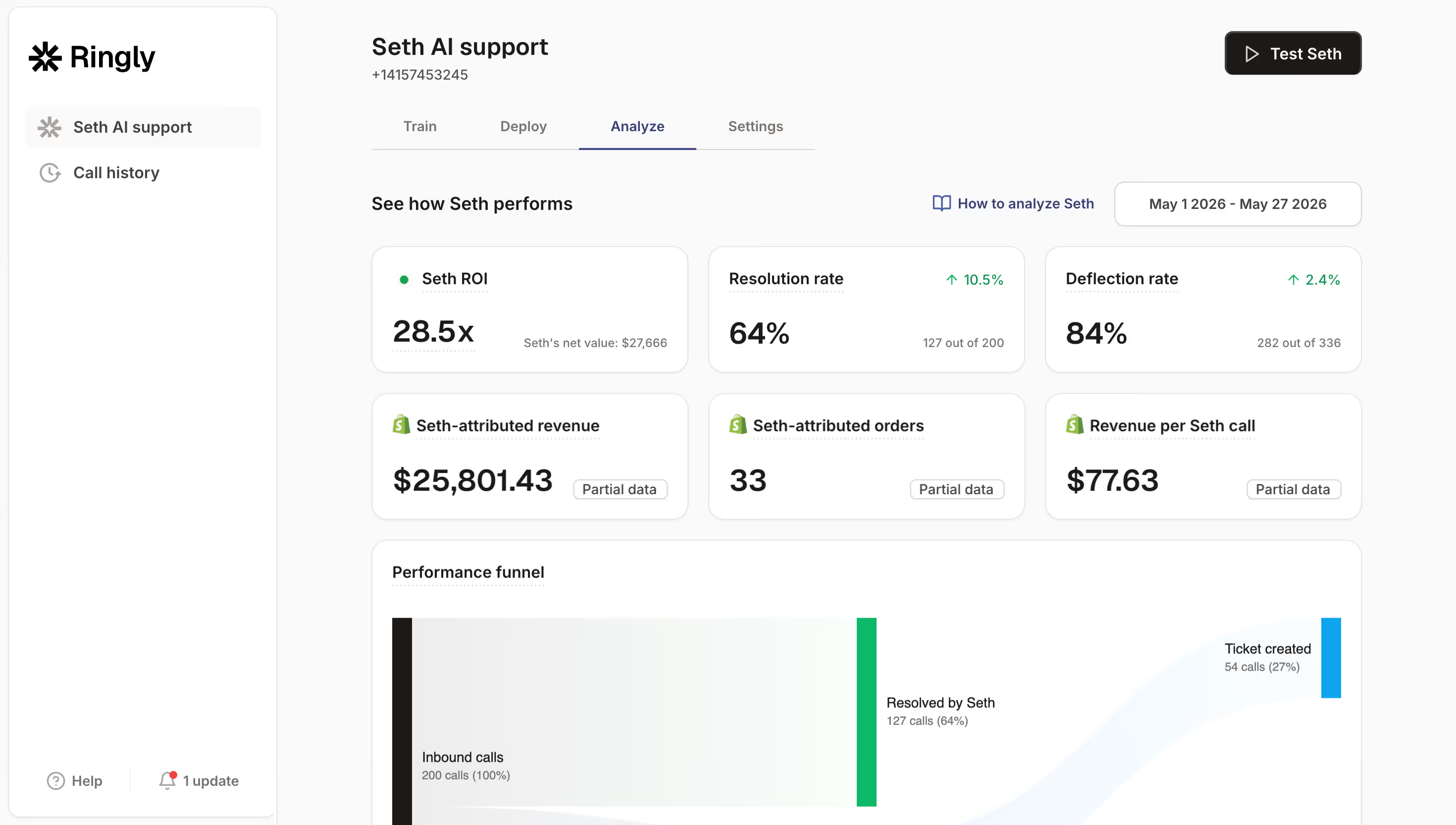
Ringly.io isn't just an abandoned cart tool. It's a full AI phone agent that handles inbound customer support calls (order status, returns, product questions) and outbound recovery calls. Seth, the AI agent, connects to your Shopify data and knows the customer's name, cart contents, and order history in real time.
Setup takes about three minutes. No code, no developer needed. And it works in 40 languages, which matters if you sell internationally.
Pricing
| Plan | Price | Minutes included |
|---|---|---|
| Grow | $349/mo | 1,000 |
| Enterprise | Custom | 5,000+ |
Overage is $0.19/minute. There's a 14-day free trial to test the full platform.
What works
- Native Shopify integration: pulls order data, cart contents, and product info without custom dev
- Full phone solution: handles inbound support AND outbound cart recovery, so you're not paying for two separate tools
- 73% resolution rate: most calls get resolved without a human touching them
- 40 languages: real multilingual support, not just English with an accent toggle
- 3-minute setup: paste your Shopify URL, configure your agent, and you're live
What doesn't
- E-commerce only: not built for general business use, so it won't work for a law firm or SaaS company
- No pay-per-result pricing: you pay monthly, not per recovered cart
- Higher starting price: $349/mo is more than cart-recovery-only apps
Why it ranks first: It's the only platform that combines abandoned cart recovery with full AI phone support. You get a complete phone solution for your Shopify store, not just a single-feature tool. For most stores, paying for one platform that does both is cheaper (and simpler) than paying for a cart recovery app plus a separate customer service tool.
2. Callsy AI
Best for: Stores that want dedicated abandoned cart calling at a lower price point
Callsy AI is a Shopify app focused specifically on abandoned cart recovery through AI phone calls and SMS. When someone abandons checkout, Callsy calls them, has a conversation, and follows up with an SMS containing a personalized discount code and checkout link.
Pricing
| Plan | Price | Calls/mo | SMS/mo |
|---|---|---|---|
| Free | $0 | 10 | 10 |
| Starter | $29 | 50 | 50 |
| Pro | $99 | 200 | 200 |
| Scale | $199 | 500 | 500 |
What works
- Free tier: 10 calls per month to test before committing
- Strong early reviews: 5.0/5 on the Shopify App Store across 19 reviews
- SMS follow-up built in: sends discount codes after the call
- 40+ languages: with 17 voice options
What doesn't
- Cart recovery only: doesn't handle inbound support calls, order status, or returns
- Volume caps: the Starter plan's 50 calls/month gets used up fast if you have serious traffic
- Newer app: limited track record compared to established platforms
Why it ranks second: Solid option if you only need cart recovery and want to start small. The free tier is genuinely useful for testing. But if you need phone support beyond just abandoned carts, you'll need a second tool.
3. Callfy
Best for: Stores that want zero-risk pricing and only pay for actual recovered sales
Callfy takes a different approach. Instead of a flat monthly fee, you pay a percentage of recovered sales. Their Growth plan is free with a 15% commission on recovered revenue. Paid plans lower the commission rate.
Pricing
| Plan | Price | Commission |
|---|---|---|
| Growth | Free | 15% of recovered sales |
| Pro | $149/mo | 7% of recovered sales |
| Enterprise | $399/mo | 5% of recovered sales |
What works
- Zero-risk start: pay nothing upfront, only a percentage of what you actually recover
- Cart segmentation: prioritize high-value carts automatically
- 50+ languages: broad international support
What doesn't
- Commission adds up: 15% of recovered sales gets expensive at volume. On $10,000 in recovered revenue, that's $1,500/month.
- Zero reviews: brand new app with no Shopify App Store reviews yet
- Monthly + commission on paid plans: the Pro plan is $149/mo plus 7%, which can get pricey
Why it ranks third: The pay-per-result model is appealing for testing, but the 15% commission makes it one of the most expensive options at scale. And with zero reviews, you're taking a bet on an unproven product.
Quick comparison
| Feature | Ringly.io | Callsy AI | Callfy |
|---|---|---|---|
| Starting price | $349/mo | Free (10 calls) | Free (15% commission) |
| Cart recovery | Yes | Yes | Yes |
| Inbound support | Yes | No | No |
| Languages | 40 | 40+ | 50+ |
| Shopify rating | N/A (direct integration) | 5.0/5 (19 reviews) | No reviews yet |
| Free trial | 14 days | Free tier | Performance-based |
Ready to see what AI phone support looks like for your store? Start your free trial. Setup takes three minutes.
ROI math: what Shopify abandoned cart phone calls actually cost and earn
Let's run through a realistic example. No cherry-picked numbers.
Your store:
- 500 abandoned carts per month (moderate Shopify store)
- $95 average order value (close to the Shopify average)
- You currently run email recovery flows
Email only (baseline):
- 4% recovery rate = 20 recovered orders
- Revenue: $1,900/month
Email + SMS:
- 7% combined recovery rate = 35 recovered orders
- Revenue: $3,325/month
- Incremental: +$1,425/month
Email + SMS + AI phone calls:
- 18% combined recovery rate = 90 recovered orders
- Revenue: $8,550/month
- Incremental vs email only: +$6,650/month
Cost of adding phone calls:
- AI calling platform: ~$150-300/month (depending on volume and provider)
- Your ROI: 22-44x on the phone calling investment alone
That $150-300/month in AI calling costs could bring in $5,000-7,000 in additional recovered revenue every month. And that's using conservative recovery rate estimates.
There's a second benefit that's harder to quantify. Merchants who use phone recovery report that average order values increase during recovery calls. The agent can suggest related products, mention bundle deals, or offer free shipping on a slightly larger order. One merchant reported AOV jumping from $52 to $78 when they added phone recovery.
Compliance basics: TCPA and abandoned cart phone calls
Let's address the legal question head-on. Is it legal to call people about their abandoned carts?
Short answer: yes, when done properly.
Abandoned cart calls aren't cold calls. The customer came to your store, added items to their cart, entered their contact information, and started checkout. They initiated the transaction. Reaching out about that specific transaction is fundamentally different from unsolicited marketing.
Here's what you need to know about TCPA compliance for cart recovery:
- Prior express consent: When a customer provides their phone number during checkout, that's a form of consent. The Fifth Circuit ruled in February 2026 that the TCPA doesn't require prior express written consent, even for autodialed calls. Oral or implied consent from conduct (like entering a phone number at checkout) can be sufficient.
- Add checkout language: Include a note near your phone field like "We may contact you regarding your order." This makes your consent basis clear.
- Honor opt-outs immediately: If someone says "don't call me again," remove them. The current standard is processing opt-outs within 10 business days.
- Respect calling hours: Don't call before 8am or after 9pm in the customer's local time zone.
- Keep records: Log when and how consent was obtained for every number you call.
If your store ships internationally, check local regulations. The TCPA covers US calls. Canada has CASL, the EU has GDPR, and other regions have their own rules.
One important note: this isn't legal advice. Talk to a lawyer if you want to make sure your specific setup is compliant. But for most Shopify stores making recovery calls to customers who provided their phone number during checkout, you're on solid ground.
How to combine phone calls with your existing Shopify recovery stack
Phone calls don't replace your email and SMS flows. They add a high-converting channel on top of what you're already doing.
Here's the full recovery sequence mapped out:
- Trigger: Shopify detects an abandoned checkout (via webhook or app integration)
- Hour 1: Abandoned cart email fires from your email platform (Klaviyo, Omnisend, etc.)
- Hour 2: SMS reminder with direct cart link
- Hour 3-4: AI phone call (only for carts above your value threshold, and only if no purchase yet)
- Hour 24: Final email, now with an incentive (10% off, free shipping)
- Hour 48: Stop all recovery attempts. Pursuing beyond this point hurts your brand more than it helps.
The key is that each channel escalates in urgency. Email is passive. SMS is a nudge. A phone call is a direct conversation. You're gradually increasing the level of engagement.
Most AI phone platforms integrate with Shopify's webhook system or have direct app integrations. Ringly.io plugs into your Shopify store directly and can work alongside your existing email and SMS tools.
Track which channel gets credit for each recovered cart. After a month, you'll have clear data on what's working and can adjust your timing and thresholds.
Try Ringly.io free for 14 days and see how phone calls fit into your existing recovery stack.
Frequently asked questions
Do Shopify abandoned cart phone calls actually work?
Yes. AI phone calls recover 10-18% of abandoned carts, compared to 3-5% for email and 2-4% for SMS. The advantage is real-time conversation: the agent can identify why the customer left and solve the problem on the spot. Combining phone calls with your existing email and SMS flows typically increases your overall recovery rate by 2-3x.
Won't calling abandoned cart customers annoy them?
Most customers respond well when the call feels like help, not a sales pitch. The key is timing (wait 3-4 hours, not 5 minutes), keeping it short (under 2 minutes), and leading with a question ("Was there anything I can help with?") instead of a pitch. Done right, it actually improves customer experience.
How much do AI abandoned cart phone calls cost?
Most platforms charge $0.10-0.25 per minute, with monthly plans starting around $29-99 depending on call volume. For a typical Shopify store doing 200-500 abandoned carts per month, expect $100-300/month, which usually returns 15-35x in recovered revenue.
Can I use Shopify Flow to trigger abandoned cart phone calls?
Yes. Shopify Flow can fire a webhook when a checkout is abandoned, which triggers your phone call service. Most dedicated Shopify apps (like Callsy or Ringly.io) handle this automatically through their Shopify integration, so you don't need to configure Shopify Flow manually.
Do I need to collect phone numbers separately for cart recovery calls?
You need to have the phone number field enabled at checkout. Go to Settings > Checkout in your Shopify admin and make the phone field optional or required. Include a short consent note near the field. You don't need a separate opt-in form, but the number does need to be provided during the checkout process.
Is it better to use AI or human agents for abandoned cart recovery calls?
For most Shopify stores, AI is the practical choice. AI agents call within minutes (humans often wait hours or days), work 24/7 including evenings and weekends, cost a fraction of human agents ($0.10-0.25/min vs $0.25-0.42/min), and handle conversations in 40+ languages. Reserve human agents for VIP customers or carts above $500 where the personal touch justifies the cost.
The channel most Shopify stores ignore
Most Shopify stores have email recovery running. Some have added SMS. Almost none are using phone calls. And that's exactly what makes this such a big opportunity right now.
The math is simple. Adding AI phone calls to your existing recovery stack costs $100-300/month and recovers 3-5x more abandoned carts than email alone. With an average Shopify AOV of $85-95, even recovering 20-30 extra orders per month pays for the tool many times over.
Phone calls aren't the future of abandoned cart recovery. They're already here. AI just made them accessible to every Shopify store, not just the ones with call center budgets.
Try Ringly.io free for 14 days and get Seth recovering abandoned carts in under three minutes.