

Here is a number that should get your attention: 80% of customers say the experience a company provides matters just as much as its products. For Shopify store owners, that experience often starts with customer service.
But here is the problem. The Shopify App Store lists dozens of helpdesk apps. That is enough to give anyone choice paralysis. Do you go with the free native option? Pay for AI automation? Focus on phone support or live chat?
I tested seven of the most popular Shopify customer service apps to cut through the noise. This guide covers everything from free tools for new stores to enterprise solutions handling thousands of tickets daily. You will find specific pricing, real limitations, and honest recommendations based on your store size and needs.
Editor's note: Want to hear some sample AI support calls made for your Shopify store?
- Just paste your store URL
- Get sample calls in under 20 seconds (no email required)
- Listen to demo calls for my store

What to look for in a Shopify customer service app
Not all helpdesk apps are created equal. Before diving into the list, let us cover what separates the good from the great.
Deep Shopify integration matters more than you would think. The best apps pull in order history, cart contents, and customer profiles automatically. When a customer asks "where's my order," your agent should not need to switch tabs to find the answer.
Multichannel support is table stakes now. Email, live chat, Facebook, Instagram, WhatsApp, phone customers expect to reach you wherever they are. A unified inbox that combines all these channels saves serious time.
AI and automation can handle 60-70% of routine questions if set up right. Look for apps that offer AI-suggested responses, automated ticket routing, and chatbots that actually understand context.
Self-service options reduce ticket volume before it starts. Knowledge bases, FAQ widgets, and order tracking portals let customers help themselves.
Pricing that scales means you will not get penalized for growth. Some apps charge per agent, others per ticket, others per conversation. Understand the model before committing.
Setup complexity varies wildly. A solopreneur needs something that works out of the box. A 50-person support team might have the resources to configure a complex enterprise tool.
Quick comparison table
| App | Starting Price | Best For |
|---|---|---|
| Key Feature | AI Capabilities | Shopify Rating |
| Shopify Inbox | Free | New stores |
| Native integration | Suggested replies | 4.7 (5,293) |
| Gorgias | $10/month | Growing stores |
| Deep Shopify integration | AI Agent ($0.90/resolution) | 4.3 (625) |
| Tidio | Free | Chat-focused stores |
| Lyro AI agent | 67% automation rate | 4.7 (1,170) |
| Zendesk | $19/month | Enterprises |
| Advanced ticketing | AI agents (included) | Enterprise standard |
| Richpanel | $20/month | Self-service focus |
| Customer portal | Sidekick AI (free) | 4.7 (128) |
| eDesk | $39/month | Multi-channel sellers |
| 300+ integrations | AI Assist ($39/mo) | 4.8 (27) |
| Ringly.io | $349 per month | Phone support |
| AI phone agent Seth | 73% call resolution | Newer entrant |
1. Shopify Inbox

Shopify Inbox is the native option, and it is completely free. That makes it the obvious starting point for new stores testing live chat for the first time.
The integration is seamless because it is built by Shopify. You get automatic cart visibility, product recommendations, and customer profile data without any configuration. When someone asks about a product, you see what they are looking at in real time.
AI-suggested replies help you respond faster to common questions. The mobile app lets you answer messages on the go. And since it is free, there is zero risk in trying it.
But the limitations become obvious as you grow. There is no phone support, no email ticketing system, and automation is basic at best. You cannot set up complex routing rules or build a knowledge base. For stores getting more than a handful of daily inquiries, you will outgrow it quickly.
Bottom line: Start here if you are new and want to test live chat. Plan to upgrade within 6-12 months as volume increases.
2. Gorgias

Gorgias positions itself as the helpdesk built specifically for ecommerce, and the claim holds up. With 15,000+ brands including MrBeast, Arc'teryx, and Reebok using the platform, it is become the default choice for growing Shopify stores.
The Shopify integration goes deeper than most competitors. You can edit orders, cancel shipments, and issue refunds directly from the ticket view. No tab-switching, no copy-pasting order numbers. Social media support is another strength Instagram DMs, Facebook comments, and TikTok messages all flow into one inbox.
Pricing starts at $10 per month for 50 tickets, which is accessible for small stores. The Basic plan at $50 gives you 300 tickets. But here is the catch: as you scale, costs add up. The AI Agent add-on runs $0.90 to $1.00 per resolved conversation. High-volume stores can easily spend hundreds monthly on automation alone.
The AI capabilities are solid. Intent and sentiment detection help prioritize urgent tickets. The AI Agent can handle returns, refunds, and order edits autonomously. Just budget for the per-resolution pricing.
Best for: Growing stores that need deep Shopify integration and do not mind paying for scale.
3. Tidio

Tidio leads with its Lyro AI agent, and the numbers are impressive. The company claims Lyro can solve up to 67% of customer problems without human intervention. For stores drowning in repetitive questions, that is a compelling pitch.
The free plan is genuinely useful, not just a teaser. You get 50 billable conversations, 100 flow visitors, and 50 Lyro AI conversations to test the waters. Paid plans start at $24.17 per month for 100 conversations, with the Growth plan at $49.17 offering 250 conversations and advanced analytics.
Live chat is where Tidio shines. The widget is customizable, the mobile apps work well, and proactive triggers can engage visitors before they ask for help. The helpdesk functionality exists but feels secondary. If email ticketing is your primary channel, you might find Tidio limiting.
Lyro AI deserves its own mention. Unlike basic chatbots that follow rigid scripts, Lyro uses natural language processing to understand context. It can be added to any plan starting at $32.50 per month for 50 AI conversations. There is even a standalone version that works with Zendesk and Salesforce if you are not ready to switch helpdesks.
Best for: Stores that want strong chat functionality with genuine AI automation at an affordable price.
4. Zendesk

Zendesk is the enterprise standard for a reason. Uber, Lush, and Siemens do not choose helpdesk software on a whim. When you need robust ticket management at scale, Zendesk delivers.
The Suite Team plan at $55 per agent per month (annual) includes AI agents, messaging, live chat, and phone support. Suite Professional at $115 adds Copilot writing tools, up to 5 help centers, and skills-based routing. Suite Enterprise at $169 unlocks 300 help centers, sandbox environments, and custom agent roles.
The AI capabilities are comprehensive. AI agents handle automated resolutions across channels. Copilot assists agents with writing and research. The platform includes workforce management tools, quality assurance, and advanced analytics that smaller competitors cannot match.
But here is the reality check. Zendesk is overkill for most small stores. The setup requires significant time and technical resources. You will need dedicated staff to configure workflows, manage permissions, and maintain the knowledge base. For teams under 10 people, the complexity often outweighs the benefits.
Best for: Enterprises and high-volume operations that need advanced security, compliance, and workforce management.
5. Richpanel

Richpanel takes a different approach. Instead of just helping your agents respond faster, it aims to reduce ticket volume through self-service. The company guarantees 30% cost savings versus Zendesk or Gorgias, plus 30% fewer tickets within 60 days.
The Help Desk starts at $20 per agent per month (annual) with email, live chat, and social channels included. The Pro plan at $50 adds phone support and unlimited automations. Pro Max at $85 includes SMS, unlimited seats, and multi-store support.
The Self-Service Portal is Richpanel's standout feature. For $100 per month (annual), customers get order tracking, FAQ access, and subscription management without contacting support. The portal handles up to 5,000 orders per month and connects to your Shopify store natively.
Sidekick AI is included free across all plans. It drafts replies using your past conversations, summarizes long threads, and provides two-way translation for international customers. The Social Media Moderator AI, also free, automatically hides harmful comments and responds to engagement on your posts.
Best for: Cost-conscious stores that want to deflect tickets through self-service rather than hiring more agents.
6. eDesk

eDesk targets a specific niche: sellers managing multiple channels. If you are selling on Amazon, eBay, and your own Shopify store simultaneously, eDesk brings everything into one inbox.
Pricing starts at $39 per agent per month for the Essential plan, which covers one store and basic features. Growth at $89 adds five stores, CSAT surveys, and data migrations. Professional at $119 includes 10 stores, custom roles, and advanced API access. Enterprise offers unlimited stores with custom pricing.
The 300+ marketplace integrations are the headline feature. Amazon Seller Central, eBay, Walmart, Etsy, and dozens more connect natively. When a customer messages you on eBay about an order, you see their full purchase history across all channels.
AI features come as add-ons. AI Automation costs $0.99 per resolution for automated ticket handling. AI Assist at $39 per user per month provides classification, summarization, and reply suggestions. AI Translations at $21 per user per month handles multilingual support.
The trade-off is Shopify depth. While eDesk connects to Shopify, it does not integrate as deeply as Gorgias or Richpanel. For pure Shopify sellers, other options offer more native functionality.
Best for: Multi-channel sellers who need to manage Amazon, eBay, and Shopify support from one place.
7. Ringly.io
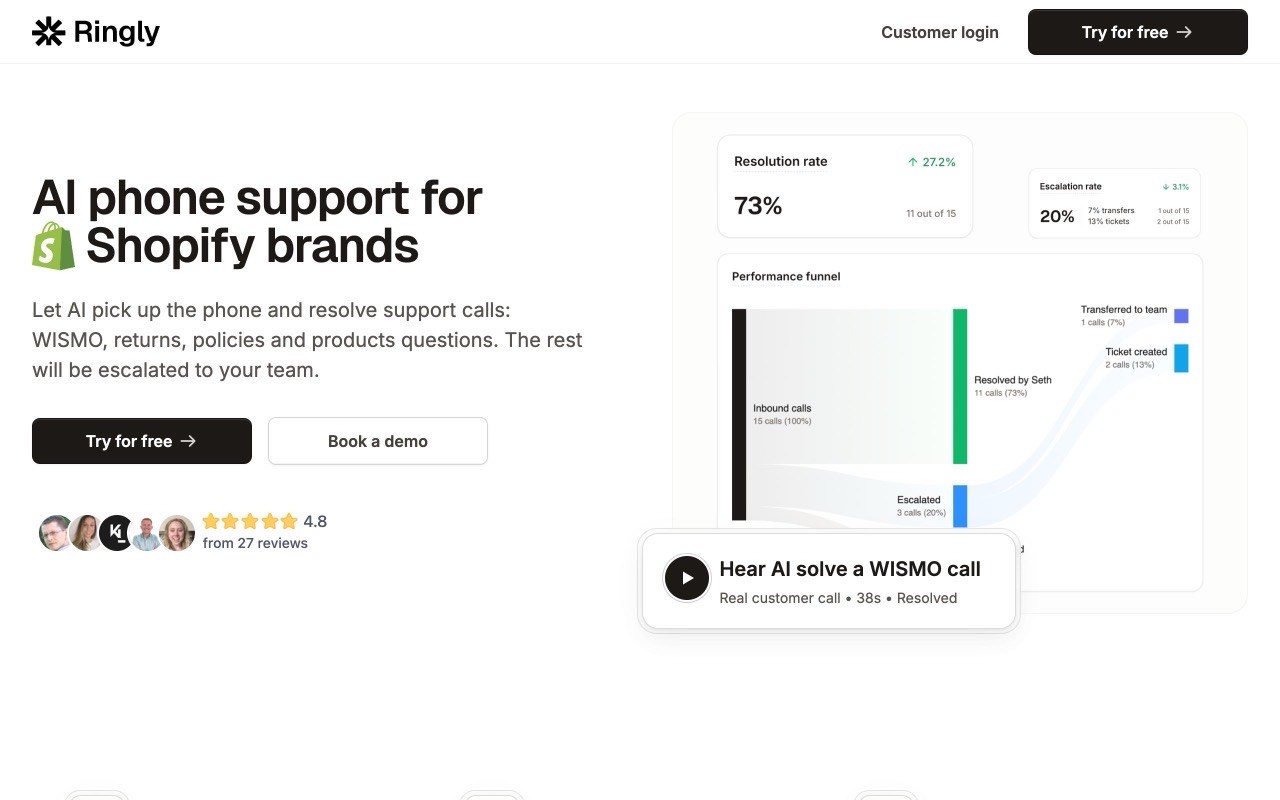
Ringly.io fills a gap that other apps ignore: phone support. While everyone else focuses on chat and email, we built an AI phone agent specifically for Shopify stores.
Our product, Seth, handles inbound calls 24/7. He answers questions, looks up orders, processes returns and exchanges, and only escalates to your team when necessary. The resolution rate averages 73%, meaning roughly three out of four calls never need a human agent.
Grow at $349 includes 1,000 minutes and self-learning AI that improves from each conversation. Enterprise (custom pricing) offers 3,000+ minutes, a private Slack channel, and custom integrations for high-volume operations.
The Shopify integration is deep. Seth pulls order status, tracking information, and customer data in real time. When someone calls asking "where's my order," he has the answer immediately. The platform supports 40 languages, so international customers get help in their native tongue.
Setup takes about three minutes. No coding required, no complex workflows to configure. You get a phone number (or bring your own), connect your Shopify store, and Seth starts answering calls.
Best for: Stores receiving phone calls who want to automate 70-80% of voice support without hiring additional staff.

How to choose the right Shopify customer service app for your store
The best app depends entirely on your situation. Here is a simple framework:
Solo founders and small stores should start with Shopify Inbox. It is free, it works, and you will learn what features you actually need. When you outgrow it, Tidio offers the most affordable upgrade path with genuine AI capabilities.
Growing stores doing 10-50 orders per day need more firepower. Gorgias offers the deepest Shopify integration if budget allows. Richpanel provides better value if you want to reduce ticket volume through self-service.
High-volume stores face different challenges. Zendesk handles enterprise complexity if you have the team to manage it. For phone-heavy operations, our AI agent at Ringly.io scales without adding headcount.
Multi-channel sellers running Amazon and eBay alongside Shopify should look at eDesk. The marketplace integrations justify the price if you are managing support across platforms.
Budget-conscious stores have options. Tidio's free plan handles basic chat. Richpanel's $20 starting price includes features that cost triple elsewhere.
Tips for getting the most from your customer service app
Once you have chosen a tool, setup matters more than the choice itself.
Start with automated responses for your most common questions. "Where's my order," "how do I return," and "what are your shipping times" should all have instant answers.
Connect your knowledge base to your chat widget. Most apps let you surface FAQ articles before customers start a conversation. This deflects tickets before they exist.
Train your team on escalation protocols. Know exactly when an AI agent should hand off to a human, and make sure your agents understand the context they are receiving.
Monitor analytics weekly, not monthly. Look for patterns in ticket volume, response times, and customer satisfaction. Spot trends early and adjust before they become problems.
Start simple and add complexity as needed. A basic setup done well beats a complex configuration that is half-finished.
Upgrade your Shopify customer service today
The right Shopify customer service app depends on your volume, your channels, and your budget. There is no universal best choice just the best choice for your specific situation.
Start with the free options to learn your needs. Upgrade when you have clear pain points that justify the cost. And remember that most apps offer free trials, so you can test before committing.
If phone support is part of your business, try Ringly.io's AI phone agent with a 14-day free trial. Seth handles the routine calls so your team can focus on the conversations that actually need a human touch.
Frequently Asked Questions
What is the best Shopify customer service app for a new store?
Start with Shopify Inbox. It's free, integrates natively, and gives you a feel for what features you'll actually need as you grow. Upgrade once you hit limitations.
How much should I expect to spend on a Shopify customer service app?
Budget anywhere from free (Shopify Inbox, Tidio free plan) to $50-100 per month for growing stores (Gorgias, Richpanel, eDesk). Enterprise solutions like Zendesk start at $55 per agent monthly.
Can AI really handle customer service for my Shopify store?
Yes, for routine questions. AI agents typically resolve 60-70% of common inquiries like order tracking and returns. Complex issues and angry customers still need human attention.
Do I need phone support for my Shopify store?
It depends on your customers. High-value products, B2B sales, and certain demographics prefer phone support. If you're getting calls now, automating them with AI (like Ringly.io) is more cost-effective than hiring.
What's the difference between Gorgias and Richpanel?
Gorgias focuses on helping agents respond faster with deep Shopify integration. Richpanel emphasizes self-service to reduce ticket volume. Choose Gorgias for agent productivity, Richpanel for ticket deflection.
Is Zendesk worth it for a small Shopify store?
Probably not. Zendesk shines at enterprise scale with complex workflows. For stores under 10 support agents, the setup complexity and per-agent pricing usually don't justify the benefits.
Can I use multiple customer service apps together?
Yes, though it's not always ideal. Some stores use one tool for chat (Tidio) and another for phone (Ringly.io). Just ensure your team has clear protocols for which channel to use when.
Looking for data to back up your strategy? Check out our latest research: 45+ AI customer service statistics for 2026 and 45 live chat statistics for 2026.