
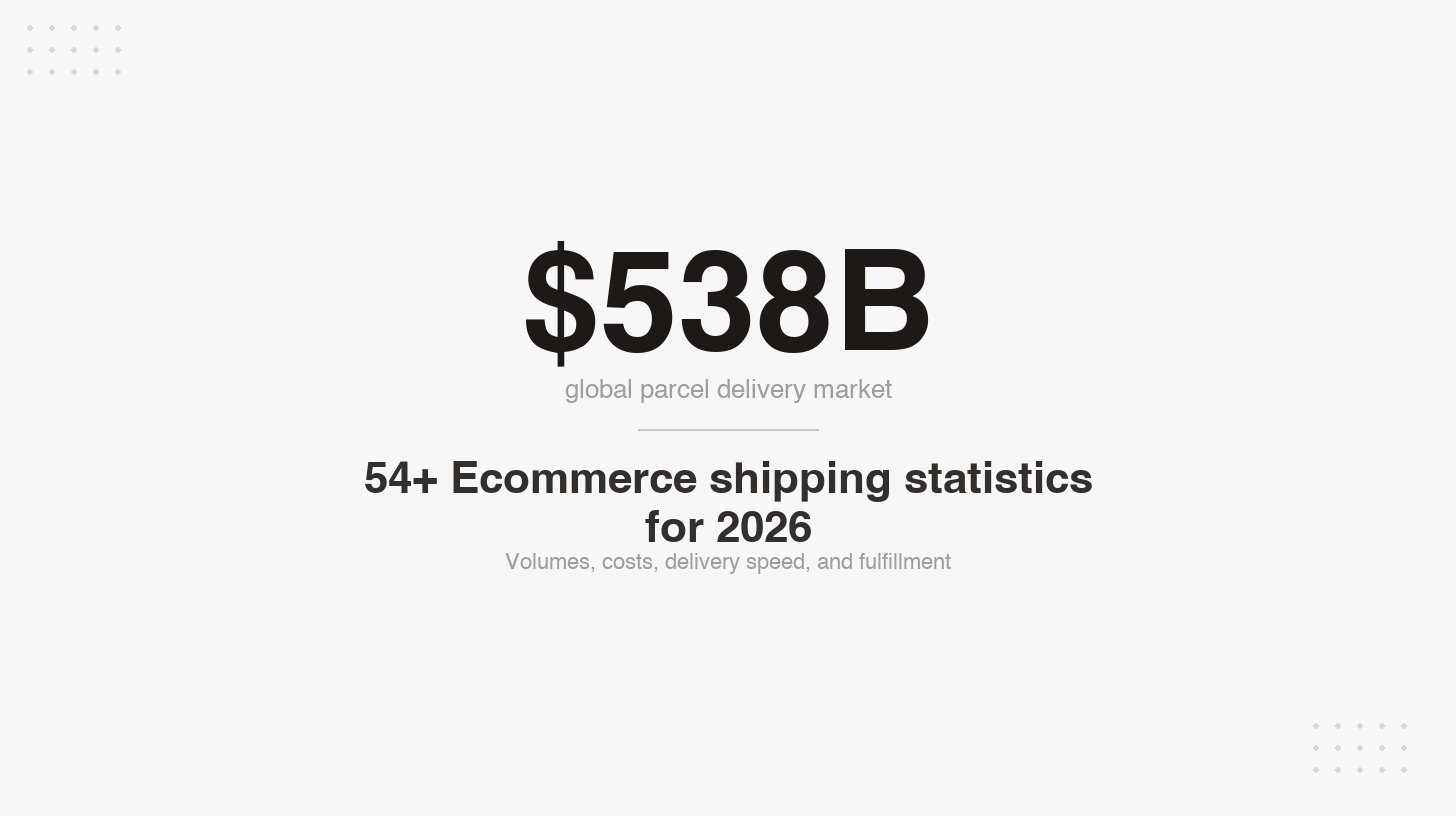
Shipping makes or breaks an ecommerce business. It's the part of the customer experience you can't fake, and the one that triggers the most support calls. We pulled together 54 data points on global parcel volumes, delivery costs, consumer expectations, and fulfillment trends so you can make smarter decisions about your shipping strategy this year.
Hear what AI support calls sound like for your store. Just paste your Shopify URL and get sample calls in under 20 seconds, no email required. Listen to demo calls for my store.
Key highlights
- The global parcel delivery market is projected to reach $538 billion in 2026, with 236 billion packages delivered worldwide.
- Last-mile delivery now eats up 53% of total shipping costs, up from 41% in 2018.
- 88% of consumers pick free shipping over fast shipping when given the choice.
- Cart abandonment sits at 70.22%, with shipping fees being the top reason shoppers bail at checkout.
- WISMO ("where is my order") queries make up 30-40% of all ecommerce support tickets.
- Same-day delivery is a $17.8 billion market in 2026, growing at over 20% per year.
Global shipping volume and market size
An estimated 236 billion parcels will be delivered globally in 2026. That's more than 647 million packages moving through logistics networks every single day. (SellersCommerce)
The global parcel delivery market is projected to reach $538 billion in 2026. This represents a 5.6% compound annual growth rate from $500.13 billion in 2025. (SellersCommerce)
24.6 billion packages are projected to ship within the US in 2026. That's a 4.9% jump compared to the previous year. (SellersCommerce)
US shipping revenue will reach $201.34 billion in 2026. The US remains the largest single-country shipping market by revenue. (SellersCommerce)
Pitney Bowes projects global parcel volume could reach 266 billion in 2026 under their most likely scenario, with a range of 232 billion to 303 billion depending on ecommerce trends. (Pitney Bowes)
US parcel volume hit 22.4 billion shipments in 2024. That was a 3.4% increase year-over-year, showing steady growth even as the post-pandemic surge leveled off. (Pitney Bowes)
The numbers here tell a clear story. Ecommerce shipping isn't slowing down. If anything, the growth is accelerating as more consumers default to online purchasing for everyday items.
Shipping costs and pricing benchmarks
The average ecommerce brand pays $8 to $15 per order to ship. When you factor in surcharges, fulfillment delays, and returns processing, the actual cost is 25-40% higher than most brands budget for. (GoBolt)
The base-rate average shipping cost per ecommerce order is $7.96. But this doesn't include the hidden costs that add up quickly. (Opensend)
Shipping costs average 10-15% of order value across most ecommerce categories. For low-value, high-volume products, that percentage can climb to 20-30%. (Opensend)
Electronics have the highest average shipping cost at $10.60 per order. Beauty and health products come in lowest at $6.03 per order. (Opensend)
Last-mile delivery now accounts for 53% of total shipping costs. That's up from 41% in 2018, making the final stretch the single largest expense in ecommerce logistics. (Upper Inc)
These numbers matter because shipping costs directly affect your margins. For a Shopify store running on tight profit margins, even a $1-2 reduction per order can mean thousands in annual savings.
Free shipping expectations and impact
88% of consumers prioritize free shipping over fast delivery. When forced to choose between the two, speed loses almost every time. (Capital One Shopping)
83% of ecommerce companies now provide free shipping options. But 45% of them require customers to spend $50 or more to qualify. (Mailmodo)
66% of shoppers expect free shipping on every order. That's regardless of cart value, which puts real pressure on smaller brands. (Capital One Shopping)
92% of consumers say free shipping offers influence their purchase decisions. That's up from 83% in 2023, meaning the expectation is only growing. (Capital One Shopping)
Free shipping orders generate 15-20% higher order values than orders without the promotion. Shoppers spend more when they feel like they're saving on delivery. (SellersCommerce)
Online shoppers spend 30% more on orders that include free delivery. This is why most ecommerce marketing strategies now center around free shipping thresholds. (SellersCommerce)
The takeaway? Shoppers now expect free shipping by default. If you're not offering it (at least above a certain threshold), you're losing sales to stores that do.
Want to see how AI handles shipping-related calls for your store? Try Ringly.io free for 14 days and get your AI phone agent answering calls in under three minutes.
Cart abandonment and shipping fees
The average cart abandonment rate is 70.22% in 2026. That means roughly 7 out of 10 shoppers who add items to their cart never complete the purchase. (Baymard Institute)
48% of shoppers abandon their cart when shipping fees, taxes, or extra costs push the total higher than expected. Unexpected costs remain the number one reason for cart abandonment. (Baymard Institute)
Cart abandonment costs ecommerce businesses $4 trillion annually. A significant chunk of that is directly tied to shipping-related friction at checkout. (Email Vendor Selection)
Free shipping can reduce cart abandonment by 20%. That's one of the most effective single changes you can make to your checkout flow. (SellersCommerce)
48% of consumers also abandon cross-border carts due to high international shipping costs. The problem gets worse for stores selling across borders. (Capital One Shopping)
The connection between shipping costs and abandoned carts is well documented at this point. If you're spending money driving traffic to your Shopify store and losing nearly half of them to shipping sticker shock, that's the first thing to fix.
Delivery speed and consumer expectations
80% of consumers expect same-day delivery. The bar for delivery speed keeps rising, driven largely by Amazon's influence on consumer expectations. (Upper Inc)
52% of brands aim for 2-3 day delivery windows for direct-to-consumer orders. This is the sweet spot where most ecommerce businesses are competing today. (ShipBob)
The same-day delivery market is projected to reach $17.8 billion in 2026. It's growing at a 20.8% CAGR, making it one of the fastest-growing segments in logistics. (The Business Research Company)
98% of consumers say delivery experience impacts brand loyalty. A poor delivery experience doesn't just lose you one sale. It loses you a customer. (Upper Inc)
Customers check their order status an average of 4.6 times per shipment. That's a lot of tracking page visits, and a lot of potential customer support calls if something looks off. (WISMOlabs)
90% of customers say real-time order tracking is a non-negotiable feature. If your store doesn't offer it, you're behind. (Upper Inc)
Speed expectations are only going in one direction. But here's the thing: most customers will accept 3-5 day shipping if you communicate clearly and give them real-time tracking. The frustration comes from uncertainty, not from waiting.
WISMO: the shipping question that floods support teams
WISMO ("where is my order") queries account for 30-40% of all ecommerce support tickets. During peak seasons like Black Friday and the holidays, that number jumps to 50% or higher. (Salesforce)
Every WISMO ticket that reaches a human agent costs between $5 and $22. For a mid-size brand processing 1,000 orders per month, that translates to $1,500 to $8,800 in monthly support costs for a single question type. (ShippyPro)
96% of shoppers track their orders when tracking is available. And 43% check tracking daily until their package arrives. (WISMOlabs)
Proactive shipment alerts reduce WISMO inquiries by up to 75%. Sending automated SMS or email updates at key milestones (shipped, out for delivery, delivered) cuts the volume dramatically. (WISMOlabs)
WISMO calls are the single biggest category of ecommerce support volume. They're repetitive, predictable, and perfect for automation. That's exactly why AI phone agents like Ringly.io can handle them so effectively. The AI looks up the order, pulls tracking info from Shopify, and gives the customer a clear answer in under 30 seconds.
If WISMO is eating your support budget, see how Ringly.io handles these calls automatically.
Returns and reverse logistics
US retail returns are projected at $849.9 billion in 2025. That's a 15.8% return rate across all retail, with ecommerce rates running even higher. (NRF)
Ecommerce return rates are estimated at 19.3% in 2025. For 2026, projections range from 20% to 24.5%, meaning roughly one in five online orders comes back. (Return Prime)
Each return costs retailers between $10 and $65. The range depends on product type, shipping distance, and whether the item can be resold. (eFulfillment Service)
65.2% of merchants now charge return fees for mail-in returns. The average fee is $9.04, reflecting the growing pressure to offset reverse logistics costs. (eFulfillment Service)
82% of consumers consider free returns a key purchase factor. This creates a real tension for brands: customers demand free returns, but returns are getting more expensive to process. (Return Prime)
Returns are one of the most expensive parts of ecommerce operations. They also generate a huge volume of support calls. Customers want to know how to initiate a return, when they'll get their refund, and whether they can exchange instead. An AI phone agent can walk them through the entire process without a human ever getting involved.
Cross-border ecommerce shipping
59% of global shoppers now buy from retailers outside their home country. Cross-border shopping is no longer a niche behavior. (Swell)
The cross-border B2C ecommerce market is projected to reach $2.16 trillion in 2026. That's up from $1.72 trillion in 2025, growing at an annual rate of 8.71%. (SQ Magazine)
Average international delivery times have dropped to 6-8 days in major trade corridors. That's down from 10+ days in 2022, thanks to better logistics infrastructure. (DHL)
30% of brands plan to start fulfilling orders in new countries in 2026. Rising shipping costs and tariff uncertainty are pushing brands to distribute inventory closer to customers. (ShipBob)
86% of brands sell on 2+ sales channels, up 8% from 2025. Multi-channel is the norm now, with 75% planning to add at least one more channel this year. (ShipBob)
Going international adds complexity, but the ecommerce market is clearly heading that direction. If you're a Shopify brand considering cross-border sales, plan for higher shipping costs and more support inquiries about customs, duties, and longer delivery windows.
Carrier market share and Amazon's dominance
Amazon delivered 6.7 billion packages in 2025. That made it the top US parcel carrier by volume, overtaking USPS for the first time. (IndexBox)
USPS shipped 6.9 billion parcels in 2024, with Amazon Logistics at 6.3 billion. Amazon's logistics arm grew 7.3% year-over-year, while USPS grew only 3.2%. (Pitney Bowes)
Amazon ships an estimated 20-25 million packages globally per day. That's roughly 833,000 packages per hour, every hour. (DemandSage)
UPS leads in revenue-based market share at 29.8%. While Amazon dominates by volume, UPS and FedEx still capture the most revenue per package. (IndexBox)
Amazon's logistics buildout has reshaped what customers expect from every ecommerce store. When your customer gets their Amazon order in one day, they wonder why your brand takes five. That gap in expectations is what drives customer service calls.
Fulfillment and warehouse automation
The warehouse automation market is valued at $29.98 billion in 2026. It's projected to more than double to $59.52 billion by 2030, growing at an 18.7% CAGR. (SellersCommerce)
4.7 million warehouse robots are installed in 50,000+ warehouses globally. Robotics adoption is accelerating fast, with over 450,000 logistics robots sold in 2025 alone (compared to 75,000 in 2019). (SellersCommerce)
80% of warehouses currently have no automation technology. Despite all the growth in robotics, the vast majority of fulfillment operations still rely entirely on manual labor. (WiFi Talents)
Automation delivers 25-30% reductions in labor costs and 300% faster order fulfillment. For brands that can afford the investment, the ROI is significant. (SellersCommerce)
The last-mile delivery market is valued at $199.68 billion in 2026. It's the fastest-growing segment of the logistics chain, projected to hit $277.76 billion by 2030. (The Business Research Company)
Automation isn't just a backend concern. Faster fulfillment means faster deliveries, fewer errors, and fewer customer support calls about wrong items or delayed orders.
Sustainable shipping
The sustainable ecommerce packaging market is estimated at $37.20 billion in 2025. It's expected to reach $54.97 billion by 2030, growing at an 8.12% CAGR. (Mordor Intelligence)
85% of consumers say sustainable packaging influences their purchasing decisions. Green packaging actively drives buying behavior — 85% of shoppers factor it into where they spend. (Ryder Ecommerce)
61% of shoppers say sustainable packaging is the top environmental factor when choosing a brand. That puts it ahead of carbon offsets, ethical sourcing, and other sustainability claims. (Ryder Ecommerce)
Sustainability matters more to ecommerce customers than most brands realize. And it's not just younger shoppers. This preference cuts across demographics.
What this means for ecommerce brands
The data tells a clear story. Shipping is getting more expensive (53% of costs now land in the last mile), customers expect it to be free (88% choose free over fast), and when something goes wrong, they pick up the phone.
That phone call is where most ecommerce brands lose money. WISMO queries alone account for 30-40% of support volume, each costing $5 to $22 when a human agent handles it. Add in return inquiries, order status questions, and shipping complaints, and you're looking at a support operation that scales linearly with your order volume.
This is exactly the problem AI phone agents solve. Shipping-related calls (WISMO, return status, delivery estimates) are repetitive and predictable. An AI agent can look up the order in Shopify, pull tracking data, and give the customer an answer in seconds. No hold time, no staffing headaches, available 24/7 in 40 languages.
The brands winning at ecommerce shipping in 2026 aren't just optimizing delivery speed and costs. They're also automating the support layer that shipping creates. Every order shipped is a potential support call. The question is whether a human or an AI picks up.
If you run a Shopify store, Ringly.io handles 73% of support calls automatically. Try free for 14 days.
Frequently asked questions
How many packages are shipped globally in 2026?
An estimated 236 billion parcels will be delivered worldwide in 2026, according to SellersCommerce. Pitney Bowes projects the number could be as high as 266 billion under their most likely scenario. That works out to roughly 647 million packages per day.
What percentage of ecommerce orders include free shipping?
About 83% of ecommerce companies offer free shipping in some form, though 45% require a minimum order (usually $50+). On the consumer side, 66% of shoppers expect free shipping on all orders regardless of cart value.
What is the average shipping cost per ecommerce order?
The base-rate average is $7.96 per order. But when you include surcharges, fulfillment costs, and returns processing, the real cost is $8 to $15 per order for most brands. Shipping typically represents 10-15% of the order value.
Why do shoppers abandon their carts?
The average cart abandonment rate is 70.22% in 2026. Unexpected shipping costs are the number one reason, cited by 48% of shoppers. Offering free shipping (even above a threshold) can reduce abandonment by up to 20%.
What are WISMO queries?
WISMO stands for "where is my order." These tracking and delivery status inquiries make up 30-40% of all ecommerce support tickets, and over 50% during peak seasons. Each one costs $5 to $22 when a human agent handles it. AI phone agents can answer these automatically by looking up order data in real time.
How much does last-mile delivery cost?
Last-mile delivery now accounts for 53% of total shipping costs, up from 41% in 2018. The last-mile delivery market itself is valued at $199.68 billion in 2026. It's the most expensive and logistically challenging part of the delivery process.
What is the ecommerce return rate?
Ecommerce return rates are estimated at 19.3% in 2025, with projections for 2026 ranging from 20% to 24.5%. Each return costs retailers between $10 and $65. About 65% of merchants now charge return shipping fees, averaging $9.04 per return.
How fast do consumers expect ecommerce delivery?
80% of consumers say they expect same-day delivery, and 98% say the delivery experience affects their brand loyalty. In practice, 52% of brands target 2-3 day delivery windows for DTC orders. Real-time order tracking is considered essential by 90% of customers.