
Shopify isn't just growing. It's pulling away from the pack. The platform crossed $11.5 billion in annual revenue in 2025, powers millions of stores globally, and processes more gross merchandise volume than some countries produce in GDP.
Whether you're running a Shopify store yourself or thinking about launching one, the numbers below give you a clear picture of where the platform stands, where it's heading, and what that means for your business in 2026.
Hear what AI support calls sound like for your store. Just paste your Shopify URL and get sample calls in under 20 seconds, no email required. Listen to demo calls for my store.
Key highlights
- $11.56 billion in annual revenue for 2025, up 30% from 2024 (MacroTrends)
- 5.6 million live Shopify stores worldwide (Wytlabs)
- $292.3 billion in gross merchandise volume processed in 2024 (Digital Commerce 360)
- 30% of the US ecommerce platform market belongs to Shopify (Red Stag Fulfillment)
- $14.6 billion in sales during BFCM 2025, a 27% jump (Shopify)
- 47,000+ Shopify Plus stores, nearly double from 2022 (Charle Agency)
Shopify revenue and financial performance
These numbers tell the story of a company that keeps accelerating while already running fast.
1. Shopify's annual revenue hit $11.56 billion in 2025. That's a 30.14% increase over 2024's $8.88 billion, marking the company's strongest growth year since the pandemic boom. (MacroTrends)
2. Revenue has grown roughly 40x in a decade. From $205 million in 2015 to $8.88 billion in 2024, and now past $11.5 billion. Few SaaS companies sustain that kind of trajectory. (Charle Agency)
3. Analysts project Shopify to exceed $12 billion in annual revenue by end of 2026. The company's compound annual growth rate sits at approximately 29% between 2023 and 2026. (Charle Agency)
4. Shopify's market cap hovers around $160 billion as of March 2026. The stock hit an all-time high of $182.19 in October 2025. (StockAnalysis)
5. Free cash flow reached $2 billion in 2025 with a 17% margin. This matters because it shows Shopify isn't just growing, it's generating real profits while doing it. (StockAnalysis)
6. Merchants processed $292.3 billion in GMV during 2024. That's a 24% increase over the $235.9 billion recorded in 2023, and the platform crossed $1 trillion in cumulative GMV that same year. (Digital Commerce 360)
Shopify's financials tell you something important: the merchants using the platform are collectively selling more every year. That rising tide lifts the entire ecosystem, from app developers to Shopify marketing apps and service providers.
Shopify store statistics and platform size
How big is Shopify, really? These numbers answer that question.
7. There are approximately 5.6 million live Shopify stores worldwide in 2026. When you include subdomains and multi-store setups, the total exceeds 9.6 million active storefronts. (Wytlabs)
8. The United States leads with roughly 2.67 million stores. That's about 39% of all active Shopify stores globally. (Store Leads)
9. The UK has 212,903 stores, Australia has 154,625, and Canada has 112,507. The platform has a strong English-speaking market presence, but is expanding rapidly elsewhere. (Statista)
10. Shopify stores increased 18% year-over-year in Q4 2025. Growth continues, though there was a minor 2.2% quarter-over-quarter dip in the same period. (Store Leads)
11. North America accounts for 2.8 million+ stores (62% share), while Europe has about 664,800. Europe is the second-largest region and growing quickly, with EMEA showing 42% year-over-year GMV growth in Q2 2025. (Red Stag Fulfillment)
12. Shopify is estimated to reach 875 million+ customers in 2026. That's the number of unique buyers purchasing from Shopify-powered stores. (Wytlabs)
With millions of stores competing for attention, customer service for Shopify becomes a real differentiator. Stores that answer customer questions quickly (especially over the phone) simply convert better.
Shopify market share statistics
Where does Shopify stand against the competition?
13. Shopify holds 10.32% of the global ecommerce platform market. That makes it the fourth-largest platform worldwide. (Omnisend)
14. In the US, Shopify commands roughly 30% of the ecommerce platform market. No other platform comes close domestically. (Red Stag Fulfillment)
15. Among the top 1 million websites, Shopify holds a 23% share. This shows particularly strong adoption among high-traffic, established merchants. (Red Stag Fulfillment)
16. Shopify's global market share grew from 10.1% in 2023 to 10.32% in 2025. Steady gains while the overall ecommerce pie itself keeps expanding. (Red Stag Fulfillment)
These market share numbers are especially meaningful for merchants thinking about where to build. A platform with 30% US market share means a massive ecosystem of developers, apps, and integrations built around your store.
Check out the best AI tools for Shopify to see what that ecosystem looks like in practice.
Shopify conversion rate and performance statistics
The stats every store owner actually cares about: how well are Shopify stores converting?
17. The average Shopify store converts 1.4% to 1.8% of visitors. That's roughly in line with broader ecommerce benchmarks. (Clean Commit)
18. Top 20% of Shopify stores convert above 3.2%. If you're hitting that mark, you're outperforming four out of five stores on the platform. (Clean Commit)
19. The top 10% convert above 4.7%. Getting here takes serious optimization across product pages, checkout flow, and customer experience. (Clean Commit)
20. Mobile conversion averages ~1.2%, while desktop hits ~2.3%. That's nearly a 2x gap, which is a problem when 79% of your traffic comes from mobile (more on that below). (Uptek)
21. Email marketing converts at 4.3%, the highest of any traffic channel. Direct traffic converts at 2.9%, and organic search at about 3.0%. (Uptek)
22. The average Shopify cart abandonment rate is approximately 70%. That's consistent with the Baymard Institute's global ecommerce benchmark of 70.19%. (Red Stag Fulfillment)
23. 48% of shoppers abandon carts due to unexpected costs at checkout. This is the number-one reason people leave without buying. (Baymard Institute via Upsella)
24. $260 billion in lost orders is recoverable in the US and EU through better checkout design. Small improvements in your checkout flow can mean real money. (Baymard Institute)
If you're looking to improve your Shopify conversion rate, conversion rate optimization starts with the basics: fast pages, transparent pricing, and a checkout that doesn't surprise people.
One often overlooked factor is customer support. When a shopper has a pre-purchase question and can't reach you, they leave.
Ringly.io helps Shopify stores answer every call with an AI phone agent that handles questions, looks up orders, and processes returns 24/7. Try it free for 14 days.

Shopify mobile commerce statistics
Mobile isn't the future anymore. It's the present.
25. 79% of all Shopify traffic now comes from mobile devices. Your store is essentially a mobile store with a desktop bonus. (Speed Boostr)
26. Mobile drives 66% of all online orders across ecommerce. On Shopify specifically, the share is likely even higher given the platform's mobile traffic numbers. (OuterBox)
27. Mobile cart abandonment runs 75-78%, compared to 65-68% on desktop. The smaller screen, distractions, and clunkier checkouts all contribute. (Upsella)
28. Desktop AOV is $155.75 vs. mobile AOV of $112.29. People spend less per order on mobile, though they shop more frequently. (Red Stag Fulfillment)
29. Average Shopify store AOV globally sits between $85 and $92. Top performers push past $120 per transaction. (Red Stag Fulfillment)
Mobile shoppers browse on the go and have quick questions. Can I return this? When will it ship? What's the difference between two sizes?
Phone support catches those customers before they bounce. Check out how ecommerce phone support can close the gap between browsing and buying.
Shopify Plus and enterprise statistics
Shopify Plus is the enterprise tier, and it's growing faster than the rest of the platform.
30. Over 47,000 live websites run on Shopify Plus as of 2026. That's nearly double the approximately 25,000 in 2022. (Charle Agency)
31. 55% of Shopify Plus merchants are based in the United States. The US leads with 25,413 Plus stores, followed by the UK (3,285) and Australia (3,056). (Uptek)
32. Shopify Plus merchants report an average 126% year-over-year revenue growth. These are stores doing between $1 million and $500 million in annual sales. (Uptek)
33. Shopify Plus stores account for 9% of the top one million internet sites. Despite being just 0.22% of all Shopify stores, Plus merchants punch far above their weight. (Uptek)
34. Major brands on Shopify Plus include Gymshark, Allbirds, Pepsi, and Kylie Cosmetics. The enterprise tier has become a serious alternative to custom-built platforms. (Uptek)
For more on what the enterprise tier offers, our breakdown of Shopify Plus features covers the full list.
Shopify Payments and Shop Pay statistics
Shopify's built-in payment processing is becoming the default choice for merchants.
35. 1.89 million merchants actively use Shopify Payments. That's about 90% of all eligible stores. In the US and Canada, adoption exceeds 95%. (CoinLaw)
36. 64% of merchant GMV was processed through Shopify Payments in Q1 2025. Total payment volume hit $47.5 billion in that quarter alone, up from $36.2 billion in Q1 2024. (CoinLaw)
37. Shop Pay has over 200 million users worldwide as of Q4 2024. That's up from 150 million earlier that year. (Awisee)
38. Shop Pay converts approximately 50% better than guest checkout. This single stat explains why Shopify is pushing Shop Pay so aggressively. (Awisee)
BFCM and seasonal sales statistics
Black Friday Cyber Monday is Shopify's annual showcase, and the numbers keep getting bigger.
39. Shopify merchants generated $14.6 billion during BFCM 2025. That's a 27% increase from the $11.5 billion in BFCM 2024. (Shopify)
40. 81 million+ customers bought from Shopify-powered brands during BFCM 2025. That's up from 76 million in 2024. (Shopify)
41. Peak sales hit $5.1 million per minute at 12:01 PM EST on Black Friday 2025. The infrastructure handled it without breaking a sweat. (Shopify)
42. 94,900 merchants had their highest-selling day ever during BFCM 2025. And 15,800 entrepreneurs made their very first sale on Shopify during the weekend. (Shopify)
43. Average cart value during BFCM 2025 was $114.70. Significantly higher than the day-to-day average, driven by holiday deals and bundling. (Shopify)
44. Cross-border orders represented 16% of all BFCM 2025 orders. International selling is becoming a baseline requirement for Shopify merchants, not something you get to later. (Shopify)
During peak sales events, customer support volume spikes. Stores using AI voice agents for customer support handle that surge without hiring temporary staff or missing calls.
That's the kind of operational edge that shows up in your bottom line. If you want to track how these events affect your business, ecommerce analytics tools can help you spot the patterns.
Shopify app ecosystem and AI statistics
The app store is where Shopify's extensibility really shines.
45. The Shopify App Store hosts over 15,500 apps as of late 2025. With 445 new apps added in just the last 30 days of that count. (AppNavigator)
46. 87% of Shopify merchants use apps to enhance their operations. The average merchant installs six apps, though some use as many as 30. (Meetanshi)
47. Shopify's Winter 2026 Edition introduced 150+ new AI-powered features. The headline: Agentic Storefronts, which let merchants surface products directly in AI chat platforms like ChatGPT, Microsoft Copilot, and Perplexity. (Shopify)
48. Shopify B2B GMV increased 96% in 2025. Wholesale and B2B commerce on Shopify is growing nearly twice as fast as the consumer side. (Digital Commerce 360)
49. 87% of retailers report AI has a positive impact on revenue. And 94% say it reduces operating costs. AI adoption among Shopify merchants is accelerating rapidly. (Shopify)
50. Shopify employs 7,600 people as of December 2025. That's down from a peak of 11,600+ before the 2023 layoffs, but the company is generating more revenue per employee than ever. (MacroTrends)
AI is reshaping how Shopify stores operate, from product descriptions to customer service. If you're curious about where AI fits into your Shopify stack, check out our roundup of the best AI tools for Shopify.
For phone support specifically, our guide to AI phone agents for Shopify covers what's possible today.
What this means for Shopify store owners
So you've seen the numbers. Here's what they actually mean for your store.
The platform is healthy and accelerating. With 30% revenue growth in 2025, a booming enterprise tier, and strong BFCM performance, Shopify isn't slowing down. Building on Shopify means building on stable ground.
The ecosystem of apps, payment solutions, and developer support keeps getting deeper. For a look at the broader picture, our ecommerce trends 2026 guide covers what's coming next.
Mobile-first is no longer optional. 79% of your traffic comes from phones. If your store isn't fast, clean, and easy to navigate on mobile, you're leaving most of your potential revenue on the table.
Mobile conversion rates run at about half of desktop rates, so there's a massive opportunity to improve. Focus on:
- Page speed
- Simplified navigation
- Ecommerce conversion rate optimization for mobile specifically
Customer experience separates winners from the other 90%. Only 5-10% of Shopify stores are considered successful. The stores that break through have something in common: they make it easy for customers to get answers, get help, and feel confident buying.
What that looks like in practice:
- Transparent pricing (48% abandon carts over unexpected costs)
- Fast, accessible ecommerce customer service
- Proactive customer retention efforts that make people feel taken care of
Phone support still matters, a lot. 76% of consumers prefer phone calls for customer support (eDesk), and US companies lose an estimated $75 billion annually from poor customer service (Freshworks).
Most Shopify stores don't offer phone support because it's expensive and hard to staff. But the stores that do answer the phone close more sales and keep more customers.
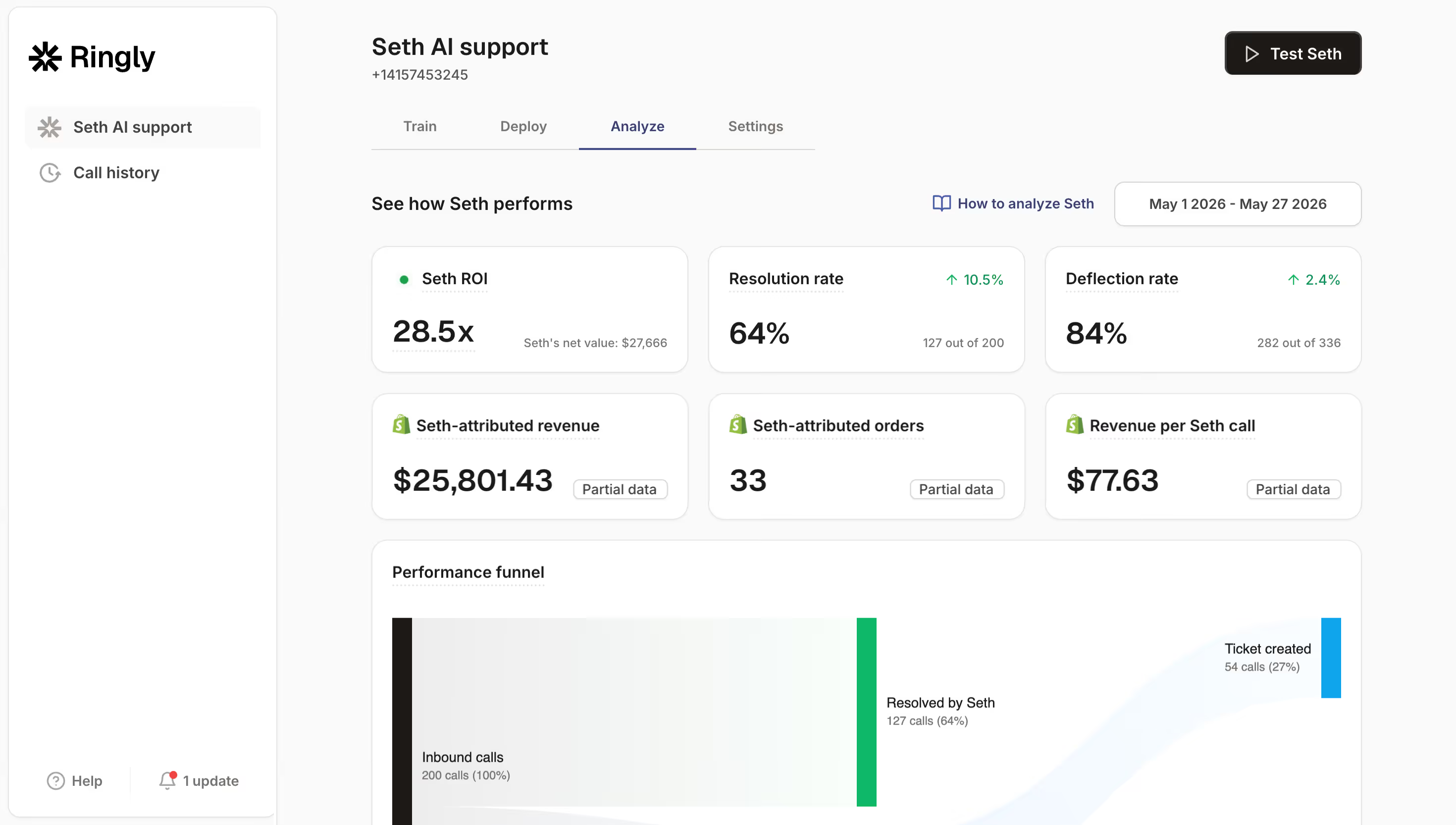
That's exactly the gap Ringly.io fills. Our AI phone agent, Seth, answers your Shopify store's calls 24/7 in 40 languages. It looks up orders, processes returns, answers product questions, and transfers to a human when needed.
Setup takes about three minutes, and 2,100+ Shopify stores already use it. Start your free 14-day trial and see how AI phone support changes your customer experience.
Frequently asked questions
How many Shopify stores are there in 2026?
There are approximately 5.6 million live Shopify stores worldwide as of 2026. Including subdomains and multi-store setups, the total exceeds 9.6 million active storefronts.
What is Shopify's market share?
Shopify holds 10.32% of the global ecommerce platform market and roughly 30% of the US market. Among the top 1 million websites, its share jumps to 23%.
What is the average Shopify conversion rate?
The average Shopify store converts 1.4% to 1.8% of visitors. Top 20% of stores convert above 3.2%, and the top 10% exceed 4.7%.
How much revenue does the average Shopify store generate?
The average Shopify store generates between $104,000 and $235,000 in yearly gross merchandise volume. In monthly terms, that's roughly $8,666 to $19,583.
What percentage of Shopify stores are successful?
About 5-10% of Shopify stores are considered successful, similar to broader ecommerce and small business rates. Stores that invest in marketing, customer service, and ecommerce SEO tend to perform significantly better.
How much did Shopify merchants make during Black Friday 2025?
Shopify merchants generated a record $14.6 billion in sales during BFCM 2025, a 27% increase from 2024. Peak sales hit $5.1 million per minute.
What is the Shopify cart abandonment rate?
The average Shopify cart abandonment rate is approximately 70%, in line with the global ecommerce average. Mobile abandonment runs higher at 75-78%, with unexpected costs at checkout being the top cause.
Is Shopify Plus worth it?
Over 47,000 stores run on Shopify Plus in 2026, and Plus merchants report an average 126% year-over-year growth. If your store does more than $1 million in annual sales, read our Shopify Plus features breakdown.