
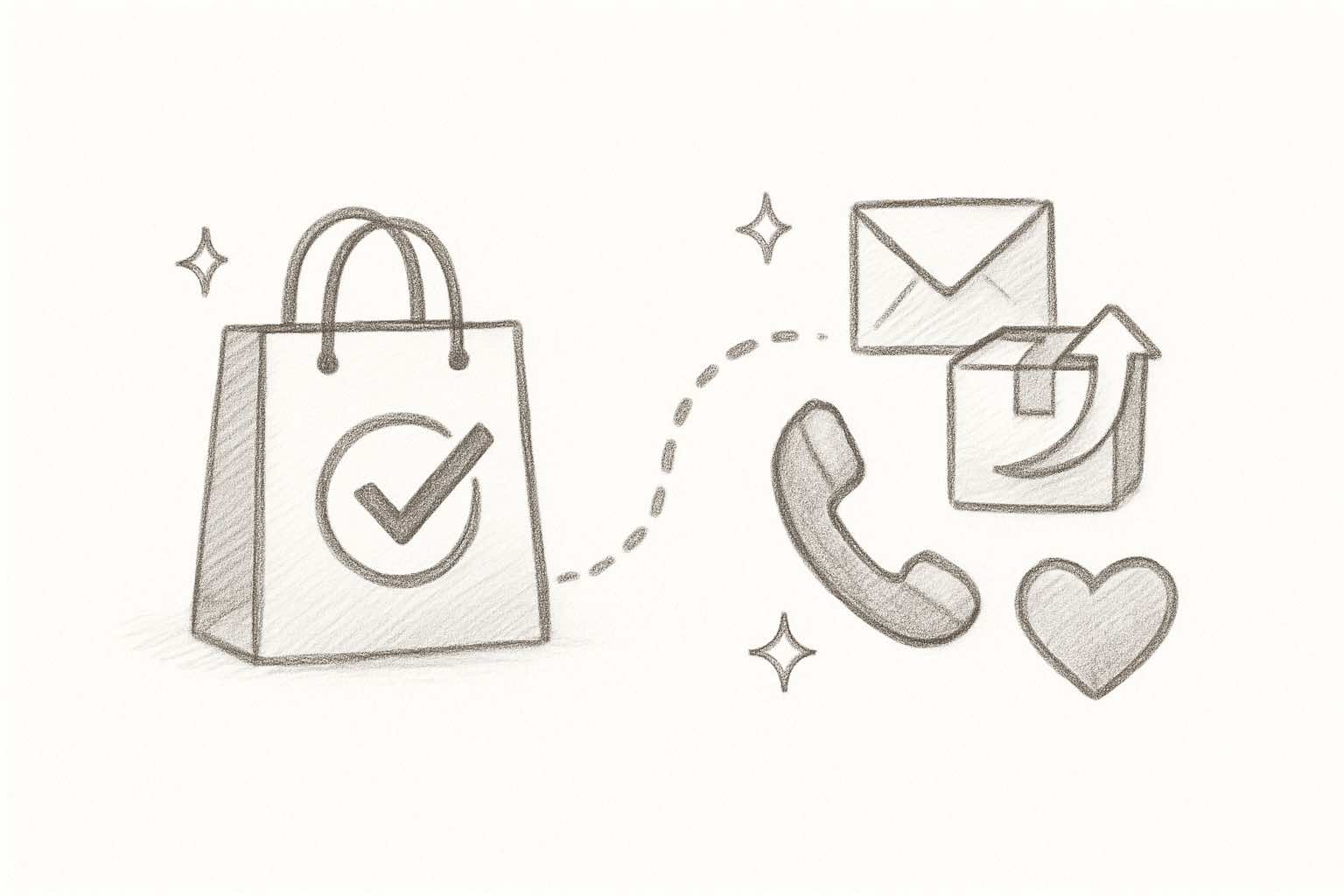
Most Shopify stores pour everything into getting the sale. Ads, email sequences, retargeting, abandoned cart recovery. Then the customer buys, and... radio silence.
That's a problem. According to Narvar's 2025 State of Post-Purchase Report, two-thirds of online shoppers feel anxiety right after clicking "buy." They're wondering if their order went through, when it'll arrive, and whether they made the right choice.
Here's what makes this even more interesting: existing customers convert at 60-70%, compared to just 5-20% for new prospects. They also spend about 67% more per order than first-time buyers. So the moment after checkout is actually where most of your future revenue gets built (or lost).
This guide breaks down every piece of a strong Shopify post-purchase experience, from email sequences to order tracking to the one channel almost nobody talks about: phone support.
Hear what AI support calls sound like for your store. Just paste your Shopify URL and get sample calls in under 20 seconds, no email required. Listen to demo calls for my store.
What is the post-purchase experience (and why most stores get it wrong)
The post-purchase experience is everything that happens between checkout and the next time a customer buys from you. That includes order confirmations, shipping updates, delivery notifications, customer support interactions, returns, review requests, and re-engagement campaigns.
Most Shopify stores treat this as an afterthought. They set up a basic order confirmation email and call it done. But PwC's 2025 Customer Experience Survey found that 52% of consumers stopped buying from a brand after just one bad experience. And 32% will walk away after a single negative interaction.
On the flip side, 94% of customers are more likely to repurchase after a positive service experience. Brands with top-tier customer experience grow revenue 80% faster than their competitors, according to Forrester.
The math is simple. Acquiring a new customer costs 5-25x more than keeping an existing one. Your post-purchase experience is the difference between a one-time buyer and a customer who comes back five more times.
Here are the key touchpoints that make up a complete post-purchase experience:
- Order confirmation: Immediate receipt with order details and estimated delivery
- Shipping and tracking: Proactive updates at every fulfillment milestone
- Delivery confirmation: Notification when the package arrives
- Customer support: Phone, email, and chat availability for questions or issues
- Returns and exchanges: A smooth, self-service process
- Review and feedback requests: Timed requests for product reviews and NPS surveys
- Re-engagement: Cross-sell emails, loyalty invitations, replenishment reminders
The post-purchase email sequence every Shopify store needs
Email is the backbone of your post-purchase experience. But there's a big difference between sending one confirmation email and running a proper sequence.
Here's the six-email framework that covers all the essential touchpoints:
1. Order confirmation (send immediately)
This is the most-opened email you'll ever send. Include a clear order summary, estimated delivery date, and a tracking link. Don't bury these in marketing fluff. Customers want to confirm their purchase went through.
2. Shipping notification (when fulfilled)
Let customers know their order is on the way. Include the carrier name, tracking number, and a direct link to the tracking page. This single email can cut WISMO calls by a significant margin.
3. Delivery confirmation (when delivered)
Confirm the package arrived. This is also a good moment to link to product care instructions, setup guides, or a quick "how to get started" video.
4. Product education (1-3 days after delivery)
Send a follow-up with tips on getting the most from the product. For supplements, that might be dosage reminders. For skincare, a routine guide. For electronics, a setup walkthrough. This reduces returns and builds trust.
5. Review request (7-21 days after delivery)
The timing depends on your product type:
| Product Category | Review Request Timing | Why |
|---|---|---|
| Seasonal items | ~7 days | Catch them while product is in use |
| Consumables (supplements, beauty) | ~14 days | Past the honeymoon phase, honest feedback |
| Hard goods (furniture, electronics) | ~21 days | Enough time to actually use and evaluate |
6. Cross-sell or replenishment (based on product lifecycle)
If you sell consumables, send a replenishment reminder before they run out. For non-consumable products, recommend complementary items based on what they bought.
Typical replenishment timing:
- Supplements: 25-30 days (before a 30-day supply runs out)
- Beauty and skincare: 45-60 days
- Pet food: 30-45 days
- Fashion: 60-90 days (seasonal recommendations)
A common concern: "Won't six emails feel like spam?" It won't. These are spread across 30+ days, each one provides real value, and customers expect transactional updates. The problem isn't too many emails. It's sending emails with no useful content.
You can set up most of this using Shopify Flow for basic automations, or tools like Klaviyo for more sophisticated segmentation and timing.
How to reduce WISMO calls and improve order tracking
"Where is my order?" is probably the most common question your support team handles. Industry data shows WISMO calls make up 30-50% of all support tickets, and during peak seasons like Black Friday, that number can spike above 70%.
Each WISMO inquiry costs about $5 to resolve. For a store doing 500 orders a month, that's potentially $750-1,250 per month in support costs just for order status questions.
Here's how to cut those numbers down:
- Use branded tracking pages: Instead of sending customers to generic carrier tracking (USPS, FedEx), create a branded tracking page on your own domain. Tools like AfterShip and Malomo make this easy. Bonus: these pages get high engagement, so you can add upsell offers or loyalty program invitations.
- Send proactive notifications: Don't wait for customers to ask. Send automated updates at every milestone: order confirmed, picked and packed, shipped, out for delivery, delivered. Shopify's native notifications cover the basics, but third-party apps give you more control.
- Set accurate delivery expectations: Overpromise and underdeliver is the fastest way to generate WISMO calls. Be honest about shipping times at checkout, and update customers immediately if there's a delay.
- Make tracking easy to find: Include tracking links in every transactional email. Add an order tracking page to your site's navigation. The harder it is to find, the more people will call or email.
But here's the thing: even with perfect tracking, some customers will still pick up the phone. Especially for high-value orders, time-sensitive deliveries, or when something goes wrong. That's where phone support becomes critical.
Post-purchase upsells that don't feel pushy
A post-purchase upsell is an offer that appears between checkout completion and the thank-you page. The customer has already paid, their shipping is confirmed, and trust is at its peak. It's the one moment in the entire shopping journey where adding an offer doesn't risk killing the original conversion.
According to Forrester, product suggestions like cross-selling and upselling contribute 10-30% of an online store's earnings. That's significant revenue most stores leave on the table.
Here's how to do it without annoying your customers:
- Keep it relevant: Offer a product that complements what they just bought. Someone who ordered a face serum would appreciate a matching moisturizer at 15% off. Someone who bought running shoes doesn't need a random kitchen gadget.
- Limit to one offer: Don't bombard them with five different products. One targeted offer converts better than a wall of options.
- Make it one-click: The customer's payment info is already saved. A single tap to add the item (no re-entering card details) is what makes post-purchase upsells work. Apps like Rebuy and AfterSell handle this on Shopify.
- Offer a real discount: 10-15% off the upsell item, or free shipping, gives customers a reason to act now rather than think about it later.
- Don't touch the original order: The upsell should add to the existing order, not modify it. Customers need to feel their original purchase is safe and confirmed.
If you want to explore this further, here's our guide on the best Shopify upsell apps.
Try Ringly.io free for 14 days and let AI handle post-purchase order status calls while you focus on growing your store.
Why phone support is the post-purchase channel everyone ignores
Every post-purchase guide you'll find online talks about email sequences, SMS notifications, and upsell pages. Almost none mention phone support. And that's a massive blind spot.
Here's why: 74% of consumers expect customer service to be available 24/7. When a customer has a question about their order, a return they want to make, or a product issue, many of them don't want to wait for an email reply. They want to talk to someone.
The most common post-purchase phone scenarios include:
- Order status checks: "Where's my package?" (this alone is 30-50% of all support)
- Return and exchange requests: Customers often prefer to explain the issue verbally
- Product questions: "How do I use this?" or "Is this compatible with...?"
- Billing concerns: Incorrect charges, subscription questions
- Complaints: When something goes wrong, calling feels more direct than emailing
The traditional barrier has been cost. Hiring a phone support agent runs $25-50/hour, and you need coverage across business hours (at minimum). For a small Shopify store, that's hard to justify.
But AI phone agents have changed the equation. Ringly.io, for example, provides an AI phone agent called Seth that handles inbound calls for Shopify stores 24/7. Seth can look up order status in real-time through your Shopify integration, process return requests, answer product questions from your knowledge base, and transfer to a human agent when the issue needs personal attention.
The numbers: Seth resolves about 73% of calls without human intervention. Setup takes about three minutes. And you're not paying $25/hour for an agent sitting around during slow hours. Plans start at $349/month for 1,000 minutes.
For the post-purchase experience specifically, this means:
- WISMO calls get resolved instantly: Seth pulls the tracking info from Shopify and reads it back to the customer
- Returns are smoother: The AI walks customers through your return policy and initiates the process
- 24/7 availability: Customers who order at midnight and have a question at 2 AM get an answer, not a voicemail
If you're on Shopify and want to hear what this sounds like for your store, try the free demo. It takes 20 seconds.
Returns and exchanges: turning a negative into a loyalty moment
Returns feel like a loss. But handled well, they're one of the strongest customer retention tools you have.
The data backs this up: 92% of consumers say they'll buy again from a store that makes returns easy. And 67% of shoppers check the returns page before they even make their first purchase. Your return policy isn't just a post-purchase concern. It's a pre-purchase conversion factor.
Here's what a strong returns process looks like:
- Self-service portal: Let customers initiate returns without emailing or calling. Tools like Loop Returns create branded return pages where customers select items, choose a reason, and get a shipping label automatically.
- Exchange-first approach: When possible, offer exchanges before refunds. "Would you like a different size instead?" retains the revenue while solving the customer's problem. This is a proven way to reduce your refund rate.
- Proactive status updates: Send return status emails at every step: return received, inspection complete, refund processed. The same communication principles that apply to outbound shipping apply to returns.
- Phone-based returns support: Some customers want to explain why they're returning something. An AI phone agent can walk them through options, suggest exchanges, and process the return, all without waiting in a queue.
The goal isn't to prevent returns. It's to make the experience so smooth that customers trust you enough to order again.
Post-purchase surveys and feedback loops
Feedback is how you find out what's working and what's broken. But timing and format matter more than most stores realize.
NPS (Net Promoter Score) surveys: Send these 3-5 days after delivery, not right after checkout. The customer needs to have actually received and used the product before they can rate their experience. Keep it to one question: "How likely are you to recommend us?"
CSAT (Customer Satisfaction) surveys: Trigger these after any support interaction. Did we solve your issue? Rate your experience. This is especially valuable for tracking phone and chat support quality.
Attribution surveys: "How did you hear about us?" is one of the most underrated questions in ecommerce. Add it to your order confirmation or thank-you page. This data helps you understand which marketing channels actually drive revenue.
Closing the loop: Collecting feedback is only half the job. Respond to negative reviews within 24-48 hours. Acknowledge the issue, explain what you're doing about it, and offer to make it right. Publicly responding to criticism builds more trust than only showcasing five-star reviews.
Tools like Okendo and Shopify's native post-purchase survey extensions can automate all of this.
Building a loyalty program that actually works
A loyalty program should be the natural next step after a great post-purchase experience. But most programs fail because they're too complicated or the rewards are too small to motivate action.
According to Open Loyalty's 2025 survey, 58% of brands saw a measurable increase in repeat purchases after investing in their post-purchase experience. A well-designed loyalty program amplifies those results.
Here's what works:
- Points per dollar spent: Simple. Customers earn 1-2 points per dollar, redeem at clear thresholds (100 points = $5 off). No confusion, no math.
- Tier-based rewards: VIP tiers (Silver, Gold, Platinum) create a sense of progress. Each tier unlocks better perks: free shipping, early access to new products, exclusive discounts.
- Referral bonuses: Give customers $10 (or a percentage discount) for every friend they refer who makes a purchase. This turns your best customers into a customer retention engine.
- Invite early: Include a loyalty program invitation in your delivery confirmation email, not buried in a footer six months later. The post-purchase window is when engagement is highest.
The biggest mistake? Making redemption confusing. If customers can't figure out how to use their points in under 10 seconds, they won't bother.
Ready to see how AI phone support fits into your post-purchase strategy? Start your free trial. Setup takes three minutes.
How to put it all together: your post-purchase checklist
Building a complete Shopify post-purchase experience doesn't need to happen overnight. Start with the highest-impact items and layer in the rest over time.
Phase 1: The basics (week 1)
- Set up a 6-email post-purchase sequence (confirmation, shipping, delivery, education, review request, cross-sell)
- Create a branded order tracking page
- Review and update your return policy
- Add a self-service returns portal
Phase 2: Support and upsells (week 2-3)
- Set up phone support (AI or human)
- Configure one post-purchase upsell offer
- Add a post-purchase survey (NPS or attribution)
- Ensure your response time meets customer expectations
Phase 3: Loyalty and optimization (month 2+)
- Launch a loyalty program with points and referrals
- A/B test your upsell offers
- Analyze survey data and adjust your flow
- Review customer service KPIs monthly
The stores that win at customer retention aren't doing anything magical. They're just methodical about every touchpoint after the sale.
Frequently asked questions
What is the post-purchase experience on Shopify?
It's everything that happens after a customer completes checkout on your Shopify store. This includes order confirmations, shipping updates, delivery notifications, customer support interactions, returns, review requests, and re-engagement emails. The goal is to turn one-time buyers into repeat customers.
How many post-purchase emails should I send?
Six is the standard framework: order confirmation, shipping notification, delivery confirmation, product education, review request, and cross-sell or replenishment. Spread over 30+ days, this doesn't feel like spam since each email provides genuine value to the customer.
Do post-purchase upsells hurt conversion rates?
No, because they appear after the original purchase is already complete. The customer's order is confirmed and their payment processed before they ever see the upsell offer. When done right (relevant product, one offer, one-click acceptance), post-purchase upsells can add 10-30% to your revenue without any risk to the initial conversion.
What percentage of support tickets are WISMO calls?
WISMO ("Where Is My Order?") calls typically make up 30-50% of all ecommerce support tickets. During peak seasons like Black Friday, that number can spike above 70%. Each one costs about $5 to resolve, making proactive tracking and automated order updates one of the highest-ROI investments you can make.
Should I offer phone support for my Shopify store?
Yes. 74% of consumers expect 24/7 service availability, and phone is the preferred channel for urgent issues like missing orders or return requests. If cost is a concern, AI phone agents like Ringly.io start at $349/month and handle most common post-purchase questions automatically, including real-time order lookups from your Shopify store.
When should I send review request emails?
It depends on your product. For seasonal items, aim for 7 days after delivery. For consumables like supplements or skincare, wait about 14 days so customers can form an honest opinion. For hard goods like furniture or electronics, give it 21 days. Sending too early means the customer hasn't used the product yet. Sending too late means they've forgotten about it.
How do I measure post-purchase experience success?
Track these metrics: repeat purchase rate (target 28%+ for ecommerce), customer satisfaction score (CSAT), Net Promoter Score (NPS), WISMO ticket volume, return rate, and customer lifetime value. Compare month-over-month. If your repeat rate is climbing and your WISMO tickets are dropping, you're on the right track.
The bottom line
The Shopify stores that build real revenue aren't just good at acquisition. They're good at what happens after.
Start with the basics: a solid email sequence and branded tracking. Then add support channels (especially phone), upsell offers, and a loyalty program. Each layer compounds the one before it.
Phone support is the piece most guides skip entirely. But when a customer calls about their order and gets an instant, helpful answer instead of a voicemail box, that's the kind of experience that turns a one-time buyer into a loyal customer.
Try Ringly.io free for 14 days and see how AI phone support fits into your post-purchase experience. Setup takes three minutes, no code required.