
Pull up your helpdesk and filter for "where" in the subject line. Then add "tracking", "shipped", and "order status". Whatever you just counted is your WISMO problem.
For most Shopify brands, that filter returns 30-50% of their entire support inbox. At an average fully-loaded cost of $5-$15 per ticket, that's the support budget you can claw back. A 500-order/month store with 40% WISMO bleeds roughly $1,400 a month on people asking where their package is. A 5K-order/month store typically spends $50K a year on the same question.
The good news: WISMO ticket volume is not random and not inevitable. It follows predictable triggers, and the deflection stack to cut it 60-80% is well-understood. This guide covers what counts as a WISMO ticket, what they actually cost you, why they spike, and the layered playbook that quietly disappears most of them.
Hear what AI support calls sound like for your store. Just paste your Shopify URL and get sample calls in under 20 seconds, no email required. Listen to demo calls for my store.
What counts as a WISMO ticket
WISMO stands for "Where Is My Order?" A WISMO ticket is any inbound customer contact whose primary purpose is asking about the status, location, ETA, or delivery exception of an order they've already placed.
It shows up on every channel:
- Email: "Hi, just checking on my order #1234, when will it ship?"
- Chat: "where is my package"
- Phone: "Hey, I ordered three weeks ago and tracking says it's still in California"
- SMS/DMs: "any update on my order?"
The phrasing varies. The intent doesn't. They want a status update, not a conversation.
It's worth being honest about the boundary cases. Some tickets start as WISMO and escalate into something else:
| Ticket type | Counts as WISMO? |
|---|---|
| "When will my order ship?" | Yes |
| "Tracking hasn't updated in 4 days" | Yes |
| "Carrier says delivered but I don't have it" | Yes (starts as WISMO, may escalate to lost-package) |
| "Can I change my shipping address?" | Adjacent. Operational, but often WISMO-adjacent |
| "I want to return this" | No (returns, post-delivery) |
| "Does this come in black?" | No (product question, pre-purchase) |
| "Cancel my order" | No (modification request) |
The reason this matters: when you start measuring WISMO, you need a clean definition. Most teams underestimate the share because they don't count chat conversations or phone calls. Build the count across every channel, or you'll plan the deflection stack at half-size.
How much WISMO tickets actually cost you
The benchmarks are uncomfortable. The Gorgias 2024 ecommerce CX report puts WISMO at 30-50% of all DTC support contacts. Zendesk's CX Trends data has order-status as the number-one contact reason in retail. Richpanel reports the same range across its Shopify customer base.
The cost-per-ticket math is the other half of the problem:
- Email tickets: $5-$10 fully loaded (agent salary, time per ticket, helpdesk seat, escalation overhead) per Help Scout's 2024 benchmarks
- Chat tickets: $4-$10 (similar to email, sometimes shorter)
- Phone tickets: $7-$16 per call for outsourced BPO. In-house phone reps land at $4-$8 per call depending on salary and call length
Multiply ticket share by ticket cost across your monthly volume and you get the line item your finance team should care about:
| Store size (orders/mo) | WISMO % | Tickets/mo (50% contact rate) | Cost @ $7/ticket | Annual WISMO cost |
|---|---|---|---|---|
| 500 | 40% | ~100 | $700 | $8,400 |
| 1,500 | 40% | ~300 | $2,100 | $25,200 |
| 5,000 | 45% | ~1,125 | $7,875 | $94,500 |
| 15,000 | 45% | ~3,375 | $23,625 | $283,500 |
The numbers assume roughly half of orders generate a support contact (varies wildly by vertical and shipping quality). The point isn't precision. It's that the WISMO line item is bigger than most founders realize. Most operators only see it as "we need another rep". That's the wrong frame.
Phone WISMO is the most expensive ticket type in the stack. It's also the most emotional, since the customer dialed in instead of typing. If you want a faster read on what your phone-side WISMO costs look like, see our breakdown of WISMO calls. For the broader context, our ecommerce customer support statistics for 2026 lays out the full picture.
If you want to skip the math and just hear what AI phone support sounds like on your own store's calls, try Ringly free for 14 days. Setup takes under an hour.
Why WISMO tickets spike (it's not random)
Every store I've audited has the same set of root causes. WISMO volume isn't a weather event. It's a leak.
- Vague shipping windows on the product page. "5-7 business days" means day 1 to the customer. Their clock starts at checkout, not at fulfillment.
- No proactive shipping notifications past the order confirmation. Shopify sends one email at order placement and one when the label is generated. That's it. The customer hears nothing for days.
- Tracking links that dump customers onto a plain carrier page. UPS and USPS pages confuse the average shopper. The status reads as nothing happening when something actually is.
- Carrier exceptions go unflagged. Stuck packages, address corrections, weather delays. Your customer notices before you do because nobody on your team is watching the tracking feed.
- No self-serve order lookup on your storefront. They can't find their order, so they email instead. If your tracking page requires a login, that counts as no self-serve.
- BFCM and promo spikes without scaled rep capacity. Volume goes 3x. Headcount doesn't. The queue blows up and people call instead of waiting.
There's a quote pattern I see across Reddit's r/shopify and the Klaviyo community that sums it up:
"Half my inbox is 'where is my order' and our shipping notification only goes out once when the label is created."
WISMO is not a support problem. It's a communication problem. The fix is to communicate before the customer asks, not to staff up to answer faster.
The WISMO deflection hierarchy
There's a five-layer model that works for every Shopify brand we've seen, regardless of vertical. Build top-down, not bottom-up.
- Prevent: set accurate expectations before they buy
- Inform: proactive notifications at every shipping event
- Self-serve: branded tracking page they can use without logging in
- Automate: AI on chat, email, and phone for the contacts that still happen
- Escalate: only the real exceptions (lost, damaged, address dispute) reach a human
Typical deflection rates per layer, stacked cumulatively:
| Layer | WISMO reduction (cumulative) |
|---|---|
| Layer 1+2 alone | 30-40% |
| Add Layer 3 (branded tracking) | +20-30% |
| Add Layer 4 (AI on the remaining contacts) | +30-50% of what's left |
| Full stack | 60-80% total ticket reduction |
The mistake most stores make: jumping straight to Layer 4 (buying a chatbot) before fixing Layer 1+2. You can automate a WISMO conversation, but if your customer never got a shipping update in the first place, you've solved the wrong problem.
Layer 1+2: prevent and inform
Most WISMO reduction comes from this layer, and most stores under-invest in it.
Pre-purchase clarity is the cheapest fix:
- Display a specific delivery window on every product page, not just "5-7 business days"
- Show "Order in the next X hours for delivery by Y" on the cart page
- Send an order confirmation that names the expected delivery date, not just the order details
Post-purchase notifications are where the real deflection happens. The default Shopify shipping confirmation is not enough. You need a notification at every meaningful event:
- Order placed (Shopify default, fine)
- Label created (default, also fine)
- In transit / first carrier scan
- Out for delivery
- Delivered
- Exception (delayed, returned to sender, address issue)
The Wonderment 2024 post-purchase report shows brands using proactive notifications reduce WISMO contacts by 20-30% on average. Klaviyo's published benchmarks put shipping SMS open rates above 95%, which is why SMS notifications work harder than email for the in-transit alerts.
Tools that handle this well: Klaviyo for email + SMS, Wonderment for the full post-purchase tracking layer, Malomo for branded notification flows, Postscript for US-focused SMS. If you're a current Klaviyo user, our Klaviyo alternatives breakdown covers what's worth switching to if you've outgrown the base tier.
Three quick wins you can ship this week:
- Add 4 missing shipping notifications: in-transit, out-for-delivery, delivered, exception
- Switch tracking links to SMS for the out-for-delivery alert (95%+ open rate)
- Rewrite your product page shipping copy with a specific delivery window, not a range
Layer 3: branded self-serve tracking
A branded tracking page is the cheapest way to convert "where is my order" emails into self-serve clicks. It's not optional anymore.
Why branded beats carrier-default:
- Customers stay on your domain instead of confusing UPS/USPS pages
- You can show order details, estimated delivery, and a clear progress timeline
- You can embed an FAQ that handles the next-most-common question ("what if it's delayed?")
- You get a remarketing surface (upsells, related products) on a page customers visit 3-7 times per order
Tools that handle this well:
- AfterShip ($11/mo Essential): the most established. Branded tracking page, 1,200+ carriers, decent UI
- Parcel Panel (free up to 20 orders/mo, $11+ paid): Shopify-native, cleaner UX for newer stores
- Wonderment ($99/mo starter): post-purchase + tracking page combo, premium positioning
For the broader picture on tracking and self-serve flows, see our ecommerce order tracking guide. If you're shopping for a fuller automation stack across multiple layers, our WISMO automation for Shopify post walks through the 4-layer stack with specific tool picks.
Layer 4: automate the WISMO ticket itself
Even with Layers 1-3 dialed in, some customers will still contact you. The deflection job at Layer 4 is to resolve those contacts without a human. The play differs by channel.
Email WISMO
This is the easiest channel to automate. Two moves cover most of it:
- Auto-reply with the order tracking link: when the customer's email contains an order number or hits the WISMO macro trigger, your helpdesk fires back a templated reply with the live tracking URL. Cuts roughly 50% of WISMO email volume on its own
- Macro libraries for common follow-ups: stuck shipment, lost-package claim, address change. Agents pick a macro instead of writing from scratch
Helpdesks that do this well: Gorgias, Zendesk, Richpanel, Reamaze, Help Scout. If you're comparing options, our Gorgias alternatives breakdown covers the tradeoffs honestly. For Shopify-specific helpdesks, the Shopify helpdesk app guide is the right starting point.
Chat WISMO
Chat is where AI chatbots earn their keep. The good ones integrate directly with Shopify and look up order status without an agent touching the conversation.
- What works: order-lookup-via-chatbot resolves 40-60% of chat WISMO without a human (Tidio and Gorgias Automate published metrics)
- What doesn't: scripted chatbots without live Shopify integration. They frustrate customers because they can't actually answer the question
- Tools: Tidio, Gorgias Automate, Siena AI, Zowie, Fin. Each handles WISMO differently; some are better at chat-only, others span email + chat
Phone WISMO
This is the channel nobody covers. Phone WISMO is the most expensive ticket type ($7-$16 per call for human BPO), the most emotional (the customer is anxious enough to dial), and the most invisible to most ops teams because the calls don't sit in a helpdesk queue.
Chatbots don't help phone WISMO. You need an AI voice agent that:
- Picks up 24/7 (the calls usually come after hours and on weekends)
- Asks for the order number, phone number, or email to find the order
- Pulls live Shopify order status, tracking link, and estimated delivery
- Texts the tracking link to the caller's phone mid-call so they have a record
- Escalates only the real exceptions (lost, damaged, address dispute) to a human
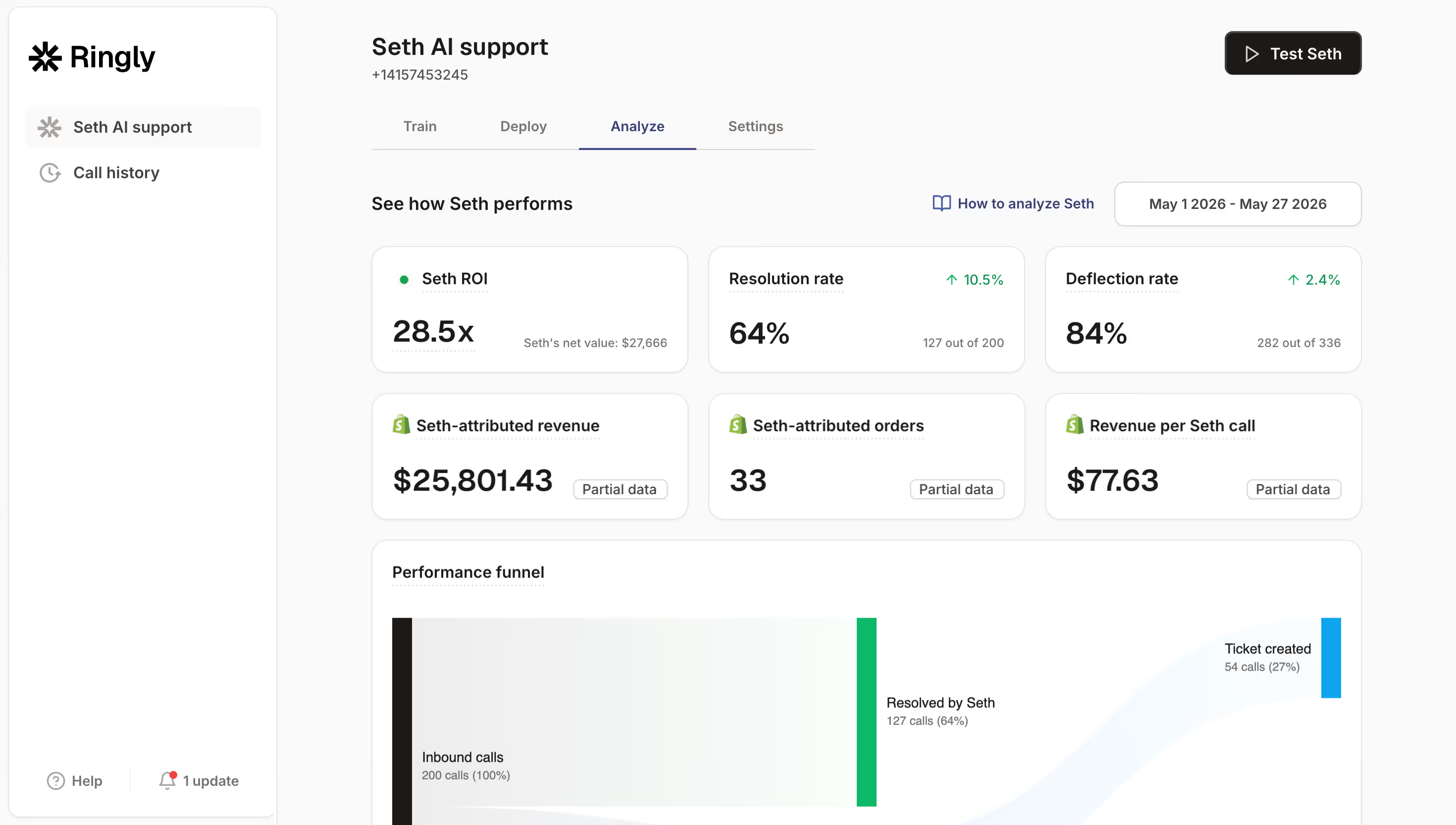
This is exactly what Ringly.io does for Shopify brands. The AI resolves 73% of inbound calls autonomously across 50+ brands at roughly $0.42 per resolved call. On WISMO specifically, that resolution rate climbs to about 81% solo, because order-status is the cleanest use case for an AI voice agent. Median WISMO call length: under a minute. Customer hangs up calmer because they have the tracking link in their text messages, not because the conversation soothed them.
For more on how AI handles the phone channel, see our AI phone agents for Shopify explainer and the voice AI customer support overview.
Ready to see what AI phone support looks like on your own store? Start your free trial. Live in under an hour.
A 30-day WISMO deflection plan
Don't try to ship the full stack in one sprint. A four-week rollout works better and lets you measure each layer's lift.
- Week 1: audit. Filter your helpdesk for WISMO tickets across email, chat, and phone. Get a baseline volume, average resolution time, and cost per ticket. This number is your before
- Week 2: ship Layer 1+2. Add the 4 missing shipping notifications. Rewrite PDP shipping copy with a specific window. Move the out-for-delivery alert to SMS. Expect 20-30% volume drop by end of week
- Week 3: ship Layer 3 + Layer 4 on highest-volume channel. Install a branded tracking page (AfterShip or Parcel Panel). Pick the channel with the most WISMO volume (usually email) and turn on auto-reply with the tracking link
- Week 4: measure and expand. Compare to your Week 1 baseline. Add the next-channel Layer 4 (chat AI if chat is heavy, phone AI if you take calls). Lock in the metrics dashboard
What good looks like by Day 30:
- WISMO ticket volume down 50-70%
- Average WISMO resolution time down 60-80%
- One or two reps reallocated to higher-value work instead of replying to "where is my order"
- Customer satisfaction score on shipping inquiries up 10-20 points (because they got the answer faster)
If you want a per-channel deep dive, first-call resolution for ecommerce covers the phone-side measurement, and customer service response time benchmarks gives you the targets for email and chat.
Mistakes that quietly inflate WISMO ticket volume
These are the patterns I see when I audit a store with a WISMO problem:
- Sending one shipping email and calling it a day. The Shopify default is the floor, not the ceiling. Brands that ship 6+ notifications per order have half the WISMO of brands that ship 2
- Tracking page that requires login. The customer doesn't want to dig out their password. They'll email instead
- Auto-reply that doesn't include the tracking link. Some helpdesks fire back a "we'll get to your ticket soon" auto-responder without the actual answer. That doubles the contact count
- Chatbot without Shopify order lookup. Scripted bots that can't actually pull order data frustrate customers and inflate human-handoff rates
- Ignoring phone WISMO because "nobody calls anymore". They call. They call during BFCM, after hours, and when their tracking has been stuck for 4 days. If you don't have a number or it goes to voicemail, you're losing trust, not contacts
- Counting deflection by ticket-closure, not customer satisfaction. A customer who gets ignored "closes" the ticket too. Measure CSAT on the deflected contacts, not just closure rate
The pattern across all six: stores treat WISMO as a queue management problem when it's a customer communication problem. Fix communication and the queue empties on its own.
How Ringly handles phone WISMO for Shopify brands
Ringly.io is AI phone support for Shopify brands. Your team wasn't hired to read the same tracking link to 50 different callers a day. Instead of growing your support headcount every time call volume goes up, the AI takes the routine inbound calls so your team can focus on the work that actually moves revenue.
On a WISMO call specifically, here's what happens. The customer dials your existing phone number. Seth (our AI voice agent) picks up, greets them in your brand voice, and asks for the order number, phone number, or email to find the order. The AI hits the check order status action against your live Shopify store, reads the current status and estimated delivery, and texts the tracking link to the caller's phone mid-call. If the package shows a real exception (lost, damaged, address dispute), the call escalates cleanly to your team with the full context preserved. If not, Seth wraps up in under a minute and the customer hangs up with a tracking link in their messages.
Across 50+ brands, the AI resolves 73% of inbound calls autonomously at roughly $0.42 per resolved call. On WISMO specifically, that climbs to about 81%. Plans: Grow $349/mo (1,000 minutes), Pro $799/mo (2,500 minutes), Enterprise custom. 14-day free trial on Pro. Live in under an hour. If the AI resolves under 65% of your calls in 90 days, we refund the last 3 months of subscription fees.
Want to see what your store's AI phone support sounds like? Try Ringly.io free for 14 days. Live in three minutes.
Frequently asked questions
What is a WISMO ticket?
A WISMO ticket is any inbound customer contact (email, chat, phone, SMS, social DM) where the primary question is the status, location, ETA, or delivery exception of an order they've already placed. The acronym stands for "Where Is My Order?". WISMO is the single largest ticket category for most DTC and Shopify brands.
What percentage of ecommerce support tickets are WISMO?
30-50% of all DTC support contacts are WISMO, per the Gorgias 2024 ecommerce CX report and corroborating Zendesk and Richpanel data. The number is higher in dropshipping and consumer electronics (50-70%) and lower in subscription products (10-20%). Post-BFCM, expect 2-3x your normal WISMO volume.
How much does a WISMO ticket cost?
Email and chat tickets run $5-$10 fully loaded per Help Scout's 2024 benchmarks. Phone tickets cost $7-$16 per call for outsourced BPO, or $4-$8 in-house. A 500-order/month store with 40% WISMO and $7 average ticket cost spends roughly $8,400 a year on order-status questions.
What's the best tool to reduce WISMO tickets?
No single tool solves it. The deflection stack is layered: proactive notifications (Klaviyo, Wonderment), branded tracking page (AfterShip, Parcel Panel), AI on chat and email (Gorgias Automate, Tidio), and AI on the phone (Ringly). Most brands get the biggest single-tool lift from adding the in-transit and out-for-delivery notifications they're missing.
Can you fully automate WISMO?
No, and you shouldn't try to. The goal is to automate the 60-80% of WISMO contacts that are routine status checks, and escalate the remaining 20-40% (lost packages, damaged shipments, address disputes) to a human. AI handles the scale; humans handle the exceptions. That's the right division of labor.
How does Ringly handle WISMO calls?
Ringly's AI voice agent picks up your phone calls 24/7, asks for the order number or callback number to find the order, pulls live status from your Shopify store, reads it back, and texts the tracking link mid-call. On WISMO calls specifically, Seth resolves about 81% solo. The remaining 19% (real exceptions) escalate to your team with full call context preserved.
Does reducing WISMO tickets hurt customer experience?
No, it improves it. The Convey post-purchase report shows 70% of customers expect a shipping update within 24 hours of placing an order, and 88% rank proactive shipping communication as important or very important. Deflection done right means customers get the answer faster, not that they get ignored. CSAT on deflected contacts typically goes up, not down.
The bottom line on WISMO tickets
WISMO is not a support problem. It's a communication problem disguised as a support problem.
The brands that fix it stop hiring reps and start shipping notifications, branded tracking pages, and AI on the channels customers actually use. The stack pays back inside 30 days. The conversation about "we need more support headcount" goes away. Your team gets to work on the contacts that actually move revenue.
If your phone is part of the WISMO pile, Ringly.io is built exactly for this. Start your free trial and hear what Seth sounds like answering your store's calls.