

Most advice about ecommerce customer service best practices reads like a generic checklist. "Be responsive." "Use multiple channels." "Be nice." Not exactly actionable.
Here's what those articles miss: customer service isn't a cost center. It's a revenue engine. Businesses that nail their support see 93% repeat purchase rates and a 5% bump in retention can translate into 25-95% higher profits, according to research from Bain & Company.
So the question isn't whether you should invest in ecommerce customer service. It's which practices actually move the needle, and how to implement them when you're running a small team.
This guide covers 12 best practices that are tied to real data, practical to implement, and focused on the stuff most articles skip entirely (like phone support, which happens to be the highest-satisfaction channel in ecommerce).
Hear what AI support calls sound like for your store. Just paste your Shopify URL and get sample calls in under 20 seconds, no email required. Listen to demo calls for my store.
Why ecommerce customer service directly impacts your revenue
Let's put some numbers on this.
According to a PwC study, 86% of consumers are willing to pay more for a better customer experience. And 89% of customers say they'll buy again from a brand after a positive service interaction.
That's not just a feel-good metric. It shows up in your bottom line.
Consider the retention angle: companies with strong omnichannel customer engagement retain 89% of their customers, compared to just 33% for companies with weak engagement. If you're spending money on ads and acquisition, losing customers because of bad support is like pouring water into a bucket with holes.
The real shift happens when you stop thinking about customer service as "handling complaints" and start treating it as customer retention strategy. Every support interaction is a chance to either lose a customer or turn them into a repeat buyer.
And the data backs this up. Customers with positive service experiences have 140% higher lifetime value than those who don't.
12 ecommerce customer service best practices for 2026
1. Set response time targets and track them religiously
Speed kills in ecommerce support. Not speed as in being fast, but the lack of it.
Research shows that sub-one-hour responses achieve 71% customer retention, compared to just 48% for responses that take 24 hours. And 90% of customers rate "immediate" responses as important, with 60% defining "immediate" as under 10 minutes.
Here are the benchmarks you should aim for:
| Channel | Target Response Time |
|---|---|
| Under 4 hours | |
| Live chat | Under 30 seconds |
| Phone | Under 3 rings |
| Social media | Under 1 hour |
Don't just set these targets. Track them. Brands that consistently measure response time benchmarks improve retention by 22% on average.
The easiest way to start? Pick one metric (first response time) and make it visible to your whole team.
2. Offer omnichannel support, but start with two channels done well
Here's the thing about omnichannel: it works, but only if you actually do it well.
Companies with strong omnichannel engagement retain 89% of customers. But trying to be everywhere at once with a small team? That's a recipe for slow responses on every channel.
Start with two channels:
- Email: It's asynchronous. You can batch responses 2-3 times per day. Great for detailed questions and documentation.
- Live chat: It's the highest-satisfaction digital channel at 87%. Customers love the speed, and it lets agents handle multiple conversations at once.
Once you've nailed those, add phone support. Then social media. The key is doing fewer channels excellently rather than five channels poorly.
A common mistake: launching on Instagram DMs, Facebook Messenger, WhatsApp, email, and live chat all at the same time. Your response time tanks across all of them, and customers notice. Two channels with fast responses beats five channels with slow ones every time.
If you're building out your customer service team structure, prioritize channel depth over channel breadth.
3. Build a self-service knowledge base before anything else
This one's almost counterintuitive. You'd think investing in more agents would be the first move. But the data says otherwise.
88% of customers expect brands to have a self-service portal, according to Statista. And 67% actually prefer finding answers themselves over contacting support.
A solid knowledge base reduces ticket volume by 20-40%. That's real time and money back in your pocket.
What to include:
- Shipping and delivery FAQs: where's my order, delivery times, shipping costs
- Return and exchange policies: step-by-step instructions, not legal language
- Product guides: sizing, care instructions, compatibility
- Order tracking portal: let customers check status without emailing you
Start with the 10 questions your team answers most. Write clear, specific answers. Put them somewhere easy to find. Product-level FAQs alone can reduce returns by up to 15%.
4. Add phone support (the highest-satisfaction channel you're probably ignoring)
Most ecommerce articles barely mention phone support. That's a mistake.
Phone is still preferred by 32% of consumers for support, and it scores highest for satisfaction on complex issues. When a customer has a real problem (wrong item, damaged delivery, billing issue), they want to talk to someone.
The reason most small stores skip phone support is cost. Hiring someone to answer calls 24/7 is expensive. But that's changed.
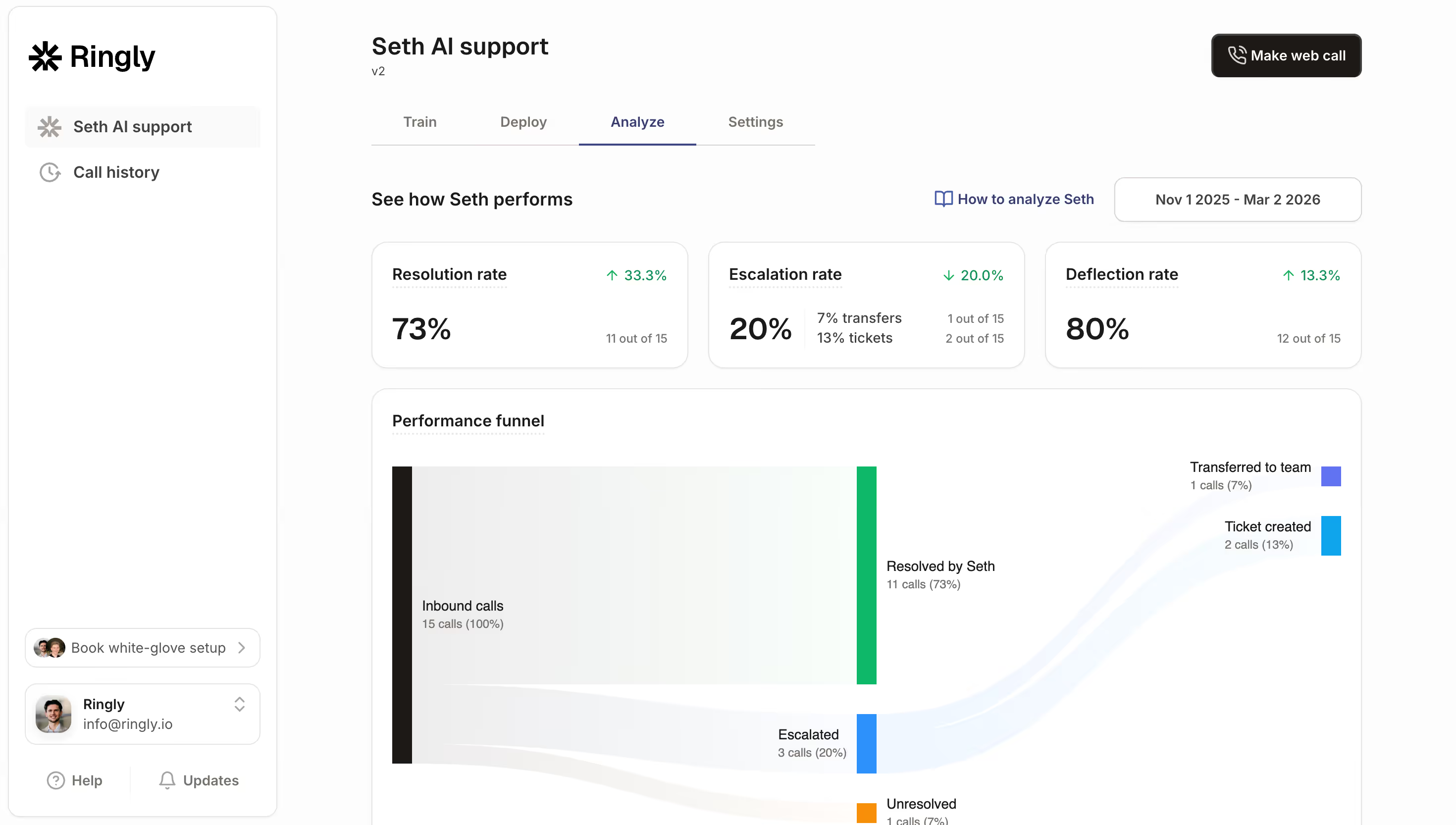
AI phone agents now handle the heavy lifting. Ringly.io, for example, uses an AI agent called Seth that answers calls for Shopify stores 24/7 in 40 languages. It looks up orders, processes returns, and resolves about 73% of calls without needing a human. Setup takes roughly three minutes.
If you've been avoiding phone support for your ecommerce store because of cost, AI voice agents have eliminated that barrier. You get the benefits of phone support without the headcount.
See what AI phone support sounds like for your store. Setup takes three minutes and you can try it free for 14 days.
5. Automate the repetitive stuff so humans handle what matters
Here's a stat that should change how you think about automation: AI-powered interactions cost between $0.50 and $3.00 per resolution. Human agent interactions cost $6.00 to $13.50. That's a 4-12x difference.
And it's not just about cost. Applying AI to customer care functions can raise productivity by 30-45%, according to McKinsey.
The trick is knowing what to automate and what to keep human.
Automate these:
- WISMO (where is my order) calls: the single most common support request
- Return status checks: "Has my refund been processed?"
- Order confirmations and shipping updates: proactive notifications
- Basic product questions: sizing, availability, store hours
Keep these human:
- Complex complaints: angry customers need empathy, not a bot
- High-value customer issues: your top 10% of spenders deserve personal attention
- Unique situations: anything outside your standard playbook
AI voice agents handle the first category perfectly. They answer the phone, look up order details, and resolve routine issues instantly. Your team can then focus on the conversations that actually require a human touch.
6. Personalize every interaction with customer context
According to Epsilon research, 80% of consumers are more likely to purchase from a brand that offers personalized experiences. In customer service, personalization isn't about fancy AI recommendations. It's about context.
Simple personalization that works:
- Use the customer's name: basic, but many brands still don't
- Reference their order history: "I see you ordered the blue jacket last week"
- Acknowledge past issues: "I know you had a shipping delay last time, so let me make sure this one goes smoothly"
- Segment by value: your VIP customers should get faster response times and more flexibility
This requires your support tools to have customer context. If your agents are asking "what's your order number?" every time, you're already behind. A good helpdesk pulls up customer data and order history automatically.
7. Be proactive, not just reactive
Reactive support waits for customers to complain. Proactive support solves problems before they become complaints.
The difference shows up in your metrics. Proactive brands see fewer inbound tickets, higher CSAT scores, and stronger repeat purchase rates. It's also one of the biggest trust builders in ecommerce.
Proactive support examples:
- Shipping delay notifications: email or text the customer before they ask. A simple "Your order is running 2 days behind schedule" prevents a flood of WISMO tickets.
- Order status updates: send automatic updates at each fulfillment stage. Shopify and most helpdesks make this easy to configure.
- Cart abandonment follow-ups: a quick phone call or email recovering a lost sale. Phone calls convert at significantly higher rates than email for abandoned carts.
- Product care reminders: post-purchase emails with usage tips and care instructions
- Restock alerts: notify customers when their favorite item is back in stock
Proactive communication reduces inbound ticket volume and makes customers feel like you're on top of things. It's one of the easiest ecommerce customer service best practices to implement because most of it can be automated through your email or SMS platform.
8. Create a clear, generous return policy
Returns aren't a problem to minimize. They're a trust signal.
According to Baymard Institute, 17% of US online shoppers have abandoned an order specifically because of an unclear or complicated return process. That's real revenue walking out the door.
Your return policy should be:
- Easy to find: linked in the footer, product pages, and checkout
- Written in plain language: no legal jargon
- Generous on timeframe: 30 days minimum, 60 or 90 if possible
- Clear on process: step-by-step instructions, prepaid labels if you can afford it
A good return experience actually increases customer loyalty. Brands that make returns easy and transparent see higher repeat purchase rates. If you're concerned about abuse, track your return rate data and adjust policies based on what you see, not on fear.
And if you're on Shopify, there are specific strategies to reduce your refund rate without making the process painful.
9. Cover after-hours and weekends
Most ecommerce shopping happens in the evenings and on weekends. But most customer service teams work 9-to-5. See the problem?
If a customer has a question at 9 PM on a Saturday and can't get help, they're either abandoning their cart or buying from someone else.
Your options for after-hours coverage:
- Self-service knowledge base: available 24/7, handles basic questions
- AI chatbots: cover chat outside business hours
- AI phone agents: handle calls around the clock without overtime
- After-hours answering services: outsourced, but can be expensive
The most cost-effective option for small to mid-size stores is combining a good self-service setup with an AI phone agent. You get full 24/7 coverage without hiring a night shift.
Try Ringly.io free for 14 days and get Seth answering calls in under three minutes.
10. Train your team on product knowledge, not just scripts
Customer service scripts have their place. But a team that only knows scripts is limited to handling the exact scenarios those scripts cover.
Product knowledge is different. When your agents truly understand what you sell, they can:
- Recommend alternatives: "That one's out of stock, but this version works even better for your use case"
- Troubleshoot creatively: solve problems the script doesn't cover
- Build genuine rapport: customers can tell when someone actually knows the product
- Upsell naturally: not as a sales tactic, but as genuine help
Invest in customer service training that goes beyond memorizing responses. Have your agents use the products. Let them sit in on product development calls. Give them authority to resolve issues without escalating every decision.
The empowerment piece matters more than people think. If every slightly unusual request has to be escalated to a manager, your response time tanks and the customer feels like they're dealing with someone who can't actually help. Give agents clear guardrails (discount limits, refund authority, replacement policies) and let them make calls within those bounds.
And if you're using customer service scripts, treat them as guidelines, not gospel.
11. Collect and act on customer feedback
Collecting feedback is easy. Acting on it is where most brands fall short.
Here's a simple feedback loop:
- Post-interaction CSAT survey: one question, right after the conversation
- Quarterly NPS survey: tracks overall brand sentiment
- Support ticket tagging: categorize issues to spot patterns
- Close the loop: tell customers what you changed because of their feedback
The "close the loop" part is critical. When a customer sees that their complaint actually led to a change, they become more loyal, not less. It turns a negative experience into a trust-building moment.
Track your customer service KPIs consistently. The trends matter more than any single data point.
12. Track the metrics that actually matter
Not all metrics are created equal. Here are the ones worth tracking for ecommerce customer service:
| Metric | What It Measures | Benchmark |
|---|---|---|
| First contact resolution (FCR) | % of issues resolved in one interaction | 70-75% |
| CSAT score | Customer satisfaction after interaction | 82% average, aim for 85%+ |
| Average first response time | How fast you reply | Under 4 hours (email) |
| Customer retention rate | % of customers who buy again | 60-70% for strong brands |
| Cost per resolution | What each ticket costs you | $2-6 depending on channel |
The ecommerce customer support statistics show that brands tracking all three core metrics (CSAT, response time, resolution time) improve retention by 22%.
Focus on first call resolution especially. It's the single metric that most strongly predicts customer satisfaction. When you solve someone's problem on the first try, everything else follows.
Common ecommerce customer service mistakes to avoid
Even with best practices in place, certain mistakes can undermine your effort. Watch for these:
- Hiding your contact information: if customers can't find how to reach you, they'll assume you don't want to be reached. That kills trust. Put your phone number, email, and chat widget where people can actually see them.
- Ignoring phone as a channel: the data is clear. Phone support drives the highest satisfaction for complex issues. Skipping it means losing your most frustrated (and often most valuable) customers. With AI phone agents, cost is no longer a valid excuse.
- Over-automating without escalation paths: automation is great until a customer genuinely needs a human and can't reach one. Always build in clear handoff points. Every automated flow should have a "talk to a person" option.
- Treating customer service as a cost center: the brands that win treat support as a revenue function. Every interaction is either building loyalty or eroding it. The 140% higher LTV for satisfied customers proves this.
- Not tracking anything: if you're not measuring response times, resolution rates, or satisfaction scores, you're flying blind. Start with one metric and build from there.
- Copying competitors instead of listening to customers: your customers will tell you what they need if you ask them. Don't assume what works for a brand 10x your size will work for you.
Frequently asked questions
What are the most important ecommerce customer service channels?
Email and live chat are the best starting points for most stores. Live chat has the highest digital satisfaction rate at 87%, while email lets small teams batch responses efficiently. Add phone support once your foundation is solid, as it drives the highest satisfaction for complex issues.
How fast should an ecommerce store respond to customer inquiries?
Aim for under 4 hours on email, under 30 seconds on live chat, and under 3 rings on phone. Sub-one-hour responses achieve 71% retention, compared to 48% for 24-hour responses. Speed matters more than perfection in that first reply.
Is phone support worth it for small ecommerce stores?
Yes, especially now that AI phone agents make it affordable. Phone support handles complex issues better than any other channel. Tools like Ringly.io let you offer 24/7 phone support without hiring, starting at $349/month for 1,000 minutes.
How can AI improve ecommerce customer service?
AI handles repetitive tasks like order status checks, return processing, and basic product questions at a fraction of the cost ($0.50-$3.00 per resolution vs $6.00+ for humans). It also enables 24/7 coverage and frees your team to focus on complex, high-value interactions. Check our full guide on AI customer service statistics for more data.
What metrics should I track for ecommerce customer service?
Start with three: first contact resolution rate (target 70-75%), CSAT score (aim for 85%+), and average first response time (under 4 hours for email). These three metrics together give you a complete picture of support quality and directly predict retention.
How do I handle customer service with a small team?
Pick 2-3 channels and do them well. Build a self-service knowledge base to deflect routine questions. Use AI for automation (chatbots, phone agents) to extend your coverage. Most Shopify stores operate solo until hitting 2,000-3,000 tickets per month, then hire part-time help. Read our small team playbook for specifics.
What's the ROI of investing in better customer service?
A 5% increase in customer retention can boost profits by 25-95% (Bain & Company). Customers with positive service experiences have 140% higher lifetime value. And 86% of consumers will pay more for better service (PwC). The ROI is measurable and significant.
Making it stick
You don't need to implement all 12 practices at once. That's a fast path to doing everything poorly.
Pick the 2-3 that match your biggest gaps. For most ecommerce stores, that's response time targets, a self-service knowledge base, and adding phone support (even if it's AI-powered).
The stores that consistently deliver great customer service aren't doing anything magical. They're doing the basics well, measuring what matters, and improving one thing at a time.
If phone support is your gap, Ringly.io gets an AI agent answering your calls in about three minutes. Start your free trial and see what it sounds like for your store.